
MRI T1 vs T2: Understanding the Difference Between T1 and T2 Weighted Images
🟢 Master the mri t1 and t2 difference with this complete guide to T1 vs T2 weighted images, signal intensity, contrast, and clinical applications.
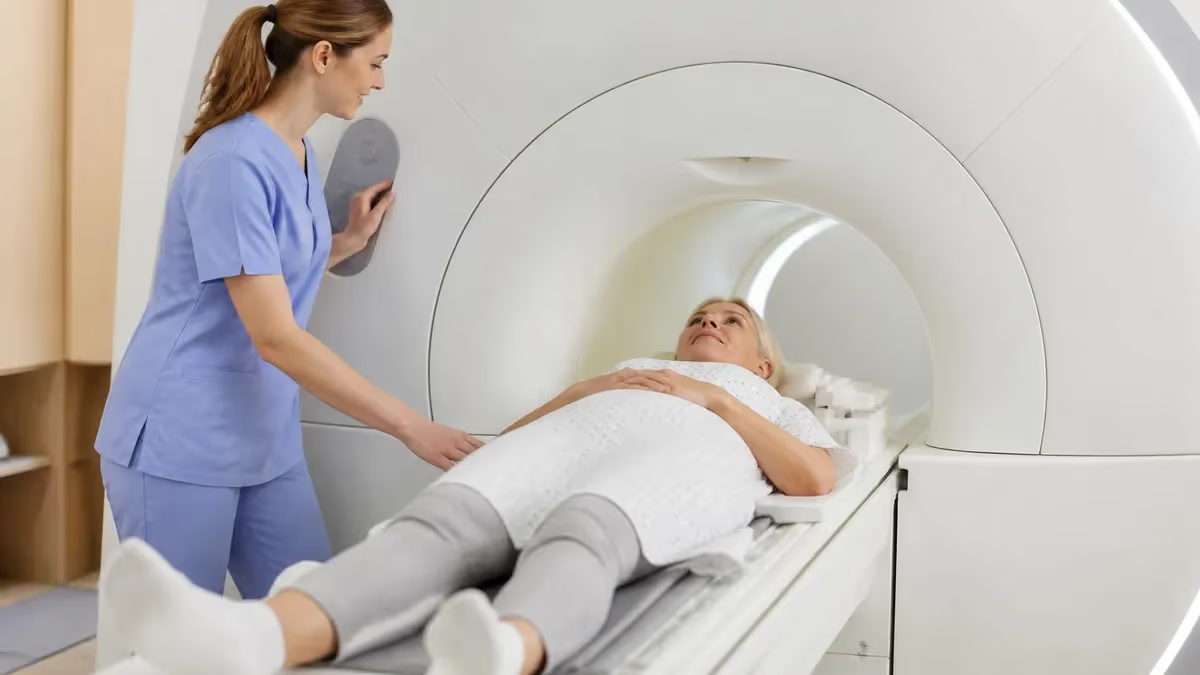
Understanding the mri t1 and t2 difference is one of the most fundamental skills in magnetic resonance imaging interpretation, and it is the first concept every radiology student, MRI technologist, and registry candidate must master before reading scans confidently. T1 and T2 are two different relaxation times that describe how protons in tissue return to equilibrium after being excited by a radiofrequency pulse, and the contrast you see on the final image depends entirely on which of these relaxation times the scanner emphasizes.
On a T1-weighted image, fat appears bright white, water appears dark, and the image generally looks anatomical, crisp, and similar to what you might expect from a CT scan in terms of grayscale logic. On a T2-weighted image, the rules flip in a way that confuses many beginners: water and most pathology appear bright, while fat appears intermediate to bright depending on the sequence, and the image becomes a powerful tool for detecting edema, inflammation, and fluid-filled lesions throughout the body.
The clinical importance of this distinction cannot be overstated. A radiologist reading a brain MRI uses T1 images to evaluate normal anatomy, gray-white matter differentiation, and post-contrast enhancement patterns, while turning to T2 and FLAIR sequences to identify multiple sclerosis plaques, ischemic changes, tumors, and any process that increases tissue water content. Without understanding which sequence is which, the entire diagnostic process collapses into guesswork.
This guide walks through every dimension of T1 versus T2 imaging in clear, practical language. We cover the underlying physics in plain English, the mnemonics that make signal intensity easy to remember, the technical parameters that control each sequence, and the real clinical scenarios where one sequence outperforms the other. By the end you should be able to glance at any MRI image and identify the weighting within seconds, then explain why a tissue appears the way it does.
For students preparing for the ARRT MRI registry or the ARMRIT exam, this material represents roughly 15 to 20 percent of all physics and sequence questions, making it one of the highest-yield topics you can study. Working through real practice questions while you read is the fastest way to lock in the concepts, so look for opportunities to test yourself as you go.
Throughout this article we draw on common clinical examples including brain, knee, spine, liver, and pelvic imaging because the same T1 and T2 principles apply across every body part. The relaxation behavior of fat, water, muscle, and pathology stays consistent whether you are scanning a shoulder or a thoracic spine mri cpt, which means once you truly understand the fundamentals you can apply them anywhere. To put this in historical context, you may also enjoy reading about the history of MRI and how T1 and T2 weighting were first discovered.
By the time you finish this guide you will know how to identify each sequence at a glance, why pathology behaves the way it does on each, which sequence to choose for specific clinical questions, and how technologists adjust scan parameters to emphasize one relaxation time over the other. That foundation will serve you for the rest of your imaging career.
T1 and T2 Imaging by the Numbers
T1 vs T2 Quick Reference Guide
Short TR and short TE produce an image where fat is bright, water is dark, and anatomy looks crisp. Best for evaluating normal structure, post-contrast enhancement, and fat-containing lesions like lipomas or marrow.
Long TR and long TE produce an image where water and most pathology appear bright while fat varies. Best for detecting edema, inflammation, cysts, tumors, and any process that increases tissue water content.
Long TR and short TE produce an image weighted by raw proton concentration with minimal T1 or T2 contrast. Particularly useful for cartilage, ligaments, and meniscal imaging in musculoskeletal MRI.
A modified T2 sequence that suppresses cerebrospinal fluid, making periventricular lesions like MS plaques far more conspicuous against a now-dark CSF background. Essential for neurological imaging.
A fat-suppressed inversion recovery technique that nulls fat signal, making it ideal for detecting bone marrow edema, soft tissue inflammation, and lesions hidden by bright fat on standard T2 imaging.
To understand the mri t1 and t2 difference at a deeper level, you need to start with what happens to hydrogen protons inside a strong magnetic field. When a patient enters the bore of a 1.5T or 3T scanner, the protons in their tissues align with the main magnetic field, creating a net magnetization vector pointing along the longitudinal axis. A radiofrequency pulse then knocks this magnetization into the transverse plane, where it precesses and generates the signal the scanner detects.
T1 relaxation, also called longitudinal or spin-lattice relaxation, describes how quickly the magnetization recovers back along the main field after being tipped away. This recovery happens as protons release energy to surrounding molecules, and the rate depends heavily on the local molecular environment. Fat protons sit in a tumbling environment that matches the Larmor frequency well, so they release energy quickly and recover fast, which is why fat appears bright on T1.
T2 relaxation, also called transverse or spin-spin relaxation, describes how quickly the transverse magnetization decays as individual protons fall out of phase with each other. Water molecules tumble too rapidly to dephase quickly, so they retain transverse magnetization longer, which is why water looks bright on T2-weighted images. Solid tissues with restricted molecular motion dephase faster and appear darker.
The scanner controls which relaxation time dominates the image by adjusting two parameters: repetition time (TR) and echo time (TE). TR is the interval between successive RF pulses, and TE is the delay between the pulse and signal measurement. A short TR forces T1 differences to dominate because tissues with long T1 values have not yet fully recovered when the next pulse arrives. A long TE allows T2 differences to develop because tissues with short T2 values have already lost most of their signal.
This is why T1-weighted sequences use short TR and short TE, while T2-weighted sequences use long TR and long TE. The combination of long TR with short TE produces proton density weighting, which depends mostly on the raw concentration of protons in each tissue. Understanding this 2x2 grid of TR and TE values is the key to predicting and recognizing every sequence type you will encounter.
One important nuance is that no image is ever purely T1 or T2 weighted. Every MRI image contains some contribution from all three contrast mechanisms, and the goal of sequence design is to maximize one while minimizing the others. Modern scanners also use fast spin echo, gradient echo, and inversion recovery variations that change the underlying physics but preserve the basic T1 versus T2 contrast goals.
Tissue T1 and T2 values also vary with field strength. At 3T, T1 values lengthen significantly compared to 1.5T, which means TR parameters often need adjustment to maintain similar contrast. T2 values change less dramatically with field strength but are affected by susceptibility differences that become more pronounced at higher fields. These technical details matter for protocol optimization and registry exam questions.
MRI Practice Test Questions
Prepare for the MRI - Magnetic Resonance Imaging exam with our free practice test modules. Each quiz covers key topics to help you pass on your first try.
MRI Knowledge
MRI Exam Questions covering Knowledge. Master MRI Test concepts for certification prep.
MRI Physics
Free MRI Practice Test featuring Physics. Improve your MRI Exam score with mock test prep.
MRI Anatomy and Pathology
MRI Test Prep for MRI Anatomy and Pathology. Practice MRI Quiz questions and boost your score.
MRI Anatomy and Positioning
MRI Questions and Answers on MRI Anatomy and Positioning. Free MRI practice for exam readiness.
MRI Contrast Agents
Free MRI Quiz on MRI Contrast Agents. MRI Exam prep questions with detailed explanations.
MRI Patient Care and Positioning
MRI Practice Questions for MRI Patient Care and Positioning. Build confidence for your MRI certification exam.
Signal Intensity by Tissue Type on T1 and T2
Fat is the classic high-signal tissue on T1-weighted images, appearing bright white because its short T1 relaxation time allows rapid recovery of longitudinal magnetization between RF pulses. On T2-weighted images, fat appears moderately bright on fast spin echo sequences but darker on older conventional spin echo techniques. Recognizing fat signal patterns is essential for identifying subcutaneous tissue, bone marrow, lipomas, and intra-abdominal fat planes.
Water behaves in the opposite way. On T1-weighted images, water and cerebrospinal fluid appear dark or black because the long T1 of water means it has not fully recovered before the next pulse. On T2-weighted images, water appears bright white because its long T2 preserves transverse magnetization through the long echo time. This water-bright behavior is why T2 sequences excel at detecting edema, cysts, joint effusions, and any fluid collection.
T1 vs T2 — When to Choose Which Sequence
- +T1 shows anatomical detail with crisp gray-white differentiation
- +T1 is the standard for post-gadolinium contrast evaluation
- +T1 highlights fat-containing lesions like lipomas and dermoids
- +T1 demonstrates subacute hemorrhage as bright methemoglobin
- +T1 provides excellent bone marrow assessment
- +T1 acquires faster than most T2 sequences
- +T1 shows proteinaceous fluid as intermediate to bright
- −T2 excels at detecting edema and inflammation
- −T2 makes most pathology stand out as bright lesions
- −T2 is essential for evaluating cystic and fluid-filled structures
- −T2 with FLAIR detects MS plaques and small infarcts
- −T2 highlights joint effusions and synovial pathology
- −T2 reveals tumors that may be invisible on T1
- −T2 shows spinal cord pathology and disc degeneration
How to Identify T1 vs T2 at a Glance
- ✓Look at the cerebrospinal fluid — if it is dark, the image is T1; if bright, it is T2
- ✓Check subcutaneous fat — bright suggests T1, intermediate or suppressed suggests T2 with fat sat
- ✓Compare gray and white matter — white brighter than gray means T1
- ✓Look for joint effusions or cysts — bright fluid means T2
- ✓Check the vitreous humor of the eye — dark is T1, bright is T2
- ✓Evaluate bone marrow — bright marrow on a non-fat-suppressed scan suggests T1
- ✓Look at any visible vessels — flowing blood patterns differ between sequences
- ✓Check the TR and TE on the image annotation if visible
- ✓Note whether contrast appears bright — gadolinium enhancement shows on T1 post-contrast
- ✓Identify edema patterns — bright signal in tissue means T2 or FLAIR weighting
Water is dark on T1, bright on T2
If you remember only one fact about MRI sequence identification, make it this: water and cerebrospinal fluid are dark on T1-weighted images and bright on T2-weighted images. This single observation lets you identify the sequence type within seconds on any MRI image you encounter, whether brain, spine, joint, or abdomen.
The clinical power of understanding the mri t1 and t2 difference becomes obvious when you start matching sequences to specific diagnostic questions. In brain imaging, T1 sequences are used to assess overall anatomy, evaluate the pituitary gland, detect subacute hemorrhage from methemoglobin, and demonstrate enhancement after gadolinium contrast. T2 and FLAIR sequences then take over for detecting demyelinating plaques, ischemic stroke, gliomas, encephalitis, and any process that increases brain water content.
In musculoskeletal imaging, the combination of T1 and T2 with fat suppression is the workhorse of joint evaluation. T1 sequences show the normal fatty marrow signal that helps identify subtle marrow replacement from tumors or infection, while T2 fat-suppressed sequences highlight bone bruises, stress fractures, joint effusions, ligament tears, and cartilage defects. A radiologist reading a knee MRI typically scrolls through both T1 and T2 stacks for every structure.
In spine imaging, T1 sequences excel at detecting marrow infiltration from metastatic disease or multiple myeloma because the normal fatty marrow signal is replaced by darker tumor tissue. T2 sequences then identify disc herniations, spinal cord edema from trauma or compression, syringomyelia, and degenerative changes that increase signal in dehydrated discs. The combination provides comprehensive coverage of nearly all spinal pathology.
Abdominal and pelvic MRI use the same principles. T1 sequences with and without fat suppression identify liver lesions, adrenal masses, hemorrhagic cysts, and proteinaceous collections. T2 sequences detect simple cysts, biliary obstruction, hydronephrosis, endometriotic lesions, and inflammatory changes in bowel wall. Combining these with diffusion-weighted imaging and post-contrast sequences provides a complete diagnostic picture.
Cardiac MRI uses T1 and T2 in specialized ways. T1 mapping quantifies myocardial fibrosis and infiltrative diseases like amyloidosis, while T2 mapping detects myocardial edema from myocarditis or acute infarction. These quantitative techniques represent the cutting edge of clinical MRI and rely on the same fundamental relaxation physics covered earlier in this guide.
Contrast-enhanced imaging deserves special attention because gadolinium contrast agents work primarily by shortening T1 relaxation in tissues where they accumulate. This means contrast enhancement is almost exclusively evaluated on T1-weighted post-contrast sequences, often with fat suppression to make the bright enhancement stand out against a darker background. Knowing this helps you understand why protocols are structured the way they are.
Different pathologies have characteristic T1 and T2 signal patterns that experienced radiologists use as fingerprints. A simple cyst is dark on T1 and bright on T2. A proteinaceous or hemorrhagic cyst is bright on T1 and bright on T2. A solid tumor is typically intermediate on T1 and bright on T2 with enhancement. A lipoma is bright on T1 and intermediate on T2 with signal loss on fat-suppressed sequences. These patterns form the basis of MRI differential diagnosis.
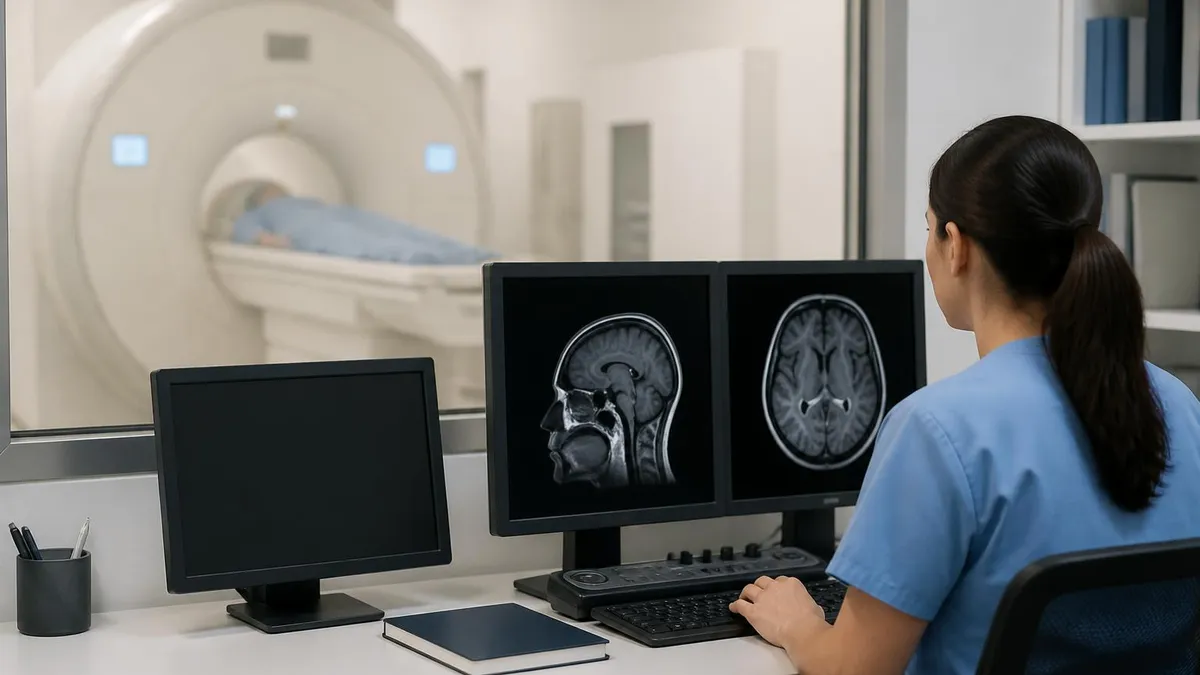
Many students learn that fat is bright on T1 and dark on T2, but this is only partially correct. Fat appears moderately bright on modern fast spin echo T2 sequences and only dark on older conventional spin echo T2 or when fat suppression is applied. Always check whether fat suppression is in use before identifying a sequence.
Mastering the practical side of the mri t1 and t2 difference means understanding how technologists actually create these sequences on the scanner console. Selecting a T1-weighted spin echo sequence requires setting TR between roughly 300 and 700 milliseconds and TE between 10 and 30 milliseconds. Selecting a T2-weighted fast spin echo sequence requires TR above 2000 milliseconds and TE between 80 and 120 milliseconds. Echo train length and other parameters fine-tune the contrast further.
Sequence choice also depends on the clinical question being asked. A patient with suspected multiple sclerosis needs sagittal and axial FLAIR sequences as the highest priority, followed by T1 post-contrast to identify active enhancing plaques. A patient with knee pain needs proton density fat-suppressed sequences for meniscal evaluation and T2 fat-suppressed sequences for bone edema. Protocol design is a deliberate process of matching sequences to anatomy and pathology.
Field strength affects sequence parameters in important ways. At 3T, the signal-to-noise ratio doubles compared to 1.5T, which allows faster scanning or higher spatial resolution. However, T1 values lengthen at 3T, requiring longer TR to maintain similar contrast. Susceptibility artifacts also worsen at higher fields, which can degrade T2-weighted sequences near metallic implants or air-tissue interfaces. Understanding these tradeoffs guides protocol optimization.
Patient factors influence sequence selection too. Pediatric patients often need shorter scan times, which favors fast spin echo sequences with longer echo trains. Patients who cannot hold their breath require respiratory-gated or free-breathing techniques in body imaging. Patients with claustrophobia benefit from the fastest possible protocols, sometimes accepting reduced contrast quality in exchange for completing the exam. MRI alternatives may also be considered when scanning is impossible.
Artifacts can mimic or obscure T1 and T2 contrast differences. Motion artifact blurs both sequences but tends to ghost more obviously on T2 because of the longer acquisition time. Chemical shift artifact appears at fat-water interfaces and is more prominent at higher field strengths. Truncation artifact creates linear bands near sharp signal transitions. Recognizing these artifacts prevents misinterpretation of normal anatomy as pathology.
Quantitative MRI techniques are increasingly moving beyond simple T1 versus T2 weighting toward absolute measurement of relaxation times in milliseconds. T1 mapping and T2 mapping produce numerical values for each voxel, allowing detection of subtle disease before visible signal changes appear. These advanced techniques rely on the same fundamental physics but extract additional diagnostic information from the relaxation curves themselves.
For students preparing for the MRI registry exam, expect detailed questions on TR and TE values, expected signal of common tissues, and the appearance of specific pathologies on each sequence. Practice questions that show signal intensity tables and ask which sequence is which are extremely common. Spending dedicated study time on this material pays dividends across the entire physics section of the exam.
To consolidate everything you have learned about the mri t1 and t2 difference, start by building a mental signal intensity chart that you can recall instantly. Memorize the appearance of fat, water, CSF, gray matter, white matter, muscle, and cortical bone on both T1 and T2 sequences. Quiz yourself daily using flashcards or practice images until recognition becomes automatic. This foundation makes everything else in MRI interpretation easier.
Next, practice identifying sequences on real clinical images rather than just textbook diagrams. Pull up case repositories online and force yourself to identify each sequence before reading the caption. Pay attention to the CSF signal first, then the fat signal, then the gray-white matter relationship. Within a few weeks of consistent practice, sequence identification becomes effortless and you can focus on the actual pathology in the image.
Build a library of classic signal patterns for common diagnoses. Subacute hemorrhage is bright on both T1 and T2. Melanoma metastases are bright on T1 due to melanin paramagnetic effects. Proteinaceous cysts are bright on T1. Calcifications are dark on all sequences. Air is signal void on all sequences. Fluid-fluid levels in hemorrhagic cysts show layering with different signal intensities. These patterns recur constantly in clinical practice.
Use mnemonics to lock in tricky relationships. WW2 stands for water white on T2. The phrase fat is fat on T1 reminds you that fat is bright on T1. The acronym FLAIR stands for fluid attenuated inversion recovery and tells you immediately that CSF will appear dark even though water-rich pathology stays bright. Whatever mnemonics work for you, use them consistently until the underlying knowledge is second nature.
When studying for registry exams, work through hundreds of practice questions specifically focused on sequence identification and signal intensity. The ARRT MRI exam and ARMRIT exam both include substantial physics content where T1 and T2 questions appear frequently. Track which question types give you trouble and revisit the underlying concepts until your accuracy approaches 90 percent or higher on practice tests.
For working technologists, develop habits that reinforce sequence knowledge during every exam. As you set up each sequence on the console, mentally predict how key tissues will appear. After the scan completes, verify your prediction by examining the images. This active engagement transforms routine scanning into ongoing education and makes you a more capable technologist. knee mri images is a great way to practice recognizing T1 versus T2 in musculoskeletal cases.
Finally, remember that understanding T1 versus T2 is only the beginning of MRI mastery. Once you have these fundamentals down, dive into advanced topics like diffusion-weighted imaging, susceptibility-weighted imaging, MR angiography, and functional MRI. Each of these techniques builds on the same relaxation physics but extracts different information from the tissue. The journey of MRI learning never ends, but it becomes more rewarding as your foundation strengthens.
MRI Questions and Answers
MRI Medical Abbreviation: What MRI Stands For and Why It Matters
The History of MRI: From Discovery to Modern Medicine
Knee MRI Images: A Complete Guide to Reading, Understanding, and Interpreting Knee Scans
Noise of MRI Machine: Why MRI Scanners Are So Loud and What to Expect
MRI Alternatives: When CT, Ultrasound, X-Ray, and PET Make More Sense Than an MRI
Join the Discussion
Connect with other students preparing for this exam. Share tips, ask questions, and get advice from people who have been there.
View discussion (8 replies)