
Lying at MEPS: What Happens, Why It's Risky, and How to Be Honest 2026 September
Can you lie at MEPS? Learn what happens if you do, what disqualifies you, and how honesty protects your military career. 🎯 Full guide inside.

If you are preparing to enlist in the U.S. military, you have probably wondered whether you can lie at MEPS — the Military Entrance Processing Station — to hide a medical condition, past drug use, or a criminal record. The short answer is an emphatic no, and the consequences of attempting to do so are far more severe than most recruits realize.
MEPS is one of the most rigorous screening environments in the federal government, designed specifically to detect inconsistencies between what applicants say and what their records reveal. Understanding meps what is it and how the process works is your first line of defense against an accidental omission that could end your military career before it begins.
The Military Entrance Processing Station is the federal facility where every prospective service member undergoes medical examinations, aptitude testing, and background screening before being cleared for military service. Trained medical officers, investigators, and counselors staff these facilities around the clock. They are experienced at identifying red flags, contradictions between verbal statements and physical findings, and discrepancies between what you say today and what third-party records — including school, medical, law enforcement, and social media — already reveal about your history.
Many recruits mistakenly believe that if they simply do not volunteer a piece of information, they are not technically lying. This is a dangerous misunderstanding. Federal law, specifically 18 U.S.C. § 1001, makes it a felony to knowingly and willfully make any false, fictitious, or fraudulent statement or representation in any matter within the jurisdiction of the executive branch of the U.S. government. MEPS is unambiguously within that jurisdiction. A deliberate omission made to deceive is treated the same as an outright lie under this statute.
The stakes could not be higher. If you lie at MEPS and are discovered before you ship to basic training, you will almost certainly be disqualified permanently and potentially face federal criminal charges. If the lie is discovered after you have already enlisted and begun your service, you can face a fraudulent enlistment discharge, which is a type of administrative separation that can affect your veterans' benefits, security clearance eligibility, and future employment prospects for decades. No medical waivable condition or minor past indiscretion is worth that risk.
It is also worth understanding that MEPS does not rely solely on what you tell them. The processing station pulls records from the National Crime Information Center, the Defense Manpower Data Center, the Social Security Administration, civilian medical providers (in many cases), and law enforcement databases at the local, state, and federal level. If you were treated at an emergency room, had a juvenile record, or received a prescription for ADHD medication, there is a meaningful chance that information already exists in a database accessible to MEPS personnel before you walk through the door.
The good news is that honesty at MEPS, even about conditions or history that might seem disqualifying, often leads to a better outcome than lying. Many conditions that recruits fear will bar them from service are actually waivable, meaning a recruiter or medical officer can request a formal exception that allows you to serve despite the condition. Waivers are granted routinely for a wide range of medical, moral, and administrative issues — but only when the applicant is honest about them from the start. A waiver denied for dishonesty is almost never reconsidered.
This guide walks you through everything you need to know about lying at MEPS: what the consequences are, which disclosures are legally required, how investigators catch omissions, what the waiver process looks like, and how to walk into MEPS with confidence knowing you have been fully transparent. Whether you are days away from your MEPS appointment or just beginning to explore enlistment, reading this article carefully could be the most important preparation you do.
Lying at MEPS by the Numbers

How MEPS Investigators Catch Lies
Pre-Appointment Records Pull
Medical History Questionnaire Review
Physical Examination Findings
Moral Pre-Screening Interview
Post-Enlistment Continuous Vetting
One of the most common questions recruits ask is: exactly what do I have to disclose at MEPS? The answer is broader than most people expect. You are legally required to report all medical conditions, diagnoses, treatments, surgeries, hospitalizations, and prescriptions — even childhood conditions, even if you consider them resolved, and even if a civilian doctor told you that you were fully recovered. The military's definition of a disqualifying medical condition differs from civilian medical standards, so a doctor clearing you for civilian life does not mean the condition is invisible to MEPS.
On the legal and moral side, you must disclose all contacts with law enforcement, including arrests that did not lead to conviction, charges that were expunged, juvenile adjudications, and traffic violations above minor infractions. Many recruits are surprised to learn that expunged records must still be disclosed to MEPS. Federal law supersedes state expungement statutes for the purposes of military enlistment. If a state court sealed your juvenile record, you are still legally obligated to report that arrest to MEPS investigators. Failure to do so is a federal offense, regardless of what a state judge ordered.
Drug and alcohol history must also be fully disclosed. This includes all illegal drug use, experimental or casual, and all episodes of alcohol abuse or treatment. It also includes use of prescription medications that were not prescribed to you, use of substances that were legal at the time but are now controlled, and prior enrollment in substance abuse treatment programs. The military is not automatically excluding everyone who has ever used marijuana — in fact, recruiters are more sophisticated about this than ever — but they are excluding everyone who lies about it.
Financial history matters too, particularly if you are pursuing a military occupational specialty that requires a security clearance. Significant debt, bankruptcies, and a history of failing to meet financial obligations can be disqualifying for certain clearance levels. More importantly, if you are asked about your financial history on a federal form and you omit or misrepresent information, you have committed the same federal false statement offense as if you lied about your medical history. Be thorough, be honest, and let your recruiter and the MEPS counselors help you navigate what is actually disqualifying versus what is waivable.
Mental health history is one of the areas where recruits are most tempted to omit information, often out of genuine fear that any psychiatric history will bar them from service. This fear is largely unfounded. Many mental health conditions — including a history of counseling, treatment for mild depression or anxiety, and even some more serious diagnoses — are waivable. What is never waivable is the discovery that you lied.
If you received outpatient counseling in high school, disclose it. If you were prescribed antidepressants for a period and then discontinued them, disclose it. The military's mental health standards have evolved significantly, and a counselor who speaks with you honestly is far better positioned to get you a waiver than one who discovers a concealed history later.
If you are processing through a location like fort jackson meps columbia sc, the same federal disclosure standards apply regardless of which MEPS facility you use. Every MEPS location in the country operates under the same Department of Defense Instruction 6130.03, which governs medical standards for appointment, enlistment, induction, and retention. There is no regional variation, no softer standard at a less-scrutinized facility, and no recruiter who has the authority to tell you that a particular disclosure rule does not apply at your specific location.
Finally, understand that your recruiter is not your lawyer and is not bound by attorney-client privilege. Your recruiter can give you general guidance about what is waivable, but they are also a federal employee who has their own legal exposure if they advise you to conceal information.
The safest approach is to be fully transparent with your recruiter early in the process, so they can advise you on the waiver process and help you build the strongest possible application file. Surprises at MEPS hurt both you and your recruiter, and the recruiters who have the best long-term success rates are the ones who work only with fully disclosed applicants.
Common Things Recruits Try to Hide at MEPS
Medical omissions are the most frequent category of dishonesty at MEPS. Recruits commonly fail to disclose ADHD diagnoses and stimulant medication history, asthma treatments, prior orthopedic injuries and surgeries, corrective eye surgery, hearing loss treatments, and mental health counseling. Each of these has a defined evaluation process, and many can be waived with supporting documentation from a treating physician. The key is to disclose them, then work with your recruiter to build a waiver packet.
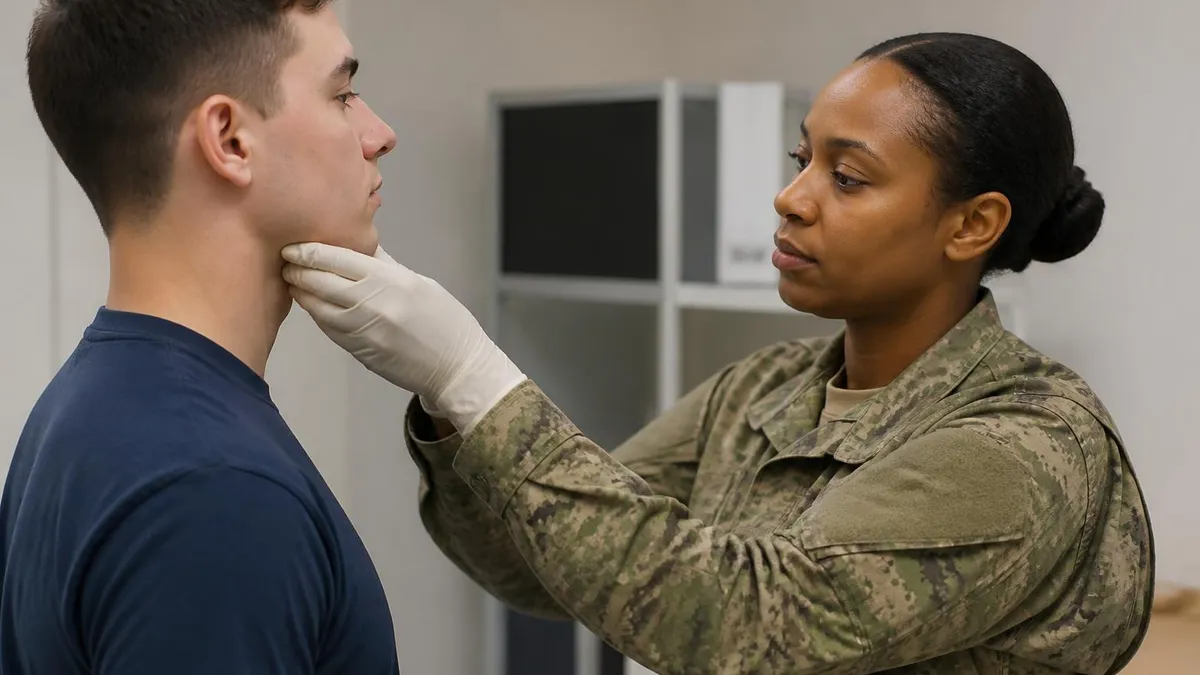
Physical findings during the MEPS medical exam can directly contradict an omitted medical history. A physician who finds a healed surgical scar, abnormal lung sounds, or corrected vision beyond certain thresholds will immediately ask about your history. If your written forms say no surgery and your body shows evidence of one, you are not just facing a medical disqualification — you are facing a fraud determination. Always disclose what has happened to your body, no matter how long ago or how minor it seemed at the time.

Honesty vs. Concealment at MEPS: A Realistic Comparison
- +Many conditions are waivable — honesty is the only way to access the waiver process
- +Honest recruits who are disqualified can often re-apply after a defined waiting period
- +A truthful record protects your security clearance eligibility throughout your career
- +Recruiters are far more motivated to advocate for honest applicants when problems arise
- +Honest disclosures are protected from automatic disqualification under DoD waiver policy
- +Peace of mind — no fear of discovery during service, security investigations, or separation
- −Some conditions that are honestly disclosed will result in disqualification without a waiver
- −The waiver process adds weeks or months to the enlistment timeline
- −Certain criminal history disclosures can trigger enhanced background review
- −Full disclosure of drug history may limit which branches or MOS options are available
- −Mental health disclosures can affect security clearance eligibility for some jobs
- −Some recruits feel embarrassed discussing sensitive medical or personal history with strangers
Honesty Checklist: What to Verify Before Your MEPS Appointment
- ✓List every medical condition, diagnosis, or chronic illness you have ever been told you have, even if resolved.
- ✓Write down every prescription medication you have taken, including the dates, dosage, and prescribing condition.
- ✓Document every surgery, hospitalization, or emergency room visit, no matter how minor or how long ago.
- ✓List all contacts with law enforcement, including arrests without conviction and expunged juvenile records.
- ✓Record all drug and alcohol use history, including the substance, approximate frequency, and date of last use.
- ✓Pull your own criminal background check from your state and verify that your self-report matches what appears.
- ✓Review your school records for any disciplinary actions involving substance use, violence, or law enforcement.
- ✓Check your financial history for bankruptcies, judgments, or significant delinquencies if you plan to seek a clearance.
- ✓Tell your recruiter everything on this list before your MEPS appointment so they can advise on waivers.
- ✓Bring supporting documentation for disclosed conditions — letters from physicians, court records, treatment summaries.
A Waiver Can Save Your Enlistment — A Lie Cannot
The single most important thing to understand about MEPS is that the waiver process exists specifically to give honest recruits a path to service despite imperfect histories. The DoD grants thousands of waivers every year for medical, moral, and administrative issues. None of those waivers are available to recruits who concealed the underlying issue. If you are worried that something in your past will disqualify you, ask your recruiter about waivers before you ever set foot in a MEPS facility.
The military waiver process is one of the most misunderstood aspects of MEPS, and that misunderstanding drives much of the dishonesty that gets recruits into trouble. A waiver is a formal request submitted by a recruiter on behalf of an applicant, asking a service branch to accept an applicant whose history or condition would otherwise disqualify them under standard DoD medical or moral standards. Waivers are reviewed by medical review boards, branch-specific commanding officers, and in some cases by the Surgeon General's office, depending on the severity of the condition involved.
To apply for a waiver, you must first be formally disqualified at MEPS based on your honest disclosure. This is the step that frightens recruits into silence: they see the disqualification as the end of the road, not as the first step in a separate review process. In reality, a disqualification at MEPS with a simultaneous waiver request is a routine and well-managed pathway that results in thousands of approvals every year. The branches need recruits, and they have built a system specifically designed to bring in qualified people who happen to have imperfect histories.
Supporting documentation is crucial to a successful waiver. If you are seeking a medical waiver, your recruiter will help you compile records from your treating physician, copies of any diagnostic tests, a statement of current status, and a physician's opinion on your fitness for military service. The stronger and more thorough the supporting documentation, the more likely the review board is to look favorably on the request. Recruits who are proactive about gathering their records and presenting a complete picture give their recruiters the best tools to argue on their behalf.
Moral waivers — those related to criminal history — follow a similar process but involve a different review chain. The character and rehabilitation evidence that matters most to a moral waiver board includes letters of support from teachers, clergy, employers, or community leaders; evidence of consistent employment or academic success following the incident; a personal statement explaining what happened and what you have learned; and documentation showing that you have met all requirements imposed by the court, including probation, community service, or restitution. A compelling rehabilitation narrative is genuinely persuasive to waiver boards.
Different military branches have different waiver policies and approval rates. Historically, the Army has been somewhat more willing to grant waivers than the other branches, particularly for moral issues, because of higher recruiting volume needs. The Navy, Air Force, Marine Corps, and Space Force each have their own waiver criteria, and the likelihood of approval for any specific condition varies by branch, by the current year's recruiting environment, and by the specific circumstances of the case. Your recruiter is your best source of current, branch-specific waiver guidance.
It is important to understand that not all conditions are waivable. Some medical conditions — certain heart defects, specific vision conditions beyond correctable limits, severe mental health diagnoses, and others enumerated in DoD Instruction 6130.03 — are permanently disqualifying with no waiver pathway. These absolute disqualifiers exist because the conditions would genuinely prevent safe and effective performance of military duties. If your condition falls into this category, no amount of documentation or advocacy will result in approval, and attempting to conceal it will only compound your situation by adding a federal false statement charge to a medical disqualification.
If you are unsure whether your condition is waivable, ask your recruiter to look it up in the relevant DoDI before your MEPS appointment. You can also review the publicly available Medical Standards for Appointment, Enlistment, or Induction in the Military Services document, which lists both the disqualifying conditions and the waiver considerations for each. Knowledge about your own situation — gathered honestly and in advance — is the most powerful preparation you can do before your MEPS day.

Lying at MEPS is not simply a military administrative matter. Under 18 U.S.C. § 1001, making a false statement to a federal agency carries a potential prison sentence of up to five years and permanent damage to your federal employment eligibility. Fraudulent enlistment under 10 U.S.C. § 884 adds military criminal exposure on top of civilian federal charges. These statutes are actively enforced, particularly when concealed conditions are discovered during security clearance investigations or after a service member has committed a serious infraction.
The consequences of a fraudulent enlistment — the formal finding that you enlisted through deliberate misrepresentation — extend far beyond your military career. A fraudulent enlistment determination results in an administrative separation from service, and the characterization of that separation is rarely favorable. Most fraudulent enlistment separations are characterized as Other Than Honorable (OTH), which is the most severe administrative discharge short of a punitive discharge from a court-martial. An OTH discharge has cascading effects on virtually every aspect of your post-military life.
Veterans with OTH discharges are generally not eligible for VA healthcare, GI Bill education benefits, VA home loan guarantees, or most other VA benefit programs. The precise rules are complex and there are some narrow exceptions, but the default position is exclusion. If you enlisted with the goal of earning educational benefits, a fraudulent enlistment that results in OTH discharge eliminates the very benefits you were seeking. You will have served time in the military and received nothing for it — or worse, faced a criminal record on top of a dishonorable exit.
Employment consequences are equally serious. Federal employment background investigations specifically ask about military service characterization and the circumstances of separation. A fraudulent enlistment finding is a significant adverse factor in any federal background investigation, including those for contractor positions with federal agencies. Many private employers, particularly in defense, law enforcement, finance, and technology, also conduct detailed employment background checks and will discover an OTH discharge. Some will ask the reason, find the fraudulent enlistment finding, and decline to hire. This is not a theoretical risk — it is a predictable outcome that former service members have reported across many industries.
Security clearance eligibility is particularly impacted. If your goal in enlisting was to obtain a security clearance and work in intelligence, cyber operations, or other cleared fields, a fraudulent enlistment finding effectively closes that door permanently. The adjudicative guidelines used by the federal government to evaluate clearance applications treat deliberate false statements to the government as among the most serious adverse factors reviewers consider. Even if you are later allowed to re-apply for federal service, the underlying finding will follow you through every subsequent clearance investigation.
Beyond the formal consequences, consider what dallas meps dallas tx and every other MEPS location represents in practical terms: it is the gateway to one of the most respected career paths available to young Americans. The military offers advanced training, leadership development, educational benefits, travel, camaraderie, and a sense of purpose that is genuinely hard to replicate in civilian life. A decision to lie at MEPS — a decision made under stress, often without full understanding of the consequences — can permanently close that gateway for someone who might have been an outstanding service member.
The ripple effects extend to family members as well. Spouses and dependents of service members rely on military healthcare, housing allowances, and other benefits that disappear with an OTH discharge. If you have or plan to have a family, the financial and practical stability that military service provides is part of the picture you are gambling with when you consider concealing information at MEPS. The right choice for your family, just as much as for yourself, is transparency.
It is also worth noting that the military takes seriously the principle of second chances, but only within the framework of honesty. Recruits who have been previously disqualified for honest disclosures can reapply after meeting specific remediation requirements — completing treatment, waiting a defined period, obtaining medical clearance, or resolving legal issues. Recruits who were separated for fraud are generally barred from reapplication permanently. The military's institutional generosity for honest applicants with complicated histories has no parallel for applicants who have demonstrated a willingness to deceive the government.
Preparing for MEPS honestly is not just about avoiding consequences — it is about walking into one of the most significant days of your life with confidence and clarity. The recruits who perform best at MEPS are those who have done the self-inventory work in advance: they know what is in their medical history, they understand their legal record, they have gathered their documentation, and they have had candid conversations with their recruiter so there are no surprises. That level of preparation transforms MEPS from a stressful unknown into a manageable, predictable process.
One of the most practical things you can do before your MEPS appointment is to request your own records. Contact every medical provider you have seen in the past ten years and request copies of your treatment summaries. Pull your own background check through a reputable service and compare it against your recollection.
If you find anything you had forgotten — an old ER visit, a traffic citation that escalated, a diagnosis from a specialist — you now have time to discuss it with your recruiter and prepare any necessary documentation for a waiver. Finding it yourself is infinitely better than having MEPS find it.
Talk to your recruiter about your full history, and do it early. Many recruits withhold information from their recruiter out of fear that the recruiter will refuse to process them. In reality, experienced recruiters have seen virtually everything and are best positioned to help when they know the full picture in advance. A recruiter who knows about a past knee surgery has time to contact orthopedic specialists, gather surgical notes, and build a compelling waiver packet. A recruiter who finds out at MEPS has no preparation time, no documentation, and limited ability to advocate effectively in the moment.
If you are concerned about a specific condition or past event and want to know before you invest time in the enlistment process whether it is likely to be waivable, ask your recruiter to check. Many recruiters have access to branch-specific waiver history and can give you a realistic expectation of outcomes. Some will do an informal pre-screening before you ever submit a formal application. This due diligence protects your time, your recruiter's time, and ensures that if you do move forward, you are doing so on an honest foundation.
The day before your MEPS appointment, review everything you have disclosed, make sure your documentation is organized, and get a full night of sleep. Physical fatigue affects your performance on the ASVAB and your ability to communicate clearly during medical interviews. Recruits who arrive rested, organized, and prepared to answer questions honestly and thoroughly consistently report less stressful MEPS experiences than those who arrive anxious about what might be discovered. The best way to reduce anxiety at MEPS is to have nothing to hide.
Understand also that the MEPS staff — medical officers, counselors, liaison officers — are professionals who are there to process you accurately, not to find reasons to reject you. They are not adversaries. They have requirements they must meet, standards they must uphold, and forms they must complete correctly, but they are not looking for ways to fail qualified recruits. When you approach them with honesty, they can do their job, and when they can do their job, the outcome is as favorable as your actual history allows it to be.
Finally, remember that what does meps stand for goes beyond the literal acronym — it stands for the military's commitment to accepting only those who can serve safely and honestly. MEPS is the front door to a career that demands integrity above almost all other qualities. The values the military will ask you to demonstrate for years — honor, courage, commitment, loyalty — begin with the answers you give on your first federal form. Start your service the way you intend to continue it: with complete honesty.
MEPS Questions and Answers



About the Author

Retired Military Officer & Armed Forces Test Preparation Specialist
United States Army War CollegeColonel Steven Harris (Ret.) served 28 years in the US Army, earning a Master of Arts in Military Science from the Army War College and a Bachelor of Science in Criminal Justice. He has coached thousands of military enlistment and officer candidate program applicants through the ASVAB, AFQT, AFCT, OAR, and officer selection assessment processes across all military branches.
Join the Discussion
Connect with other students preparing for this exam. Share tips, ask questions, and get advice from people who have been there.
View discussion (8 replies)