
Dallas MEPS in Dallas TX: Complete Recruit Processing Guide 2026 October
Dallas MEPS in Dallas TX guide — 💯 Stemmons Freeway location, what to expect, what to bring, lodging, processing time, and common delays.
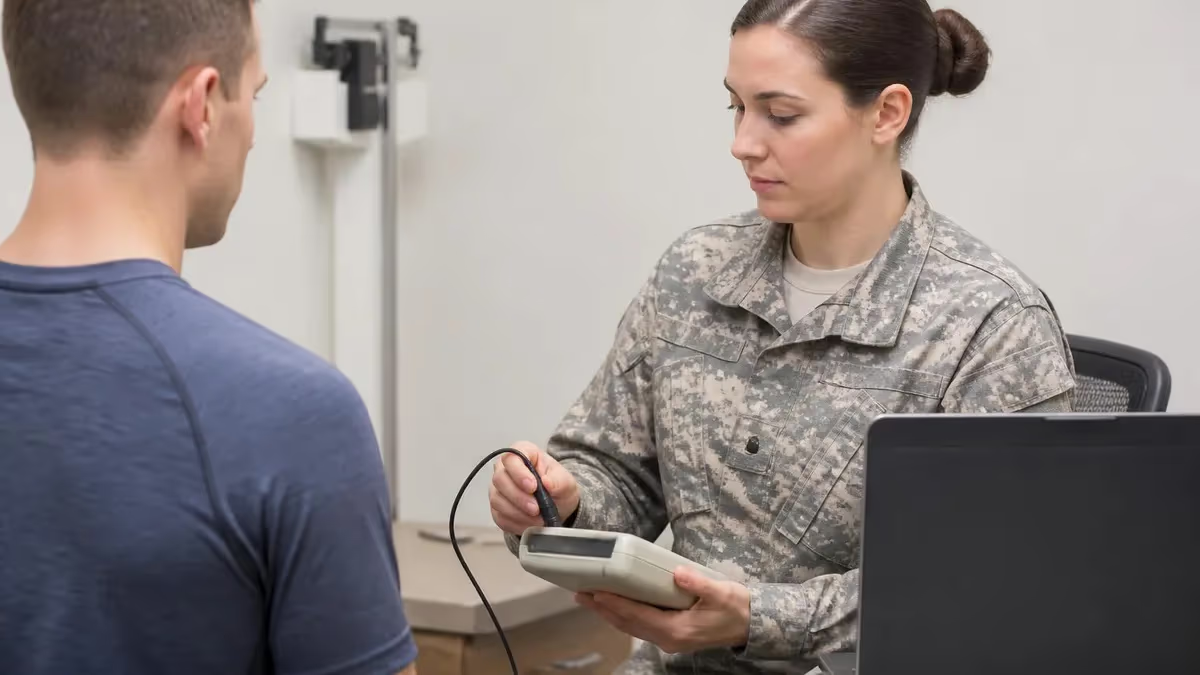
The Dallas MEPS — short for Military Entrance Processing Station — sits on the southbound service road of Stemmons Freeway (I-35E) in Dallas, Texas, and processes recruits from across North Texas and Oklahoma who are about to enlist in the U.S. Armed Forces.
If your recruiter has scheduled you to report here, you've reached the final federal gate before swearing in: medical exam, ASVAB confirmation, fingerprinting, job counseling, and the Oath of Enlistment all happen inside this building. Knowing the building, the schedule, and the standards before you walk in is the single biggest predictor of whether you finish processing in one day or get sent home for a second trip.
Like every MEPS in the country, the Dallas station is operated by the U.S. Military Entrance Processing Command (USMEPCOM), not by any single service branch. Inside the facility you'll find liaisons from the Army, Navy, Marine Corps, Air Force, Space Force, and Coast Guard all working side-by-side, processing recruits against one federal standard. The Dallas MEPS serves a huge geographic footprint — recruits from Fort Worth, Plano, Tyler, Sherman, Lawton OK, and even further out in West Texas funnel through this single station, which is why volume on a typical processing day can run into the low hundreds of applicants.
Most recruits don't drive themselves to Dallas MEPS. Your recruiter books a hotel room near the facility the night before, the military pays for it, and a contracted shuttle picks you up before dawn the morning of processing. That's by design — MEPS wants every applicant rested, sober, drug-free, and on-site by 5:30 a.m. so the day's medical and administrative line can begin moving immediately.
Showing up under-slept or having driven from far away introduces noise into a process the federal government has spent decades tuning for consistency. Use the hotel night the way it's intended: arrive early, eat a light dinner, organize your documents, sleep.
The what is meps question is one almost every first-time applicant asks the night before processing. The short answer: MEPS is a federal joint-service facility that decides whether you are medically, mentally, morally, and aptitude-eligible to enter the U.S. military.
It does not pick your branch — your recruiter and your contract do that — and it doesn't pick your job; your ASVAB line scores and your branch's open slots do that. What MEPS does is verify that the person standing in front of the physician matches the person on the recruiter's pre-screening paperwork, and that they meet the published standards.

Dallas MEPS: Key Numbers
Key Facts at a Glance
| Item | Value | Details |
|---|---|---|
| Typical processing day length | 8–12 hrs | |
| Typical check-in time | 5:30 AM | |
| Minimum AFQT score (Army) | 31 | |
| Minimum AFQT (Air Force/Space Force) | 36 |
The medical examination is the part most Dallas MEPS applicants worry about, and the part that drives the most same-day deferrals. The MEPS physician is not your family doctor. Their job is not to advise you or treat you — it's to apply DoD Instruction 6130.03 to your body and decide whether you meet the entrance standards.
That instruction runs hundreds of pages and covers asthma, ADHD medication history, joint surgery, vision, hearing, BMI, blood pressure, tattoos in prohibited locations, scars, dental, dermatology, mental health treatment, prior concussions, and dozens of other categories. If the recruiter's pre-screening (the DD Form 2807-2) flagged anything, the MEPS physician will dig into it. If nothing was flagged but something turns up during the exam, that's an automatic processing halt while records are pulled.
Vision testing at Dallas MEPS covers near and far acuity, depth perception, and color vision. Bring your glasses or contacts — including your prescription on paper if you have it. Color-vision-restricted MOSs (Army intel, Navy aviation, EOD, certain Air Force jobs) require a normal Ishihara result, so even if your distance vision is perfect, a color deficiency can close certain doors. Audiometry runs in a sound booth at the back of the medical bay. Don't try to game it — the test is designed to flag inconsistency.
Height and weight standards are branch-specific and applied with no flexibility on the processing day. If you're inside the table for your branch you're fine; if you're outside it but inside the body-tape measurement, you'll be taped at MEPS and your body-fat percentage applied against the branch's allowable maximum.
If you're outside both, you go home, lose weight, and come back. Many recruits who fail the standard on a Tuesday are convinced they would have passed on Monday — don't gamble. Hit your branch's standard with three to four pounds of margin before your scheduled MEPS date, especially in a Dallas summer where dehydration alone can change a weigh-in.
What to Know Before You Go
- Location: Stemmons Freeway (I-35E) service road, Dallas, TX — your recruiter provides the exact address
- Hours: Monday–Friday, processing day starts at 5:30 AM
- Lodging: Military pays for a hotel the night before — shuttle to MEPS in the morning
- Duration: Plan 8–12 hours; most applicants finish same-day
- What to wear: Comfortable, loose clothing, no jewelry, no offensive graphics
- What NOT to do: No caffeine, no alcohol within 24 hours, no all-nighter at the hotel
Honesty on the medical history form is the single most important behavior you can bring to Dallas MEPS. Recruits sometimes get advised — by other recruits, by online forums, occasionally by an unethical recruiter — to omit a prior diagnosis or a childhood condition because "they'll never find it." That advice is wrong, and the consequences of following it are severe. Concealing prior medical conditions on the DD Form 2807-2 is fraudulent enlistment under federal law.
When the condition surfaces later (at a basic training screening, at a duty station physical, in a VA disability claim), the resulting administrative discharge can be other-than-honorable or worse, and the legal record follows you for life. The correct play is to disclose the condition, bring the supporting records, and let your recruiter pursue a waiver. Most conditions are waiverable. A concealed diagnosis is never recoverable.
Lab work at Dallas MEPS includes a urinalysis and a urine drug screen. The drug screen tests for THC, cocaine, amphetamines, methamphetamines, opioids, PCP, and other controlled substances. A positive result is a hard processing halt — you're sent home and a re-application date is set, typically 90 days out minimum but sometimes longer depending on branch and substance.
Texas does not have legalized recreational marijuana, but recruits from neighboring states or those who used while traveling sometimes assume the metabolite has cleared when it hasn't. THC is fat-soluble and lingers in heavy users for 60 days or more. Don't assume — abstain for the entire window your recruiter advises.
Fingerprinting and the criminal-history background check happen on the same day. Every applicant is fingerprinted with a digital scanner; the prints are submitted to the FBI's IAFIS database and matched against any arrest or court records. Sealed and expunged juvenile records sometimes still appear here, and recruits who said "I have no record" because they thought a juvenile case was sealed can find themselves explaining the discrepancy to a MEPS counselor.
Disclose every interaction with law enforcement during pre-screening — even traffic citations above a certain dollar amount — and let your recruiter sort out whether it requires a moral waiver. Don't let the system find something you didn't disclose.
What Happens at Dallas MEPS
Confirm identity with government photo ID. Sign initial paperwork. Recruiter pre-screening reviewed.
If you haven't tested elsewhere, you take the ASVAB at the MEPS computer-based testing room.
Vision, hearing, blood pressure, height/weight, urinalysis, drug screen, orthopedic, physician interview.
FBI database check. Sealed juvenile records sometimes still appear here — disclose everything to your recruiter first.
Branch liaison matches your ASVAB scores against currently open MOSs/ratings for your ship-date window.
Final ceremony. Raise right hand, repeat the oath, sign DD Form 4. You are now sworn into the U.S. Armed Forces.

If you arrived at Dallas MEPS without a valid ASVAB score on file, you'll test in the MEPS computer-based testing room before the medical line. Most recruits these days take the ASVAB at a satellite Military Entrance Test (MET) site or directly at the recruiter's office weeks before their MEPS date, which means the score is already in the system and your job counseling session can use it.
If you're testing same-day at Dallas, expect about three hours in the test room. The score determines your Armed Forces Qualification Test (AFQT) percentile — Army minimum 31, Marines 32, Navy 35, Air Force and Space Force 36, Coast Guard 40 — and your line scores feed into branch-specific composite scores that gate access to specific MOSs and ratings.
Job counseling — sometimes called "classification" or "going downstairs" depending on the building's layout — is where your ASVAB scores and your branch's available slots are matched against your interests. The branch liaison pulls up a screen showing every job currently open to a recruit with your scores, your ship-date window, and your medical profile. That list is what's actually available right now; it's not the entire job catalog.
If a job you wanted isn't on the list, you can ask whether it might appear if you take a later ship date, but you can't conjure slots that don't exist. Don't sign a contract for a job you haven't researched. Say "I need to think about it" if you need to — the right to step back exists, and a deferred contract is much cheaper than four years in the wrong MOS.
Dallas MEPS: Day-By-Day Breakdown
The evening before your Dallas MEPS processing day:
- Hotel check-in: Military-paid hotel near MEPS; recruiter provides details and shuttle schedule
- Document review: Photo ID, Social Security card (original), birth certificate, glasses/contacts, medication list, medical records for disclosed conditions
- Early bedtime: 4:00–4:30 AM wake-up the next morning — sleep is non-negotiable
- No alcohol: Showing up with alcohol in your urine is an automatic processing halt
- Light dinner: Avoid heavy or unusual food that could affect your morning lab values
- Pack the bag: Loose clothing, paperback for waits, no electronics in processing areas
Pack like you're going on a one-night business trip, not a vacation. Wear comfortable, loose clothing — sweatpants and a t-shirt are fine — because you'll be in and out of a gown all morning and on your feet most of the day. Avoid underwire bras, complicated belts, jewelry, hats, and anything with offensive or political graphics.
Bring your photo ID, your Social Security card (the actual card, not a photocopy or a screenshot), your birth certificate (a certified copy with a raised seal, not a hospital "memento" version), Selective Service registration if applicable, and any supporting medical records for disclosed conditions.
Glasses or contacts, prescription bottles labeled with your name, and a list of every medication you currently take should all go in your bag. Phones and electronics are restricted inside processing areas — you'll keep them at the hotel or in a locker. Bring a paperback if you want something to read during waits.
- No caffeine. Elevated heart rate and blood pressure at the start of the physical can trigger deferrals or specialist consults that would not have been needed otherwise.
- No alcohol within 24 hours. Detected in the urinalysis. Automatic processing halt.
- No energy drinks, no cold medicine, no allergy medication with pseudoephedrine. All raise heart rate and can alter lab values.
- No dehydration cuts. Trying to make weight by drying out triggers specific-gravity flags on your urine sample.
- No all-night gaming at the hotel. Fatigue affects vision testing, hearing testing, and ASVAB performance.
- No skipped breakfast. Eat something light. You have an 8–12 hour day ahead.
Some pre-processing behaviors save the day and others sabotage it. The single most underrated rule: no caffeine the morning of your medical. Caffeine raises your resting heart rate and your blood pressure, both of which are measured at the start of the physical.
A recruit who normally has a 70 BPM resting heart rate and 118/72 blood pressure can roll into MEPS at 92 BPM and 138/86 after a large coffee — and now the physician has to repeat the reading, send them to a quiet room to settle, and possibly defer them for a cardiology consult that wouldn't have been needed at all. Drink water instead. Skip energy drinks completely. The same applies to over-the-counter cold medicines, allergy medicines containing pseudoephedrine, and anything that elevates heart rate.
Other behaviors to avoid: no alcohol within 24 hours (it shows up in the urinalysis and disqualifies you on the spot), no all-night gaming sessions at the hotel (fatigue affects vision testing, hearing testing, and your ASVAB if you're testing same-day), no last-minute weight cut by dehydration (it changes lab values and can trigger a high specific gravity flag on your urine sample), and no skipping breakfast at the hotel (you need calories to get through 8-12 hours on your feet). Eat something light, drink water, sleep early, arrive on time. Boring discipline beats clever tricks every time at MEPS.

What to Bring to Dallas MEPS
- ✓Social Security card (original — not a photocopy or screenshot)
- ✓Birth certificate (certified copy with raised seal — hospital souvenir version is not accepted)
- ✓Valid government-issued photo ID (driver's license, state ID, or U.S. passport)
- ✓Selective Service registration number or card (males 18–25)
- ✓High school diploma or transcripts showing graduation date
- ✓College transcripts if applicable
- ✓Glasses or contact lenses you currently use, plus your prescription on paper if you have it
- ✓List of every prescription medication you take, with the original bottles labeled in your name
- ✓Medical records for any condition you plan to disclose: surgeries, injuries, asthma history, mental-health treatment
- ✓Operative reports for any past surgery
- ✓Loose, comfortable clothing — no jewelry, no underwire, no offensive graphics
- ✓Paperback book or printed reading material — phones and laptops are restricted in processing areas
- ✓Your recruiter's phone number written on paper in case your phone is locked away
Processing day at Dallas MEPS typically runs 8 to 12 hours from check-in to oath, but it occasionally stretches longer when the day's volume is heavy or when an applicant generates a deferral that ripples back through the schedule. Most recruits finish in one day.
A meaningful minority finish in two — usually because the recruit needed to take the ASVAB same-day on top of medical, or because additional medical records had to be requested. A small percentage of applicants are deferred or disqualified outright, but the more common pattern is "temporarily deferred pending documentation," which means you go home with a list of what to gather and return for completion within a few weeks.
Common reasons for delay at Dallas MEPS, in roughly the order they appear: blood pressure above the standard at first reading, height/weight outside the table, undisclosed medical condition that comes up during the physician interview, missing or expired ID, missing Social Security card, ASVAB score that hasn't transferred into the system yet, fingerprint records that flag an undisclosed arrest, vision or hearing finding that requires a specialist, urine sample flagged for specific gravity or color (often dehydration), or a depth-perception finding that affects a specific MOS the recruit wanted.
Each of these is fixable; none of them is rare. The applicants who breeze through are the ones who pre-screened thoroughly with their recruiter, brought every requested document, and didn't try to power through with caffeine and willpower.
The meps meaning in practical terms for a Dallas recruit is simple: it's the federal gate where your enlistment becomes real. Walking in, you're an applicant. Walking out — assuming you complete same-day — you've taken the Oath of Enlistment and signed your DD Form 4. From that moment forward you're either on a ship date or in the Delayed Entry Program (DEP), and the standards that applied at MEPS continue to apply until you ship to training.
Dallas MEPS: What to Expect
- +All processing — medical, ASVAB, job counseling, oath — completed in a single day for most recruits
- +Military pays for the hotel the night before, the shuttle to MEPS, and meals during the processing day
- +Many disqualifying conditions can be waived — a deferral is not a permanent disqualification
- +Job counseling shows you live data — exactly which MOSs and ratings are open right now for your ASVAB profile
- +Oath of Enlistment is a clear milestone — you walk out sworn into the U.S. Armed Forces
- −Processing days are 8–12 hours long and physically tiring — sleep and food matter
- −Concealed medical history found during the physician interview or in fingerprint records triggers an automatic processing halt
- −Job counseling can feel rushed — research your top three MOSs before you arrive
- −Phones and electronics are restricted inside processing areas — bring a paperback for the waits
- −A bad blood pressure reading from morning caffeine can cost you the entire day
The Oath of Enlistment ceremony at Dallas MEPS is brief. An officer leads you and other recruits who completed processing that day through the words: to support and defend the Constitution of the United States. You raise your right hand, repeat the oath, sign your contract, and you're done. When you walk out of the Dallas MEPS building you are sworn into the U.S. Armed Forces, even if you don't ship for weeks or months.
If you ship directly — within days of MEPS rather than entering DEP — your branch's reception station will receive you next: Fort Jackson for Army basic, Great Lakes for Navy boot, Parris Island or San Diego for Marines, Lackland for Air Force or Space Force, or Cape May for Coast Guard.
If you enter DEP, you go home with a ship date, keep monthly contact with your recruiter, and maintain your physical and legal standards until the day you leave. DEP isn't a free pass — applicants have been released from contracts for weight gain or new arrests during DEP.
For applicants who don't complete same-day processing, the recovery path is straightforward. Your recruiter receives the MEPS feedback, you collect whatever documentation or waiver materials are required, and you're rescheduled for a return visit. A deferral is not a disqualification. Most deferred applicants complete on their second visit and ship on schedule.
If you remember nothing else from this guide, remember three things. First, disclose your medical and legal history completely — concealment doesn't work and the cost of getting caught is much higher than a waiver. Second, prepare for the medical exam by sleeping well, skipping caffeine, hydrating with water, and bringing every document your recruiter asked for.
Third, take the job counseling session seriously — your MOS or rating determines the next four to six years of your life, and the right to say "I need to think about it" is yours. Dallas MEPS, like every MEPS, is designed to process you efficiently against a federal standard. Showing up rested, documented, and informed is how you make that processing go your way.
Sample MEPS - Military Entrance Processing Stations Practice Questions
Try these questions from our free MEPS - Military Entrance Processing Stations practice tests. The correct answer and an explanation follow each question.
An applicant is asked by a friend who is also processing at MEPS to share answers from the vocational interest inventory. What should the applicant do?
- A. Share the answers quietly to help their friend
- B. Decline and remind their friend that all responses must be their own
- C. Report the request to MEPS staff immediately
- D. Share general guidance but not specific answers
Answer: B. Decline and remind their friend that all responses must be their own
All inventories and assessments at MEPS must be completed independently and honestly to ensure proper placement.
A recruit signs an Army contract with a '$20,000 enlistment bonus' addendum. Under what circumstance would the recruit be required to repay a portion of the bonus?
- A. If they fail to complete the required service obligation due to misconduct or voluntary separation
- B. If they score lower than expected on post-training qualification exams
- C. If they are promoted ahead of schedule to a higher pay grade
- D. If they request a compassionate reassignment within their first year
Answer: A. If they fail to complete the required service obligation due to misconduct or voluntary separation
Enlistment bonuses are recoupable if the service member fails to complete the agreed service obligation, particularly due to misconduct or voluntary early separation.
A female applicant discloses she is currently pregnant during MEPS processing. What is the standard outcome?
- A. She is permanently disqualified from military service
- B. She receives a temporary disqualification until post-delivery clearance
- C. She may still enlist but must waive prenatal care
- D. The recruiter decides whether to proceed with enlistment
Answer: B. She receives a temporary disqualification until post-delivery clearance
Pregnancy results in a temporary medical disqualification at MEPS; the applicant may return for processing after delivery and appropriate medical recovery.
Which document must an applicant bring to MEPS to verify their Social Security number during pre-processing?
- A. A utility bill
- B. An original Social Security card or official document displaying the full SSN
- C. A photocopy of the Social Security card
- D. A birth certificate alone
Answer: B. An original Social Security card or official document displaying the full SSN
MEPS requires an original or certified document displaying the full Social Security number, not a photocopy.
Take the full MEPS - Military Entrance Processing Stations practice test
MEPS Questions and Answers
About the Author
Retired Military Officer & Armed Forces Test Preparation Specialist
United States Army War CollegeColonel Steven Harris (Ret.) served 28 years in the US Army, earning a Master of Arts in Military Science from the Army War College and a Bachelor of Science in Criminal Justice. He has coached thousands of military enlistment and officer candidate program applicants through the ASVAB, AFQT, AFCT, OAR, and officer selection assessment processes across all military branches.
Join the Discussion
Connect with other students preparing for this exam. Share tips, ask questions, and get advice from people who have been there.
View discussion (8 replies)