
MEPS Army: Complete Guide to What Army Recruits Experience 2026 September
Free MEPS Army: ❓ Complete Guide to practice test with instant feedback and detailed answer explanations. Prepare for your exam.
MEPS — the meps army Processing Station — is where your Army career officially begins. Every person who enlists in the U.S. Army passes through MEPS, and understanding what is meps before you arrive takes the mystery out of a process that recruits often describe as stressful simply because they didn't know what to expect. MEPS determines whether you're medically, mentally, and morally qualified to serve, and it's where you choose your Military Occupational Specialty (MOS) and take the oath of enlistment.
For Army recruits, MEPS is a two-day process: Day 1 is typically the ASVAB (Armed Services Vocational Aptitude Battery) test if you haven't taken it yet, followed by check-in. Day 2 is the full processing day — medical examination, background review, MOS selection, and the oath. Your recruiting station arranges transportation and hotel accommodations for the overnight stay. The government covers your hotel and meals during MEPS processing, so there's no cost to you for this phase of the meps process.
The Army uses your ASVAB scores more granularly than the other branches. Every MOS has specific ASVAB line score requirements drawn from subtest combinations — not just the overall Armed Forces Qualifying Test (AFQT) score. A high AFQT score gets you in the door, but your individual subtest performance determines which MOS options the Army will offer you at MEPS. Recruits who want a specific career field — intelligence, aviation, signal, infantry — need to understand those line score requirements before their MEPS appointment.
This guide walks through every stage of the MEPS Army process in sequence: arrival, the medical examination, the ASVAB (if applicable), MOS briefing, the oath of enlistment, and what happens in the days and weeks that follow your MEPS processing. Whether you're a delayed entry program (DEP) recruit refreshing on what's ahead or a future soldier preparing for your first MEPS visit, this is the complete picture.
It's worth noting that MEPS processing is not a competition — it's a qualification evaluation. Your job is to meet standards, not to outperform other recruits. The medical staff are there to confirm you're physically fit to serve, not to disqualify you unnecessarily. Honest, accurate disclosure of your medical history protects you legally and practically: undisclosed conditions discovered later can result in discharge or loss of benefits. Going in prepared and straightforward is the most effective MEPS strategy available.
One thing many recruits don't anticipate: MEPS is a federal facility where military bearing matters even before you're officially in the Army. Recruits who arrive with attitude problems, disrespect for staff, or behavioral issues during processing have been dismissed and had their processing suspended. You don't need to know how to march or salute, but you should treat every interaction at MEPS with the professionalism you'd want to demonstrate on day one of basic training. The staff at MEPS have seen thousands of recruits and respond well to applicants who are respectful, organized, and honest.
The overnight hotel experience is part of MEPS too. The government-contracted hotel serves recruits from multiple branches — Army, Navy, Air Force, Marines, Coast Guard — who are all going through MEPS on the same processing cycle. Use the evening to review your documents, get a full meal, and rest. Socializing is fine, but recruits who stay up late talking, using phones, or otherwise disrupting sleep are doing themselves no favors. The MEPS day starts early and runs long, and showing up tired is a controllable disadvantage.
The medical examination is where most disqualifications occur, and it's also where undisclosed history creates the biggest problems. MEPS physicians use DoD Instruction 6130.03 and Army AR 40-501 to evaluate whether each medical condition meets service standards. Many conditions that disqualify you initially are waiverable — but only if you disclosed them honestly in the first place. The Army Medical Evaluation Board (AMEB) process handles waiver requests, and having clean, accurate documentation speeds that process significantly compared to reconstructing a medical history that was initially incomplete.
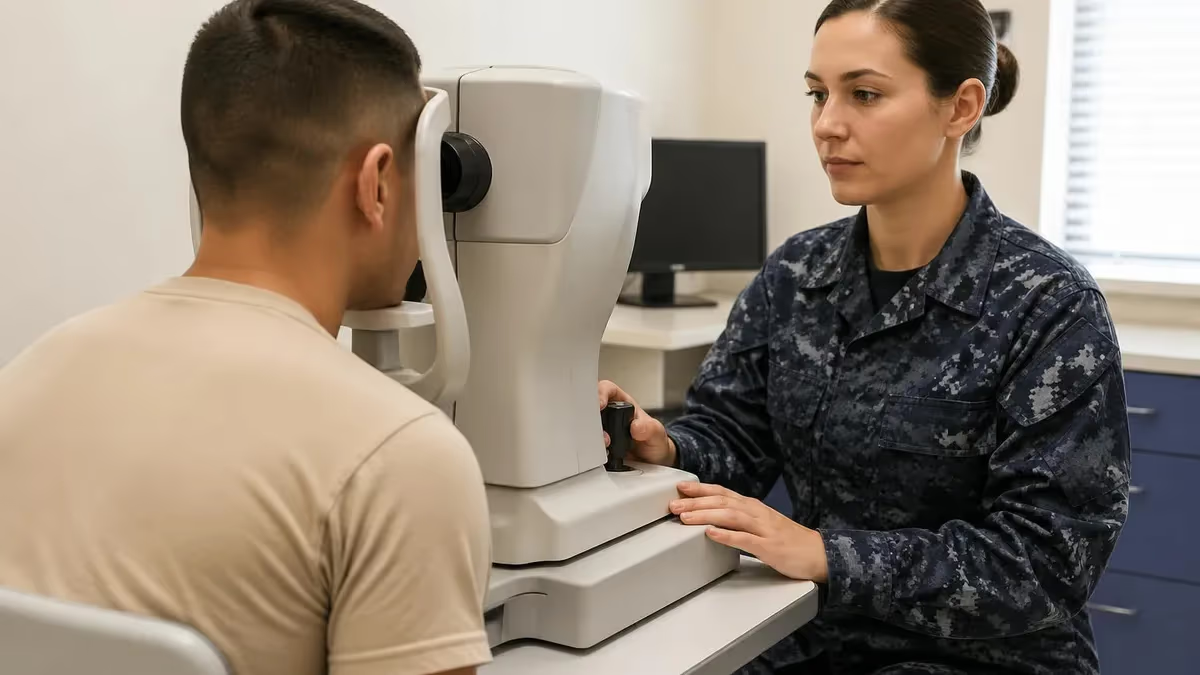
Vision is evaluated at MEPS more thoroughly than most recruits expect. The Army requires uncorrected distance vision of 20/40 in the better eye and 20/100 in the worse eye for most MOS categories, correctable to 20/20 with glasses or contacts. Aviation, special operations, and some intelligence MOS categories have stricter standards. Laser corrective surgery (PRK or LASIK) may disqualify you temporarily — typically 6 to 12 months must pass post-surgery before MEPS can approve your physical for many career fields. If you've had corrective surgery, confirm the wait period with your recruiter before scheduling MEPS.
The orthopedic evaluation — which includes the duck walk, various balance tests, and range-of-motion assessments — screens for musculoskeletal issues that might limit your performance in basic training or combat roles. Flat feet, knee injuries, lower back problems, and shoulder instability are commonly flagged here. Many orthopedic findings are waiverable for general service but may restrict MOS eligibility. Recruits who have had surgery should bring operative reports and clearance letters from their orthopedic surgeon.
Mental health history is reviewed through your medical questionnaire and potentially a brief evaluation by a MEPS mental health professional. History of depression, anxiety disorder, ADHD, or substance use treatment triggers additional review. Many candidates with mental health history qualify after evaluation — the determination is based on functional impact and treatment history, not the diagnosis label alone. Accurate disclosure is essential: the Army discovers undisclosed mental health history during security clearance investigations, and failing to disclose creates a fraudulent enlistment finding that is more serious than the underlying history itself.
Understanding meps meaning helps frame the entire experience correctly. MEPS is a gateway, not an obstacle — its purpose is to confirm that you meet the standards required to succeed in Army training and service, not to find reasons to reject qualified recruits. The vast majority of applicants who arrive prepared and honest complete MEPS processing successfully. Those who struggle usually do so because of documentation gaps, undisclosed history, or physical conditions that were known in advance but not addressed before the MEPS appointment.
Hearing loss is a more common MEPS finding than most recruits expect. If you've spent years at concerts, working in noisy environments, or using headphones at high volume, your audiogram may show threshold shifts that flag you for additional evaluation. Mild-to-moderate hearing loss is often waiverable for most Army MOS categories, but severe or profound loss in certain frequency ranges can restrict your MOS eligibility or trigger a disqualification for physically demanding roles. If you know your hearing has been affected by noise exposure, mention it proactively rather than hoping the audiogram misses it.
The blood draw and urinalysis are routine but have specific stakes. The drug screen tests for standard controlled substances at federal cutoff levels — the Army's standard is strict and there's no distinction between legal and illegal drugs in states where marijuana has been decriminalized or legalized. THC metabolites remain detectable in urine for 30 days or more after use depending on frequency and body composition. Recruits who fail the urine screen are typically disqualified immediately and must reapply after a significant waiting period.

MEPS Army Preparation Guide
- Social Security card — Original, not a photocopy. MEPS requires the actual document.
- Government-issued photo ID — Driver's license, state ID, or passport. Your recruiter will confirm what's accepted.
- Medical records — Any records your recruiter or MEPS specifically requested: surgery reports, prescription history, mental health treatment summaries.
- Glasses or contacts — If you use corrective lenses, bring them. Bring your current prescription if available.
- Overnight essentials — Toiletries, a change of clothes, phone charger. The hotel is government-contracted and functional but basic.
MOS selection is one of the most important conversations of your early Army career, and it happens at MEPS during your meeting with the Army Guidance Counselor. The counselor presents available MOS options based on your ASVAB line scores, Army needs at the time of your processing, and your preferences. Not every MOS is available on every day or every processing cycle — Army needs fluctuate with current force structure requirements. If your first-choice MOS isn't available, you can choose to wait (enter DEP and return when openings appear) or select an alternate.
Your enlistment contract specifies your MOS, training start date, station of choice (if applicable), enlistment bonuses, and enlistment length (typically 2, 3, 4, or 6 years for active duty). Read the contract carefully before signing. The incentives listed — bonuses, training options, duty station preferences — are only binding if they're written into the contract itself, not just verbally discussed. Verbal promises from anyone at MEPS or your recruiting station that aren't in the signed contract are not enforceable.
Some Army MOS categories require additional processing at MEPS beyond the standard screening. Special operations-linked MOS categories (18X — Special Forces Candidate, for example) require the Special Operations Recruiting Battalion to pre-screen your application before MEPS can finalize your contract. Aviation-warrant programs require aviation physicals and aptitude testing administered at Fort Rucker (now Fort Novosel) rather than at standard MEPS. Your recruiter will flag these additional requirements early in your application process if they apply to your chosen career path.
The meps military process for the Army includes a final security review before your oath. For MOS categories requiring a security clearance, you'll complete a Questionnaire for National Security Positions (SF-86) at MEPS, which initiates the background investigation. The investigation doesn't need to complete before you ship to basic training, but your security clearance must be granted before you can work in the cleared capacity of your MOS. Most Army recruits don't need to worry about this timeline — investigations typically complete during AIT (Advanced Individual Training).
Your MOS contract is more than a job assignment — it defines the training pipeline you'll enter, the location of your Advanced Individual Training (AIT), and potentially the installation where you'll first be stationed. Some MOS categories come with station of choice incentives that let you request your preferred duty station as a condition of the contract. These aren't guaranteed, but they're honored when operationally possible. If station of choice matters to you (family proximity, geographic preference), raise it during MOS counseling at MEPS before you sign.
Enlistment bonuses — when available — are MOS-specific and tied to contract length. Not all MOS categories offer bonuses, and bonus amounts change with Army retention and recruiting needs. Your Guidance Counselor at MEPS will advise on current bonus eligibility for each option presented to you. Bonuses are paid on a schedule (typically first installment after completing AIT, remaining payments at annual intervals) and are taxable income. If a bonus is part of your enlistment decision, verify the payment terms are in writing in your contract before signing.

- ✓Review the official MEPS exam content outline
- ✓Take a diagnostic practice test to identify weak areas
- ✓Create a study schedule (4-8 weeks recommended)
- ✓Focus on your weakest domains first
- ✓Complete at least 3 full-length practice exams
- ✓Review all incorrect answers with detailed explanations
- ✓Take a final practice test 1 week before exam day
Enlisting in the Army Through MEPS: What to Expect
- +MEPS is free — all transportation, hotel, and meals covered
- +Most disqualifying conditions can be waived with proper documentation
- +ASVAB can be taken at your recruiting station before MEPS to reduce pressure
- +Guidance Counselors present all available MOS options, not just what recruiters push
- +Oath of Enlistment is a meaningful formal moment, not just paperwork
- +DEP gives you time between MEPS and ship date to prepare for basic training
- −Long day — MEPS processing often runs 8 to 12 hours on processing day
- −Medical disqualifications require waiver applications that can take weeks to months
- −MOS availability varies by processing date — your top choice may not be open
- −Undisclosed medical or criminal history causes significantly more problems than disclosed history
- −Contract terms are binding once signed — changing MOS or options is difficult
- −ASVAB retest policy has a minimum wait period before scores can be improved

After your MEPS processing and oath, you enter the Delayed Entry Program (DEP) — unless you shipped immediately, which is rare. DEP allows you to maintain your enlistment status while waiting for your basic training date, which can be weeks to several months away depending on MOS training pipeline schedules.
While in DEP, you remain in contact with your recruiting station and may attend DEP meetings, physical training sessions, and preparation activities your recruiter organizes. DEP is not basic training — it's a holding status — but staying physically fit and mentally prepared during this period gives you a significant advantage when you actually arrive at reception.
Your ship date is the date you return to MEPS for final processing before departing for basic training. On ship day, MEPS re-confirms your medical status (urine drug screen, any pending lab results), verifies your documents, and processes your final paperwork. You then travel by government-arranged transportation to your assigned Reception Battalion — the entry point for Army basic combat training. Most recruits fly, though ground transportation is used for nearby installations.
In the weeks between MEPS and your ship date, focus on the physical fitness standards you'll be tested against at reception. The Army Combat Fitness Test (ACFT) replaced the older APFT in 2020 and consists of six events: three-repetition maximum deadlift, standing power throw, hand-release push-ups, sprint-drag-carry, leg tuck (or plank), and two-mile run. Arriving at basic training already training at these standards reduces the adjustment stress of reception week and lets you focus on learning Army skills rather than fighting basic physical assessments.
The period between MEPS and shipping is also the right time to settle personal affairs — notify your bank of your upcoming absence, arrange mail forwarding, update your employer on your departure date, and ensure your family knows your unit assignment and how to contact Army family support services. The Army's installation Family Support Groups and Army Community Service offices provide resources for families of soldiers entering training, and connecting your family with these resources before you leave simplifies a transition that's significant for everyone involved.
Physical preparation during the DEP period is arguably the highest-impact use of your time. Army basic training's attrition rate is low, but injuries — particularly shin splints, stress fractures, and shoulder injuries — disproportionately affect recruits who arrive physically underprepared. Running progressively during DEP, adding body weight strength work, and practicing the ACFT movements (deadlift, push-up variations, carrying events) builds the conditioning base that prevents injury during the high-volume physical training of basic combat training's first three weeks.
Mental preparation matters too. Basic training is designed to be disorienting and stressful — the discomfort is intentional, not punitive. Recruits who arrive with realistic expectations about what the first few weeks involve adapt faster than those who are blindsided. Reading first-person accounts from recent graduates of your specific basic training installation, connecting with DEP members who've shipped before you, and maintaining a disciplined daily schedule during DEP are all preparation habits that pay dividends at reception and during basic training itself.
MEPS Practice Test Questions
Prepare for the MEPS - Military Entrance Processing Stations exam with our free practice test modules. Each quiz covers key topics to help you pass on your first try.
MEPS Introduction to MEPS
MEPS Exam Questions covering Introduction to MEPS. Master MEPS Test concepts for certification prep.
MEPS ASVAB
Free MEPS Practice Test featuring ASVAB. Improve your MEPS Exam score with mock test prep.
MEPS Paragraph Comprehension
MEPS Mock Exam on Paragraph Comprehension. MEPS Study Guide questions to pass on your first try.
MEPS Military Entrance Processing Stations...
MEPS Test Prep for Military Entrance Processing Stations (MEPS) Applicant Processing and Standards. Practice MEPS Quiz questions and boost your score.
MEPS Military Entrance Processing Stations...
MEPS Questions and Answers on Military Entrance Processing Stations (MEPS) ASVAB Aptitude Testing. Free MEPS practice for exam readiness.
MEPS Military Entrance Processing Stations...
MEPS Mock Test covering Military Entrance Processing Stations (MEPS) Enlistment and Oath Ceremony. Online MEPS Test practice with instant feedback.
MEPS Military Entrance Processing Stations...
Free MEPS Quiz on Military Entrance Processing Stations (MEPS) Job Counseling and Contracts. MEPS Exam prep questions with detailed explanations.
MEPS Military Entrance Processing Stations...
MEPS Practice Questions for Military Entrance Processing Stations (MEPS) MEPS Medical Examinations. Build confidence for your MEPS certification exam.
MEPS Military Entrance Processing Stations...
MEPS Test Online for Military Entrance Processing Stations (MEPS) Moral and Background Screening. Free practice with instant results and feedback.
MEPS Applicant Pre-Screening Process
MEPS Study Material on Applicant Pre-Screening Process. Prepare effectively with real exam-style questions.
MEPS Applicant Processing and Conduct
Free MEPS Test covering Applicant Processing and Conduct. Practice and track your MEPS exam readiness.
MEPS ASVAB Administration and Purpose
MEPS Exam Questions covering ASVAB Administration and Purpose. Master MEPS Test concepts for certification prep.
MEPS ASVAB Aptitude Testing
Free MEPS Practice Test featuring ASVAB Aptitude Testing. Improve your MEPS Exam score with mock test prep.
MEPS Enlistment Contracts and Oaths
MEPS Mock Exam on Enlistment Contracts and Oaths. MEPS Study Guide questions to pass on your first try.
MEPS Job Selection and Counseling
MEPS Test Prep for Job Selection and Counseling. Practice MEPS Quiz questions and boost your score.
MEPS Job Selection and Enlistment
MEPS Questions and Answers on Job Selection and Enlistment. Free MEPS practice for exam readiness.
MEPS Medical Examination Procedures
MEPS Mock Test covering Medical Examination Procedures. Online MEPS Test practice with instant feedback.
MEPS Medical Examination Process
Free MEPS Quiz on MEPS Medical Examination Process. MEPS Exam prep questions with detailed explanations.
MEPS Moral and Background Standards
MEPS Practice Questions for Moral and Background Standards. Build confidence for your MEPS certification exam.
MEPS Army Questions and Answers
About the Author

Retired Military Officer & Armed Forces Test Preparation Specialist
United States Army War CollegeColonel Steven Harris (Ret.) served 28 years in the US Army, earning a Master of Arts in Military Science from the Army War College and a Bachelor of Science in Criminal Justice. He has coached thousands of military enlistment and officer candidate program applicants through the ASVAB, AFQT, AFCT, OAR, and officer selection assessment processes across all military branches.
Join the Discussion
Connect with other students preparing for this exam. Share tips, ask questions, and get advice from people who have been there.
View discussion (8 replies)