
What Is MEPS Army? Step-by-Step Enlistment Guide 2026 September
💯 Free What Is MEPS Army? Step Practice Test practice test with instant feedback and detailed answer explanations. Prepare for your exam.
What Is MEPS Army?
MEPS stands for Military Entrance Processing Station, and for Army recruits, it is the official gateway into military service. Every person who wants to enlist in the United States Army — whether active duty, Army Reserve, or Army National Guard — must complete MEPS processing before they can sign a contract or take the oath of enlistment. Understanding what MEPS is and how it applies specifically to Army applicants helps you walk in prepared and confident.
MEPS is a joint-service facility, meaning it processes applicants for all military branches, not just the Army. However, the Army sends more recruits through MEPS than any other branch. On a typical processing day, you will share the facility with Navy, Marine Corps, Air Force, Space Force, and Coast Guard applicants, but your Army-specific testing, medical evaluation, and job selection are handled by Army recruiters and MEPS guidance counselors assigned to your branch.
The MEPS meaning for Army applicants goes beyond a single test or appointment. It is a multi-step evaluation designed to verify that you meet the Army's mental, physical, and moral standards for service. MEPS determines whether you qualify, what Army jobs (MOS — Military Occupational Specialty) you are eligible for, and which component of the Army you will enter. Without completing MEPS and receiving a medical and administrative clearance, no recruit can officially enlist.
Most Army recruits visit MEPS twice. The first visit, often called a "pre-screening" or initial MEPS visit, covers the ASVAB test, a preliminary medical screening, and initial job counseling. The second visit — your "ship-out MEPS" — is when you finalize your contract, receive your official MOS assignment, and take the oath of enlistment. Some recruits complete both visits on consecutive days; others return weeks or months later after completing the Delayed Entry Program (DEP). Your Army recruiter will coordinate both appointments and brief you on what to expect each time.
Arriving informed makes a measurable difference. Recruits who understand the process experience less anxiety, make better job selection decisions, and are less likely to encounter administrative delays. Everything from your paperwork to your physical measurements is scrutinized at MEPS, so treating this appointment like the serious professional evaluation it is pays off. Knowing what the Army expects before you walk through the door puts you ahead of the majority of applicants who show up with little preparation.
MEPS facilities are typically located near major metro areas and military installations. If you live far from the nearest MEPS location, the Army arranges overnight lodging at a government-contracted hotel the night before your processing day. Transportation from the hotel to the facility is provided, and meals on the day of processing are covered.
Most recruits arrive the evening before their scheduled appointment, which means your MEPS experience essentially begins the day before you walk through those doors. This advance preparation period is a good time to review your paperwork, get adequate sleep, and confirm you understand what happens at each stage of the day ahead.
Recruits who have previously attempted to enlist in another branch or who have prior military service have additional paperwork requirements at MEPS. If you previously enlisted and separated — regardless of the circumstances — that history is part of your MEPS record and must be disclosed fully. Trying to hide a prior enlistment or separation characterization at MEPS is considered a fraudulent entry into military service, a federal offense that can follow you permanently. Honesty at every stage of MEPS, even when the truth is unflattering, is always the correct approach.
Army ASVAB Testing and MOS Selection at MEPS
The ASVAB — Armed Services Vocational Aptitude Battery — is the centerpiece of Army testing at MEPS. You either take the ASVAB at your recruiter's office before your MEPS visit, or complete it at MEPS on arrival. The computerized version of the test (CAT-ASVAB) is administered at MEPS and adapts in difficulty based on your performance. The pencil-and-paper version is sometimes used at Military Entrance Test (MET) sites and schools.
The Army uses your AFQT score — a composite derived from the Arithmetic Reasoning, Word Knowledge, Paragraph Comprehension, and Math Knowledge subtests — as the minimum qualification score. The Army requires a minimum AFQT of 31 for high school graduates. Applicants with a GED must score at least 50. Scoring higher opens up more MOS options and may qualify you for enlistment bonuses, so there is always a practical incentive to prepare thoroughly rather than aiming just to pass.
Beyond the AFQT, the Army calculates line scores from the ASVAB subtests. These line scores — categories like Skilled Technical (ST), General Technical (GT), Electronics (EL), and Clerical (CL) — determine which MOS jobs you are eligible for. Intelligence and language roles require a high GT score; technical jobs in aviation, electronics, or signal communications require strong ST or EL scores. Your Army MEPS guidance counselor uses these line scores to match you with available jobs that fit both your scores and the Army's current needs.
MOS selection at MEPS is one of the most consequential decisions in your military career. A MEPS guidance counselor will present you with a list of available MOS options that match your scores, physical profile, and clearance eligibility. This is the moment to ask detailed questions about training length, duty station options, deployment history for that specialty, and any reenlistment bonuses. Do not let the counselor rush you through this step. You are signing a contract for years of service, and understanding what each job actually involves is worth every minute of deliberation.
If the MOS you want is not available on your processing day, you may be offered a "needs of the Army" option or asked to wait for your preferred job to open. Some recruits enlist into an open-general category (like 11X for Infantry or 18X for Special Forces Candidate), which means accepting the job the Army assigns after Basic Combat Training rather than choosing a specific specialty upfront. Your recruiter can advise on whether holding out for a specific MOS is realistic based on current Army recruiting priorities and your scores.
It is worth understanding that ASVAB scores cannot be submitted from a prior test indefinitely. Scores taken more than two years before your MEPS appointment expire and you may be required to retest. This two-year window encourages recruits who scored poorly years ago to retest with current preparation rather than relying on outdated results. If your scores have improved significantly since your first test, retesting at MEPS can dramatically expand your MOS options. Preparation resources including official ASVAB study materials and practice tests are widely available and make a real difference in outcomes.
Army guidance counselors at MEPS are a resource you should use fully during the MOS selection session. They know which jobs are in high demand, which carry enlistment bonuses, and which are most likely to transition well to civilian careers after service. Asking about training pipeline length — the time between Basic Training graduation and actually reporting to your first duty station — is practical because some MOS pipelines last over a year. Understanding the full commitment before you sign ensures there are no surprises about your service timeline.

Army Medical Standards at MEPS
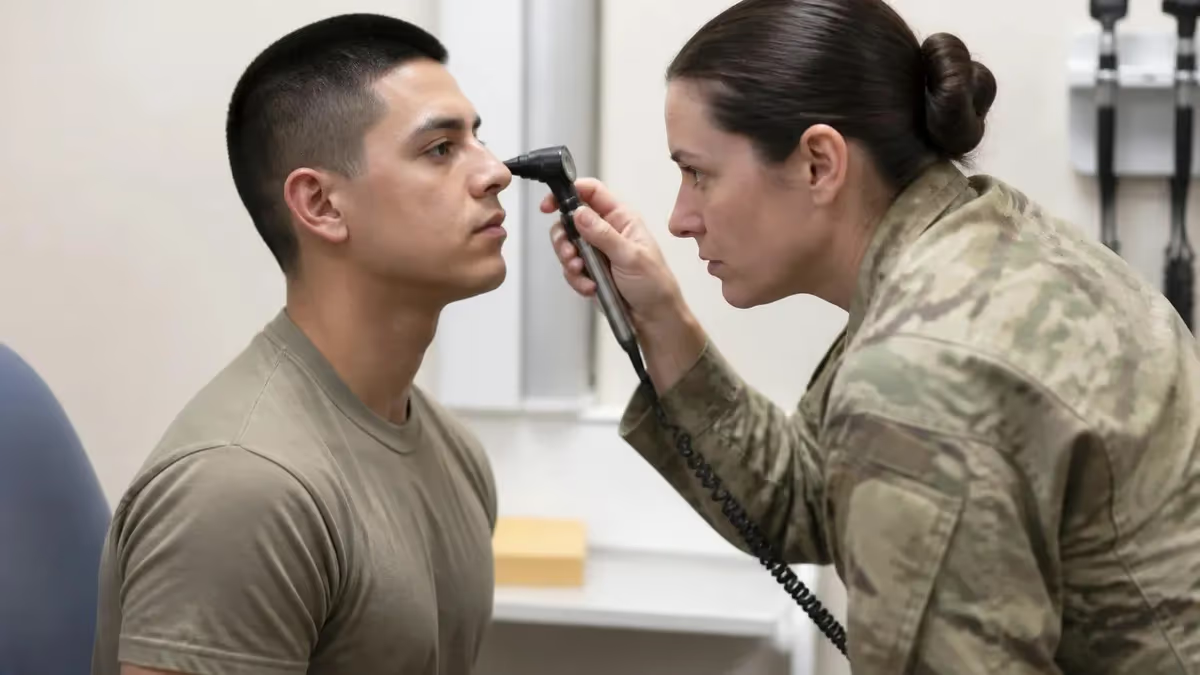
The medical examination at MEPS is one of the most thorough physical evaluations most recruits have ever experienced. For the Army, this exam is conducted by MEPS medical staff — not your personal doctor — and it follows standardized Department of Defense medical accession standards outlined in DoDI 6130.03. The examination covers every major body system and includes laboratory testing, not just a basic checkup.
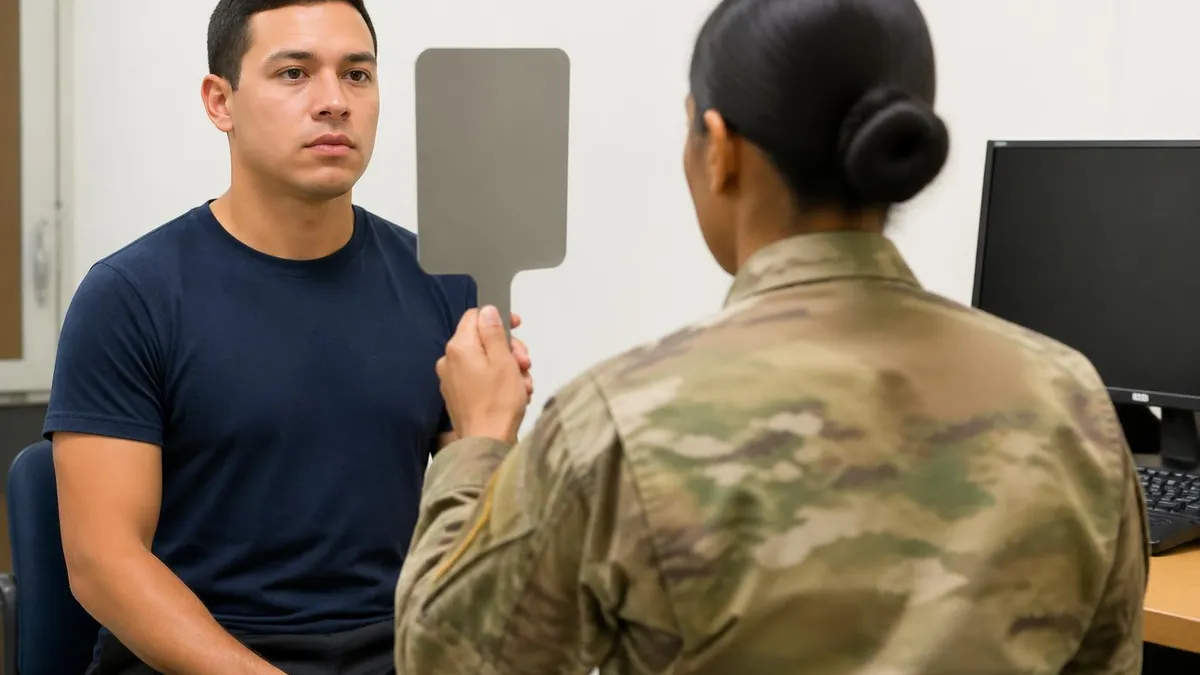
Height and weight are measured immediately and must fall within Army Body Composition Program standards. Blood pressure is checked and must be within acceptable ranges without medication. Vision testing checks both corrected and uncorrected visual acuity; the Army allows corrective lenses, but extremely poor uncorrected vision disqualifies some MOS roles. Hearing tests using audiometry determine if you meet hearing standards for your selected specialty, since certain Army jobs require better hearing than others.
Orthopedic screening is particularly thorough. You will be asked to perform a range of movements — duck walk, standing on toes, bending forward — to assess joint function and detect prior injuries. A history of significant knee, shoulder, ankle, or back injuries may trigger further evaluation. Scars and surgical history are reviewed. Prior sports injuries, even from years ago, can result in a temporary disqualification requiring additional medical documentation before a waiver is considered.
Common disqualifying conditions include asthma diagnosed after age 13, certain cardiac conditions, recent surgeries, untreated mental health diagnoses, and substance abuse history. However, many conditions that initially disqualify an applicant can be addressed through a medical waiver process. Waivers are not guaranteed — they require documentation, command review, and approval — but they are granted regularly for conditions that do not actually impair a recruit's ability to perform Army duties safely. Your recruiter can advise on whether a waiver is worth pursuing based on your specific situation and the Army's current accession needs.
Psychological screening is also part of the MEPS medical process. A MEPS psychological technician will review your mental health history from your forms and conduct a brief screening interview. Diagnoses such as depression, anxiety, or ADHD that were treated in childhood but resolved may be reviewable under specific waiver criteria. Active, ongoing treatment for significant psychiatric conditions is generally disqualifying. Honesty during this screening matters — misrepresenting your medical history to enlist is a federal offense and can result in separation after service begins.
Drug and alcohol screening is a mandatory part of Army MEPS processing. A urine sample is collected on your processing day and tested for a standard panel of controlled substances. Testing positive results in immediate disqualification and requires a waiting period before reapplication — typically 90 days for most substances, though more serious findings may extend or permanently bar enlistment.
There is no way to game or delay the drug test, and attempting to submit an adulterated sample is a criminal matter. Candidates who have used marijuana or other controlled substances should consult with their recruiter honestly about timing and Army waiver policy before scheduling their MEPS appointment.
The medical standards used at MEPS are the same standards applied to every Army recruit regardless of your home state, the recruiter you worked with, or which specific MEPS facility processes you. This consistency means that a disqualification you receive at one MEPS cannot be bypassed by going to a different location.
If you disagree with a medical finding, you have the right to request a review, but the process requires documented medical evidence — not simply a different opinion from your personal physician. Understanding this consistency helps calibrate expectations and ensures you approach any disqualification through the correct official channels.
The Delayed Entry Program and What Happens After MEPS
Most Army recruits do not ship to Basic Combat Training immediately after MEPS. Instead, they enter the Delayed Entry Program (DEP), also called the Delayed Enlistment Program. DEP allows recruits to finalize their enlistment contract at MEPS but defer their actual ship date by up to 365 days. During this period, you are officially in the Army Reserve as a private E-1, but you are not on active duty and are not yet attending Basic Training.
DEP is common because Basic Combat Training slots and MOS school seats must be scheduled months in advance. Your ship date is assigned based on when your chosen MOS school has an available training seat. If you want a specific MOS badly enough to wait six months for a slot, DEP makes that possible while locking in your contract. Some recruits also use DEP time to lose weight, improve physical fitness, or complete any outstanding administrative requirements such as obtaining a security clearance pre-screening.
While in DEP, you are expected to maintain contact with your recruiter and attend any scheduled DEP meetings or physical training sessions. If your physical condition changes significantly or you are arrested, you are required to notify your recruiter immediately. Entering DEP does not mean you are committed beyond the point of no return — DEP discharges are possible before ship date, though they become more complicated the closer you get to your Basic Training date.
On your ship date, you return to MEPS one final time for a brief administrative review. This visit confirms that nothing has changed since your initial processing — your weight is checked, you answer health and legal questions, and you take the oath of enlistment again if you did not take it on your initial visit. From MEPS, you board transportation to your Basic Combat Training installation. The MEPS Army processing timeline from first appointment to ship date varies widely, but understanding each stage helps you plan the transition into service without surprises.
The military MEPS process is the same for every branch in terms of facility and staff, but Army-specific standards, scores, and job options make preparation branch-specific. Recruits who research Army ASVAB line score requirements, review Army medical accession standards, and come to MEPS with complete documentation consistently report smoother processing days than those who show up uninformed. The work you put in before your MEPS appointment directly shapes the quality of your MOS selection and the start of your Army MEPS experience.

Army Component MEPS Differences
Active duty Army recruits complete full MEPS processing and typically ship to Basic Combat Training within weeks to months of contract signing. MOS selection is based on real-time Army vacancies. Active duty contracts typically run 3-6 years for first-term service. MEPS processing includes full administrative background check and security clearance initiation for applicable MOS roles.
What to Bring to Army MEPS
- ✓Valid government-issued photo ID (driver's license, state ID, or passport)
- ✓Social Security card or official Social Security documentation
- ✓Birth certificate (original or certified copy)
- ✓High school diploma or GED certificate
- ✓List of all medications (prescription and over-the-counter) with dosages
- ✓Eyeglasses or contact lenses if you wear them — bring both if possible
- ✓Medical records for any surgeries, hospitalizations, or significant conditions
- ✓Comfortable, loose-fitting clothing that is easy to remove for medical exams
- ✓Marriage or divorce certificates if applicable
- ✓Any court documents related to legal history (tickets, arrests, charges)

- +Comprehensive medical screening catches undiagnosed conditions before service
- +ASVAB line scores open doors to specialized technical Army careers
- +MOS contract guarantees your training path before you commit to service
- +DEP allows time to prepare physically and finalize life logistics before shipping
- +MEPS oath is a meaningful ceremonial milestone recognized by family and friends
- −Long processing days — typically 6 to 12 hours with significant waiting periods
- −Medical disqualifications from old injuries or conditions you considered resolved
- −Pressure during MOS selection can lead recruits to accept jobs they didn't want
- −Waiver process for disqualifying conditions adds weeks or months of uncertainty
- −DEP period requires maintaining Army fitness and weight standards before shipping
MEPS Questions and Answers



About the Author

Retired Military Officer & Armed Forces Test Preparation Specialist
United States Army War CollegeColonel Steven Harris (Ret.) served 28 years in the US Army, earning a Master of Arts in Military Science from the Army War College and a Bachelor of Science in Criminal Justice. He has coached thousands of military enlistment and officer candidate program applicants through the ASVAB, AFQT, AFCT, OAR, and officer selection assessment processes across all military branches.
Join the Discussion
Connect with other students preparing for this exam. Share tips, ask questions, and get advice from people who have been there.
View discussion (8 replies)