
MEPS Jobs: Civilian Careers at Military Entrance Processing Stations
🎓 Prepare for the MEPS Jobs: Civilian Careers at Military certification. Practice questions with answer explanations covering all exam domains.
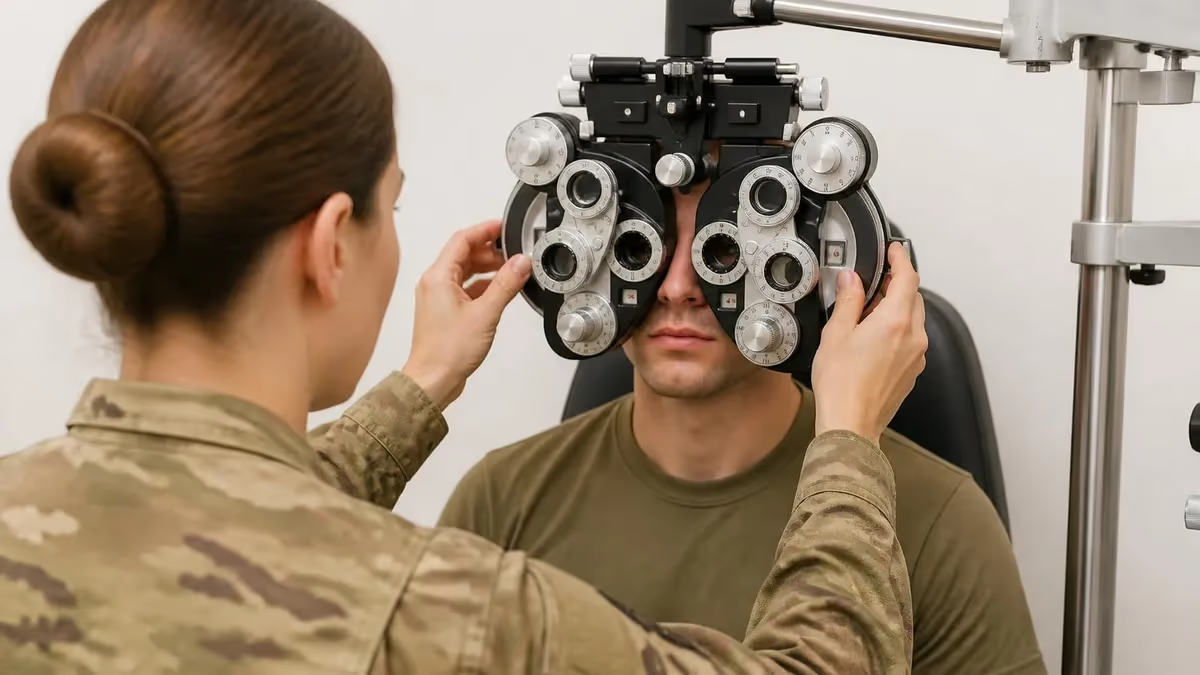
Military Entrance Processing Stations (MEPS) employ a substantial civilian workforce alongside the active-duty military personnel and medical staff who make up the core of each station's operations. The 65 MEPS facilities across the United States — operated by the US Army on behalf of all military branches — rely on federal civil service employees in a range of administrative, medical, and technical roles to support the processing of approximately 400,000 applicants per year.
Civilian jobs at MEPS offer federal employee benefits, job stability, and the opportunity to work within the military community in a support role that directly contributes to national defence without requiring military enlistment.
The US Army, which manages MEPS facilities under the Military Entrance Processing Command (MEPCOM), uses the federal civil service system to fill non-military positions at each station. These positions are classified under the General Schedule (GS) pay system, which means that MEPS civilian employees receive federal pay that scales with the grade level (GS-5 through GS-14, depending on the position) and step within that grade, with periodic step increases based on time in service and satisfactory performance.
Federal employees at MEPS are also eligible for federal health insurance, the Federal Employees Retirement System (FERS), the Thrift Savings Plan (TSP), and other standard federal benefits. All MEPS civilian positions are advertised on USAJOBS.gov, the federal government's official job application platform.
Medical Officer positions at MEPS include civilian medical examiners (MEs) who conduct the physical examinations of applicants, review medical records, and make medical qualification determinations. MEPS medical examiners hold medical degrees (MD or DO) and must be licensed to practice medicine in the United States.
The MEPS medical examination role combines clinical examination skills with regulatory knowledge — MEPS medical examiners must apply the Department of Defense medical standards for military accession, making determinations about whether specific medical conditions are disqualifying or whether waivers may be appropriate. Medical technicians, nurses, and laboratory personnel support the medical examination process in additional civilian roles within MEPS medical departments.
Administrative and clerical positions at MEPS include roles such as administrative specialists, human resources assistants, records management specialists, and reception and scheduling personnel. These positions handle applicant records, coordinate scheduling of processing appointments, manage the flow of administrative paperwork that accompanies each applicant's processing, and support the operational functions of the MEPS facility.
Administrative positions at MEPS typically fall in the GS-5 through GS-9 range depending on the specific role and complexity of duties. Veterans with administrative experience frequently apply for these positions, and many MEPS administrative staff are veterans who sought employment in the military community after their active-duty service.
ASVAB testing positions at MEPS involve administering and monitoring the Armed Services Vocational Aptitude Battery — the computerised adaptive test that assesses applicants' cognitive abilities across multiple domains and helps determine job eligibility within the military.
The ASVAB testing function at MEPS is managed by personnel who are responsible for maintaining testing security, administering the computerised test according to Military Accession Processing System protocols, and ensuring that test administration meets the standardised conditions required for valid ASVAB scores. Some MEPS facilities also have liaisons who communicate with applicants and their recruiters about ASVAB results and how results affect job options within each branch.
MEPS civilian vacancies don't open on a regular schedule — they appear when positions turn over. Set a USAJOBS job alert for 'MEPCOM' or 'MEPS' in your target state or city so you're notified immediately when a matching position is posted. Popular locations fill quickly after announcement.
Military Liaison Officers and branch-specific personnel assigned to MEPS represent a different category of MEPS workers — active-duty military personnel who coordinate between their branch's recruiting command and the MEPS facility.
Each military branch (Army, Navy, Marine Corps, Air Force, Space Force, Coast Guard) maintains liaison representation at MEPS to support recruits from that branch, answer branch-specific questions about job selection (MOS, rating, AFSC, etc.), and facilitate the administrative connection between recruiting and processing. These positions are filled by active-duty service members on assignment, not by civil service employees — but they are relevant context for understanding the full workforce that operates within a MEPS facility.
The MEPS physical environment shapes what it's like to work at one of these facilities. MEPS stations are typically located in or near military installations, in federal office buildings, or in dedicated MEPS facilities in metropolitan areas close to the recruiting populations they serve. The working environment is orderly, structured, and professionally demanding — MEPS process large numbers of applicants on a tight schedule, and all staff contribute to maintaining the flow of processing from arrival through oath of enlistment.
The pace can be intensive during high-volume periods, particularly in late summer and early fall when high school graduates commonly enter military processing. Civilian employees who enjoy a structured, mission-focused environment tend to thrive at MEPS; those who prefer casual or highly autonomous work settings may find the military-adjacent culture more constraining than they anticipated.
The mission of MEPS — ensuring that every person who enters military service meets the physical, mental, and moral standards of their chosen branch — gives civilian employees a direct connection to the broader purpose of national defence. This sense of mission is one of the most frequently cited job satisfiers among MEPS civilian employees.
Processing an applicant who has worked through medical history complications to achieve qualification for military service, or seeing a nervous young person swear the oath of enlistment after a challenging processing day, provides a sense of meaningful contribution that many routine federal positions do not offer. The combination of federal employment stability and purposeful work within the military community is the defining appeal of MEPS civilian careers for many applicants.
Contractor positions represent an additional category of employment at and around MEPS facilities, distinct from federal civil service positions. Contracting companies that support MEPCOM operations provide supplemental staffing in areas such as information technology, administrative support, medical coding, and records management.
Contractor positions at MEPS are not federal civil service positions — they do not carry GS-grade pay scales, federal benefits, or federal retirement — but they do provide proximity to the MEPS environment and can serve as a pathway to identifying federal positions when they open. Job seekers who are interested in the MEPS environment but have not yet landed a federal civil service role may find that contractor work at a MEPS facility provides both income and inside knowledge of how federal hiring processes work at that location.
For job seekers who are interested in MEPS careers but are not yet sure which specific role best fits their background, informational conversations with current MEPS employees — through professional networks, veterans service organisations, or LinkedIn — can provide valuable ground-level insight into what the day-to-day work is like in different positions.
Federal hiring is competitive and the application process is time-consuming; having a clear picture of which position type aligns best with your background and interests before investing in the application process makes the effort more targeted and the ultimate employment experience more satisfying. The hiring process rewards preparation — candidates who invest time in building strong federal resumes and understanding qualification standards consistently outperform those who submit generic applications.

| Section | Questions | Time | Notes |
|---|---|---|---|
| Medical Examiner (MD/DO) | GS-12 to GS-14 | Medical degree required | Conducts physical exams, reviews medical history, makes DoD accession standard determinations |
| Medical Technician / Nurse | GS-7 to GS-11 | Clinical certification required | Supports physical examination process, lab collection, vision and hearing testing |
| Administrative Specialist | GS-5 to GS-9 | No degree required for GS-5 | Records management, scheduling, applicant flow, processing documentation |
| ASVAB Testing Monitor | GS-5 to GS-7 | Exam administration experience | Administers computerised ASVAB, maintains test security, coordinates testing environment |
| Guidance Counselor | GS-9 to GS-12 | Counseling background preferred | Works with applicants on job selection, qualification questions, and MEPS process support |
| Human Resources / Finance | GS-7 to GS-11 | HR/finance background | Personnel management, payroll processing, employee benefits administration for MEPS staff |
Applying for MEPS jobs follows the standard federal civil service hiring process via USAJOBS.gov. Creating a USAJOBS profile and uploading a federal resume — which differs in format from a typical private sector resume — is the first step.
Federal resumes are more detailed than standard resumes, typically including specific dates of employment (month and year), exact hours per week worked, specific descriptions of duties and accomplishments, and GS grade level equivalencies for prior federal service if applicable. The additional detail required in federal resumes is designed to enable personnel specialists to verify that applicants meet the specific qualification standards for each GS grade level.
Qualification requirements for MEPS jobs vary by position type and grade level. Entry-level administrative positions (GS-5) typically require a bachelor's degree or one year of specialized experience. Higher GS grades require progressively more specific experience, education, or a combination of both, as defined in the Office of Personnel Management (OPM) qualification standards for each job series.
Medical positions have additional professional licensure requirements that must be verified as part of the hiring process. Some positions also specify the Knowledge, Skills, and Abilities (KSAs) that applicants must address directly in their application materials — failure to address specific KSAs is a common reason applicants are not considered despite otherwise meeting minimum qualifications.
Veterans preference is a significant advantage in federal civil service hiring and is particularly relevant for MEPS job applicants, given that many veterans are drawn to employment in MEPS facilities after their military service. Veterans who served on active duty and received an honorable or general discharge receive five-point hiring preference; veterans with a service-connected disability receive ten-point preference.
In addition, veterans who have a 30% or greater service-connected disability are given special consideration under the Schedule A hiring authority. Veterans who are eligible for preference must document their eligibility by providing a copy of their DD-214 and, for disability preference, documentation from the VA confirming their disability rating.
The security clearance process is an important consideration for MEPS job applicants, as many positions at military facilities require a background investigation resulting in a security clearance at the Secret or higher level. The investigation evaluates financial history, employment history, criminal records, foreign contacts, and other factors that bear on an individual's reliability and trustworthiness in a position of national security significance.
The clearance process typically takes several months and is initiated after a conditional job offer has been made — candidates begin work in an interim status while the full investigation is completed. Prior military service, a clean financial history, and no significant criminal record are factors that generally support a straightforward clearance process.

Federal resumes must include exact employment dates (month/year), hours per week, and detailed duty descriptions for every job listed — far more detail than a typical private sector resume. Omitting these details can disqualify you automatically. USAJOBS.gov has a federal resume builder tool that guides you through the required format.
Working environment at MEPS is structured and professionally formal, reflecting the military context in which the facility operates. Civilian employees at MEPS are expected to maintain the professional demeanor and standards appropriate to a federal military installation — this includes dress codes (typically business casual or professional attire, not casual), punctuality, and respect for the chain of command and rank conventions of the military personnel who share the facility.
Civilian employees do not wear military uniforms or hold military rank, but they operate within a military culture and their conduct reflects on the facility as a whole. Many former military members who work at MEPS report that the cultural familiarity is one of the most attractive aspects of the job — the military environment feels like home.
Career development opportunities within the MEPS civilian workforce include advancement through the GS pay system (promotion to higher grade levels as experience and demonstrated competency increase), leadership development programmes available through the Army civilian training system, lateral movement to other federal agencies or DoD components, and transition to contractor roles supporting MEPS operations.
The MEPCOM also offers civilian leadership development opportunities through the Army Civilian Service organisation, which provides training in federal HR, leadership, and management skills for civilian employees who aspire to supervisory and management roles within the MEPS system. Long-term civilian careers within MEPS are common, and many MEPS civilian employees remain in the system for 10 to 20+ years before retirement.
Professional development for MEPS civilian employees is supported through the Army Civilian Training Education and Development System (ACTEDS), which provides career development roadmaps for each civilian job series, access to online training, tuition assistance for job-related education, and leadership development programmes for civilian employees with supervisory aspirations.
MEPS employees who invest in their professional development — particularly in federal HR, security, medical administration, or the specific functional area of their position — accelerate their advancement through the GS pay system and increase their competitiveness for positions of greater responsibility. Federal employees who combine a strong performance record with continuous professional development are well-positioned for internal promotion and for competitive selection for leadership roles within MEPCOM.
The geographic distribution of MEPS facilities means that federal employees with MEPS experience have the option of transferring between facilities across the country through the federal internal transfer process. Employees who accept a permanent change of station (PCS) transfer to another MEPS location maintain their GS grade and federal service continuity, allowing for career development and geographic mobility without sacrificing seniority or benefits.
This mobility option is particularly attractive for spouses of active-duty military members who may need to relocate frequently — civilian MEPS employees who relocate with their military spouse can often find employment at the MEPS nearest their new duty station, maintaining continuous federal employment despite geographic moves.
Retirement planning is a significant benefit consideration for MEPS civilian employees, as federal service under the Federal Employees Retirement System (FERS) provides a defined benefit pension in addition to Social Security and the Thrift Savings Plan (TSP). FERS employees who complete at least five years of federal service and reach the minimum retirement age with sufficient service years receive a pension that is a percentage of their high-3 average salary — the average of their three highest consecutive salary years.
Combined with TSP matching contributions (the federal government matches up to 4% of salary, plus a 1% automatic contribution), Social Security benefits, and federal health insurance in retirement, the total compensation package for a long-service MEPS federal employee often compares favourably to equivalent private-sector positions — making the somewhat lower base salaries of GS positions more competitive in total compensation terms than they first appear. For those planning a long civilian career in public service, the MEPS environment offers a rare combination of mission significance, structured federal employment, and the camaraderie of working alongside those who serve.

MEPS civilian positions are not posted continuously — they open when vacancies occur. Set up a USAJOBS job alert for 'MEPS' or 'MEPCOM' in your target location so you're notified immediately when a position opens. MEPS jobs in desirable locations fill quickly; early application is essential. Check USAJOBS.gov regularly and apply as soon as an appropriate vacancy is announced.
- ✓Create a USAJOBS.gov profile and upload a complete federal resume with exact employment dates and hours per week
- ✓Set up a job alert on USAJOBS for 'MEPCOM' or 'MEPS' at your target location — vacancies open infrequently
- ✓Review the specific qualification requirements for your target GS grade level before applying
- ✓Address all Knowledge, Skills, and Abilities (KSAs) listed in the job announcement — missing KSAs = not considered
- ✓Gather veterans preference documentation (DD-214, VA disability letter if applicable) before applying
- ✓Be prepared for a thorough background investigation — clean up any financial issues or outstanding accounts before applying for positions requiring a clearance
- ✓Tailor your federal resume to the specific position announcement — not a generic resume
- ✓Be patient with the federal hiring timeline — federal hiring typically takes 60–120 days from announcement close to offer
- ✓Consider contacting the HR point of contact listed in the job announcement if you have questions about qualifications
- ✓Research the specific MEPS location where you're applying — understand the mission, volume, and any special characteristics of that facility
MEPS Pros and Cons
- +MEPS has a publicly available content blueprint — you know exactly what to prepare for
- +Multiple preparation pathways accommodate different schedules and budgets
- +Clear score reporting shows specific strengths and weaknesses
- +Study communities share current insights from recent test-takers
- +Retake policies allow recovery from a difficult first attempt
- −Tested content scope requires substantial preparation time
- −No single resource covers everything optimally
- −Exam-day performance can differ from practice test performance
- −Registration, prep, and retake costs accumulate significantly
- −Content changes between versions can make older materials less reliable
MEPS Questions and Answers
About the Author

Retired Military Officer & Armed Forces Test Preparation Specialist
United States Army War CollegeColonel Steven Harris (Ret.) served 28 years in the US Army, earning a Master of Arts in Military Science from the Army War College and a Bachelor of Science in Criminal Justice. He has coached thousands of military enlistment and officer candidate program applicants through the ASVAB, AFQT, AFCT, OAR, and officer selection assessment processes across all military branches.
Join the Discussion
Connect with other students preparing for this exam. Share tips, ask questions, and get advice from people who have been there.
View discussion (8 replies)