
MEPS Meaning: What Is a Military Entrance Processing Station? 2026 September
📚 Get ready for your MEPS Meaning: What Is a Military certification. Practice questions with step-by-step answer explanations and instant scoring.
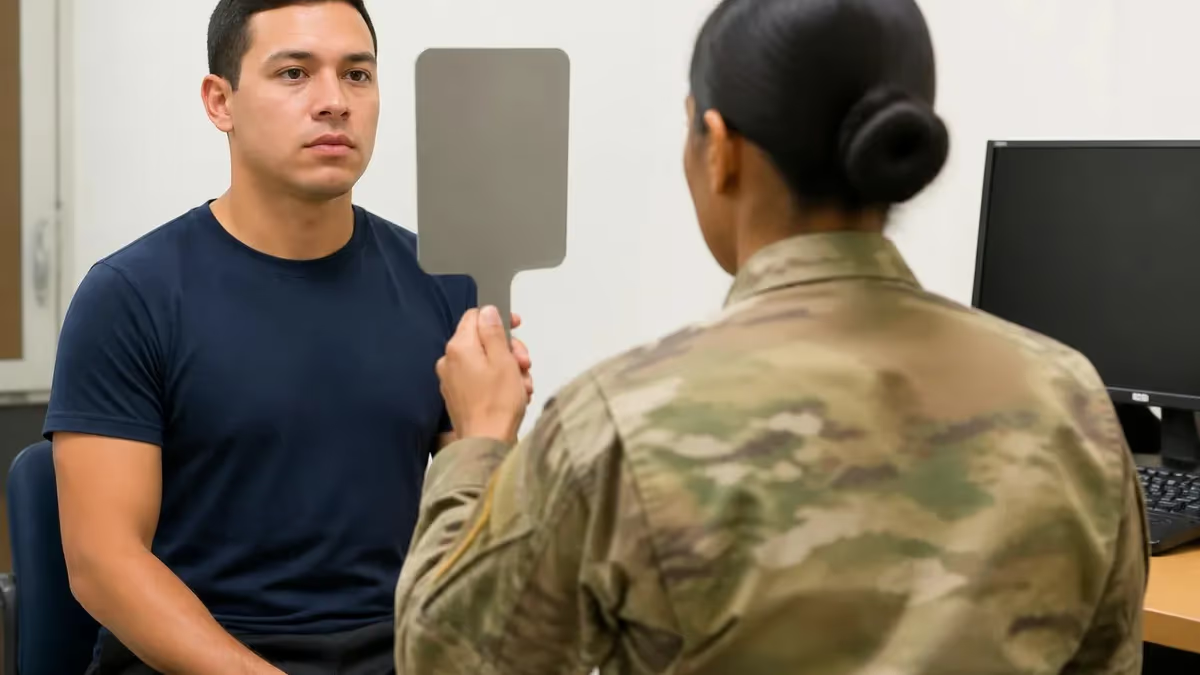
What Is MEPS?
MEPS — Military Entrance Processing Station — is the federal facility every person who wants to enlist in the U.S. Armed Forces must pass through before taking the oath. There are 65 MEPS locations across the country, operated by the Department of Defense, processing roughly 150,000 applicants per year. Your recruiting office assigns you to the nearest one. You don't pick it.
The purpose of MEPS is two things. First: a comprehensive medical examination. Second: an ASVAB (Armed Services Vocational Aptitude Battery) evaluation if you haven't already taken it. Together, they determine whether you're physically and cognitively qualified to serve — and which military specialties your scores make available. The process is identical regardless of which branch you're applying to. Army, Navy, Air Force, Marine Corps, Space Force, and Coast Guard all run applicants through the same MEPS infrastructure. Branch-specific standards differ slightly, but the evaluation itself is fully standardized.
Everything at MEPS is legally binding. If you sign anything there, you've committed to those terms. The MEPS medical exam alone disqualifies roughly 20–30% of first-time applicants — which makes thorough preparation the single most impactful thing you can do before your date. Don't treat MEPS as a routine appointment. It's a gate, and the preparation you bring determines how cleanly you clear it.
Most applicants spend one or two full days at MEPS. Day one is the medical phase: blood work, urinalysis, vision testing, hearing screening, orthopedic assessment, and a detailed review of your medical history form. Plan for 8 to 12 hours from check-in to completion. Day two — sometimes the same visit for returning applicants — is job selection: reviewing your ASVAB scores with a branch counselor, choosing your MOS or rate, signing the enlistment contract, and taking the Oath of Enlistment.
Understanding MEPS meaning in context means knowing that until you raise your right hand, you can withdraw at any point. After the oath, you're legally bound by the terms of your contract — the branch, the specialty, and the ship date you agreed to. Read everything before you sign. The counselors move quickly; you're allowed to slow down.
The MEPS process has no shortcuts. Staff are professional and efficient, but they run every applicant through a fixed protocol. You can't charm your way past a medical disqualifier or negotiate a job the board says is unavailable. What you can control is how prepared you are: how accurate your medical history is, how well you understand your ASVAB scores, how clearly you know what job you want. That preparation is the only real leverage you bring through the door.
When MEPS issues a result other than qualified, it falls into one of two categories. A Temporary Disqualification (TDQ) means a condition can be resolved — weight, a recent surgery still in recovery, an incomplete record. A Permanent Disqualification (PDQ) means a condition is incompatible with service standards at this time, though many PDQ findings are waiverable. Neither a TDQ nor a PDQ automatically ends your military aspirations. Both are navigable with the right recruiter support and documentation. The distinction matters because it determines your next step: fix it or waive it.

What MEPS Actually Looks Like
Most MEPS facilities are government office buildings — not military installations. No parade ground, no drill sergeants, no uniforms in formation. The atmosphere is clinical: corridors, waiting rooms, examination stations, testing bays. Staff wear civilian clothes or medical whites. The environment is efficient and impersonal by design — MEPS processes high volumes of applicants accurately, not warmly.
You'll spend a lot of time waiting. That's expected and unavoidable. Bring patience the same way you bring your documents.
A few things MEPS is not. It's not a fitness test — no push-ups, pull-ups, or timed runs at MEPS. Physical fitness testing happens at basic training. MEPS checks whether your body and mind meet the baseline standards for service, not whether you're already in peak shape. It's also not an interview. No one at MEPS evaluates your motivation, personality, or why you want to serve. Those conversations happen with your recruiter. Staff are evaluating data — medical history, test scores, documentation — against a standardized checklist. Everything is binary: you meet the standard or you don't.
Don't schedule your MEPS date when you're sick, under-slept, or recovering from a recent illness. Lab work is affected by hydration and recent activity. Hearing tests are sensitive to recent loud noise exposure — skip the concert the night before. Blood pressure readings are affected by caffeine and stress. Some conditions that flag as potential disqualifiers on an off day pass cleanly on a normal health day. Go to MEPS when you're at your physical baseline, not when you're depleted. The evaluation reflects the day you show up.
If your MEPS is too far to commute, your recruiter arranges a government-contracted hotel the night before. A MEPS shuttle picks up the group early in the morning. Use the hotel to sleep — not to prepare at the last minute. Every document you need should be organized and packed before you leave home. Surprises at the hotel become delays at the station.
The original Social Security card requirement alone catches people off guard every cycle — laminated cards aren't accepted, and SSA replacements can take 10–14 business days by mail. Birth certificate replacements take even longer in some states. Treat your recruiter's document checklist as a hard deadline, not a suggestion.
Return visits to MEPS — for job selection and the oath — are typically two to four hours rather than a full day. Some applicants complete both phases in a single two-day trip, staying at the government hotel between day one and day two. Others go home after the medical phase and return on a separate scheduled date. Your recruiter coordinates which approach works given your proximity to the MEPS facility and the timeline of your enlistment. Either way, the outcome of that second visit determines your ship date, your branch assignment, and the job you'll train for — so treat day two with the same seriousness as day one.
MEPS Medical Exam: What Gets Evaluated
Vision and hearing are among the most common disqualification reasons at MEPS.
- Vision: Most branches require corrected vision of 20/20 or better for many specialties. Uncorrected acuity must fall within acceptable range (typically 20/200 or better). Color vision testing is required — certain MOS categories require normal color vision. PRK and LASIK are generally acceptable after a healing period.
- Hearing: Pure-tone audiometry tests both ears across multiple frequencies. Significant loss at 500–3000 Hz ranges can disqualify. Hearing aids don't qualify you — you must meet the standard unaided.

Medical Standards: What Disqualifies You?
The military evaluates physical fitness through PULHES — a six-factor profile covering Physical capacity, Upper extremities, Lower extremities, Hearing, Eyes, and psychiatric (mental health). Each branch sets acceptable ranges within those six factors. A condition that disqualifies you from one branch may be waiverable or acceptable in another — so a MEPS disqualifier from the Army doesn't automatically close the Navy or Air Force. It's worth asking your recruiter before you give up.
The most common MEPS military disqualifiers: uncorrectable vision below 20/200 (corrected vision must reach 20/20 for most specialties), hearing loss outside pure-tone audiometry thresholds, BMI above branch limits, significant orthopedic history — prior ACL or ligament repair, chronic spine conditions, stress fractures in load-bearing bones — asthma diagnosed or treated within the past three years, and psychiatric conditions with recent medication or ongoing treatment. Most of these have waivers available. The waiver process is branch-specific and adds weeks to months to your timeline. When your recruiter advises you to document a condition carefully before your MEPS date, that's the waiver groundwork being built early.
Waivers aren't guaranteed — they're granted at each branch's discretion based on the operational impact of the condition. A waiver for flat feet is common. A waiver for a recent ACL reconstruction might require a 12-month post-surgical waiting period plus a functional assessment. A mental health waiver may require a letter from a treating physician and detailed treatment records. None of this is impossible, but it's a process. Know what you're dealing with before your MEPS date, not after.
Body composition surprises more applicants than almost anything else. Each branch maintains height and weight tables — maximum allowable weight by height and age. Exceed it, and you'll be measured for body fat using tape measurements (the circumference method). Fail both the weight standard and the body fat percentage and you get a TDQ: rescheduled until you meet standards. It's one of the most common and most preventable delays. Know your branch's numbers before your date, check honestly, and build in margin if you're anywhere close to the line.
Be completely honest on your medical pre-screen form. The military retains MEPS records indefinitely. Applicants have been administratively separated — and prosecuted for fraudulent enlistment — years into service for conditions they didn't disclose at MEPS. The risk isn't getting caught on day one. It's that the record follows you: during a security clearance investigation, a VA disability claim, or a routine duty station medical. If you had childhood asthma, prior surgeries, mental health counseling, or any condition you're uncertain about — document it, bring records, and let the MEPS physician decide. Your job is accuracy. Theirs is evaluation.
What to Bring to MEPS
- ✓Two valid photo IDs — state driver's license or ID plus one more (passport, school ID with photo)
- ✓Original Social Security card — laminated or photocopied cards not accepted
- ✓Original birth certificate (certified copy acceptable; hospital certificate is not)
- ✓High school diploma or official transcripts if still enrolled in college
- ✓Medical records for any condition disclosed on your pre-screen form
- ✓Prescription medications in original labeled containers
- ✓Eyeglasses in their case — bring glasses even if you normally wear contacts
- ✓Bank account routing and account numbers for direct deposit setup
- ✓Comfortable, loose-fitting clothing you can move freely in for the physical exam
- ✓Any court records for legal issues your recruiter has counseled you on

ASVAB at MEPS: Understanding Your Scores
If you arrive without a prior ASVAB score, you take the full battery at MEPS. Ten subtests — General Science, Arithmetic Reasoning, Word Knowledge, Paragraph Comprehension, Mathematics Knowledge, Electronics Information, Auto and Shop, Mechanical Comprehension, Assembling Objects, and Verbal Expression — feed into the AFQT composite plus branch-specific line scores. Minimum AFQT thresholds: Army 31, Marine Corps 32, Navy 35, Air Force and Space Force 36, Coast Guard 40. Clearing the minimum gets you in the door. It doesn't get you the job you want.
Each specialty has its own composite requirement on top of the AFQT. The Army uses line scores — GT, CL, ST, EL, and others — to determine MOS eligibility. The Navy uses AFQT plus arithmetic, mechanical, and electronics composites for rating selection. The Air Force uses four composites: Mechanical, Administrative, General, and Electrical. A nuclear-trained Navy sailor needs scores far above the minimum AFQT. An Army linguist needs a high ST (Skilled Technical) and sometimes passes a separate DLAB. What happens at MEPS at the job counselor's table is a scored negotiation — applicants who know their target composites get considerably better options than those who don't.
The job board shifts daily. A slot available today may be full next week. Flexibility on ship date combined with strong scores is the best negotiating position you can have. If you need to retest, wait periods apply: one calendar month after the first attempt, one more after the second, then six months per subsequent attempt. Arithmetic Reasoning and Mathematics Knowledge have the most AFQT impact for most applicants — focused prep on those two produces the biggest gains. If your scores are already strong, shift time toward the Electronics and Mechanical subtests to open up technical specialties that pay better and offer stronger civilian career transitions after service.
After MEPS: The Delayed Entry Program and Ship Day
Once you've cleared medical, selected your job, and taken the oath, you enter the Delayed Entry Program — DEP. This is the window between your MEPS date and your basic training ship date. DEP runs from a few weeks to just over a year depending on when your MOS or rate training slot opens. Air Force cyber and linguistics specialties commonly carry six-month or longer wait times because of security clearance processing pipelines. Reserve and Guard units can have even longer timelines depending on unit needs and training cycle availability.
Use DEP time productively. Attend every PT session your recruiter organizes — arriving at basic training already able to pass your branch's fitness standards makes a measurable difference in how quickly you adapt to the training environment. Study your branch's basic knowledge requirements: rank structure (enlisted and officer), military time, phonetic alphabet, and the General Orders specific to your branch. Many recruits who struggle at basic training do so not because of physical fitness but because of basic knowledge gaps that could have been closed during DEP. Get your personal affairs fully in order before you ship. Notify your employer in writing, handle any outstanding financial obligations, arrange a power of attorney if needed, and ensure someone you trust can manage your accounts and mail while you're gone.
The military runs a background investigation between your MEPS date and basic training. New legal trouble — even a minor citation in some jurisdictions — can delay or cancel your ship date. Significant weight gain can result in a DEP meeting with your recruiter and a mandatory delay until you're back in standard. Substance use can result in administrative discharge from DEP before you ever ship. Your MEPS eligibility isn't a permanent certificate. You have to maintain it all the way through ship day.
Ship day is a hard deadline. On that date you return to MEPS for a brief re-processing visit. Staff confirm nothing has changed since your original date, you retake the Oath of Enlistment for the record, and then you travel with your group to the reception battalion at your basic training installation. From there, the military's schedule is the only one that applies. What is MEPS in practical terms is the most consequential 12-hour evaluation you'll face before you ship. The scores you produce, the paperwork you sign, and the job you negotiate that first day shape the trajectory of your entire enlistment. Walk in prepared, honest, and clear on what you want from day one.
MEPS Pros and Cons
- +MEPS has a defined, publicly available content blueprint — candidates know exactly what to prepare for
- +Multiple preparation pathways accommodate different learning styles and schedules
- +A growing ecosystem of study resources means candidates at any budget level can access quality preparation materials
- +Clear score reporting allows candidates to identify specific strengths and weaknesses for targeted remediation
- +Professional recognition associated with strong performance provides tangible career and academic benefits
- −The scope of tested content requires substantial preparation time that competes with existing commitments
- −No single resource covers the full content scope — candidates typically need multiple study tools
- −Test anxiety and exam-day performance variability mean preparation effort does not always translate linearly to scores
- −Registration, preparation, and potential retake costs accumulate into a significant financial investment
- −Content and format can change between exam versions, making older preparation materials less reliable
MEPS Questions and Answers
About the Author

Retired Military Officer & Armed Forces Test Preparation Specialist
United States Army War CollegeColonel Steven Harris (Ret.) served 28 years in the US Army, earning a Master of Arts in Military Science from the Army War College and a Bachelor of Science in Criminal Justice. He has coached thousands of military enlistment and officer candidate program applicants through the ASVAB, AFQT, AFCT, OAR, and officer selection assessment processes across all military branches.
Join the Discussion
Connect with other students preparing for this exam. Share tips, ask questions, and get advice from people who have been there.
View discussion (8 replies)