
Lansing MEPS: Michigan Military Entrance Processing Station Guide 2026
Pass your Lansing MEPS: Michigan Military exam on the first attempt. Practice questions with detailed answer explanations, hints, and instant scoring.
Where Is Lansing MEPS?
The Lansing Military Entrance Processing Station (MEPS) serves military recruits from Michigan's Lower Peninsula. It's located in Lansing, Michigan — the state capital — and processes applicants for all five branches of the U.S. military: Army, Navy, Marine Corps, Air Force, and Coast Guard.
The station handles everything from your initial physical examination and ASVAB score verification to the final oath of enlistment. If you're heading to Lansing MEPS for the first time, knowing exactly what to expect can make the difference between a smooth processing day and an unnecessarily stressful one.
Lansing MEPS Address and Contact
Address: 120 East Jolly Road, Lansing, MI 48910
Phone: (517) 887-3100
Hours: Monday through Friday, reporting times typically start at 5:30 AM for full processing days. Check with your recruiter for your specific report time.
The station is located near I-496 on the south side of Lansing. Parking is available on-site. Your recruiter will coordinate your transportation — most applicants are provided with a hotel the night before to ensure an early start.
What Is MEPS and Why Do You Go?
MEPS — Military Entrance Processing Station — is the federal facility where the military determines whether you're qualified to serve. Every person who joins any branch of the U.S. military passes through a MEPS. There are 65 MEPS locations across the country, and Lansing serves the central Michigan region.
At MEPS, you'll complete your medical examination, verify your ASVAB scores, work with a military guidance counselor (MGC) to review job options, and — if everything checks out — take the Oath of Enlistment. It's a long day, typically 8-12 hours, but it's the gateway to military service.
Understanding how long meps take helps set realistic expectations. Full processing days run 8-12 hours, though not every visit requires the full process.
Lansing MEPS Processing: Step by Step
Here's what actually happens on your Lansing MEPS processing day, in order:
Check-In and Documentation
You'll arrive early — often before 6:00 AM. Bring your Social Security card, birth certificate, photo ID, and any documents your recruiter gave you. You'll check in with MEPS staff, and your paperwork begins. Don't bring items you can't keep with you — personal electronics, extra cash, or anything that could raise questions during your visit.
Medical Examination
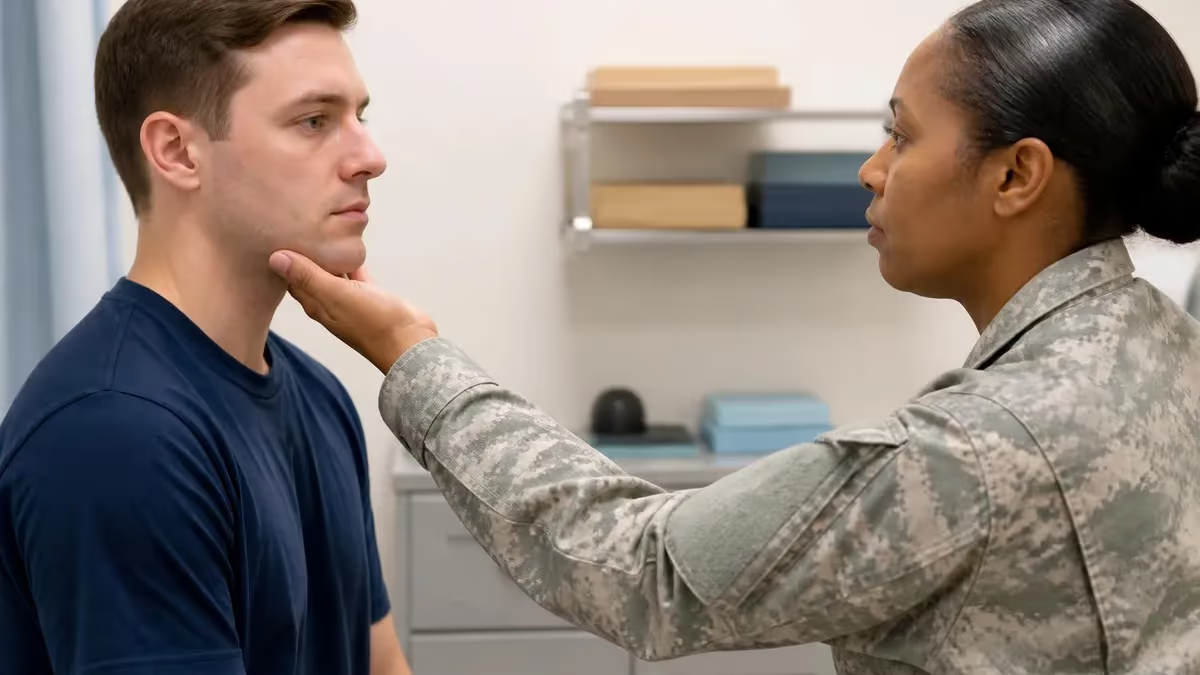
The physical is the longest and most critical part of your MEPS visit. It includes:
- Height and weight measurement (must meet branch-specific standards)
- Vision and hearing tests
- Blood pressure and pulse
- Urine analysis (drug screening)
- Blood draw for HIV and other panels
- Orthopedic exam — range of motion, joint checks, duck walk
- Review of medical history questionnaire (be thorough and honest)
- MEPS physician examination and sign-off
Honesty on your medical history is non-negotiable. Withholding prior medical conditions or injuries is considered fraud — and it creates grounds for discharge later if discovered. If you have a prior condition, your recruiter can often get you a medical waiver. Lying is never worth the risk.
ASVAB Score Review
If you haven't yet taken the ASVAB, you may take it at Lansing MEPS (or you've already taken it at a recruiter's office). Your scores are reviewed to determine which military occupational specialties (MOS) or ratings you qualify for.
Meeting with Your Military Guidance Counselor
After your medical exam, you'll meet with a counselor from your specific branch. They'll walk you through available job options based on your ASVAB scores, discuss enlistment bonuses, and talk through contract options. This is an important meeting — ask questions about job training, deployment patterns, and anything in your contract you don't understand. You're committing years of your life here.
Oath of Enlistment
If everything goes well — medical, paperwork, and contract — you'll take the Oath of Enlistment at the end of your processing day. This is typically done as a group with other recruits from all branches who processed the same day. It's a meaningful moment, so most families can observe if arrangements are made in advance with your recruiter.
What to Bring to Lansing MEPS
Packing correctly matters. Here's exactly what to bring:
Pro Tip: Focus your MEPS study time on areas where you score lowest. Most exam questions test application of knowledge, not memorization.

- ✓Original Social Security card (not a photocopy)
- ✓Birth certificate (original or certified copy)
- ✓State-issued photo ID or driver's license
- ✓Eyeglasses or contacts (bring both if you have them) — no sunglasses
- ✓List of all medications with dosage information
- ✓Medical records for any prior surgeries, injuries, or diagnoses
- ✓Recruiter-provided documents and enlistment packet
- ✓List of prior addresses for the past 5 years
- ✓High school/college transcripts if applicable
What NOT to Bring to Lansing MEPS
MEPS has strict rules about what you can't bring in. Leave these at home or in your car:
- Personal cell phones (you typically can't use them during processing)
- Weapons of any kind
- Tobacco products inside the facility
- Excess cash beyond what you need for incidentals
- Jewelry that may interfere with medical equipment
- Any items that could create a security concern
Dress professionally and conservatively. No offensive graphics, no gang-related clothing. You're presenting yourself to the military — first impressions at MEPS do matter.
Lansing MEPS Hotel: The Night Before
For applicants traveling from outside the immediate Lansing area, your recruiter typically arranges a hotel stay the night before your processing day. The military pays for this lodging. You'll usually be transported to the hotel by your recruiter or a government-contracted shuttle and taken to MEPS early the next morning.
Take the hotel night seriously. Get to bed early — you're waking up well before dawn. Eat a reasonable dinner, avoid alcohol entirely, and get everything organized so you're not scrambling at 5 AM. The recruiter may brief you at the hotel about what to expect the next day.
Medical Disqualifications at MEPS
Some conditions can temporarily or permanently disqualify applicants from military service. Common issues that come up at MEPS include:
- Height/weight not meeting standards — Each branch has specific requirements. This is one of the most common reasons for temporary disqualification. Your recruiter should help you prepare well in advance.
- Positive drug test — Automatic disqualification. There are no waivers for positive drug tests.
- Prior surgeries or injuries — Many are waiverable with proper documentation and healing time.
- Asthma, corrective surgery (LASIK), mental health history — These require additional review and often waivers depending on the branch and circumstances.
- Tattoos in restricted areas — Branch-specific tattoo policies are enforced. Some locations and types are still disqualifying for certain branches.
If you're disqualified at MEPS, it doesn't necessarily mean you can never serve. Your recruiter can often pursue a waiver with proper documentation. The Baltimore MEPS guide and Dallas MEPS guide both cover the waiver process for common conditions in more detail.
Lansing MEPS for DEP (Delayed Entry Program)
Not everyone at MEPS ships out immediately. Many recruits enter the Delayed Entry Program (DEP) after processing, meaning they've enlisted but won't go to basic training for weeks or months. DEP allows recruits to maintain their civilian job or finish school while their ship date approaches.
If you're entering DEP through Lansing MEPS, you may return to MEPS on your ship date for a final out-processing step before heading to basic training. Your recruiter will explain your specific obligations during DEP, which typically include regular contact and maintaining physical fitness standards.
Frequently Asked Questions
Before your visit, review the answers to questions that trip up first-time applicants. And if you want to practice for the military testing side of things, the fort dix meps and Fort Jackson MEPS guide provide additional context on processing standards across different stations.
MEPS: Pros and Cons
- +meps — mEPS credential is recognized by employers and industry professionals
- +Higher earning potential compared to non-credentialed peers
- +Expanded career opportunities and professional advancement
- +Structured learning path builds comprehensive knowledge
- +Professional development that stays current with industry standards
- −Preparation requires significant time and study commitment
- −Associated costs for exams, materials, and renewal fees
- −Continuing education needed to maintain credentials
- −Competition for advanced positions can be challenging
- −Requirements and standards may vary by state or region
Pros and Cons at a Glance
| Pros | Cons |
|---|---|
| meps — mEPS credential is recognized by employers and industry professionals | Preparation requires significant time and study commitment |
| Higher earning potential compared to non-credentialed peers | Associated costs for exams, materials, and renewal fees |
| Expanded career opportunities and professional advancement | Continuing education needed to maintain credentials |
| Structured learning path builds comprehensive knowledge | Competition for advanced positions can be challenging |
| Professional development that stays current with industry standards | Requirements and standards may vary by state or region |
Sample MEPS - Military Entrance Processing Stations Practice Questions
Try these questions from our free MEPS - Military Entrance Processing Stations practice tests. The correct answer and an explanation follow each question.
What is the role of the Military Entrance Processing Station (MEPS) physician during the medical examination?
- A. To treat illnesses found during the exam
- B. To determine medical qualification for military service based on DoD standards
- C. To assign recruits to specific military occupational specialties
- D. To administer the Armed Services Vocational Aptitude Battery (ASVAB)
Answer: B. To determine medical qualification for military service based on DoD standards
The MEPS physician evaluates applicants against DoD Instruction 6130.03 standards to determine whether they are medically qualified for military service.
Which federal agency oversees the operation of Military Entrance Processing Stations (MEPS)?
- A. Department of Veterans Affairs
- B. Department of Defense through the Military Entrance Processing Command (MEPCOM)
- C. Department of Homeland Security
- D. Office of Personnel Management
Answer: B. Department of Defense through the Military Entrance Processing Command (MEPCOM)
MEPS are operated under the Military Entrance Processing Command (MEPCOM), which falls under the Department of Defense.
According to Title 10 of the U.S. Code, which of the following individuals is authorized to administer the Oath of Enlistment at a Military Entrance Processing Station?
- A. Any non-commissioned officer (E-7 or above)
- B. A senior civilian MEPS administrator (GS-13 or higher)
- C. Any commissioned officer
- D. Only the MEPS Commanding Officer
Answer: C. Any commissioned officer
Title 10, Section 502 of the U.S. Code specifies that the Oath of Enlistment may be administered by a range of officials, including the President, Vice-President, Secretary of Defense, and any commissioned officer. This makes any commissioned officer, regardless of rank or position at MEPS, legally authorized to perform this duty.
An applicant tests positive for amphetamines at MEPS. They claim a valid prescription for Adderall. What happens next?
- A. The positive result is automatically dismissed
- B. The applicant is immediately disqualified with no appeal
- C. The MRO contacts the applicant to verify the prescription before reporting results
- D. The recruiter decides whether to report the result
Answer: C. The MRO contacts the applicant to verify the prescription before reporting results
A Medical Review Officer (MRO) contacts the donor to allow them to provide documentation of a legitimate prescription before a result is reported as positive.
Take the full MEPS - Military Entrance Processing Stations practice test
About the Author

Retired Military Officer & Armed Forces Test Preparation Specialist
United States Army War CollegeColonel Steven Harris (Ret.) served 28 years in the US Army, earning a Master of Arts in Military Science from the Army War College and a Bachelor of Science in Criminal Justice. He has coached thousands of military enlistment and officer candidate program applicants through the ASVAB, AFQT, AFCT, OAR, and officer selection assessment processes across all military branches.
Join the Discussion
Connect with other students preparing for this exam. Share tips, ask questions, and get advice from people who have been there.
View discussion (8 replies)