
Fort Dix MEPS Fort Dix NJ: Complete Processing Guide 2026 September
📗 Prepare for the Fort Dix MEPS Fort Dix NJ: Complete certification. Practice questions with answer explanations covering all exam domains.
Fort Dix MEPS: New Jersey's Military Entrance Processing Station
If you're enlisting from New Jersey or the surrounding region, there's a very good chance you'll pass through Fort Dix MEPS — officially located at Joint Base McGuire-Dix-Lakehurst (Joint Base MDL) in Burlington County, New Jersey. It's one of more than 65 Military Entrance Processing Stations spread across the country, and it's the gateway between civilian life and the U.S. Armed Forces for thousands of recruits every year.
Understanding what is meps before you show up is one of the best things you can do. Recruits who arrive informed are calmer, make fewer mistakes, and move through the process faster. Those who show up without a clue often add hours to an already long day — or worse, get flagged for something they could have easily prepared for.
Fort Dix MEPS isn't just a single appointment. It's a full-day (sometimes two-day) processing event that determines whether you're physically, mentally, and morally qualified to serve. The station handles everything from ASVAB testing and medical examinations to background checks and your final oath of enlistment. Get it right and you walk out with a ship date. Get it wrong and you're looking at a waiver process, a retest, or a disqualification.
The meps meaning goes deeper than just a physical — it's the official gateway where the military decides your fate. Every branch uses MEPS: Army, Navy, Marine Corps, Air Force, Space Force, and Coast Guard all send their applicants through the same stations. You'll be in the waiting room with recruits from every branch, which can feel chaotic if you're not prepared for it.
Joint Base McGuire-Dix-Lakehurst is a massive installation — the result of three former bases being merged into one joint facility. The MEPS station there serves recruits primarily from New Jersey but also pulls from parts of surrounding states depending on geographic assignment and recruiter location. The base sits in the Pine Barrens region of central Jersey, roughly equidistant between Philadelphia and the Shore. It's a significant military footprint in an otherwise rural setting, and arriving there for the first time has a way of making everything feel very real, very fast.
New Jersey has a long and deep military heritage — from the Revolutionary War encampments at Morristown to the wartime production hubs of the twentieth century. Fort Dix itself has been part of that story since World War I, when it was established as a training ground for soldiers heading to Europe.
The base has transformed significantly over the decades, and today's Joint Base MDL is a modern multi-mission installation serving all branches. But the mission of its MEPS station remains the same as it's always been: get the right people into military service, and screen out those who aren't yet ready.
If you want to study up before arriving, the meps military content on this site covers the broader context of what the station does and how it fits into the enlistment process. Read it before your appointment — it's time well spent.
What to Expect on Your Fort Dix MEPS Processing Day
You've got a full day ahead — probably the longest and most consequential civilian day of your pre-service life. Most recruits don't realize just how early it starts. If you're processing at Fort Dix MEPS, your recruiter will almost certainly arrange for you to stay at a nearby contracted hotel the night before. You'll travel to the hotel with other recruits from your area — sometimes a small group, sometimes a full van — and a military liaison will check you in and brief you on the next morning's schedule.
Lights are not out early. You'll probably stay up later than you should talking to other recruits. Keep it reasonable and get to bed — the early morning call comes fast. Typically you'll be bused to the MEPS station by 5:30 or 6:00 AM, which means you're up by 4:30 at the latest. This isn't a gentle introduction to military life, but it's intentional.
Once you arrive at the station, check-in is the first order of business. You'll hand over your paperwork — identification documents, medical records if you have them, and any forms your recruiter gave you to complete in advance. Staff will verify your identity and confirm your appointment. Don't lose anything between the hotel and the station. Missing a single document can derail your entire processing day.
After check-in, the day splits into several major stations, and the order you go through them isn't always predictable. MEPS runs multiple applicants simultaneously, so you'll be called for different sections at different times. Hurry up and wait is the unofficial motto — you'll move fast for ten minutes and then sit for forty. That's just the nature of the process.
Your recruiter coordinates everything about your Fort Dix MEPS appointment — the hotel, the transportation, the required forms, and your specific appointment time. Don't try to show up independently or modify the schedule without clearing it with them first. The MEPS system is tightly coordinated, and walk-ins or schedule changes create problems that ripple through the entire day's processing queue. Trust the system, follow your recruiter's instructions, and you'll be fine.

ASVAB Testing at MEPS
If you haven't taken the ASVAB yet — or if you're retesting — that happens here. The Armed Services Vocational Aptitude Battery measures your aptitude across math, verbal ability, science, and mechanical comprehension. Your scores determine which jobs you qualify for in each branch. The computerized version at MEPS is adaptive, meaning questions get harder or easier based on your answers.
If you already took the ASVAB at a recruiter's office via the PiCAT or a confirmation test, you may just need a short verification test at MEPS. Your recruiter will tell you which applies. Brush up either way — your scores follow you throughout your military career, and higher scores open significantly more job options. Don't walk into the ASVAB cold when you have days or weeks to prepare.
Medical Examination
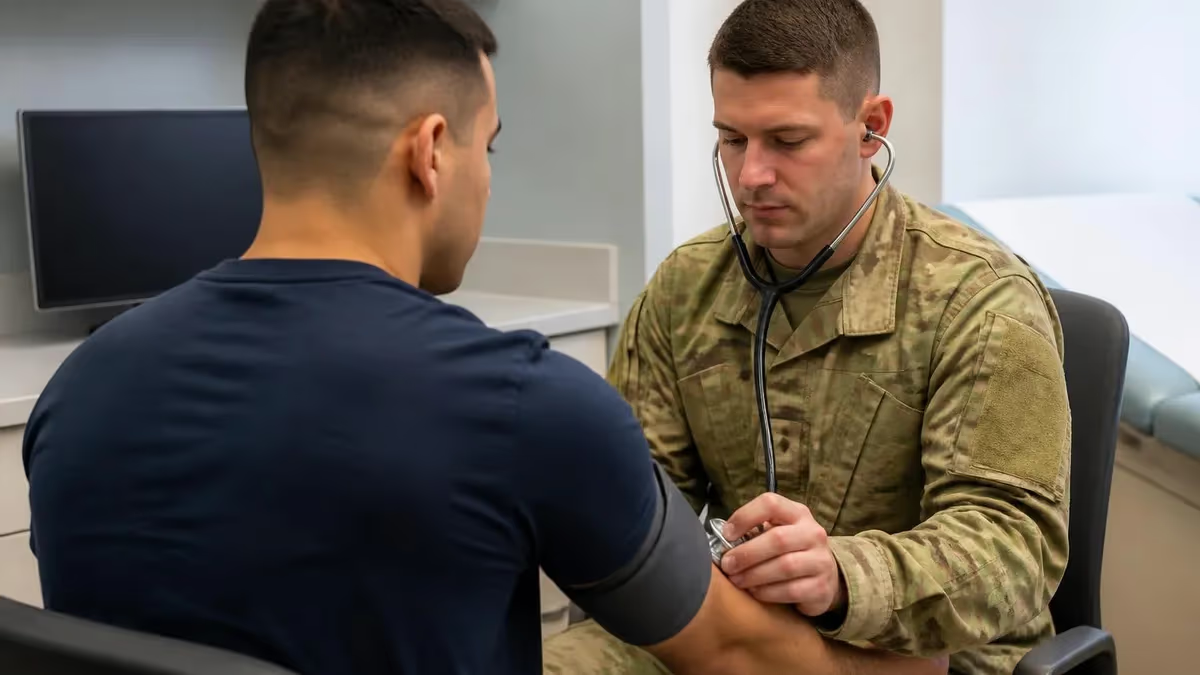
The medical portion is the most intensive part of the day. You'll go through a full physical examination — vision and hearing tests, blood pressure and vitals, urine and blood samples, and orthopedic screening where staff watch you walk, bend, squat, and move in ways designed to flag musculoskeletal issues. Your medical history questionnaire is also reviewed here.
You filled out that form (DD Form 2807-2) before arriving. Everything on it matters. Undisclosed conditions discovered at MEPS can disqualify you permanently and create legal problems. Disclose everything. There's a waiver process for many conditions — what there's no process for is lying and getting caught. The meps medical examination is thorough by design; expect it to take several hours across multiple rooms and providers.
Background Check
The background investigation portion reviews your criminal history, drug use disclosures, and any prior military service. Arrests, citations, and juvenile records are relevant — even expunged ones. The MEPS staff will review what you disclosed and may ask follow-up questions. Consistency between your paperwork and your verbal answers matters here more than almost anywhere else in the process.
Classification and Oath
Once you've cleared medical and testing, you'll meet with a job counselor — called a classifier — who reviews your ASVAB scores and available job openings in your branch. This is where you select your Military Occupational Specialty (MOS for Army, rating for Navy, AFSC for Air Force, etc.). Go in with preferences but stay flexible.
The openings available on any given day depend on current branch needs. If everything goes smoothly, your day ends with the Oath of Enlistment. You raise your right hand, swear to support and defend the Constitution of the United States, and it's done. A brief ceremony — but a genuine moment for most recruits.
- ✓Confirm your exam appointment and location
- ✓Bring required identification documents
- ✓Arrive 30 minutes early to check in
- ✓Read each question carefully before answering
- ✓Flag difficult questions and return to them later
- ✓Manage your time — don't spend too long on one question
- ✓Review flagged questions before submitting

Medical Standards at Fort Dix MEPS — What Can Disqualify You
The medical examination at MEPS uses standards established by Department of Defense Instruction 6130.03 — the same standards apply at every MEPS station in the country, including Fort Dix. These aren't arbitrary hurdles. They exist because military service places extreme physiological and psychological demands on personnel, and the branches need recruits who can meet those demands before investing years of training in them.
A disqualification from the MEPS physical is not always the end of the road. Many conditions that trigger an initial DQ can be addressed through a medical waiver process. The key is knowing your situation going in and working with your recruiter to prepare the right documentation. The full scope of what happens at MEPS medically is significant — it's one of the most thorough physical evaluations most young Americans will ever undergo.
The six categories below represent the most common areas where applicants run into problems. Knowing them in advance isn't just helpful — it's essential. If any of these apply to your situation, talk to your recruiter before your MEPS appointment, not after. They can help you document your history correctly, request relevant medical records, and in some cases prepare a waiver package before you ever set foot in the building.
One thing that surprises many recruits: MEPS medical standards aren't a binary pass/fail on each condition. They're evaluated in context — how severe is it, how long ago did it occur, what treatment was involved, and is there any ongoing impact on daily function or physical performance?
A broken arm that healed cleanly in high school is very different from a chronic injury that required surgery and still causes pain. The medical staff at Fort Dix MEPS are trained to make these distinctions, and they do it dozens of times a day. Your job is to give them the full, accurate picture and let them make the call.
MEPS Practice Test Questions
Prepare for the MEPS - Military Entrance Processing Stations exam with our free practice test modules. Each quiz covers key topics to help you pass on your first try.
MEPS Introduction to MEPS
MEPS Exam Questions covering Introduction to MEPS. Master MEPS Test concepts for certification prep.
MEPS ASVAB
Free MEPS Practice Test featuring ASVAB. Improve your MEPS Exam score with mock test prep.
MEPS Paragraph Comprehension
MEPS Mock Exam on Paragraph Comprehension. MEPS Study Guide questions to pass on your first try.
MEPS Military Entrance Processing Stations...
MEPS Test Prep for Military Entrance Processing Stations (MEPS) Applicant Processing and Standards. Practice MEPS Quiz questions and boost your score.
MEPS Military Entrance Processing Stations...
MEPS Questions and Answers on Military Entrance Processing Stations (MEPS) ASVAB Aptitude Testing. Free MEPS practice for exam readiness.
MEPS Military Entrance Processing Stations...
MEPS Mock Test covering Military Entrance Processing Stations (MEPS) Enlistment and Oath Ceremony. Online MEPS Test practice with instant feedback.
MEPS Military Entrance Processing Stations...
Free MEPS Quiz on Military Entrance Processing Stations (MEPS) Job Counseling and Contracts. MEPS Exam prep questions with detailed explanations.
MEPS Military Entrance Processing Stations...
MEPS Practice Questions for Military Entrance Processing Stations (MEPS) MEPS Medical Examinations. Build confidence for your MEPS certification exam.
MEPS Military Entrance Processing Stations...
MEPS Test Online for Military Entrance Processing Stations (MEPS) Moral and Background Screening. Free practice with instant results and feedback.
MEPS Applicant Pre-Screening Process
MEPS Study Material on Applicant Pre-Screening Process. Prepare effectively with real exam-style questions.
MEPS Applicant Processing and Conduct
Free MEPS Test covering Applicant Processing and Conduct. Practice and track your MEPS exam readiness.
MEPS ASVAB Administration and Purpose
MEPS Exam Questions covering ASVAB Administration and Purpose. Master MEPS Test concepts for certification prep.
MEPS ASVAB Aptitude Testing
Free MEPS Practice Test featuring ASVAB Aptitude Testing. Improve your MEPS Exam score with mock test prep.
MEPS Enlistment Contracts and Oaths
MEPS Mock Exam on Enlistment Contracts and Oaths. MEPS Study Guide questions to pass on your first try.
MEPS Job Selection and Counseling
MEPS Test Prep for Job Selection and Counseling. Practice MEPS Quiz questions and boost your score.
MEPS Job Selection and Enlistment
MEPS Questions and Answers on Job Selection and Enlistment. Free MEPS practice for exam readiness.
MEPS Medical Examination Procedures
MEPS Mock Test covering Medical Examination Procedures. Online MEPS Test practice with instant feedback.
MEPS Medical Examination Process
Free MEPS Quiz on MEPS Medical Examination Process. MEPS Exam prep questions with detailed explanations.
MEPS Moral and Background Standards
MEPS Practice Questions for Moral and Background Standards. Build confidence for your MEPS certification exam.
Tips for MEPS Day
The preparation you do before stepping foot on Joint Base MDL is just as important as what you do on the day itself. Start by reviewing every document your recruiter listed — Social Security card, birth certificate, government-issued photo ID, and any additional paperwork specific to your situation (prior military discharge, court records, adoption papers, etc.). Check the list the night before. Check it again in the morning. Put everything in a folder, not loose in your bag.
Know your medical history cold. The DD Form 2807-2 questionnaire asks about conditions, surgeries, medications, and injuries. You should be able to answer every question accurately without guessing. Sit down a week before your appointment and actually think through your history — talk to your parents if you need to, look up old records. Write it down and review it with your recruiter before you go.
If you're worried about the ASVAB, study. There are free practice resources on this site specifically designed to help you prepare. Your ASVAB score determines which jobs are available to you — higher scores open more doors. Don't walk into the test cold when you have days or weeks to prepare.

Fort Dix MEPS: What Works in Your Favor
- +Processing standards are fully documented — you can research and prepare for every section of the day
- +Many initial medical disqualifications can be appealed through the waiver process
- +The contracted hotel the night before is military-funded — no out-of-pocket cost to recruits
- +Fort Dix MEPS benefits from being on a major active installation with experienced permanent staff
- +ASVAB scores are portable — strong scores from a previous test carry over and may reduce your testing burden
- −Early start times (5:30–6:00 AM) require arriving the night before for most recruits
- −The full processing day can run 10+ hours with unpredictable wait times between stations
- −Medical history omissions — even accidental ones — can create serious legal complications
- −Job availability on classification day depends on real-time branch inventory, not your preferences
- −Disqualifications requiring waivers can delay enlistment timelines by weeks or months
Nearby MEPS Stations and Final Thoughts on Fort Dix
Fort Dix MEPS sits in an interesting geographic position — it's not the only option for recruits in the greater mid-Atlantic region. Depending on where you live and which recruiter signs you up, you might be processed at a different station entirely. It's worth knowing what's nearby, both for context and in case your geographic assignment points elsewhere.
Baltimore MEPS serves recruits from Maryland and parts of the DC metro area. It's one of the busier East Coast stations given the population density of the region. If you're in southern New Jersey near the Delaware border, your geographic assignment could go either direction depending on current capacity and recruiter networks.
Fort Jackson MEPS in South Carolina is a major processing hub for the Southeast and handles a significant volume of Army recruits in particular given Fort Jackson's role as a primary Army basic training installation. It's not a likely alternative for most New Jersey applicants, but worth knowing about if you have family connections or relocation situations affecting your processing assignment.
Dallas MEPS is one of the country's largest and busiest stations, serving the densely populated North Texas region. It illustrates the scale variation across the network — some MEPS stations process far more applicants per day than others, which affects wait times and scheduling availability considerably.
What makes Fort Dix MEPS worth understanding in its own right is the setting. Joint Base McGuire-Dix-Lakehurst is a significant installation, and arriving there gives you your first real taste of life on a military base. The security checkpoints, the uniformed personnel, the structured environment — it tends to hit differently than a recruiter's strip-mall office. For many recruits, it's the first moment where enlisting feels real rather than theoretical. You're not just talking to a recruiter anymore. You're in it.
The processing experience at Fort Dix runs identically to every other MEPS station in the country because the standards are federal, not local. But each station has its own character, its own pace, and its own physical environment. Fort Dix MEPS, embedded in a major joint base in the New Jersey Pine Barrens, has a particular atmosphere that recruits from the Northeast tend to remember.
There's something about processing at a facility with that much history — a base that has been training American service members since the First World War — that gives the whole experience a weight that a generic office building just doesn't have.
One more thing worth saying clearly: MEPS is not adversarial. The staff there aren't looking for reasons to disqualify you. They're doing a job — evaluating whether you meet the standards required for military service. When you arrive prepared, honest, and cooperative, that process goes smoothly. When you arrive evasive, unprepared, or combative, it doesn't. The single biggest variable in your MEPS experience isn't the station or the staff. It's you.
If you leave Fort Dix MEPS with a ship date in hand — congratulations. You've cleared one of the biggest hurdles between you and military service. If you leave with a temporary disqualification or a waiver request, don't give up. Work with your recruiter, get the documentation together, and come back prepared. Study the material, know your history, and show up ready to commit to a long day. That's the Fort Dix MEPS formula. Not complicated — it just requires preparation, honesty, and showing up ready to commit to the day.
MEPS Questions and Answers
About the Author

Retired Military Officer & Armed Forces Test Preparation Specialist
United States Army War CollegeColonel Steven Harris (Ret.) served 28 years in the US Army, earning a Master of Arts in Military Science from the Army War College and a Bachelor of Science in Criminal Justice. He has coached thousands of military enlistment and officer candidate program applicants through the ASVAB, AFQT, AFCT, OAR, and officer selection assessment processes across all military branches.
Join the Discussion
Connect with other students preparing for this exam. Share tips, ask questions, and get advice from people who have been there.
View discussion (8 replies)