
MEPS Locations: Find Military Entrance Processing Stations Near You
🔎 Pass the MEPS Locations: Find Military Entrance exam with confidence. Practice questions with detailed explanations and instant feedback on every answer.
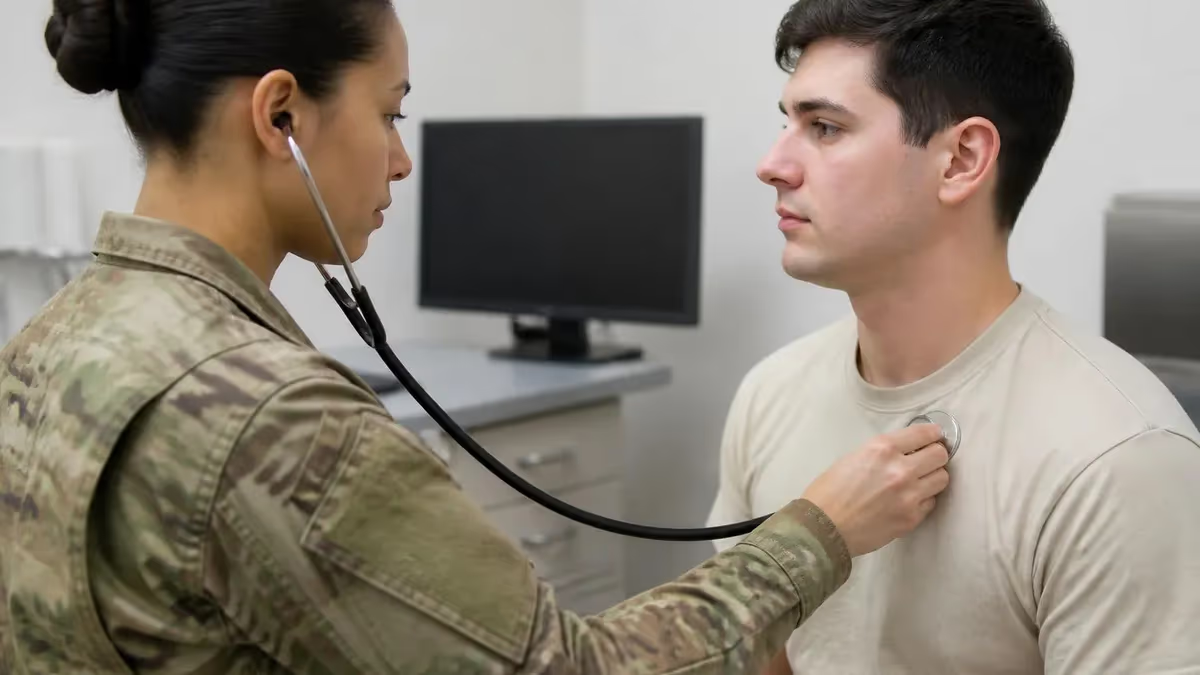
MEPS locations are federally operated processing centers that serve as the gateway to military service for all active duty and reserve component recruits. Every branch of the United States Armed Forces — Army, Navy, Marine Corps, Air Force, Space Force, and Coast Guard — uses the MEPS network. When a recruiter tells you that you need to go to MEPS, they mean you'll be going to the nearest MEPS facility that serves your area to complete the required processing steps before you can take the oath of enlistment and enter service.
The 65 MEPS locations are distributed across the country with concentration in areas with high recruiter activity and population density. Each MEPS serves a defined geographic territory — typically a metropolitan area and its surrounding region. Recruits are assigned to the MEPS that covers the location where they live, not where their recruiter's office is located, though recruiters typically work with the MEPS that serves their area. If you live near a state border, you may be assigned to a MEPS in a neighboring state if it's geographically closer or better aligned with USMEPCOM's regional assignments.
MEPS processing typically takes one to two days. Most recruits stay overnight at a contracted hotel near the MEPS the night before their appointment, with transportation coordinated through their recruiter. The MEPS day itself covers medical examination, testing (ASVAB or PICAT verification), background review, and administrative processing. Recruits who pass all requirements may take the oath of enlistment on the same visit, though some recruits require follow-up medical review before final processing. Understanding what happens at MEPS — and preparing specifically for it — significantly reduces the stress of what can be a long, unfamiliar process.
Recruits are often surprised by how much of MEPS involves waiting. The facility processes many recruits simultaneously, and the scheduling of medical appointments, testing stations, and counseling sessions means there are periods of waiting between active components. Recruits who arrive prepared — knowing roughly what to expect and in what order — handle this waiting better than those who arrive uncertain about the process. The waiting periods are also an opportunity to review any material you wanted to refresh before testing, particularly if you have time before the ASVAB or verification test is scheduled in your processing sequence.
MEPS locations are spread across all major regions of the United States.
The Northeast region includes MEPS in cities such as Boston (MA), Albany (NY), New York City (NY), Providence (RI), Manchester (NH), and Portland (ME). The Mid-Atlantic region includes Baltimore (MD), Philadelphia (PA), Pittsburgh (PA), Richmond (VA), and Raleigh (NC). The Southeast region covers Atlanta (GA), Jacksonville (FL), Miami (FL), Tampa (FL), New Orleans (LA), Jackson (MS), and Charlotte (NC).
The Midwest includes Chicago (IL), Detroit (MI), Indianapolis (IN), Cleveland (OH), Columbus (OH), Minneapolis (MN), Kansas City (MO), and Omaha (NE). The Southwest includes Dallas (TX), Houston (TX), San Antonio (TX), El Paso (TX), Albuquerque (NM), and Phoenix (AZ). The West Coast region includes Los Angeles (CA), San Diego (CA), San Jose (CA), Sacramento (CA), Portland (OR), and Seattle (WA). Additional MEPS serve Hawaii and Puerto Rico.
In states where there is no MEPS facility, Military Entrance Test (MET) sites serve as satellite locations for ASVAB testing only — recruits who test at a MET site still travel to a MEPS for their medical examination and final processing. MET sites are typically located at National Guard armories or military reserve centers.
There are more than 55 MET sites, so recruits in rural or remote areas don't necessarily need to travel to a MEPS for initial testing, though the full MEPS visit cannot be bypassed entirely. Your recruiter will explain whether testing at a MET site first or going directly to MEPS makes more sense based on your location and timeline.
Alaska and Hawaii each have their own MEPS — Anchorage MEPS serves Alaska, and Honolulu MEPS serves Hawaii. Recruits in US territories like Puerto Rico and Guam are served by San Juan MEPS and Agana MET site respectively. If you're overseas or in an unusual geographic situation, your recruiter can clarify which MEPS serves your area or whether alternative arrangements apply to your specific case.
If you're curious about the specific MEPS that serves your county or zip code, the fastest way to find out is to ask your recruiter directly. Recruiters coordinate with their assigned MEPS regularly and know exactly which facility covers their territory. The USMEPCOM website also maintains a locator tool and a complete directory of all 65 MEPS locations including addresses, phone numbers, and the regional headquarters they report to.
For recruits in geographic areas served by MET sites rather than a full MEPS, the site will be listed in USMEPCOM's directory as well. Knowing your MEPS location in advance also lets you research what to expect specifically — some MEPS facilities have published guidance on their particular procedures, hotel contractors, and transportation arrangements that supplements what your recruiter tells you.

Recruits don't select their MEPS location — it's assigned based on your home address as part of USMEPCOM's geographic territory assignments. Your recruiter will tell you which MEPS you'll go to and will coordinate transportation and lodging. If you believe you've been assigned to the wrong MEPS based on your location, discuss it with your recruiter — adjustments are sometimes possible but are not common.
The MEPS visit covers four main components: medical examination, aptitude testing, background and security screening, and administrative processing including the oath of enlistment. Not all recruits complete all four components in a single visit — some require follow-up medical appointments, and testing may be completed at a MET site before the MEPS visit. The sequence can vary based on your branch, your recruiter's scheduling, and whether you took the PICAT (which means you'll take the verification test at MEPS rather than the full ASVAB).
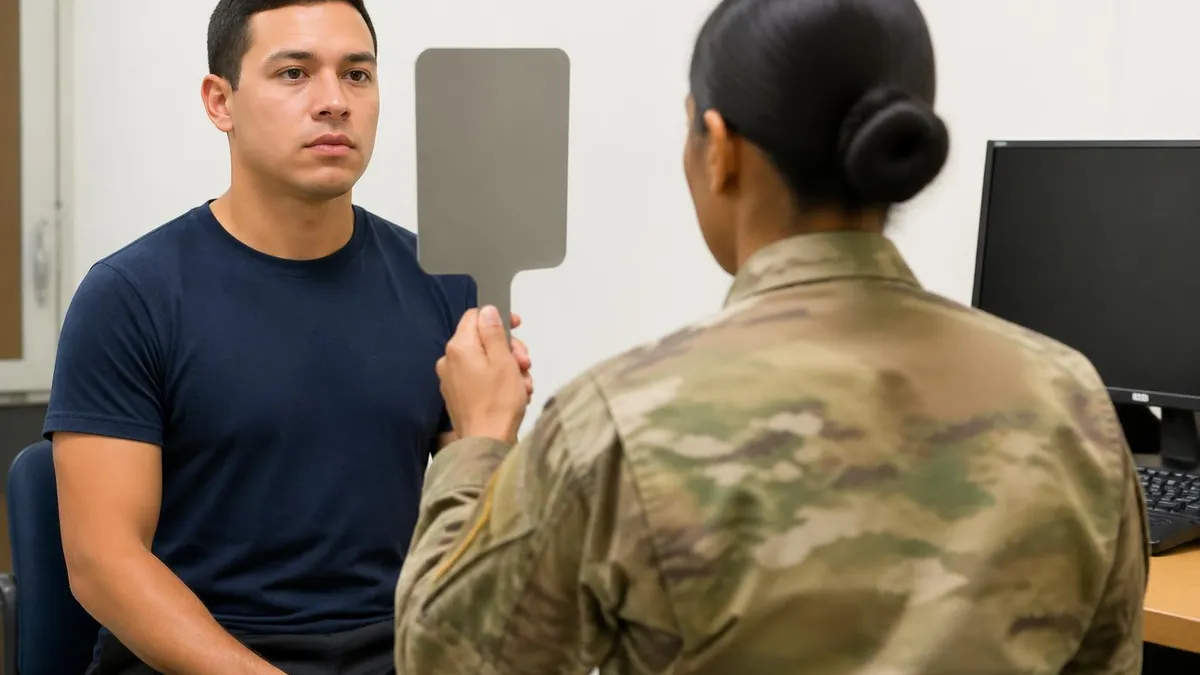
The medical examination is the most comprehensive component. A doctor performs a physical, reviews your medical history, evaluates hearing and vision, tests for drug use, and screens for medical conditions that would affect service eligibility. The examination is detailed — recruits are asked about their complete medical history, including childhood conditions, surgeries, and any medications they've taken.
Failing to disclose a medical condition can result in discharge later in your military career, so thorough and honest disclosure is required. Conditions that would seem to disqualify a recruit sometimes have waivers available; the MEPS physician and your recruiter can advise on specific situations.
Background screening at MEPS includes verification of identification documents, a review of your criminal history, and depending on the type of position or clearance you're seeking, additional screening may begin at MEPS as well. Recruiters help recruits gather the required documents before the MEPS visit — photo ID, Social Security card, and birth certificate are standard requirements. Missing documentation is a common reason for MEPS processing delays, so confirming your document checklist with your recruiter well before your appointment is time well spent.
The sequence of MEPS processing can vary — some recruits test first, then do their medical; others complete the medical first. The sequencing is determined by the MEPS facility's scheduling system, not by the recruit or recruiter. What's consistent is that all required components must be completed before you can be cleared for the oath of enlistment. Recruits sometimes assume that because they passed one component quickly, the remaining components will also go quickly.
In practice, any single component that requires additional review, follow-up documentation, or a waiver request can extend the overall timeline significantly. Going into MEPS without preconceptions about timing — and being patient with the process — makes the experience less stressful than expecting a fast, linear progression through each step.
The most common reason for MEPS processing delays that aren't medically related is missing documentation. Standard requirements include a government-issued photo ID, Social Security card, and original birth certificate. Medical records requested by your recruiter, glasses prescription, and medication information also need to be in hand. Confirm your complete document checklist with your recruiter at least one week before your appointment — not the day before.
Aptitude testing at MEPS is either the full ASVAB or the PICAT verification test, depending on whether you pre-screened online. Recruits who haven't taken the PICAT take the full ASVAB — all nine subtests — at MEPS. This produces a full battery of scores used to determine which military occupational specialties (Army MOS), ratings (Navy), AFSCs (Air Force), or MOSs (Marines) you qualify for. The ASVAB at MEPS is administered in a standardized computer lab under strict test conditions, with no external materials permitted.
Recruits who took the PICAT online take the PICAT verification test instead of the full ASVAB. As discussed in the verification test section, this is a shorter test covering Arithmetic Reasoning, Word Knowledge, and Paragraph Comprehension — the three sections that compose the AFQT score. If the verification test confirms your PICAT score, your PICAT results are used for enlistment processing. If your scores diverge beyond the acceptable threshold, you'll take the full ASVAB on the same visit. This can extend your MEPS day, which is worth factoring into your preparation timeline.
Test results at MEPS are immediate — you typically learn your ASVAB or verification test results the same day. If you score high enough on the AFQT for your target branch, the counseling and job selection phase can begin the same day. Recruits who score lower than expected on their first MEPS test may be able to retest after a waiting period, though retesting policies vary by branch and by how recently you last tested. Your recruiter can advise on the retest timeline specific to your situation.
For recruits who are undecided about which branch to join, ASVAB scores at MEPS can actually inform that decision. Different branches have different minimum AFQT score requirements, and certain branches have composite score requirements for specific jobs that are more demanding than others. The Navy's nuclear propulsion programs, for example, have high math and science composite score requirements.
The Army's intelligence and signal corps jobs have specific technical composite requirements. Getting your ASVAB results at MEPS gives you concrete data about which branches and jobs you qualify for — which can sharpen a decision that was previously based only on general impressions. The job counseling that follows testing at MEPS is specifically designed to match your scores with available openings in your target branch.
Many recruits are curious whether they can improve their MEPS ASVAB score by retesting if they score lower than hoped. Retesting is possible but subject to waiting periods that vary by branch. Some branches require a 30-day wait before a retest; others may require longer.
Each branch also has policies about how many times you can retest and what documentation of prior testing is required. If your goal is a specific MOS or rating that requires a particular composite score, discussing the retest option with your recruiter early — before your initial MEPS visit — helps you understand your options if the first result doesn't meet your target.

MEPS Processing Components
| Section | Questions | Time | Weight |
|---|---|---|---|
| Medical Examination | 1 | — | Required |
| Aptitude Testing (ASVAB or PICAT Verification) | 2 | — | Required |
| Background Screening | 3 | — | Required |
| Administrative Processing | 4 | — | Required |
Preparation for MEPS has two dimensions: the administrative preparation (gathering documents, understanding the schedule) and the test preparation (ASVAB or PICAT verification). Both matter. Recruits who show up to MEPS without required documents face processing delays. Recruits who didn't adequately prepare for testing face either a low ASVAB score that limits their job options or a failed PICAT verification that forces them to take the full ASVAB unexpectedly.
For testing preparation, use ASVAB practice tests focused on the sections most relevant to your situation. If you're taking the full ASVAB at MEPS, prepare across all nine subtests with emphasis on Arithmetic Reasoning, Word Knowledge, Paragraph Comprehension, and Mathematics Knowledge — these have the most weight in AFQT and branch-specific composite scores.
If you've already taken the PICAT, focus your remaining preparation on Arithmetic Reasoning, Word Knowledge, and Paragraph Comprehension since those are the sections the verification test covers. Timed practice under realistic conditions is more valuable than untimed content review, especially in the final weeks before your MEPS appointment.
On the administrative side, confirm the required documents with your recruiter at least one week before your MEPS appointment. Standard documents include a government-issued photo ID, your Social Security card, your birth certificate, and any medical records your recruiter has asked you to bring for conditions disclosed during the pre-screening process.
If you have glasses or contacts, bring your prescription. If you take regular medications, bring them and know the names and dosages. Recruits who are well-organized and have their documentation in order move through the administrative phases of MEPS more smoothly and spend less of their energy managing logistics — leaving more focus for the testing component.
Sleep is one of the most underestimated preparation factors for MEPS. The MEPS day typically starts very early — recruits often report at 5 AM or earlier — and runs for many hours. Cognitive test performance is meaningfully affected by sleep deprivation, and the medical examination process also requires you to be alert and accurate when answering questions about your medical history.
Recruits who stay up late the night before their MEPS visit (often due to nervousness or last-minute studying) often report that they were less sharp during testing than they expected. Treating the night before your MEPS appointment like the night before a major test — normal evening routine, adequate sleep, no alcohol, and avoiding anything that might disrupt rest — gives you the best foundation for performing well across all components of the MEPS process.
Dressing appropriately for MEPS is a small but practical preparation item that recruits sometimes overlook. The medical examination requires recruits to change into examination gowns for portions of the physical, and the overall environment is professional. Comfortable, clean clothing that's easy to change in and out of is practical. Avoid elaborate hairstyles or jewelry that might complicate the physical examination. The MEPS environment is somewhat formal — recruits who look and act professionally tend to have smoother interactions with the staff, and the habit of presenting yourself professionally is one that will serve you well throughout military service.
- ✓Confirm your MEPS location and appointment date with your recruiter
- ✓Gather all required documents: photo ID, Social Security card, birth certificate
- ✓Bring any required medical records or prescription information
- ✓Complete ASVAB or PICAT verification test preparation — don't leave it to the day before
- ✓Get adequate sleep the night before; the MEPS day starts early and runs long
- ✓Eat a normal meal before departing — medical and testing performance is affected by hunger or being rushed
- ✓Bring glasses or contact lenses if you use them, and know your prescription
- ✓Confirm transportation and lodging arrangements with your recruiter
- ✓Know which branch and job options you're interested in — counseling happens the same day if testing goes well
- ✓Avoid alcohol for at least 24 hours before your MEPS appointment

- +Recruits who prepare well for the ASVAB or PICAT verification test typically complete testing and move to job counseling the same day
- +MEPS processing is comprehensive — completing it successfully means you've cleared every major gate before entering service
- +Transportation and lodging are typically coordinated by your recruiter at no cost to the recruit
- +Test results are immediate — you know your scores the same day, allowing job counseling to begin right away
- +MEPS staff are experienced in processing recruits from many backgrounds and are generally efficient at moving people through the sequence
- −The MEPS day is long — recruits who aren't prepared for 8 to 12 hours of processing, waiting, and examinations may find it more exhausting than expected
- −Medical history questions are comprehensive and require accurate, complete disclosure — undisclosed conditions discovered later can result in discharge
- −Missing documentation (ID, Social Security card, birth certificate) is the most common avoidable reason for processing delays
- −Score divergence on the PICAT verification test means taking the full ASVAB on the same day, which extends an already long MEPS visit
- −Medical waivers can add weeks or months to the enlistment timeline for recruits with disclosed medical conditions



MEPS Locations: Questions and Answers
About the Author
Retired Military Officer & Armed Forces Test Preparation Specialist
United States Army War CollegeColonel Steven Harris (Ret.) served 28 years in the US Army, earning a Master of Arts in Military Science from the Army War College and a Bachelor of Science in Criminal Justice. He has coached thousands of military enlistment and officer candidate program applicants through the ASVAB, AFQT, AFCT, OAR, and officer selection assessment processes across all military branches.
Join the Discussion
Connect with other students preparing for this exam. Share tips, ask questions, and get advice from people who have been there.
View discussion (8 replies)