
MEPS Test Guide: What to Expect at Military Entrance Processing 2026 September
Free MEPS practice test with questions and answer explanations. 🧠 Prepare for the 2026 September exam with instant scoring.
What Is the MEPS Test?
The MEPS test is a series of medical, physical, and aptitude evaluations that every military enlistment candidate must complete at a Military Entrance Processing Station. MEPS — which stands for Military Entrance Processing Stations — is run by the Department of Defense and serves as the gateway for anyone seeking to enlist in the U.S. Armed Forces. Whether you're joining the Army, Navy, Air Force, Marine Corps, or Coast Guard, you'll go through MEPS before you can officially sign your enlistment contract.
"The MEPS test" typically refers to the ASVAB (Armed Services Vocational Aptitude Battery), which is the primary written exam administered at MEPS. But MEPS is actually a multi-day process that combines the ASVAB with a full medical examination, a physical fitness screen, background verification, and the swearing-in ceremony. Understanding the full scope of what happens at MEPS helps you prepare appropriately — not just for the written test, but for the entire processing experience.
Processing at MEPS takes one to two days depending on your branch and circumstances. Day 1 typically covers the ASVAB and medical screening. Day 2 (if required) covers additional medical tests or processing steps. Some candidates complete everything in a single long day; others stay overnight at a government-contracted hotel near the MEPS facility.
The stakes at MEPS are high. Your ASVAB scores determine which military jobs you're eligible for. Your medical screening determines whether you're physically qualified to serve at all. And any disqualifying condition discovered at MEPS — whether medical, legal, or financial — can end your enlistment process entirely. Preparation matters.
Why the MEPS Test Matters for Your Military Career
Your ASVAB score at MEPS isn't just a qualifying hurdle — it directly shapes which military career paths are open to you. The ASVAB generates several composite scores (called line scores or "ASVAB composites") that different military branches use to determine eligibility for specific jobs. These include the General Technical (GT) score, the Clerical (CL) score, the Mechanical Maintenance (MM) score, the Electronics (EL) score, and others.
Each military occupational specialty (MOS) or rate has minimum line score requirements. A job in military intelligence might require a GT score of 105 or higher. A job in electronics might require an EL score of 93 or higher. A combat arms MOS might only require a lower GT score. Going into MEPS with a high ASVAB score — across multiple subtests, not just the AFQT — keeps the widest range of options available to you.
This is why ASVAB prep is so valuable even for candidates who are confident they'll meet the minimum AFQT threshold. Minimum qualifying is different from qualifying for the best jobs. If you want a technical, intelligence, medical, or specialized job in the military, you need line scores that reflect the relevant aptitude areas. Study strategically: don't just prepare for the AFQT subtests. Prepare for Electronics Information, Mechanical Comprehension, and General Science if those are relevant to your target jobs.
What Happens at MEPS
Most candidates arrive at the MEPS hotel the night before their scheduled processing date. Processing typically begins at 5:00–6:00 AM. Here's the general sequence:
- Check-in and paperwork review — verify identity, sign forms, confirm medical history
- ASVAB testing — the computerized CAT-ASVAB (if not already taken at a recruiting station), typically 1.5–3 hours
- Medical history review — a MEPS physician reviews your SF-86 questionnaire and asks follow-up questions
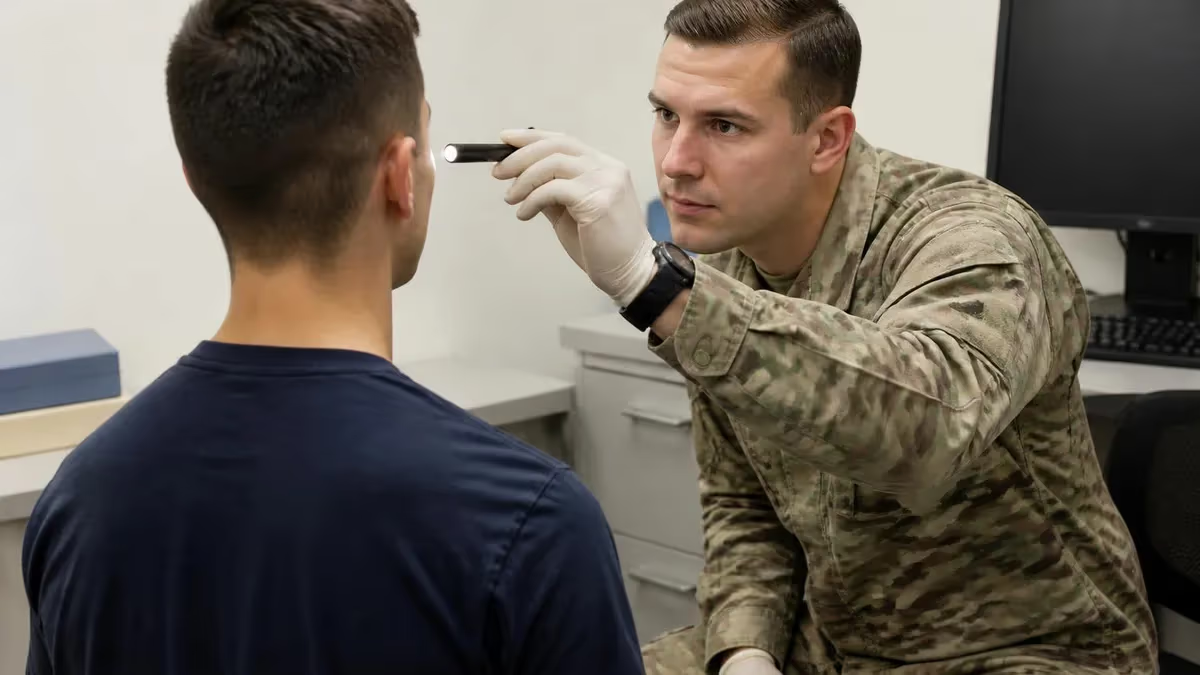
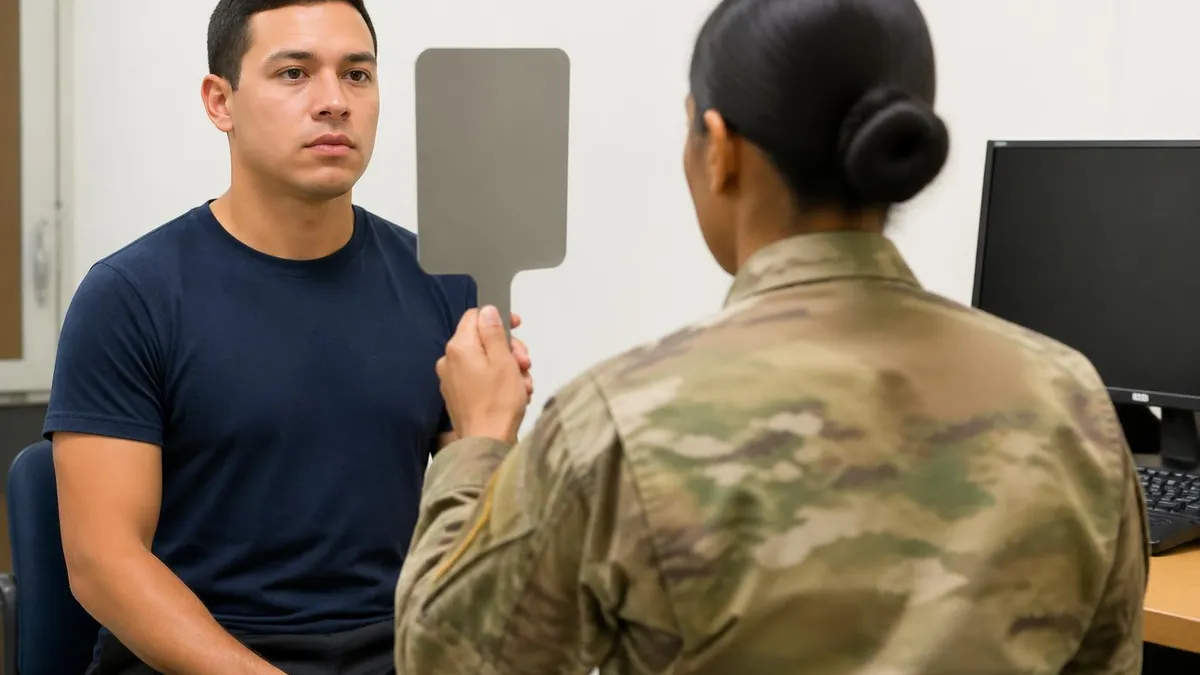
- Physical examination — height, weight, blood pressure, vision, hearing, urinalysis, blood draw
- Orthopedic and neurological screening — range of motion tests, duck walk, other physical assessments
- Medical determination — physician gives a qualified, disqualified, or deferred decision
If you pass medical screening on Day 1, you proceed to job selection counseling and, ultimately, the swearing-in ceremony. This is when you officially enlist.

How to Prepare for MEPS
Most of the prep work for MEPS comes down to three areas: your ASVAB score, your medical readiness, and your administrative preparation. Here's what to focus on in the weeks before your MEPS date.
Prepare Your ASVAB Score
Your ASVAB score is the most actionable thing you can improve before MEPS. A higher score opens more job options — potentially much better military occupational specialties (MOS) than you'd qualify for with a borderline score. Even if you've already taken the ASVAB and have qualifying scores, retaking it to improve your line scores can open up job options that weren't available before.
The four AFQT subtests — Arithmetic Reasoning, Mathematics Knowledge, Word Knowledge, and Paragraph Comprehension — are the ones that directly affect your enlistment eligibility. These are also the four most improvable through focused study. Two to four weeks of consistent practice on these sections can meaningfully move your AFQT score.
For Arithmetic Reasoning and Mathematics Knowledge, review basic algebra, fractions, percentages, ratios, and word problems. For Word Knowledge, build vocabulary through daily study of word lists — prefix and suffix patterns are particularly useful since they let you decode unfamiliar words from context. For Paragraph Comprehension, practice reading dense passages quickly and answering questions about main idea, supporting details, and inferences.
Get Your Medical Documentation Ready
If you have any documented medical history — prior surgeries, ongoing prescriptions, diagnosed conditions, past injuries — compile that documentation before your MEPS appointment. Bring copies. The MEPS physician will ask about anything in your medical history and having documentation on hand makes the process smoother and faster.
Do not try to conceal medical history at MEPS. Concealing a medical condition to gain enlistment is a federal offense. If you're discovered during active service, it can result in discharge and criminal charges. If a waiverable condition is part of your history, work through the proper waiver process — many people with pre-existing conditions serve successfully after receiving a waiver.
Prepare Logistically
MEPS days are long. You'll be there for 8–12 hours minimum. Bring what you need but keep it simple — MEPS provides government transportation, lodging if needed, and meals. Dress conservatively: business casual or clean casual clothing. Avoid clothing with offensive graphics or language. Wear comfortable shoes — you'll be on your feet for hours and you'll change into a gown for the medical exam anyway.
Bring your Social Security card (the actual card, not just the number), your state-issued photo ID or passport, and any required legal documents your recruiter instructed you to bring. Don't bring valuables — personal electronics may need to be stored and anything lost or stolen at MEPS is your responsibility.
Common Reasons People Are Disqualified at MEPS
Disqualification at MEPS happens more often than most recruits expect. Understanding the most common disqualifying conditions helps you assess your situation honestly before your appointment.
Body weight and BMI. Height-to-weight standards are branch-specific and non-negotiable at MEPS. If you're over the limit, you won't process. Some branches allow tape testing (body fat percentage measurement) as an alternative, but this is branch-specific. If you're borderline on weight, talk to your recruiter in advance — don't show up uncertain.
Vision problems. Uncorrected vision must meet specific thresholds. Corrected vision requirements also apply. Candidates who've had refractive surgery (LASIK, PRK) must typically meet a waiting period requirement before MEPS processing. Check your branch's current vision standards — they're specific and non-obvious.
Prior medical conditions. Asthma, ADHD, mental health diagnoses, past surgeries, and chronic conditions are among the most common reasons for medical disqualification. Many of these are waiverable, but waivers require documentation and time. Don't wait until MEPS to disclose these — work through the waiver process beforehand with your recruiter.
Criminal history. Felony convictions are typically permanently disqualifying. Some misdemeanor convictions require moral waivers. Multiple minor offenses can also accumulate to a disqualifying threshold. Full disclosure is required — background checks at MEPS are thorough.
Drug use. Urinalysis and blood tests at MEPS screen for controlled substances. A positive test is disqualifying and can create a permanent bar to enlistment. Prior use disclosed honestly during your medical history review is handled differently than use discovered through testing — but policies vary by branch. Consult your recruiter.
If you're concerned about a potential disqualifying condition, ask your recruiter directly. They'd rather know about it in advance and work through the waiver process than lose a qualified candidate to a surprise disqualification at MEPS. Honest disclosure and proper documentation handling are the right approaches.
It's worth understanding what "waiverable" actually means in practice. A waiver is not a guarantee. Your recruiter submits a waiver request to the relevant branch authority, which reviews it case by case. The outcome depends on the severity of the condition, your overall profile, and the branch's current manpower needs. During high-recruiting periods, waivers tend to be approved more readily. During periods of reduced recruiting, the bar is higher.
The most important thing you can do if you think a waiver might be needed is to get all your documentation organized well in advance. Medical records, treatment notes, specialist letters, and any supporting documentation that shows the condition is resolved or well-managed all strengthen a waiver request. Your recruiter can guide you on exactly what the specific waiver process requires for your branch and condition type.
Being honest during the MEPS process also protects you long-term. Service members who concealed disqualifying conditions to enlist can face serious consequences if the concealment is discovered during service — including dishonorable discharge and potential criminal charges under the Uniform Code of Military Justice. The short-term risk of being disqualified at MEPS is far preferable to the long-term consequences of fraudulent enlistment.

MEPS Preparation Checklist
- ✓Take ASVAB practice tests to reach your target score before your MEPS date
- ✓Compile medical history documentation — surgeries, diagnoses, medications
- ✓Disclose any pre-existing conditions to your recruiter before MEPS (not at MEPS)
- ✓Bring Social Security card (original), photo ID, and any required legal documents
- ✓Get adequate sleep the night before — MEPS starts early and runs long
- ✓Dress conservatively — business casual, comfortable shoes
- ✓Avoid alcohol for at least 24 hours before your appointment
- ✓Don't bring valuables or large amounts of cash
ASVAB Study Tips for MEPS Success
The ASVAB is the most controllable variable in your MEPS preparation. Unlike medical history or legal background, you can significantly improve your ASVAB score through deliberate study. Here's how to approach it strategically.
Start with a practice test — ideally a full CAT-ASVAB simulation. Your baseline scores tell you which subtests need the most work. Most candidates find Word Knowledge and Paragraph Comprehension are their lowest scores in the AFQT subtests, since vocabulary and reading comprehension require consistent long-term development. Arithmetic Reasoning and Mathematics Knowledge tend to respond faster to targeted review because the underlying math content is finite and well-defined.
For vocabulary improvement, focus on high-frequency military and general vocabulary words, and study root words, prefixes, and suffixes. Being able to decode unfamiliar words from their parts is far more useful on the actual test than memorizing individual word definitions.
For math, work through basic algebra, fractions, percentages, ratios, and proportions. The ASVAB math sections rarely go beyond algebra II — it's not calculus, it's not statistics, it's fundamental math executed accurately and quickly. Most wrong answers on math sections come from arithmetic errors rather than lack of conceptual knowledge, so practice doing calculations carefully under mild time pressure.
Don't ignore the technical subtests if you're interested in technical jobs. Electronics Information, Mechanical Comprehension, and Auto and Shop Information directly determine your eligibility for technical MOS options. A recruiter can tell you which line scores matter for the specific jobs you're targeting — let that guide your prep.
One more practical tip: the CAT-ASVAB adapts to your performance, meaning each question you see is determined by how you answered the previous one. You can't skip questions and come back. Every question counts. This is different from paper-and-pencil ASVAB versions and means your pacing strategy needs to be consistent from the very first question. Practice with adaptive format simulations so the CAT structure doesn't surprise you on the day.

MEPS and Your Military Career Path
What happens at MEPS shapes the trajectory of your military career in ways that go beyond just getting in. Your ASVAB line scores determine which jobs you can qualify for — not just your AFQT for basic eligibility. Job-specific line scores vary significantly between occupations, and improving your line scores before MEPS opens access to more technical, higher-skilled, and often better-compensated military jobs.
During job selection counseling at MEPS, you'll work with a liaison officer from your branch to review available jobs and select an MOS or rate that fits your scores, interests, and the branch's current needs. Going into this conversation knowing which jobs you're interested in — and having the scores to qualify for them — gives you much more negotiating power. Candidates who arrive without preferences or with minimal scores often end up in whichever jobs need to be filled.
For more information on what to expect at specific MEPS locations, including travel and lodging details, check the location-specific guides on this site — including the Baltimore MEPS guide and the Dallas MEPS guide. These cover practical logistics that vary by location and can help you know what to expect before arrival.
The MEPS timing guide also covers the full processing timeline in more detail, including what factors can extend your processing and how to plan your day accordingly.
The job selection process at MEPS can move faster than candidates expect. Once you're medically qualified and your ASVAB scores are confirmed, you may sit down with a liaison officer within hours. If you're not prepared with job preferences, you'll be making decisions under time pressure with limited information. Research military job options before MEPS — look up which jobs in your branch interest you, note the line score requirements, and make sure your ASVAB prep covered the relevant subtests.
The oath of enlistment at MEPS is the moment your military service officially begins. Depending on whether you're enlisting regular Active Duty, Reserve, or National Guard, the terms of your service commitment are formalized at this point. Read everything before you sign. Ask your recruiter to explain any terms you don't understand. You're making a significant commitment and it starts at MEPS.
Your performance throughout the MEPS process — from your ASVAB scores to your medical screening results to your conduct during processing — creates the first official record of your military career. Arriving prepared, composed, and honest sets the right tone. It's not just about getting through the gate. It's about starting your service on solid ground.
MEPS Pros and Cons
- +MEPS has a publicly available content blueprint — you know exactly what to prepare for
- +Multiple preparation pathways accommodate different schedules and budgets
- +Clear score reporting shows specific strengths and weaknesses
- +Study communities share current insights from recent test-takers
- +Retake policies allow recovery from a difficult first attempt
- −Tested content scope requires substantial preparation time
- −No single resource covers everything optimally
- −Exam-day performance can differ from practice test performance
- −Registration, prep, and retake costs accumulate significantly
- −Content changes between versions can make older materials less reliable



MEPS Questions and Answers
About the Author

Retired Military Officer & Armed Forces Test Preparation Specialist
United States Army War CollegeColonel Steven Harris (Ret.) served 28 years in the US Army, earning a Master of Arts in Military Science from the Army War College and a Bachelor of Science in Criminal Justice. He has coached thousands of military enlistment and officer candidate program applicants through the ASVAB, AFQT, AFCT, OAR, and officer selection assessment processes across all military branches.
Join the Discussion
Connect with other students preparing for this exam. Share tips, ask questions, and get advice from people who have been there.
View discussion (8 replies)