
MEPS: What to Expect at Kansas City Military Entrance Processing 2026 September
💡 Pass your MEPS: What to Expect at Kansas City exam on the first attempt. Practice questions with detailed answer explanations, hints, and instant scoring.
What Is MEPS and What Does Kansas City MEPS Do?
MEPS stands for Military Entrance Processing Station — a federally operated facility where military applicants are evaluated for eligibility to enlist in the United States Armed Forces. There are 65 MEPS locations across the country, and the Kansas City MEPS serves applicants from Missouri, Kansas, and surrounding regions who are working toward enlistment in the Army, Navy, Air Force, Marine Corps, Space Force, or Coast Guard. Every branch of the military uses MEPS for its initial screening process.
The Kansas City MEPS is operated by the US Military Entrance Processing Command (USMEPCOM) and staffed by Department of Defense civilians, military personnel, and medical professionals. Its job is to determine whether an applicant is medically, physically, and morally qualified to serve — and then, for those who qualify, to help the enlistment process by matching applicants to available military occupational specialties based on their ASVAB scores and physical capabilities.
Processing at MEPS is typically a one-to-two day experience. For most applicants, the first day involves medical examination and testing. The second day — which may immediately follow the first or occur after a delay while results are reviewed — involves job counseling, contract signing, and the oath of enlistment for those entering the Delayed Entry Program (DEP). Some applicants complete both phases in a single extended day, particularly if their medical records are straightforward and their ASVAB scores are already on file.
Your recruiter coordinates your MEPS appointment and will provide transportation guidance — many applicants are transported to MEPS by their recruiting office, either directly or through a contracted lodging arrangement near the MEPS facility for early morning processing. Confirm all logistics with your recruiter well before your scheduled MEPS date. Arriving unprepared or without required documents delays your processing and may require a return visit.
What Happens During MEPS Medical Processing?
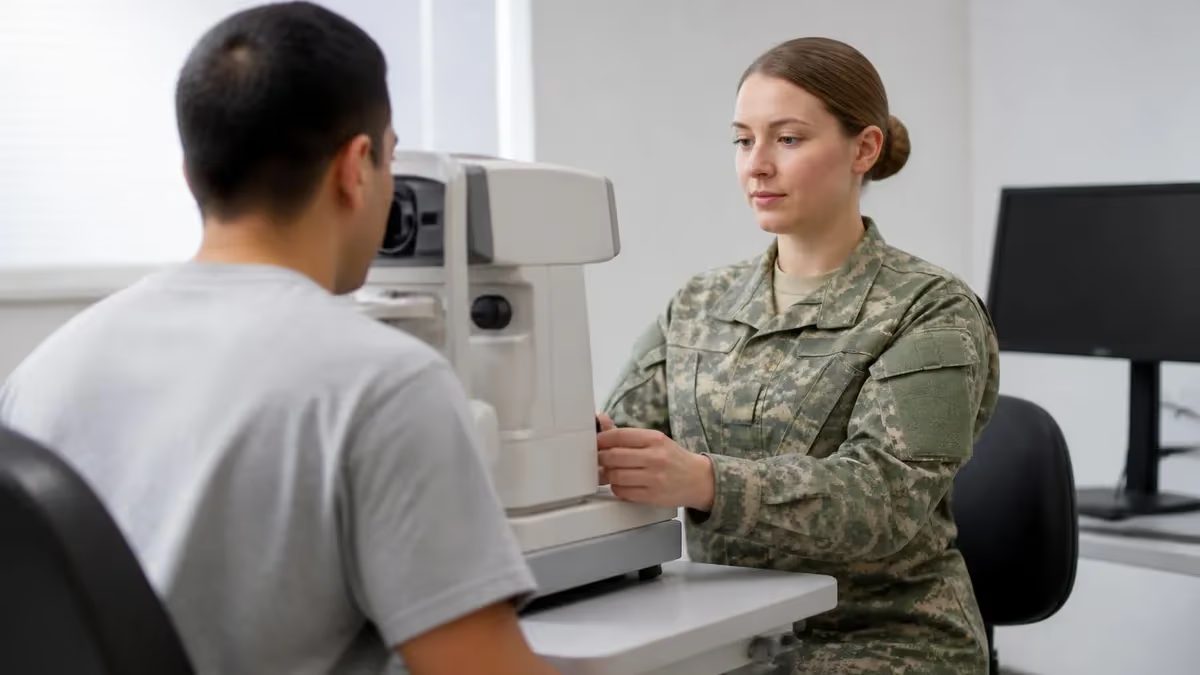
The medical examination is the centerpiece of MEPS processing and the most variable part of the experience, since the depth of review depends on an applicant's medical history. Applicants with prior injuries, surgeries, chronic conditions, or mental health histories undergo more detailed review. For applicants with straightforward medical histories, the physical moves through multiple stations in a defined sequence, with each station completed before moving to the next.
The MEPS physical begins with height and weight measurement and a body fat assessment if you are outside the height-to-weight table limits. Blood pressure, pulse, and vision are checked at the front of the process. A urine sample is collected for drug testing — this is a federal drug screen and applicants who test positive for controlled substances are disqualified and must wait before reapplying.
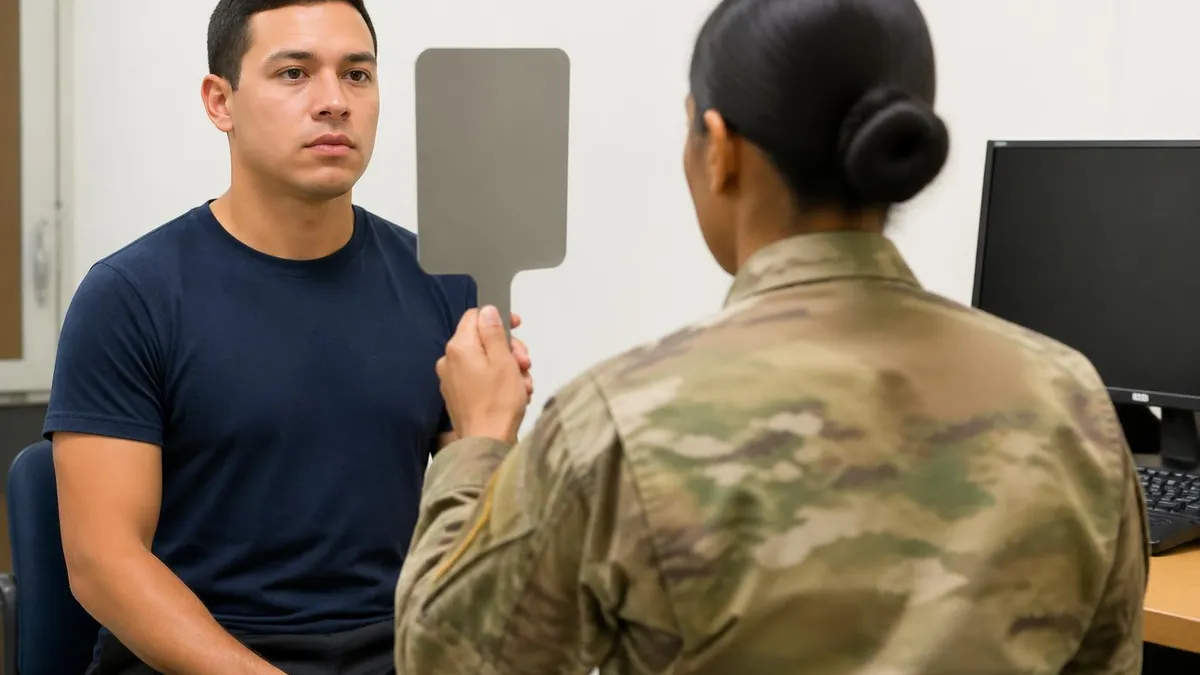
Blood is drawn for HIV testing and other screening. Hearing is tested through an audiometric evaluation in a soundproof booth. Color vision is assessed using standardized color plates, which matters for certain military occupations that require color discrimination.
A full orthopedic and neurological evaluation follows. Applicants perform a series of movements — the duck walk, squat thrusts, and other functional movements — that evaluate range of motion, joint stability, and gross motor function. Physicians examine the spine, knees, hips, and shoulders for any signs of previous injury, surgery, or condition that might affect military fitness requirements. If any movement produces pain or reveals instability, the medical officer may order additional documentation from your civilian physician before proceeding.
Your medical history — documented on a form you complete before arriving at MEPS — is reviewed in detail by the MEPS physician. Every disclosed condition, surgery, medication, and mental health episode is evaluated against the Department of Defense's medical standards. Conditions that are resolved, stable, or that fall within the waivable range may be handled through a medical waiver process, which your recruiter can help initiate. Conditions that meet the standards for outright disqualification result in a determination of Temporarily Not Qualified (TNQ) or Permanently Not Qualified (PNQ), depending on the nature of the condition.
Honesty during the MEPS medical history review is critical. The DD Form 2807-1 (medical history questionnaire) asks detailed questions about past medical conditions, surgeries, mental health treatment, medications, and substance use. Applicants who conceal information and later have it discovered face serious legal consequences, including fraudulent enlistment charges. When in doubt about whether a condition is relevant, disclose it — the MEPS physician will determine its significance. Many conditions that applicants fear will disqualify them are either waivable or do not meet the threshold for disqualification under current DOD standards.

- ✓Valid photo ID — driver's license, state ID, or passport; expired IDs are not accepted
- ✓Social Security card — original required, not a photocopy
- ✓Birth certificate — original or certified copy; hospital records do not substitute
- ✓All prescription eyeglasses and contact lenses you currently use
- ✓Medical records for any prior surgeries, injuries, or chronic conditions disclosed on your medical history form
- ✓Educational documents — high school diploma, GED, or college transcripts if applicable
- ✓Any waiver documentation your recruiter has already initiated with USMEPCOM
- ✓Comfortable, non-restrictive clothing you can move in freely — you will perform physical movement evaluations
ASVAB Testing at MEPS: What to Expect
Many applicants take the ASVAB — Armed Services Vocational Aptitude Battery — at MEPS, though some take it at their high school, a Military Testing site, or at their recruiter's office before their MEPS date. If you have already taken the ASVAB and your scores are on file, the MEPS ASVAB station may be skipped — confirm your score status with your recruiter before your appointment.
The ASVAB at MEPS is administered in computerized format as the CAT-ASVAB (Computer Adaptive Test). Unlike the paper ASVAB, the CAT-ASVAB adapts its question difficulty based on your responses, which means the number of questions per section is smaller and the test typically takes about 1.5 hours to complete.
The key score produced is the AFQT (Armed Forces Qualification Test), which is a composite of four specific ASVAB subtests — Arithmetic Reasoning, Mathematics Knowledge, Paragraph Comprehension, and Word Knowledge. The AFQT determines whether you qualify for enlistment in a given branch. The remaining subtests contribute to line scores that determine which military occupational specialties are available to you.
Preparing for the ASVAB before your MEPS date is one of the highest-use things you can do as a military applicant. A higher AFQT opens more branch options. A higher set of line scores opens more MOS options — which directly affects your quality-of-life in the military, since job satisfaction, training opportunities, and post-military career relevance all trace back to which MOS you qualify for and select at MEPS. Our practice tests cover the ASVAB subtests you'll encounter and give you a realistic preview of the question format and difficulty.
One important nuance of MEPS ASVAB testing is the score validity period. ASVAB scores are valid for two years from the date of testing. If you took the ASVAB more than two years before your MEPS date, you will need to retest. If you are unhappy with your scores from a prior administration, you can request to retest — but retesting is subject to waiting periods (typically 30 days between attempts after the first retest). MEPS administers the CAT-ASVAB on a scheduled basis, and your recruiter will coordinate the testing appointment as part of your overall MEPS scheduling.

Job Counseling, Contract Signing, and the Oath of Enlistment
After medical processing and ASVAB testing, qualified applicants meet with a MEPS job counselor — a military enlisted member trained in MOS classification and branch-specific occupational requirements. The job counselor reviews your ASVAB line scores, physical profile (established during the medical exam), and available positions in the branch you're enlisting in. Together, you select an MOS or rating from the list of occupations you qualify for and that have current openings.
This counseling session is one of the most important conversations you will have in your military journey. Not every job you are qualified for on paper will be available — the military assigns people to where the needs are, and popular positions fill quickly. Knowing your ASVAB scores in advance and researching the jobs available in your branch gives you a better foundation for the conversation. Ask specific questions about training pipeline length, duty station options, and any bonuses or enlistment incentives tied to specific positions.
Once a job is selected, the enlistment contract is prepared and signed. This contract specifies your branch, MOS, enlistment length, paygrade, and any agreed-upon bonuses or special programs. Read the contract carefully before signing. After signing, most applicants swear into the Delayed Entry Program (DEP), which reserves your job and hold date while you wait for your ship date to basic training. DEP periods range from a few weeks to approximately a year, depending on your job and the branch's scheduling needs. During DEP, you remain a civilian but are legally committed to your enlistment on your ship date.
The oath of enlistment for DEP entry takes place at MEPS in a brief ceremony, typically in a group setting with other new DEP members and family members who were permitted to attend. A commissioned officer or NCO administers the oath. For active duty shipments — where you ship directly to basic training without a DEP period — the oath is the final step before departure from MEPS. Taking the oath marks the formal beginning of your military service commitment.
Medical Waivers and What To Do If You're Not Qualified at MEPS
Receiving a Temporarily Not Qualified (TNQ) determination at MEPS is not the end of your military journey. Many applicants are TNQ'd for conditions that are waivable or that require additional documentation — a specialist evaluation, surgical records, or a letter of clearance from a treating physician. Your recruiter will work with MEPS and USMEPCOM to initiate the waiver process and gather whatever documentation the reviewing physician requires. This process takes time, sometimes weeks or months, and there are no guarantees — but a TNQ should be treated as a request for more information rather than a permanent rejection.
Medical waivers are evaluated on a case-by-case basis and depend on the specific condition, the branch you're applying to, the military occupational specialty you're seeking, and your overall medical record. Some conditions — such as a history of asthma, corrective eye surgery, or prior orthopedic procedures — are commonly waived when the applicant meets the recovery criteria and can provide supporting documentation. Other conditions — including active substance dependence, certain neurological disorders, or conditions requiring ongoing medication that is incompatible with military service — are more difficult or impossible to waive.
If you receive a PNQ (Permanently Not Qualified) determination, your options are limited but not necessarily zero. The Department of Defense updates its medical accession standards periodically, and conditions that were previously disqualifying have sometimes been reclassified as waivable over time. An attorney who specializes in military law can review your case and advise whether an appeal or alternate path to service exists. Organizations like the National Veterans Legal Services Program can point you toward appropriate legal resources.
For applicants who are disqualified for non-medical reasons — a criminal history, failed drug test, or financial or dependency issues — the process similarly involves either a waiver or a waiting period before reapplication. Moral waivers for certain criminal records are processed differently than medical waivers and require approval at the branch recruiting command level. Your recruiter is the primary point of contact for initiating any waiver process and will be honest with you about whether the waiver is realistically worth pursuing given current approval rates.

How to Prepare for MEPS: Practical Steps Before Your Appointment
Preparation for MEPS starts well before your appointment date and covers both logistical and physical readiness. The first step is gathering all required documents — birth certificate, Social Security card, photo ID, educational records, and all relevant medical records — and having them ready weeks in advance. Missing any of these on your MEPS day can cancel or significantly delay your processing, so treat this document checklist as a hard deadline, not a suggestion.
If you have any prior medical history — surgeries, injuries, chronic conditions, prescription medications, mental health treatment — begin gathering documentation from your treating physicians as soon as your recruiter identifies the need. Specialist letters, operative reports, and clearance letters from physicians can take weeks to obtain, and MEPS requires them before making waiver determinations. Proactively asking your recruiter what documentation they anticipate needing is one of the most useful things you can do in the weeks leading up to your appointment.
Physical preparation matters primarily for the movement evaluation portion of the MEPS physical. You do not need to be in peak athletic condition to pass the MEPS physical — it is not a fitness test in the traditional sense. But if you have a joint condition, recent injury, or range-of-motion limitation, working with a physical therapist in advance and having documentation of your recovery status is advisable. Being able to perform the duck walk, squat thrusts, and basic range-of-motion movements without pain or instability is the goal.
For the ASVAB, the most direct preparation is consistent practice across all subtests — not just the four AFQT subtests, but the technical subtests that determine your MOS eligibility. Use official ASVAB practice materials and our practice tests to simulate the timed CAT-ASVAB format. Focus extra preparation time on your weakest subject areas, since line scores can be as important as the AFQT for accessing the jobs you actually want.
Going into MEPS with a strong ASVAB score gives you more choices at the job counseling table and reduces the pressure of the entire MEPS experience. Applicants who arrive prepared — with documents organized, ASVAB scores solid, and MOS preferences researched — consistently report a smoother, faster MEPS experience and greater satisfaction with their final job selection.
MEPS Pros and Cons
- +MEPS has a publicly available content blueprint — you know exactly what to prepare for
- +Multiple preparation pathways accommodate different schedules and budgets
- +Clear score reporting shows specific strengths and weaknesses
- +Study communities share current insights from recent test-takers
- +Retake policies allow recovery from a difficult first attempt
- −Tested content scope requires substantial preparation time
- −No single resource covers everything optimally
- −Exam-day performance can differ from practice test performance
- −Registration, prep, and retake costs accumulate significantly
- −Content changes between versions can make older materials less reliable
Pros and Cons at a Glance
| Pros | Cons |
|---|---|
| MEPS has a publicly available content blueprint — you know exactly what to prepare for | Tested content scope requires substantial preparation time |
| Multiple preparation pathways accommodate different schedules and budgets | No single resource covers everything optimally |
| Clear score reporting shows specific strengths and weaknesses | Exam-day performance can differ from practice test performance |
| Study communities share current insights from recent test-takers | Registration, prep, and retake costs accumulate significantly |
| Retake policies allow recovery from a difficult first attempt | Content changes between versions can make older materials less reliable |



MEPS Questions and Answers
About the Author

Retired Military Officer & Armed Forces Test Preparation Specialist
United States Army War CollegeColonel Steven Harris (Ret.) served 28 years in the US Army, earning a Master of Arts in Military Science from the Army War College and a Bachelor of Science in Criminal Justice. He has coached thousands of military enlistment and officer candidate program applicants through the ASVAB, AFQT, AFCT, OAR, and officer selection assessment processes across all military branches.
Join the Discussion
Connect with other students preparing for this exam. Share tips, ask questions, and get advice from people who have been there.
View discussion (8 replies)