
Fast Track LPN Programs: Accelerated Paths to Licensure in 2026
Fast track LPN programs let you earn your practical nurse license in 9-12 months. ✅ Compare costs, requirements, and NCLEX-PN prep strategies.
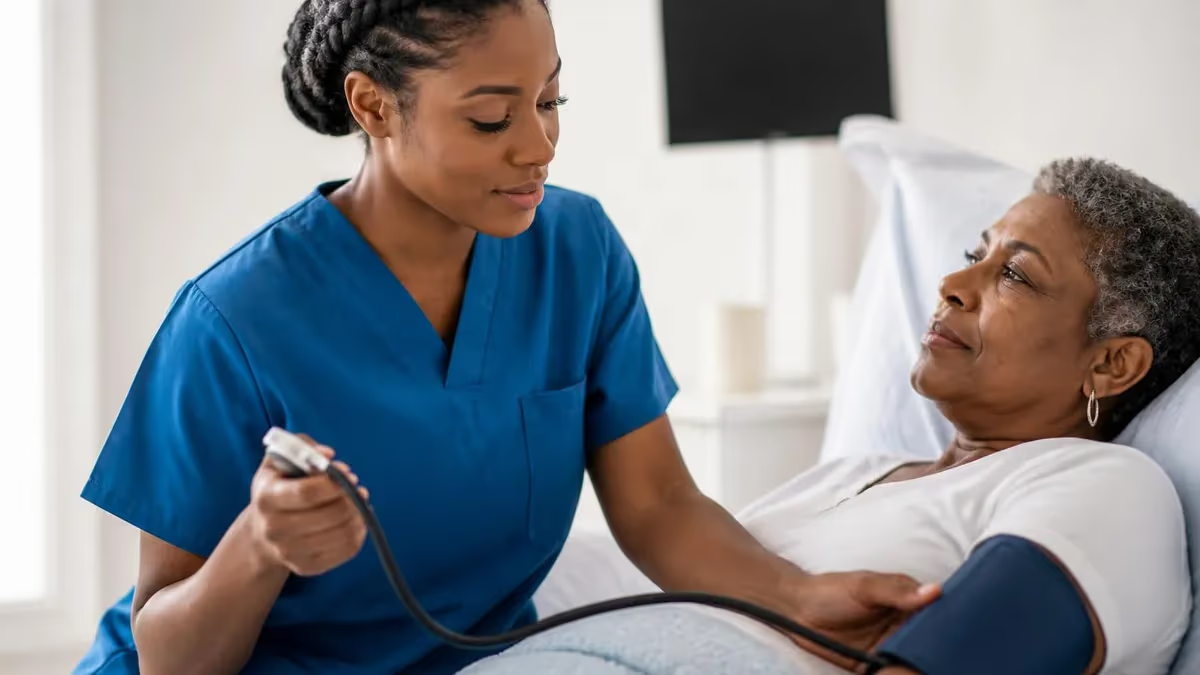
Fast track LPN programs compress the traditional 18-month practical nursing curriculum into 9 to 12 months of intensive, focused study so you can sit for the NCLEX-PN and start working at the bedside in less than a year. These accelerated tracks have exploded in popularity since 2023 as hospitals, long-term care facilities, and home health agencies struggle to fill an estimated 195,000 LPN vacancies projected through 2032 by the Bureau of Labor Statistics. If you want a healthcare credential without committing two to four years to a degree, this guide walks through everything you need to know.
The appeal of an accelerated route is obvious: lower opportunity cost, faster paycheck, and a credential that opens doors to acute care, geriatrics, pediatrics, and outpatient clinics. Most fast track programs are offered by community colleges, vocational-technical centers, and a growing number of private career schools that have simplified classroom theory by running classes year-round, eliminating summer breaks, and using simulation labs to compress clinical hours. Some hybrid models also let you complete didactic coursework online while reserving in-person time for skills labs and supervised clinical rotations.
Before you enroll, you need to understand the trade-offs. Accelerated learning means a punishing schedule of 35 to 45 contact hours per week, very little time for outside employment, and a sharp learning curve in pharmacology, medical-surgical nursing, and maternal-child care. Students who succeed typically have a strong support system, dedicated study time of 20+ hours weekly outside class, and realistic financial planning to cover tuition without working full-time. Burnout is real, and the attrition rate in fast track cohorts hovers around 18 to 25 percent nationally.
Another factor people overlook is state board approval. Every LPN program must be approved by the state board of nursing in the jurisdiction where it operates, and only graduates of approved programs are eligible to sit for the NCLEX-PN licensure exam. Accelerated programs are scrutinized closely because regulators want to confirm clinical hours, faculty credentials, and student outcomes meet the same standards as traditional tracks. Always verify approval status on your state board website before paying a deposit or signing an enrollment contract.
This article breaks down the realistic timeline, admission requirements, total cost, curriculum components, clinical hour expectations, NCLEX-PN pass rate data, and post-graduation career options. We will also cover hybrid and online options, financial aid eligibility, military-friendly programs, and bridge pathways for medical assistants, CNAs, and military medics looking to advance. By the end you will know whether a fast track program is right for you, what to look for in a quality school, and how to set yourself up for first-time NCLEX success.
Finally, this guide includes practice question recommendations because no accelerated program can succeed without aggressive self-testing. The compressed timeline means you do not get a second chance to master pharmacology or coordinated care concepts. Students who pass on the first attempt almost universally report completing 2,000 to 4,000 practice questions across all NCLEX-PN client need categories during their final 90 days of study. Free question banks, paid review courses, and mobile apps now make this more accessible than ever for working students.
Fast Track LPN Programs by the Numbers

Typical 12-Month Fast Track LPN Timeline
Months 1-2: Foundations
Months 3-4: Pharmacology
Months 5-7: Med-Surg Rotations
Months 8-9: Specialty Rotations
Months 10-11: Capstone & Review
Month 12: NCLEX-PN
Admission requirements for fast track LPN programs are typically more stringent than traditional tracks because schools need to confirm you can survive the compressed pace. The baseline floor at most accredited programs includes a high school diploma or GED with a 2.5+ GPA, official transcripts demonstrating completion of high school biology and algebra, a passing score on the TEAS (Test of Essential Academic Skills) or HESI A2 entrance exam, and verification of US work authorization. Some schools also require completion of a Certified Nursing Assistant program or 100+ hours of documented patient care experience.
The TEAS exam deserves special attention because it functions as the primary academic gatekeeper. Composite scores generally need to land at the 60th percentile or higher, with section minimums in reading, math, science, and English usage. The science section trips up most applicants because it covers human anatomy, physiology, life science, and basic chemistry. Plan for 6 to 8 weeks of dedicated TEAS preparation using official ATI study materials, and consider retaking the test if your first attempt comes back below your target program's threshold.
Background checks and drug screens are non-negotiable. State boards of nursing require fingerprint-based criminal background investigations through the FBI and state law enforcement databases. Felony convictions, certain misdemeanors related to drugs or violence, and pending charges can disqualify you from licensure even if you complete the program. Most schools require a declaration of any criminal history at application, and some will conduct a pre-admission board of nursing review to assess licensure eligibility before you invest in tuition.
Health and immunization requirements add another layer. Programs require proof of current immunizations including MMR, varicella, Tdap, hepatitis B series, annual influenza, and a negative TB test (often two-step PPD or QuantiFERON-Gold). CPR certification at the Basic Life Support (BLS) Healthcare Provider level through the American Heart Association is mandatory before clinicals begin. Many programs also require N95 fit testing, COVID-19 vaccination or approved exemption documentation, and a physical exam clearing you for the physical demands of nursing.
Beyond the paperwork, schools increasingly screen for behavioral fit. Personal essays, recorded video interviews, and structured admission interviews probe your reasons for choosing nursing, your understanding of the LPN scope of practice, and your awareness of the time commitment involved. Demonstrating concrete knowledge of what LPNs actually do day-to-day, perhaps by shadowing a licensed practical nurse or working as a CNA, dramatically improves your candidacy. For students planning LPN to RN: Bridge Programs, Requirements, and Career Paths later, mention that long-term goal during your interview.
Finally, deadlines matter more in fast track admissions because most programs start new cohorts every 4 to 6 months rather than once a year. This rolling enrollment is great if you decide quickly, but seat counts are limited to typically 24 to 36 students per cohort to maintain clinical placement quality. Apply at least 4 months before your target start date, have all transcripts and test scores submitted early, and follow up with admissions counselors weekly. Programs frequently maintain waitlists, and applicants who demonstrate consistent communication often move up when accepted students withdraw before orientation.
LPN Practice Test Questions
Prepare for the LPN - Certified Practical Nurse exam with our free practice test modules. Each quiz covers key topics to help you pass on your first try.
LPN - Certified Practical Nurse Basic Care...
LPN Exam Questions covering - Certified Practical Nurse Basic Care and Comfort. Master LPN Test concepts for certification prep.
LPN - Certified Practical Nurse Coordinate...
Free LPN Practice Test featuring - Certified Practical Nurse Coordinated Care. Improve your LPN Exam score with mock test prep.
LPN - Certified Practical Nurse Health Pro...
LPN Mock Exam on - Certified Practical Nurse Health Promotion and Maintenance. LPN Study Guide questions to pass on your first try.
LPN - Certified Practical Nurse Pharmacolo...
LPN Test Prep for - Certified Practical Nurse Pharmacological Therapies. Practice LPN Quiz questions and boost your score.
LPN - Certified Practical Nurse Physiologi...
LPN Questions and Answers on - Certified Practical Nurse Physiological Adaptation. Free LPN practice for exam readiness.
LPN - Certified Practical Nurse Psychosoci...
LPN Mock Test covering - Certified Practical Nurse Psychosocial Integrity. Online LPN Test practice with instant feedback.
LPN - Certified Practical Nurse Reduction ...
Free LPN Quiz on - Certified Practical Nurse Reduction of Risk Potential. LPN Exam prep questions with detailed explanations.
LPN - Certified Practical Nurse Safety and...
LPN Practice Questions for - Certified Practical Nurse Safety and Infection Control. Build confidence for your LPN certification exam.
LPN Ethical, Legal & Professional Standards
LPN Test Online for Ethical, Legal & Professional Standards. Free practice with instant results and feedback.
LPN Health Evaluation & Monitoring
LPN Study Material on Health Evaluation & Monitoring. Prepare effectively with real exam-style questions.
Online, Hybrid, and Campus Fast Track LPN Programs
Fully online LPN programs do not actually exist in the regulatory sense because state boards of nursing require hands-on clinical hours that cannot be replicated through a screen. What is commonly marketed as 'online' is really an online theory component paired with in-person clinical placements arranged near your home. This works well if you live in a metro area with partner facilities, but rural students often discover the school cannot place them locally and may need to relocate temporarily.
The pure online portion typically includes recorded lectures, asynchronous discussion boards, virtual simulation modules, and proctored exams via webcam services like ProctorU or Honorlock. Self-discipline matters enormously here because nobody is checking attendance daily. Successful online students block dedicated study hours, treat coursework like a full-time job, and use weekly video office hours with instructors. Expect to log 30 to 40 hours weekly between recorded content, reading assignments, and virtual practice scenarios.
Should You Choose a Fast Track LPN Program?
- +Earn licensure and start working in under 12 months
- +Lower total tuition cost than traditional 18-month tracks
- +Less time out of the workforce reduces lifetime opportunity cost
- +Strong job demand with 195,000+ projected vacancies through 2032
- +Direct pathway into accelerated LPN-to-RN bridge programs after 1 year experience
- +Year-round enrollment means no waiting for traditional fall semester start dates
- −Intense 35-45 hour weekly schedule leaves little room for outside work
- −Higher attrition rate (18-25%) than traditional programs
- −Compressed pacing means less time to absorb difficult pharmacology content
- −Some employers prefer ADN/BSN candidates for hospital staff RN positions
- −Burnout risk is significant without strong family and financial support
- −State board approval varies and not every accelerated program qualifies for federal aid
Fast Track LPN Program Enrollment Checklist
- ✓Verify the program is approved by your state board of nursing.
- ✓Confirm regional or national accreditation for federal financial aid eligibility.
- ✓Request 3-year NCLEX-PN first-time pass rate data in writing from admissions.
- ✓Submit official high school and any college transcripts by stated deadlines.
- ✓Complete TEAS or HESI A2 entrance exam with required composite score.
- ✓Obtain BLS Healthcare Provider CPR certification through the American Heart Association.
- ✓Update all required immunizations and document a negative two-step TB test.
- ✓Pass FBI and state criminal background checks plus 10-panel drug screen.
- ✓Secure financial aid through FAFSA, scholarships, or employer tuition reimbursement.
- ✓Complete program-specific orientation, uniform fittings, and clinical compliance paperwork.
A program below 80% first-time pass rate is a red flag
Every state board of nursing publishes annual first-time NCLEX-PN pass rate data for every approved program. The national average hovers around 82 percent, and quality fast track programs match or exceed that benchmark. If a school refuses to share its data or reports rates below 75 percent for two consecutive years, walk away. Low pass rates indicate weak curriculum, inadequate review, or admission standards that accept students who are not academically prepared for the compressed pace.
Tuition for fast track LPN programs ranges from $8,000 at community colleges and vocational-technical centers to $25,000+ at private career schools. The gap reflects both regional cost-of-living differences and the business model: public schools are subsidized by state taxpayers, while for-profit institutions must recover marketing, facilities, and staffing costs entirely from student tuition. Generally, you get similar curriculum quality at both ends of the spectrum because state boards mandate consistent clinical hours, content areas, and faculty credentials regardless of school type.
Hidden costs add up faster than most students expect. Budget an additional $2,500 to $4,500 on top of base tuition for textbooks ($600-$900), uniforms and shoes ($200-$400), clinical equipment including a stethoscope and penlight ($150-$300), background checks and drug screens ($150-$250), required medical exam and immunization updates ($200-$500), CPR certification ($85-$120), TEAS exam fees ($115 per attempt), and licensure costs including NCLEX-PN registration ($200) and state application fees ($75-$200). Some programs also charge separate technology fees, simulation lab fees, and graduation fees.
Federal financial aid through the FAFSA is your best friend, but only if your program holds Title IV eligibility through regional or national accreditation. Pell Grants up to $7,395 per academic year (2025-2026) require no repayment for students from lower-income families. Direct Subsidized and Unsubsidized Loans allow undergraduates to borrow $5,500 to $12,500 annually depending on dependency status. Always exhaust grants and subsidized loans before taking on private debt with higher interest rates and less flexible repayment terms.
Scholarship opportunities specific to nursing students are surprisingly plentiful. The Health Resources and Services Administration (HRSA) Nurse Corps Scholarship pays full tuition plus a monthly stipend in exchange for a 2-year service commitment at a Critical Shortage Facility after graduation. State nursing associations, hospital systems, and nonprofit foundations all offer awards ranging from $500 to $10,000. Search Fastweb, the AACN scholarship database, and your state board of nursing website for current opportunities, and apply broadly because most awards see modest applicant pools.
Employer tuition reimbursement deserves special consideration if you currently work in healthcare. Hospital systems, long-term care chains, and home health agencies increasingly cover full LPN tuition in exchange for 1 to 2 year post-graduation employment commitments. CNAs, medical assistants, and unit clerks should ask their HR departments about these programs before paying tuition out of pocket. Some employers also offer paid time off for clinicals, scheduling accommodations during exam weeks, and signing bonuses of $5,000 to $15,000 for new graduate LPNs who join their staff.
Finally, consider the lifetime return on investment honestly. The median LPN salary of $59,730 according to BLS 2024 data means most graduates recoup tuition within the first year of employment. Geographic variation matters: California, Washington, Massachusetts, and Alaska pay top-quartile LPN wages exceeding $70,000 annually, while southern states often pay $42,000 to $48,000. Use Bureau of Labor Statistics state-level Occupational Employment Statistics to model realistic earnings in your area before committing to a specific program or relocation.

Several online operators market 'fast track LPN certifications' that are not approved by any state board of nursing. Graduates of these programs cannot sit for the NCLEX-PN and cannot legally work as licensed practical nurses anywhere in the United States. Always verify your program's approval status directly on your state board of nursing website before paying any deposit, and confirm graduates from the past 3 years successfully obtained LPN licensure.
Passing the NCLEX-PN on your first attempt after a fast track program requires deliberate, evidence-based preparation that begins on day one of nursing school, not after graduation. The exam uses computer-adaptive testing (CAT) to evaluate competency across five client need categories: Safe and Effective Care Environment, Health Promotion and Maintenance, Psychosocial Integrity, Physiological Integrity, and the integrated processes spanning all categories. Question counts range from 85 to 150, and the exam can end early if your performance clearly demonstrates competency or, conversely, clear failure.
Most fast track graduates schedule their NCLEX-PN 2 to 4 weeks after program completion to maintain content recency without losing momentum. This window allows for one intensive review course (UWorld, Kaplan, Hurst, or ATI), 1,500 to 2,500 practice questions with detailed rationale review, and 2 to 3 full-length predictor exams under timed conditions. Aim for sustained accuracy of 65 to 70 percent on practice questions before scheduling your test date, and never schedule the exam until you have consistently hit that threshold on three consecutive predictor assessments.
Active practice question review beats passive content review every single time. After missing a question, write down which concept tripped you up, the correct rationale, and one related concept you should remember. Build this into a personal weak-area journal, and revisit it weekly. Students who treat practice questions as a primary learning method rather than a measurement tool pass at significantly higher rates than students who reread textbooks or rewatch lectures hoping the content will stick.
Dosage calculation and pharmacology questions deserve disproportionate practice time because they appear in 12 to 18 percent of exam items and are weighted heavily for safety reasons. Master ratio-proportion, dimensional analysis, and the formula method for medication calculations until you can solve them without conscious effort. Memorize high-alert medications, common drug suffix patterns (statins, prils, sartans, olols, etc.), and the top adverse reactions for the 100 most-prescribed drugs in primary care and acute care settings.
Test-day logistics are not optional details. Arrive at the Pearson VUE testing center 30 minutes early with your Authorization to Test email and government-issued photo ID. The exam is 5 hours maximum with two optional breaks at 2 and 3.5 hour marks. Use those breaks for water, light snacks, and mental reset, but do not check your phone or discuss content with anyone. Pace yourself at roughly 1 to 2 minutes per question, but do not panic if certain items take longer. Read carefully because misreading just one word in the stem causes most wrong answers.
If the unexpected happens and you do not pass on the first attempt, you can retest after a 45-day waiting period. Use that time aggressively: review your Candidate Performance Report to identify weak content areas, switch to a different review course if your current resources are not working, increase practice question volume to 50+ per day, and consider joining a study group with other re-testers.
Most students who pass on attempt two report doing roughly twice the practice questions they completed before their first attempt. Resources like our LPN Practice Test PDF (Free Printable 2026) are valuable for offline drilling when screen fatigue sets in.
Once you pass the NCLEX-PN and receive your license, the real work begins. New graduate LPNs typically start in long-term care, skilled nursing facilities, rehabilitation hospitals, home health, or outpatient clinics, where the patient acuity matches the LPN scope of practice and orientation programs are most strong. Hospital staff LPN positions still exist but have shrunk as hospitals shift toward all-RN bedside models. Plan your first job search around the settings where LPN demand is strongest, then build skills that transfer when you decide to advance.
First-year orientation should not be skipped or shortened. Quality employers provide 6 to 12 weeks of paid orientation with a dedicated preceptor, gradually increasing your patient load and complexity. During this period you build confidence with medication administration, wound care, tube feedings, catheterization, IV maintenance (where state scope permits), and end-of-life care. Document every skill you perform and every challenging case you encounter because this clinical exposure becomes valuable when you apply to bridge programs or specialty roles later.
Continuing education is mandatory in nearly every state to maintain LPN licensure, typically 24 to 30 contact hours every two years. Choose CE courses strategically to deepen expertise in areas you enjoy: IV therapy certification, wound care specialty certification, dementia care, hospice and palliative care, or geriatric nursing. These add-on credentials open doors to higher-paying positions, charge nurse roles in long-term care, and clinical educator opportunities within your facility.
Networking matters in nursing more than many new graduates realize. Join your state LPN association, attend local nursing job fairs, and connect with nurse managers on LinkedIn. Many of the best LPN positions never appear on public job boards because they are filled through internal referrals and word-of-mouth recommendations. A practical nurse with a strong professional reputation in a metropolitan area can typically pick from 5 to 10 job offers within two weeks of starting a search, often with $3,000 to $8,000 signing bonuses.
Bridge advancement should be on your radar from day one. The LPN-to-RN pathway typically requires 12 to 24 months of full-time study after one year of clinical experience, and many employers cover tuition. Online and hybrid options make this manageable while continuing to work. Research Online LPN to RN Programs: Bridge to Your RN License Without Leaving Work to understand the curriculum jump from practical to registered nursing and start mapping your timeline before you even graduate from your LPN program.
Finally, protect your license like the valuable asset it is. Always document care thoroughly, refuse assignments outside your scope of practice in writing if challenged, maintain professional liability insurance ($100-$150 annually through NSO or similar carriers), keep your continuing education current, and never administer a medication or perform a procedure you are not competent to do. Board of nursing investigations almost always trace back to scope violations, poor documentation, or substance use issues. Stay aware of these risks, build a peer support network, and you will enjoy a long and rewarding nursing career.
LPN Questions and Answers


How this page was made: written with AI tools and published by Nathan Beja, founder of Practice Test Geeks, who is responsible for its content. Exam facts are checked against the official sources listed below. Not reviewed by a subject-matter expert. Editorial policy
Sources & references
Exam facts on this page (fees, format, dates, passing scores) are checked against these official sources; the date is our last check. Editorial policy
- op.nysed.gov — Fees, renewal, score validity · verified Oct 2026
- nclex.com — Score release, fees, exam format, registration deadline, retake policy, eligibility, test dates, time limit, retake fee, test delivery · verified Oct 2026