
Which Is Harder HVAC or Electrician? A Complete Career Comparison Guide
✏️ Which is harder HVAC or electrician? Compare training difficulty, salary, physical demands, and career outlook to choose the right skilled trade for you.
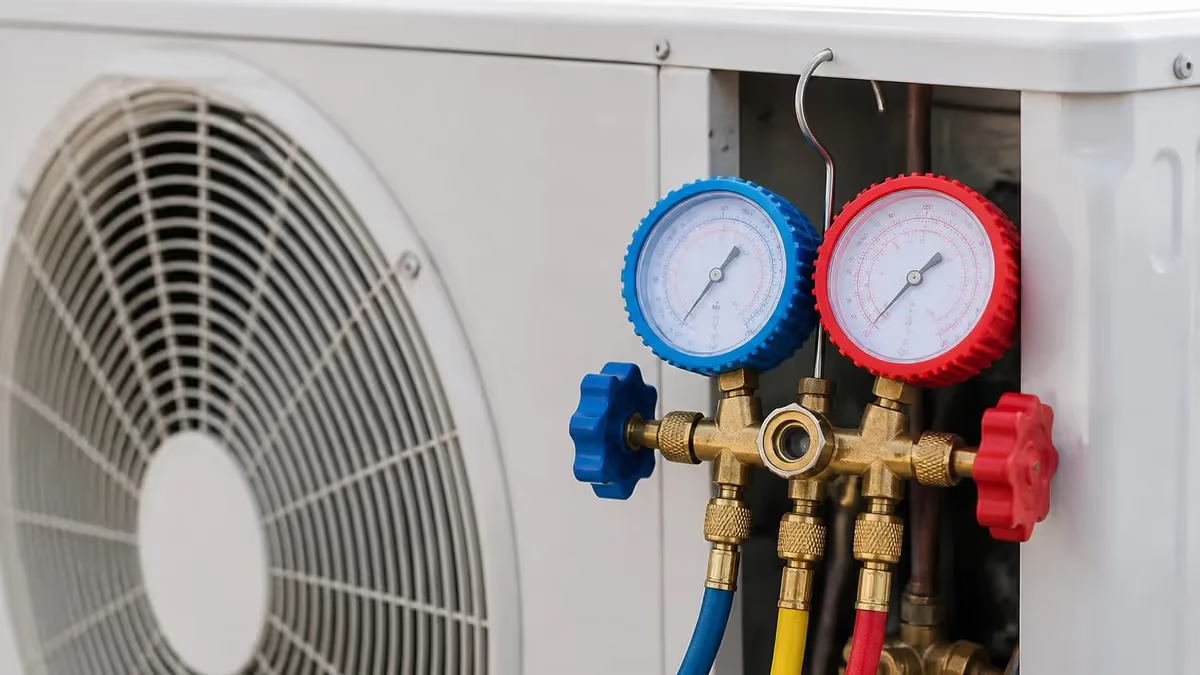
Deciding which is harder HVAC or electrician work remains one of the most common questions people ask before entering the skilled trades. Both careers demand technical knowledge, physical endurance, and years of dedicated training, yet they differ significantly in the types of challenges workers face daily. Understanding these differences helps aspiring tradespeople choose the path that aligns best with their natural strengths, interests, and long-term professional goals.
HVAC technicians work with complex mechanical systems that combine refrigeration principles, airflow dynamics, electrical components, and combustion processes into unified climate control solutions. The breadth of knowledge required spans multiple engineering disciplines, making initial learning curves steep for many newcomers. Electricians, meanwhile, focus deeply on electrical theory, code compliance, and circuit design, requiring precise mathematical reasoning and an unwavering commitment to safety protocols that protect lives.
The difficulty comparison between these two trades depends largely on individual aptitude and which types of problem-solving come naturally to you. Someone who excels at spatial reasoning and enjoys working with diverse mechanical components may find HVAC more intuitive, while those drawn to logical systems and mathematical precision often gravitate toward electrical work. Neither trade is objectively easier than the other across all dimensions of comparison.
Physical demands also differ between the two professions in meaningful ways that affect long-term career sustainability. HVAC technicians frequently work in cramped attics, on rooftops in extreme weather, and in confined crawlspaces while handling heavy equipment. Electricians spend considerable time pulling wire through walls, climbing ladders, and working in awkward positions inside junction boxes. Both careers require excellent physical conditioning and carry distinct ergonomic risks.
From a licensing and education standpoint, both trades require completion of apprenticeship programs that typically last four to five years. However, the specific exam content and continuing education requirements vary significantly between HVAC certification and electrician licensing in most states. Understanding these structural differences helps candidates prepare mentally and financially for the investment each career path requires before reaching journeyman status.
Salary potential and job market demand represent another critical comparison point that influences career decisions. The Bureau of Labor Statistics projects strong growth for both HVAC technicians and electricians through 2032, though regional variations create pockets of exceptional opportunity in each field. Market conditions, specialization choices, and willingness to pursue advanced certifications all influence earning potential regardless of which trade you ultimately select.
This comprehensive guide examines every dimension of the HVAC versus electrician comparison, from daily job duties and training requirements to salary trajectories and quality-of-life factors. By the end, you will have clear, data-driven insight into which career path presents challenges best suited to your personal strengths, preferences, and lifestyle goals in the current job market landscape.
HVAC vs Electrician by the Numbers

Training and Education Requirements Compared
Combines classroom instruction in refrigeration theory, electrical fundamentals, and mechanical systems with 8,000+ hours of on-the-job training under licensed supervision over four to five years.
Focuses on electrical theory, NEC code compliance, circuit design, and safety protocols through 8,000-10,000 hours of supervised fieldwork combined with 576+ classroom hours over four to five years.
HVAC technicians pursue EPA 608, NATE, and state mechanical licenses. Electricians must pass journeyman and master exams covering NEC code, load calculations, and installation methods.
Both trades require ongoing education to maintain licenses. HVAC techs need refrigerant handling updates while electricians must stay current with triennial NEC code revisions and safety standards.
HVAC offers specializations in commercial refrigeration, building automation, and energy auditing. Electricians can specialize in industrial controls, renewable energy, fire alarm, or low-voltage systems.
hvac vs plumbing salarys between HVAC technicians and electricians reveal interesting patterns that shift depending on experience level, geographic location, and chosen specialization. Entry-level HVAC technicians typically earn between $32,000 and $40,000 annually during their first two years, while apprentice electricians in the same timeframe often start slightly higher at $34,000 to $42,000 due to prevailing union wage structures in many metropolitan markets across the country.
At the journeyman level, both trades converge closer in earning potential, with experienced HVAC technicians earning $55,000 to $75,000 and journeyman electricians commanding $58,000 to $80,000 in most major markets. The gap narrows further when HVAC technicians factor in overtime premiums during peak cooling and heating seasons, which can add $8,000 to $15,000 annually for those willing to work extended hours during high-demand periods in summer and winter months.
Master-level professionals in both trades can exceed six-figure incomes, particularly those who own their own businesses or hold specialized certifications in high-demand niches. Master electricians in commercial and industrial settings routinely earn $85,000 to $120,000, while HVAC professionals specializing in commercial refrigeration, building automation systems, or energy management consulting can achieve similar compensation levels in major metropolitan areas.
Geographic variations significantly impact earning potential in both fields, making location a crucial factor in career planning. HVAC technicians in Sun Belt states with extreme heat like Arizona and Texas often earn premium wages due to year-round cooling demand and technician shortages. Similarly, electricians in states with booming construction activity, renewable energy mandates, or data center development corridors command substantially higher wages than national averages suggest.
Benefits packages and job stability also factor into total compensation comparisons between these two career paths. Union electricians typically receive comprehensive health insurance, pension contributions, and structured pay increases, while HVAC technicians employed by larger mechanical contractors often enjoy similar benefit packages along with company vehicles and tool allowances that add meaningful value beyond base salary figures.
The self-employment income ceiling for both trades exceeds what most salaried positions offer, with successful HVAC business owners and electrical contractors earning $150,000 to $300,000 or more annually. However, entrepreneurship introduces business risk, capital requirements, and management responsibilities that not all tradespeople find appealing or sustainable long-term regardless of the income potential available.
When evaluating total career earnings over a thirty-year span, both trades offer remarkably similar cumulative compensation for those who advance through licensure milestones at comparable rates. The deciding factor often comes down to regional demand dynamics and individual willingness to pursue specialized certifications that command premium rates in specific market segments rather than any inherent superiority of one trade over the other.
HVAC Practice Test Questions
Prepare for the HVAC - Heating Ventilation and Air Conditioning exam with our free practice test modules. Each quiz covers key topics to help you pass on your first try.
HVAC Air Conditioning
HVAC Exam Questions covering Air Conditioning. Master HVAC Test concepts for certification prep.
HVAC Code Compliance
Free HVAC Practice Test featuring Code Compliance. Improve your HVAC Exam score with mock test prep.
HVAC Electrical Controls
HVAC Test Prep for Electrical Controls. Practice HVAC Quiz questions and boost your score.
HVAC Energy Efficiency
HVAC Questions and Answers on Energy Efficiency. Free HVAC practice for exam readiness.
HVAC Heating Systems
HVAC Mock Test covering Heating Systems. Online HVAC Test practice with instant feedback.
HVAC Load Calculations
Free HVAC Quiz on HVAC Load Calculations. HVAC Exam prep questions with detailed explanations.
HVAC Tools and Equipment
HVAC Practice Questions for HVAC Tools and Equipment. Build confidence for your HVAC certification exam.
HVAC Refrigeration
HVAC Test Online for Refrigeration. Free practice with instant results and feedback.
HVAC Safety Practices
HVAC Study Material on Safety Practices. Prepare effectively with real exam-style questions.
HVAC System Design
Free HVAC Test covering System Design. Practice and track your HVAC exam readiness.
HVAC Thermodynamics
HVAC Exam Questions covering Thermodynamics. Master HVAC Test concepts for certification prep.
Daily Work Comparison: HVAC vs Electrician Technical Demands
HVAC technicians spend their days diagnosing complex mechanical failures across refrigeration circuits, combustion systems, airflow distribution networks, and electronic control boards. A typical service call requires measuring superheat and subcooling values, testing capacitors and contactors, checking refrigerant charge levels, and evaluating ductwork for leaks. The variety of systems encountered daily ranges from simple residential split systems to sophisticated commercial rooftop units with variable refrigerant flow technology and building automation integration points.
Physical demands include carrying heavy compressors and coils to rooftops, crawling through attic spaces with limited headroom, and working outdoors in temperature extremes that test endurance. Troubleshooting requires integrating mechanical, electrical, and thermodynamic knowledge simultaneously, which many professionals consider the most intellectually challenging aspect of the trade. The constant evolution of refrigerant regulations, equipment efficiency standards, and smart home technology integration keeps learning requirements perpetually active throughout an HVAC career.

HVAC vs Electrician: Advantages and Disadvantages of Each Trade
- +HVAC offers year-round demand in virtually every climate zone across the United States
- +Diverse mechanical and electrical skills provide multiple career pivot opportunities
- +Emergency service calls create lucrative overtime and premium pay opportunities
- +Growing green energy sector creates new HVAC specializations in heat pump technology
- +Lower fatal injury rate compared to electrical work according to OSHA statistics
- +Self-employment startup costs are manageable with a van and basic tool inventory
- −HVAC work involves extreme temperature exposure in attics and on rooftops regularly
- −Refrigerant handling carries environmental liability and requires EPA certification maintenance
- −On-call rotations disrupt work-life balance during peak heating and cooling seasons
- −Heavy equipment lifting contributes to chronic back and knee injuries over time
- −Technology changes rapidly requiring constant investment in training and new diagnostic tools
- −Customer-facing role demands soft skills that not all technically-minded workers enjoy developing
Career Decision Checklist: Choosing Between HVAC and Electrician
- ✓Assess whether you prefer working with mechanical systems or purely electrical circuits
- ✓Research apprenticeship availability and union membership options in your local area
- ✓Compare licensing requirements and exam difficulty in your specific state
- ✓Shadow both an HVAC technician and an electrician for at least one full workday each
- ✓Evaluate your tolerance for extreme temperature exposure versus electrical hazard proximity
- ✓Calculate total training costs including tools, school tuition, and reduced apprentice wages
- ✓Consider your long-term physical health and which demands you can sustain for decades
- ✓Investigate business ownership potential and startup capital requirements for each trade
- ✓Review Bureau of Labor Statistics projections for both occupations in your metro area
- ✓Speak with experienced professionals in both trades about job satisfaction and career regrets
Neither Trade Is Universally Harder
Industry surveys consistently show that perceived difficulty depends on individual learning style. Visual-spatial learners often find HVAC troubleshooting more intuitive, while logical-mathematical thinkers frequently excel at electrical code interpretation and circuit analysis. The hardest trade is the one that conflicts with your natural cognitive strengths.
Job market projections for both HVAC and electrical trades paint an optimistic picture through 2032 and beyond, driven by infrastructure modernization, energy efficiency mandates, and an aging workforce creating replacement demand. The Bureau of Labor Statistics projects six percent growth for HVAC technicians and seven percent growth for electricians over the decade, both faster than average for all occupations. These numbers translate to approximately 38,000 new HVAC positions and 80,000 new electrician positions nationally during this period.
The electrification movement sweeping through residential and commercial building sectors creates particularly strong demand for electricians who understand EV charger installation, solar panel integration, battery storage systems, and electrical panel upgrades necessary to accommodate increased power loads. This trend benefits HVAC professionals as well since heat pump adoption requires technicians who understand both refrigeration principles and the electrical infrastructure upgrades these systems require for proper installation and operation.
Regional demand variations create localized markets where one trade dramatically outperforms the other in terms of job availability and wage premiums. Southern and southwestern states with extreme cooling demands and rapid population growth tend to favor HVAC technicians, while states investing heavily in renewable energy infrastructure, data center construction, and electric vehicle adoption create exceptional electrician demand that pushes wages well above national median figures.
The retirement wave affecting both trades creates urgency in workforce development that benefits new entrants regardless of which path they choose. Approximately thirty percent of current HVAC technicians and electricians will reach retirement age within the next decade, creating replacement demand that exceeds new construction needs alone. This demographic shift virtually guarantees job security for qualified professionals entering either trade during the current decade.
Automation and artificial intelligence, while disrupting many white-collar occupations, pose minimal threat to skilled tradespeople who perform physical installations and repairs in unpredictable environments. Both HVAC and electrical work require hands-on problem-solving in unique physical spaces that robots cannot navigate effectively, ensuring these careers remain resistant to technological displacement for the foreseeable future according to labor economists and industry analysts.
The growing complexity of building systems actually increases demand for both trades simultaneously rather than creating competition between them. Modern smart buildings require HVAC technicians and electricians to collaborate closely, and professionals who understand both disciplines command premium rates as building automation specialists, commissioning agents, or energy management consultants who bridge the gap between mechanical and electrical systems.
Entrepreneurship opportunities remain strong in both fields, with the skilled trades experiencing a shortage of qualified contractors willing to start businesses and serve growing customer demand. New HVAC companies and electrical contracting firms can achieve profitability within their first year when launched by experienced professionals with established reputations, strong technical skills, and basic business management knowledge gained through small business development resources available in most communities.

Licensing requirements vary dramatically between states. Some states require only EPA 608 certification for HVAC work while others mandate full mechanical contractor licenses. Similarly, electrician licensing ranges from municipal permits to state-level master electrician exams. Always verify your specific state requirements before committing to a training pathway to avoid costly surprises.
Specialization paths within each trade create dramatically different career trajectories that influence long-term satisfaction and earning potential well beyond what entry-level comparisons suggest. HVAC technicians can pursue specializations in commercial refrigeration, industrial process cooling, building automation systems, energy auditing, indoor air quality consulting, or clean room environmental controls. Each specialization carries distinct certification requirements, salary premiums, and working condition differences that effectively create sub-careers within the broader HVAC profession.
Electricians similarly branch into diverse specializations including industrial motor controls, fire alarm systems, low-voltage data cabling, renewable energy installation, marine electrical systems, or high-voltage utility line work. Industrial electricians working in manufacturing facilities or power plants often earn the highest wages in the trade, while residential service electricians enjoy more predictable schedules and direct customer relationships that many professionals find personally rewarding despite somewhat lower compensation ceilings.
Career advancement in HVAC typically progresses from apprentice to journeyman technician to lead technician or service manager before reaching business ownership or consulting roles. Each advancement stage requires additional certifications, demonstrated competency, and often formal leadership training that transforms technically skilled workers into effective team managers capable of overseeing complex projects involving multiple technicians and significant capital expenditures.
The electrician advancement ladder follows a similar apprentice-journeyman-master progression, with master electricians qualifying to pull permits, supervise apprentices, and operate independent contracting businesses. Some electricians pursue electrical engineering degrees later in their careers, leveraging field experience to enter design roles, building inspection positions, or electrical code development committees where practical trade knowledge informs policy decisions affecting the entire industry.
Cross-training between HVAC and electrical disciplines represents an increasingly valuable career strategy as building systems become more integrated and employers seek professionals capable of troubleshooting across traditional trade boundaries. Technicians who hold both HVAC and electrical licenses command premium service rates and enjoy broader employment opportunities than single-trade professionals, particularly in facilities management, building commissioning, and energy performance contracting sectors.
Teaching and training roles provide another advancement avenue for experienced professionals in both trades who enjoy mentoring the next generation of skilled workers. Community colleges, trade schools, union training centers, and apprenticeship programs constantly need qualified instructors who combine deep technical knowledge with practical field experience. These positions offer predictable schedules, reduced physical demands, and the satisfaction of shaping future professionals while maintaining competitive compensation.
Management positions within mechanical and electrical contracting companies offer six-figure salaries to experienced tradespeople who develop project estimation, scheduling, and team leadership capabilities beyond their core technical skills. Operations managers, estimators, and project managers in both trades enjoy reduced physical demands while leveraging their field knowledge to make critical business decisions that determine company profitability and customer satisfaction outcomes.
Making the final decision between HVAC and electrician careers requires honest self-assessment across multiple dimensions including physical tolerance, cognitive preferences, lifestyle priorities, and long-term career ambitions. Start by spending time with professionals in both trades through job shadowing opportunities, informational interviews, or pre-apprenticeship programs that provide hands-on exposure before requiring full commitment to a multi-year training pathway that represents significant time and financial investment.
Consider your physical constitution and long-term health carefully when evaluating these career paths. HVAC work demands tolerance for extreme temperatures, heavy lifting of equipment weighing up to 150 pounds, and sustained work in cramped spaces that stress joints and spine alignment. Electrical work requires extensive overhead reaching, prolonged standing, and fine motor precision that becomes challenging for workers with developing arthritis or reduced grip strength as they age through decades of career service.
Your relationship with ongoing education should also influence this decision since both trades require continuous learning throughout your entire career. HVAC technology evolves rapidly with new refrigerants, equipment platforms, and control systems introduced every few years requiring updated training. Electrical codes update on three-year cycles with the National Electrical Code revision process, and new technologies like energy storage and electric vehicle infrastructure create entirely new knowledge domains that working electricians must master.
Financial planning during the apprenticeship years deserves careful consideration since both trades require four to five years of reduced earnings while you develop competency under supervision. Apprentice wages in both HVAC and electrical trades typically start at forty to fifty percent of journeyman rates, increasing annually as skills develop. Planning for this income limitation through savings, reduced expenses, or part-time supplemental income helps ensure you complete training without financial stress derailing your progress.
The social aspects of each trade differ in ways that affect daily job satisfaction for many workers. HVAC service technicians often work independently, driving between residential and commercial customers throughout the day with significant autonomy over scheduling and approach. Electricians more frequently work in team environments on construction sites where camaraderie develops but individual autonomy decreases. Understanding whether you thrive in solitary or collaborative work settings helps predict long-term career satisfaction in either path.
Tool investment requirements differ between the trades and represent a meaningful startup cost that apprentices must plan for over their training period. HVAC technicians gradually accumulate manifold sets, vacuum pumps, leak detectors, combustion analyzers, and digital diagnostic tools that collectively cost $5,000 to $15,000 depending on quality levels chosen. Electricians invest in hand tools, meters, conduit bending equipment, and specialty items that typically total $3,000 to $8,000 during the apprenticeship period before employer-provided tool allowances offset ongoing replacement costs.
Ultimately, the question of which is harder between HVAC and electrician work has no universal answer because difficulty is subjective and deeply personal. The harder career is always the one that conflicts with your natural abilities, interests, and physical capabilities. Choose the trade that excites you intellectually, challenges you in ways you find motivating rather than discouraging, and aligns with the lifestyle you envision for yourself and your family over a career spanning three or more decades of productive professional service.
HVAC Questions and Answers

HVAC Air Duct Sealing: The Complete Homeowner and Contractor Guide to Sealing Ductwork for Efficiency, Comfort, and Indoor Air Quality

HVAC Replacement Services: Complete Guide to System Replacement, Costs, and What to Expect
HVAC Heating: The Complete Guide to Furnaces, Heat Pumps, Boilers, and Modern Home Heating Systems
HVAC Solutions: The Complete Guide to Heating, Cooling, and Indoor Air Quality Systems for Homes and Buildings

Commercial HVAC Repair: Systems, Costs, and Service Strategies
About the Author

NATE Certified HVAC Technician & Licensing Exam Trainer
Universal Technical InstituteMike Johnson is a NATE-certified HVAC technician and EPA 608 universal-certified refrigerant handler with a Bachelor of Science in HVAC/R Technology. He has 19 years of commercial and residential HVAC installation and service experience and specializes in preparing technicians for NATE certification, EPA 608, A2L refrigerant safety, and state HVAC contractor licensing examinations.