
Entry Level HVAC Jobs: A Complete Guide to Starting Your Heating and Cooling Career
❓ Find entry level HVAC jobs near me with this complete guide to roles, pay, daily duties, and how to launch a heating and cooling career in 2026.
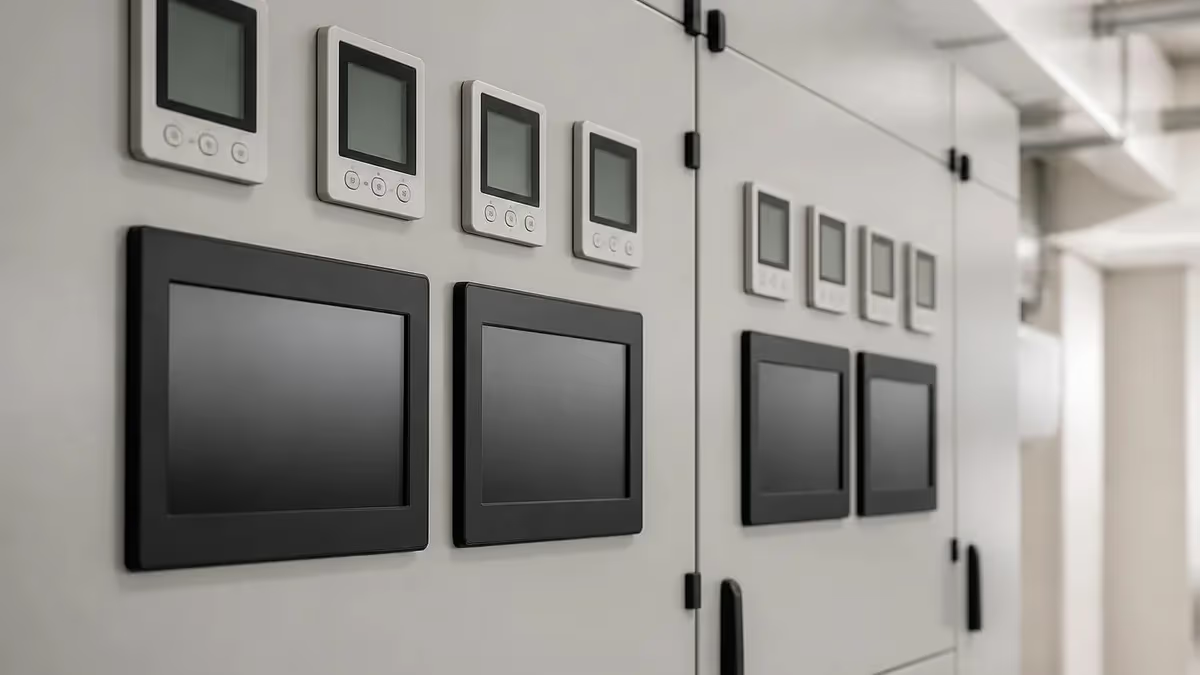
If you have been searching for entry level hvac jobs near me, you are looking at one of the most reliable skilled-trade career paths in the United States. Heating, ventilation, and air conditioning work is in constant demand because every home, office, hospital, and factory depends on climate control year-round. The field rewards people who like hands-on problem solving, do not mind getting dirty, and want to earn a paycheck without spending four years and tens of thousands of dollars on a university degree first. Practice with the free HVAC practice test on PracticeTestGeeks (35 questions with answer explanations).
An entry level position is exactly what it sounds like: a starting role where you learn the trade while you earn. You might be hired as a helper, an apprentice, an installer assistant, or a maintenance technician. Most of these jobs do not require prior experience. Employers want dependable workers who show up on time, follow directions, and are willing to learn. From there, your skills, certifications, and hustle determine how quickly you move up the ladder toward journeyman and master technician status.
The numbers behind this field are encouraging. The U.S. Bureau of Labor Statistics projects faster-than-average growth for HVAC technicians, driven by aging equipment, stricter energy codes, and new construction. Tens of thousands of openings appear each year, many of them at the beginner level. That demand means a motivated person can find work in nearly any city or town, often within weeks of starting their search rather than months of waiting.
Pay starts modestly but climbs fast. A green helper might begin near $16 to $19 an hour, but within two to three years a competent technician can reach $25 to $35 an hour, and specialists or those who move into entry level hvac jobs on the sales and design side can earn well into six figures with commission. Overtime during peak summer and winter seasons adds significantly to annual income, and many shops cover tools, training, and certification costs.
This guide walks you through everything a newcomer needs to know. We cover the real job titles you will see in listings, the daily duties you should expect, the certifications that open doors, the pros and cons of the work, and a practical roadmap to get hired. Whether you are fresh out of high school, switching careers, or leaving the military, the path into HVAC is clearer and more accessible than most people assume it to be.
We will also be honest about the challenges. HVAC work can be physically demanding, the hours stretch during emergencies, and the learning curve is steep at first. But for people who stick with it, the trade offers stability, mobility, and the eventual freedom to run your own business. Read on for a complete, practical look at what entry level HVAC work really involves and how to land your very first role in the trade.
Free HVAC Study Tools
Interactive HVAC resources on PracticeTestGeeks, free to start:
- HVAC EPA 608 Refrigerant Certification — 35 questions with instant scoring and answer explanations
- HVAC flashcards — review key terms and concepts card by card
- HVAC study guide — topic-by-topic overview of what the exam covers
- HVAC cheat sheet — one-page printable summary for last-minute review
Entry Level HVAC Jobs by the Numbers

Common Entry Level HVAC Roles You Will See
The most common starting point. You assist a lead technician, carry equipment, learn tools, and absorb the trade on the job while earning a wage. No experience required at most shops.
Focuses on new-system installs in homes and buildings. You lift units, run line sets, assemble ductwork, and connect components under supervision, building strong mechanical fundamentals fast.
Performs routine tune-ups, filter changes, coil cleaning, and basic inspections on a service route. A steady, predictable role ideal for learning system behavior and customer interaction.
Shadows experienced techs on repair calls, learning diagnostics, refrigerant handling, and electrical troubleshooting. A direct pipeline toward higher-paid service and repair work.
Handles parts, inventory, and scheduling. Not field work, but a foot in the door that lets you learn the business while transitioning into a technical role over time.
The day-to-day reality of an entry level HVAC job depends on which role you land, but several duties are nearly universal for newcomers. Expect to spend your first months as the extra set of hands: loading the truck, fetching tools, carrying condensing units, and keeping job sites clean and safe. These tasks may feel menial, but they are how you learn the equipment, the layout of a system, and the rhythm of a professional crew. Reliability here earns you the trust that leads to more technical assignments down the road.
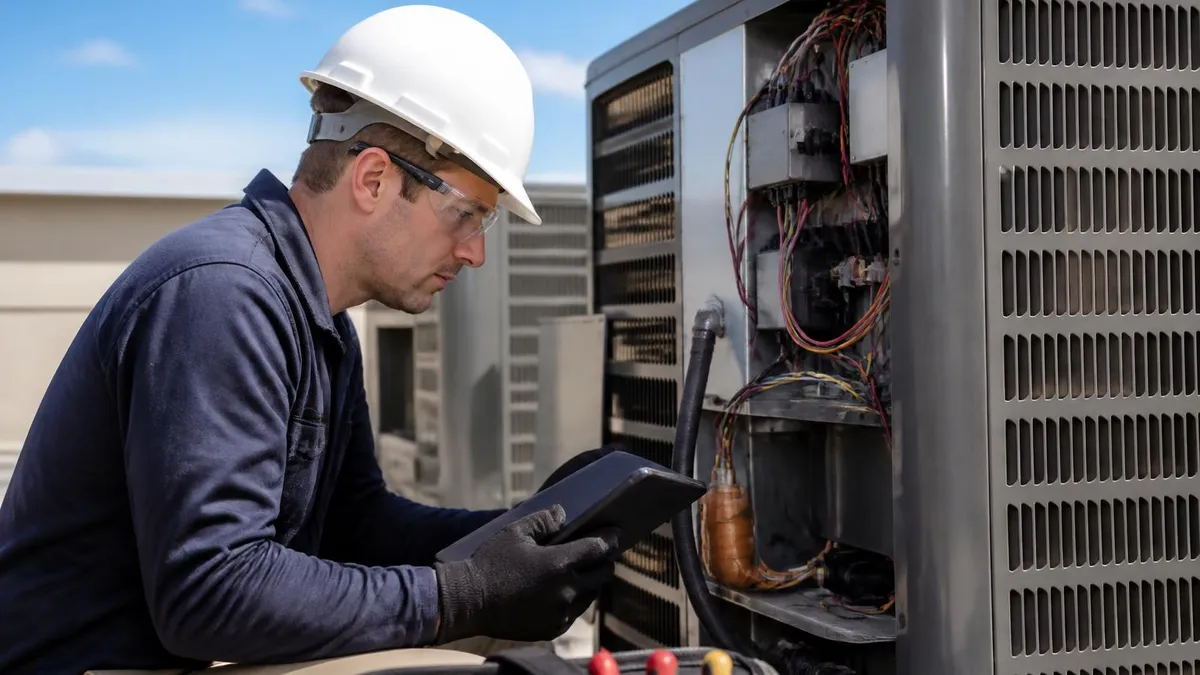
On installation jobs, beginners help set air handlers, position outdoor condensers on pads, assemble and hang sheet-metal or flex ductwork, and pull refrigerant line sets through walls and attics. You will learn to read basic mechanical drawings, level equipment, and torque fittings correctly. Mistakes at this stage are caught and corrected by the lead, which is exactly why the apprentice model works so well. Every install teaches you something a textbook cannot about how real buildings and systems actually behave.
Maintenance routes introduce you to the diagnostic side of the trade. You will replace filters, wash condenser coils, clear condensate drains, check refrigerant charge with gauges, tighten electrical connections, and measure temperature splits across the evaporator. Documenting your findings teaches you what a healthy system looks like, which makes spotting a failing one far easier later. Many techs say maintenance work is the single best teacher for a beginner because of the sheer volume of equipment you get to touch.
Service and repair trainees ride along on no-cool and no-heat calls, the bread and butter of any HVAC business. Here you watch a seasoned tech follow a logical troubleshooting sequence: confirm the complaint, check power and thermostat, inspect the capacitor and contactor, verify airflow, then measure refrigerant pressures. Learning this disciplined approach early separates good technicians from parts-changers who guess. You will also start interacting with customers, explaining problems in plain language and building the trust that drives repeat business.
Safety is woven into every duty. You will learn lockout-tagout for electrical work, proper ladder and lift use, refrigerant handling rules, and how to recognize carbon monoxide hazards on combustion equipment. Personal protective equipment such as gloves, safety glasses, and steel-toe boots becomes second nature. A good shop drills safety constantly because a single careless moment with electricity, pressurized refrigerant, or a gas furnace can cause serious injury. Treating safety seriously marks you as a professional from your very first day.
Finally, expect administrative and soft-skill duties that surprise many newcomers. You will fill out service tickets, photograph completed work, log refrigerant usage for EPA compliance, and communicate with dispatch. Punctuality, a clean appearance, and respectful customer interaction matter as much as technical skill, especially in residential work where you are a guest in someone's home. Mastering these habits early makes you the kind of helper a lead technician actually wants to bring along and invest time in training.
Training Paths Into Entry Level HVAC Jobs
Many people enter HVAC with no schooling at all by getting hired as a helper and learning entirely on the job. A shop pays you while a lead technician teaches you the trade in real working conditions. This path costs nothing in tuition and starts earning immediately, which appeals to career-changers and anyone who learns best by doing rather than sitting in a classroom for months on end.
The trade-off is a slower, less structured climb. You learn what your particular shop does and may miss theory that a formal program covers. To offset this, pair on-the-job work with self-study and your EPA 608 certification. Combining real experience with deliberate learning lets you advance toward journeyman level on roughly the same timeline as a trade-school graduate, often without taking on any debt at all.
Is an Entry Level HVAC Job Right for You?
- +Strong, recession-resistant demand in every region
- +Earn a wage while you learn with little or no debt
- +Clear advancement path to journeyman and business owner
- +Hands-on, varied work instead of a desk job
- +Employers often pay for tools and certifications
- +Overtime and seasonal peaks boost annual income
- +Skills transfer anywhere you choose to live
- −Physically demanding with heavy lifting and tight spaces
- −Hot attics in summer and cold rooftops in winter
- −Long or on-call hours during peak heating and cooling seasons
- −Steep early learning curve with lots to memorize
- −Lower starting pay until you gain experience
- −Exposure to electrical, refrigerant, and gas hazards
- −Customer-facing pressure on emergency service calls
Pros and Cons at a Glance
| Pros | Cons |
|---|---|
| Strong, recession-resistant demand in every region | Physically demanding with heavy lifting and tight spaces |
| Earn a wage while you learn with little or no debt | Hot attics in summer and cold rooftops in winter |
| Clear advancement path to journeyman and business owner | Long or on-call hours during peak heating and cooling seasons |
| Hands-on, varied work instead of a desk job | Steep early learning curve with lots to memorize |
| Employers often pay for tools and certifications | Lower starting pay until you gain experience |
| Overtime and seasonal peaks boost annual income | Exposure to electrical, refrigerant, and gas hazards |
Checklist to Land Entry Level HVAC Jobs Near Me
- ✓Earn your high school diploma or GED.
- ✓Get a clean, valid driver's license and reliable transportation.
- ✓Study for and pass the EPA Section 608 certification exam.
- ✓Build a basic tool kit or confirm the shop supplies tools.
- ✓Take practice tests to sharpen core HVAC knowledge.
- ✓Write a simple resume highlighting reliability and mechanical aptitude.
- ✓Apply to local contractors, supply houses, and trade-school job boards.
- ✓Search online listings using 'HVAC helper' and 'HVAC apprentice'.
- ✓Prepare to discuss your willingness to learn in interviews.
- ✓Follow up promptly after every application and interview.
Get Your EPA 608 Early
Federal law requires anyone who handles refrigerant to hold EPA Section 608 certification. Earning it before or just after you start work signals real commitment and makes you far more useful on day one. Many employers will hire you without it, but having it already done puts your resume at the top of the pile.
Compensation in HVAC follows a predictable and rewarding arc. Entry level helpers and apprentices typically start somewhere between $16 and $20 per hour depending on region, with higher cost-of-living areas paying more. That may sound modest, but unlike many starting jobs, it comes with a built-in raise schedule tied to your growing skill. Every certification you earn and every system you master gives you concrete use to ask for more, and good shops reward technicians who level up quickly with steady raises.
Within one to three years, a technician who applies themselves can reach the $25 to $35 per hour range as they take on independent service calls and diagnostics. The BLS reports a median annual wage near $48,000 for HVAC technicians overall, but that figure hides wide variation. Top earners in the trade, including those in commercial refrigeration, controls, and specialized industrial work, regularly exceed $75,000 to $90,000, especially when overtime is factored into the picture.
Seasonality is a major income driver. During the brutal heat of summer and the coldest weeks of winter, demand for repairs spikes and overtime becomes plentiful. Many technicians earn a substantial share of their annual income during these peak windows, working extra hours at premium pay. Learning to manage your energy and finances around these cycles is part of becoming a seasoned pro who thrives in the trade rather than burning out after a couple of brutal seasons.
Advancement is where HVAC really shines as a career. After gaining experience as a service technician, common next steps include lead technician, service manager, project estimator, or controls specialist. Each step adds responsibility and pay. The trade also offers lateral moves into related, often higher-paying niches such as design, energy auditing, and equipment sales, where technical credibility combined with people skills commands strong commissions and bonuses on top of base pay.
Geography matters too. A technician's skills transfer across state lines with minimal friction, so you can chase opportunity to growing markets or follow family without restarting your career. Some regions, particularly fast-growing Sun Belt cities and dense metro areas, face acute technician shortages and pay premiums to fill them. Researching local pay scales before you accept an offer ensures you are not leaving money on the table early in your career, when habits and expectations get set.
The ultimate advancement, for many, is ownership. A large share of HVAC business owners started exactly where you are now, carrying tools for someone else. After years of field experience and perhaps a master's license, they launched their own service company. Owning a shop transforms the trade from an hourly job into a scalable business with employees, recurring maintenance contracts, and equity you can eventually sell. Few entry level paths anywhere offer that kind of long-term ceiling.
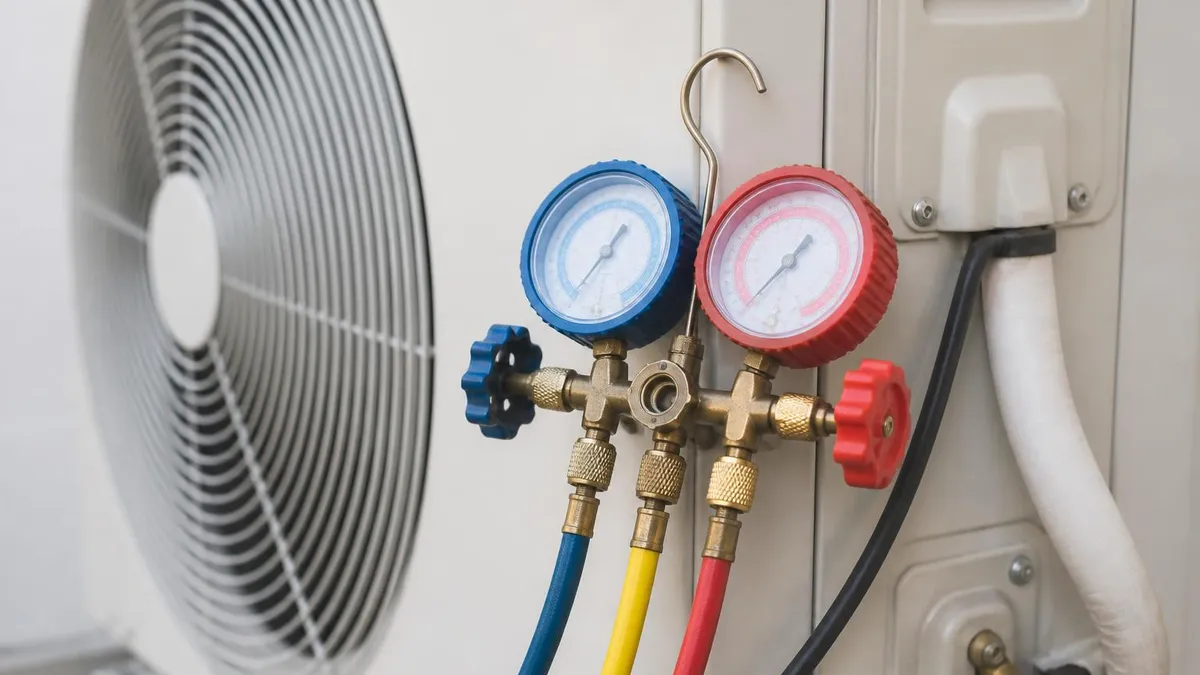
Handling refrigerant without EPA 608 certification is illegal and can trigger heavy fines for you and your employer. Improper venting also harms the environment and violates federal Clean Air Act rules. Always log refrigerant use and recover, never vent, when servicing any equipment.
Success in an entry level HVAC job depends on a blend of mechanical aptitude, basic math, and people skills. You do not need to be a genius, but you should be comfortable with fractions, simple algebra, and reading measurements, because sizing equipment and calculating airflow rely on numbers. Mechanical curiosity, the kind that makes you want to understand how a system works rather than just swapping parts, is the single best predictor of who thrives and who plateaus in this trade over time.
The tools of the trade become extensions of your hands over time. Beginners should be familiar with basic hand tools such as screwdrivers, nut drivers, adjustable wrenches, and pliers, plus a quality multimeter for electrical work. As you advance you will add refrigerant gauges, a vacuum pump, recovery machine, leak detector, and a digital manifold. Many shops supply the expensive specialty equipment, but owning your own reliable hand tools shows professionalism and keeps you productive on every call.
Electrical knowledge is non-negotiable. A huge share of HVAC failures are electrical: bad capacitors, burned contactors, failed relays, and wiring faults. Understanding voltage, amperage, resistance, and basic circuits lets you diagnose confidently instead of guessing. Practice tests on electrical controls are an excellent low-stakes way to build this knowledge before you face a live panel, where a mistake can be dangerous or destroy expensive components. This is foundational skill that genuinely pays to study hard early.
Refrigeration theory ties the whole trade together. Knowing how the refrigerant cycle moves heat, what superheat and subcooling mean, and how pressures relate to temperatures lets you interpret gauge readings and judge whether a system is correctly charged. Beginners often find this concept abstract at first, but it clicks with repetition and hands-on practice. Mastering it early sets you apart from helpers who can only follow rote instructions without understanding why a system behaves the way it does in the field.
Soft skills round out the technical foundation. HVAC technicians spend their days in customers' homes and businesses, so communication, honesty, and a tidy professional appearance directly affect your success. Being able to explain a repair in plain terms, give an honest assessment, and treat a property with respect builds the trust that generates reviews, referrals, and repeat business. Those same skills become essential if you ever move toward entry level hvac jobs with a customer-facing focus.
Finally, develop a learning mindset that lasts your whole career. Equipment evolves constantly, from variable-speed compressors to smart thermostats and low-GWP refrigerants. The technicians who earn the most are the ones who keep studying, attend manufacturer trainings, and stay current with code changes. Treating your first job as the start of lifelong learning, rather than a fixed skill set, is what eventually carries you from carrying tools to running your own truck or full business.
With the background covered, here is the practical playbook for actually landing your first HVAC role. Start by casting a wide net. Search job boards for terms like 'HVAC helper,' 'HVAC apprentice,' 'install assistant,' and 'maintenance technician trainee.' Apply to a mix of large regional companies, which offer structured training, and small local shops, which often teach you a broader range of skills faster because you do a little of everything. Do not wait to feel fully qualified; entry level means they expect to train you.
Make your application stand out without padding it. Employers hiring beginners screen primarily for reliability and attitude, so emphasize any history of punctuality, physical work, customer service, or mechanical hobbies. A candidate who shows up to the interview on time, dressed neatly, with a clean driving record and an EPA 608 already in hand will beat a more experienced but flaky applicant nearly every time. References from prior employers who can vouch for your dependability carry real weight in hiring.
Prepare for the interview by being ready to answer one core question honestly: are you willing to learn and work hard in tough conditions? Talk about your interest in the trade, your understanding that the work is physical, and your goal to grow into a skilled technician. If you have taken practice tests or watched instructional content, mention it. Demonstrating that you have already invested effort before being paid signals exactly the initiative shops want in a long-term, dependable hire.
Once hired, your first ninety days set your trajectory. Show up early, keep your truck and tools organized, ask thoughtful questions, and never pretend to know something you do not. Lead technicians notice helpers who are eager and teachable, and they reward them with more responsibility. Keep a notebook of what you learn on each call, review it at night, and connect it to the theory you study. This deliberate habit accelerates your climb up the ladder dramatically over the first year.
Keep stacking credentials as you work. Beyond EPA 608, pursue manufacturer certifications, NATE certification, and any state licensing your region requires. Each credential raises your pay ceiling and marks you as serious. Many employers reimburse exam fees and offer raises tied directly to certifications, so there is rarely a reason to delay. Treat your free evenings as an investment, using practice tests and study guides to prepare efficiently rather than learning everything the hard way on the job.
Finally, protect your body and your reputation, the two assets that carry an HVAC career. Lift with your legs, stay hydrated in hot attics, wear your protective gear, and never cut corners on electrical or gas safety. Just as important, build a name for honesty and quality work. The trade is smaller than it looks, and a strong reputation follows you to better jobs, higher pay, and eventually your own customers. Start with discipline now, and the entry level job becomes the launchpad for a long, profitable career.
Sample HVAC Practice Questions
Try these questions from our free HVAC practice tests. The correct answer and an explanation follow each question.
When a heat pump switches from cooling to heating mode, which component reverses refrigerant flow direction?
- A. Thermostatic expansion valve
- B. Reversing valve (4-way valve)
- C. Accumulator
- D. Filter drier
Answer: B. Reversing valve (4-way valve)
The reversing valve (four-way valve) redirects refrigerant flow to switch the roles of the indoor and outdoor coils between heating and cooling modes.
A residential heat pump operates correctly in cooling but has poor performance in heating mode. What should be suspected?
- A. Dirty air filter
- B. Defrost control malfunction
- C. Low refrigerant charge
- D. Faulty contactor
Answer: B. Defrost control malfunction
A faulty defrost control prevents the heat pump from clearing ice from the outdoor coil, drastically reducing heating capacity.
What is the maximum fill level (by weight) allowed when filling a refrigerant recovery cylinder?
- A. 100% of the cylinder's rated capacity
- B. 80% of the cylinder's rated capacity
- C. 90% of the cylinder's rated capacity
- D. 70% of the cylinder's rated capacity
Answer: B. 80% of the cylinder's rated capacity
Recovery cylinders must not be filled beyond 80% of their rated capacity to allow for liquid refrigerant expansion with temperature changes.
Which of the following is an 'internal gain' source that adds to the cooling load in a building?
- A. Exterior wall conduction
- B. Occupants, lighting, and appliances
- C. Outdoor air infiltration only
- D. Ground-floor slab conduction
Answer: B. Occupants, lighting, and appliances
Internal gains from people, lights, and equipment add sensible and latent heat directly to the conditioned space, increasing the required cooling capacity.
HVAC Questions and Answers
HVAC Sales: The Complete Guide to Selling Heating and Cooling Systems, Building Customer Trust, and Closing More Deals
HVAC Air Duct Sealing: The Complete Homeowner and Contractor Guide to Sealing Ductwork for Efficiency, Comfort, and Indoor Air Quality

HVAC Drain Pan: Complete Guide to Function, Maintenance, and Troubleshooting
HVAC Solutions: The Complete Guide to Heating, Cooling, and Indoor Air Quality Systems for Homes and Buildings

Commercial HVAC Repair: Systems, Costs, and Service Strategies
How this page was made: written with AI tools. We have not yet matched this exam's facts to an official source, so confirm fees, dates and rules with the exam body. Not reviewed by a subject-matter expert. Editorial policy