
HVAC Technician Pay: Complete Salary Guide, Factors That Boost Your Income, and How to Maximize Your Earning Potential
Learn what HVAC technician pay looks like in 2026 — 🏆 average salaries, top-paying states, certifications that raise your income, and career growth tips.
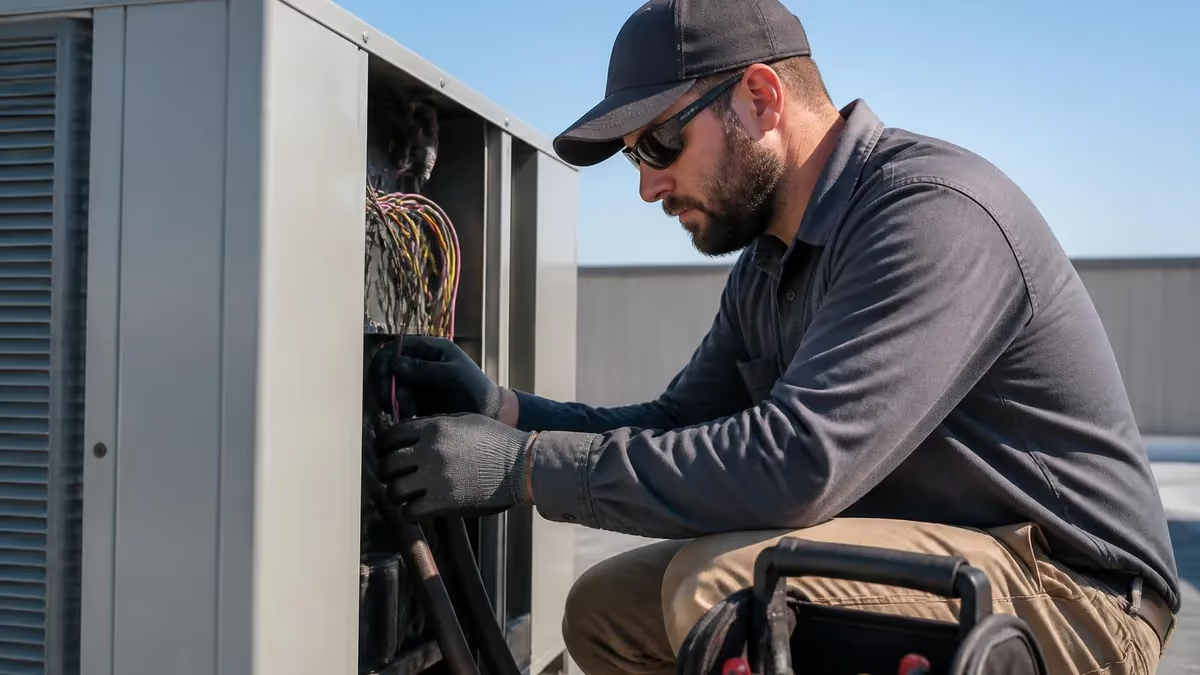
Understanding HVAC technician pay is one of the first things anyone considering this career wants to know — and for good reason. Heating, ventilation, air conditioning, and refrigeration work is skilled, hands-on, and in consistently high demand across every region of the United States. According to the U.S. Bureau of Labor Statistics, the median annual wage for HVAC mechanics and installers sits at approximately $57,300, but experienced technicians in high-cost states or specialized niches regularly earn well above $80,000 per year.
HVAC pay is not a single fixed number. It shifts based on geographic location, years of experience, employer type, certifications held, and whether a technician works residential, commercial, or industrial accounts. A newly certified installer in rural Alabama will take home a very different paycheck than a senior commercial controls technician in New York City or San Francisco. Understanding where you fall on that spectrum — and what levers you can pull to move up it — is the foundation of a smart HVAC career plan.
The skilled trades have enjoyed a sustained wage resurgence since the mid-2010s, and HVAC has been among the biggest beneficiaries. An aging infrastructure, tightening energy-efficiency regulations, and a shortage of qualified technicians entering the workforce have collectively driven wages upward faster than many white-collar fields. The U.S. Bureau of Labor Statistics projects HVAC employment to grow by roughly 9 percent through 2032 — well above the national average for all occupations — which means competitive compensation should remain a feature of this career for years to come.
Entry-level technicians starting through an apprenticeship or trade school program typically earn between $18 and $24 per hour, translating to roughly $37,000 to $50,000 annually. That number rises sharply after two to four years of field experience. Journey-level technicians commonly earn $28 to $38 per hour, and those who pick up specialized skills in refrigerants, building automation systems, or commercial chillers can push well past $45 per hour in competitive markets. Overtime pay, on-call premiums, and performance bonuses further boost annual compensation beyond base hourly rates.
Employer type is another major variable. Union technicians working under collective bargaining agreements — particularly in large metropolitan areas — benefit from negotiated wage scales, defined benefit pensions, and rich benefit packages that non-union workers rarely match. Independent contractors and business owners trade that stability for higher ceiling income, sometimes doubling or tripling what an employee earns once the business is established, though they also absorb overhead and insurance costs. Franchise and large national service companies tend to offer middle-ground pay with reliable benefits and structured advancement tracks.
Certifications play an outsized role in determining where your earnings land relative to peers with similar years of experience. EPA 608 certification is a legal requirement to handle refrigerants, but credentials like NATE (North American Technician Excellence), HVAC Excellence, and manufacturer-specific training from brands like Carrier, Trane, or Lennox can add several dollars per hour to your market value almost immediately. Employers actively recruit certified technicians because they require less oversight and can handle a wider range of service calls independently.
This guide breaks down HVAC technician pay by experience level, state, specialty, and certification, and gives you a concrete roadmap for maximizing your income throughout your career. Whether you are just researching trade school options or looking to negotiate your next raise, the salary data and strategies here will help you make informed decisions. You can also explore hvac technician pay opportunities in the sales side of the industry, where top performers in equipment and service sales can earn six-figure commission-based incomes.
HVAC Technician Pay by the Numbers
HVAC Technician Pay by Experience Level
Apprentices and helpers typically earn $18–$24/hr ($37,000–$50,000 annually). Pay is often tied to apprenticeship wage scales that step up every 6 to 12 months as skills are demonstrated and hours accumulate.
Fully certified technicians who can handle service calls independently average $28–$38/hr ($58,000–$79,000 annually). Specializations in refrigeration, controls, or commercial systems push wages toward the top of this range quickly.
Senior techs and lead installers earn $38–$50/hr ($79,000–$104,000 annually). These roles often include training newer technicians, managing complex commercial jobs, and serving as technical escalation points for the service team.
Moving into supervisory roles adds $5–$15/hr above senior technician rates, with salaries regularly exceeding $90,000. Responsibilities include job scheduling, labor coordination, client communication, and material procurement.
Geographic location is arguably the single biggest determinant of HVAC technician pay outside of pure experience. States with high costs of living, strong union presence, or extreme climates that drive year-round HVAC demand consistently top the salary charts. California, Massachusetts, Washington, Illinois, and New York regularly rank among the highest-paying states for HVAC technicians, with mean annual wages ranging from $68,000 to over $82,000. These states combine high labor costs, strong building codes, and dense commercial infrastructure to create strong, competitive markets for skilled tradespeople.
Alaska and Hawaii present interesting cases: both states offer above-average HVAC wages — often exceeding $75,000 — driven by logistical challenges, extreme weather conditions, and a limited pool of available technicians. Employers in these states must pay premiums to attract and retain talent, and the physical demands of working in these environments are reflected in compensation. Remote or rural postings sometimes include housing allowances or per diem payments on top of base wages, further boosting total compensation.
The Sun Belt states — Texas, Florida, Arizona, and Nevada — offer a different value proposition. Nominal wages in these states ($52,000–$62,000 on average) are lower than in the Northeast or West Coast, but so is the cost of living. Purchasing power-adjusted compensation in Phoenix, Dallas, or Las Vegas can rival or exceed what a technician earns in Los Angeles once housing costs are factored in. The Sun Belt also offers virtually year-round cooling season work, meaning fewer seasonal layoffs and more consistent overtime opportunities than northern states where heating dominates and summer work slows.
Metropolitan areas within any state pay substantially more than their rural counterparts. The Boston, San Francisco, Chicago, Seattle, and New York City metro areas all support HVAC wages 20–35 percent above their state averages because commercial building density is high, unionization rates are improved, and the cost of living drives all labor costs upward. Technicians who are willing to commute into urban cores from lower-cost suburbs can capture city wages while managing housing costs more effectively — a strategy many experienced technicians deliberately pursue.
Rural markets have their own advantages, particularly for technicians who are willing to run their own business. In areas with few competitors, an experienced technician with a truck and tools can command premium service rates simply because of limited local supply. Small-town HVAC business owners who serve a 50-mile radius often gross $150,000–$250,000 annually, converting healthy margins into owner earnings that exceed urban employee wages. The tradeoff is customer acquisition effort, business management overhead, and the absence of benefits that come with employment.
Regional climate also shapes which skills carry premium pay. In the northern tier of states — Minnesota, Wisconsin, Michigan, and the Dakotas — expertise in high-efficiency heating systems, heat pumps, and boilers is particularly valuable because the heating season is long and equipment failures in winter are urgent emergencies that customers pay premium rates to fix quickly. Conversely, in the deep South and desert Southwest, superior knowledge of high-efficiency cooling systems, refrigerant handling, and indoor air quality commands top rates because air conditioning is a year-round necessity rather than a seasonal comfort.
The mid-Atlantic region — Pennsylvania, Virginia, Maryland, and the Carolinas — represents a balanced market where both heating and cooling work drive demand throughout the year. These states have seen particularly strong wage growth over the past five years as construction booms in the Research Triangle, Northern Virginia tech corridor, and suburban Philadelphia have created more commercial HVAC work than the local workforce can efficiently supply. Technicians in these growth corridors have real negotiating use with employers who are actively competing for skilled labor.
HVAC Practice Test Questions
Prepare for the HVAC - Heating Ventilation and Air Conditioning exam with our free practice test modules. Each quiz covers key topics to help you pass on your first try.
HVAC Air Conditioning
HVAC Exam Questions covering Air Conditioning. Master HVAC Test concepts for certification prep.
HVAC Code Compliance
Free HVAC Practice Test featuring Code Compliance. Improve your HVAC Exam score with mock test prep.
HVAC Electrical Controls
HVAC Test Prep for Electrical Controls. Practice HVAC Quiz questions and boost your score.
HVAC Energy Efficiency
HVAC Questions and Answers on Energy Efficiency. Free HVAC practice for exam readiness.
HVAC Heating Systems
HVAC Mock Test covering Heating Systems. Online HVAC Test practice with instant feedback.
HVAC Load Calculations
Free HVAC Quiz on HVAC Load Calculations. HVAC Exam prep questions with detailed explanations.
HVAC Tools and Equipment
HVAC Practice Questions for HVAC Tools and Equipment. Build confidence for your HVAC certification exam.
HVAC Refrigeration
HVAC Test Online for Refrigeration. Free practice with instant results and feedback.
HVAC Safety Practices
HVAC Study Material on Safety Practices. Prepare effectively with real exam-style questions.
HVAC System Design
Free HVAC Test covering System Design. Practice and track your HVAC exam readiness.
HVAC Thermodynamics
HVAC Exam Questions covering Thermodynamics. Master HVAC Test concepts for certification prep.
HVAC Specialty Pay Breakdown
Residential HVAC technicians earn an average of $52,000–$68,000 annually, with top performers in high-demand markets reaching $80,000 or more. Residential work involves frequent customer interaction, a wide variety of equipment brands, and the ability to diagnose and repair systems quickly on the first visit. Technicians who develop strong soft skills alongside technical knowledge tend to earn significantly more through repeat business and referrals.
Service and maintenance technicians in residential settings often earn more per hour than installers because diagnostics and repair require deeper knowledge and direct client billing. Flat-rate pricing systems, common in residential service, reward fast, accurate technicians who can complete multiple calls per day. Top residential service techs completing six to eight calls daily in premium markets routinely out-earn their commercial peers on a pure hourly-equivalent basis.

Is HVAC a High-Paying Trade Career Worth Pursuing?
- +Median salary well above the national median for all occupations at $57,300+
- +Strong and consistent job growth projected through 2032 — 9% above average
- +Multiple paths to six-figure income without a four-year college degree
- +Overtime, on-call, and emergency call premiums significantly boost annual take-home pay
- +Specializations in commercial, industrial, or refrigeration dramatically increase earning ceiling
- +Self-employment and business ownership offer income potential well beyond employee wages
- −Entry-level wages of $18–$24/hr require patience while skills and certifications accumulate
- −Physical demands — heavy lifting, tight spaces, extreme temperatures — take a toll long-term
- −Seasonal income swings can occur in regions where only heating or cooling dominates
- −Certification and tool costs are significant upfront investments for new technicians
- −On-call rotation and emergency service expectations can disrupt personal schedules
- −Income ceiling as an employee is lower than running your own business, but business risk is real
Certifications and Steps That Raise HVAC Technician Pay
- ✓Earn EPA 608 Universal certification — required to handle any refrigerant, boosts hiring eligibility immediately.
- ✓Pass NATE certification in your primary specialty to demonstrate verified competency to employers.
- ✓Complete manufacturer training with Carrier, Trane, Lennox, or Daikin to qualify for premium service contracts.
- ✓Pursue HVAC Excellence certification to signal professional-level skill and commitment to career growth.
- ✓Obtain a state journeyman or master HVAC license to unlock higher-tier job postings and pay bands.
- ✓Add low-voltage and electrical certifications to handle building automation and controls work independently.
- ✓Learn BACnet, Modbus, or Niagara Framework basics to qualify for commercial building automation roles.
- ✓Complete an EPA 609 certification if you service automotive HVAC systems as part of your workload.
- ✓Accumulate documented continuing education hours annually to maintain certifications and demonstrate commitment.
- ✓Build a portfolio of complex service calls and project completions to support salary negotiation conversations.
NATE-Certified Technicians Earn Up to 20% More
Research consistently shows that NATE-certified HVAC technicians command wages 15–20 percent higher than non-certified peers with equivalent years of experience. Employers value NATE certification because it reduces callbacks, improves first-call resolution rates, and signals a technician who invests in professional development. If you hold only EPA 608, adding NATE certification is the single highest-ROI credential move available to most working technicians.
Maximizing your HVAC income over a career is less about luck and more about deliberate choices made at key transition points. The first major decision is where to work right after certification. Joining a union apprenticeship in a major metro market will give you structured wage increases, comprehensive benefits, and a clear path to journey-level status — but it will also lock you into a geographic market and a specific pace of advancement.
Working for a large national service contractor gives you broad equipment exposure, structured training, and a benefits package, but wage ceilings are often compressed compared to union or specialty shop pay.
The smartest early-career move for most technicians is to prioritize breadth of equipment experience over immediate pay. A technician who spends their first five years working on a wide variety of equipment brands, system types, and building sizes will be dramatically more valuable in year six than one who spent those same years doing routine maintenance on a single brand of rooftop units. Breadth gives you diagnostic confidence, negotiating use, and the foundation needed to move into specialty or supervisory roles that carry the best pay premiums.
Overtime is not just a bonus — for many technicians it is a systematic income strategy. A technician earning $32 per hour at regular time earns $48 per hour in overtime. Working 10–15 hours of overtime per week during peak heating and cooling seasons can add $15,000–$25,000 to annual income with no change in base pay rate. Technicians who make themselves available for on-call rotation and emergency service calls capture further premium rates — many employers pay 1.5x to 2x for emergency after-hours response — that compound meaningfully over a full year.
Moving into a specialty is the clearest path to breaking past the $80,000 ceiling on standard residential and light commercial work. Commercial chiller technicians, building automation specialists, industrial refrigeration experts, and hospital/data center HVAC technicians all routinely earn $85,000–$110,000 because their skills are scarce, the systems they maintain are critical, and the cost of a mistake is measured in hundreds of thousands of dollars. Each of these specialties requires additional training and certification investment, but the return on that investment is realized within one to two years in most markets.
Service sales is another high-income path that many excellent technicians overlook. Technicians who develop the ability to identify and explain upgrade opportunities to homeowners and facility managers — improved efficiency, indoor air quality, smart thermostats, planned maintenance agreements — add significant revenue to every service call. Companies reward this behavior with commissions, bonuses, or higher base pay. Some technicians discover that they have strong sales aptitude and eventually move into full-time equipment or service sales roles where top performers earn $100,000–$150,000 or more annually.
Starting your own business is the highest-ceiling income strategy in HVAC, but it carries real financial and operational risk. Successful HVAC business owners in mid-size markets typically gross $500,000–$1.5 million annually with a small crew, netting owner earnings of $120,000–$250,000 after expenses.
The critical success factors are a consistent lead flow (which takes time to build), a strong reputation for quality and reliability, and the ability to manage people and money alongside technical work. Most successful HVAC business owners spent at least seven to ten years as employees first, building both their technical skills and their client relationships before going independent.
Regardless of the path you choose, salary negotiation is a skill worth developing deliberately. Research wages in your specific market before any negotiation conversation — state and metro-area data from BLS, trade association surveys, and hiring platforms like Indeed and LinkedIn all provide useful data points. Know your certifications, your callback rate, and any other measurable performance metrics that demonstrate your value. Employers routinely offer lower wages to technicians who accept the first offer, so entering negotiations with market data and specific performance evidence is the most effective way to move pay in your direction.

Without EPA Section 608 certification, you cannot legally purchase or handle regulated refrigerants — which means you cannot independently complete the majority of HVAC service calls. This single credential is the baseline requirement for any pay progression beyond entry-level helper work. If you have not yet passed your EPA 608 exam, prioritize it above all other certifications. Study resources, practice tests, and testing locations are widely available through trade schools and HVAC supply distributors nationwide.
The union versus non-union debate is one of the most persistent conversations in HVAC, and it directly shapes what technicians earn and how their careers develop. Union HVAC technicians — represented primarily by the United Association of Plumbers and Pipefitters (UA) and the Sheet Metal Workers' International Association (SMWIA) — work under collective bargaining agreements that establish minimum wage scales, defined benefit pension contributions, and health insurance coverage. In major urban markets, union journey-level wages routinely exceed $45–$55 per hour before benefits, with pension and insurance contributions adding another $20–$30 per hour in total compensation value.
Non-union technicians have more variability in their compensation — some earn less than their union peers, others earn comparable or higher base wages, particularly in the commercial and industrial specialty sectors. The non-union path typically offers more flexibility in scheduling, geographic mobility, and the ability to advance at whatever pace your skills develop rather than on a negotiated schedule. For entrepreneurial technicians who plan to start their own business, non-union experience often provides more exposure to the business development and customer service aspects of the trade that are essential for eventual self-employment success.
The benefits gap between union and non-union employment has narrowed at larger non-union contractors, many of whom now offer 401(k) matching, health insurance, paid time off, and tool allowances to compete for talent. However, the defined benefit pensions that union contracts include are rare outside of union employment and represent a meaningful component of lifetime compensation for technicians who stay in a union job for a full career. A pension that pays $3,000–$5,000 per month in retirement has an actuarial value of $750,000–$1.25 million — a benefit that non-union technicians must fund entirely through personal savings and 401(k) contributions.
For technicians weighing union versus non-union employment early in their careers, the choice often comes down to geography and career goals. In cities where the UA or SMWIA have strong market presence — Chicago, New York, Boston, Seattle, San Francisco — union wages are so substantially above market that the choice is often clear. In right-to-work states and smaller markets, the union premium is less dramatic, and the flexibility and advancement speed of non-union employment may offer better overall outcomes for ambitious technicians who want to move quickly into supervisory or specialty roles.
Another dimension of the union/non-union question is job security and work continuity. Union technicians working through a hiring hall benefit from a dispatch system that connects them to work when their current project ends, reducing the periods of unemployment that non-union technicians can experience between jobs. This continuity is particularly valuable during economic downturns when construction and commercial renovation work slows — the union's collective bargaining position and work-sharing arrangements help spread available hours across members rather than letting some work full-time while others are laid off entirely.
Whichever path you take, the most important union/non-union consideration is the quality of training available. Union apprenticeship programs — typically five years combining classroom instruction with on-the-job training under journeyman supervision — are among the most comprehensive technical education programs in the trades. Many non-union contractors offer excellent in-house training programs and sponsor employees through trade school and certification courses, but the quality varies widely. Before accepting any HVAC position, ask specifically about the training program, mentorship structure, and how the company supports technicians who want to advance their certifications.
Total compensation transparency is another area where the two paths diverge significantly. Union contracts are public documents that specify every element of compensation, making it easy to compare one contractor's union wage scale against another. Non-union compensation is negotiated individually and often not disclosed openly, which creates information asymmetry that tends to favor employers.
Technicians in non-union settings benefit from actively networking with peers, monitoring job boards, and periodically benchmarking their compensation against current market offers — even if they are not actively looking to change jobs, knowing what your skills are worth in the open market strengthens your negotiating position at review time.
Building a long-term HVAC career strategy means thinking beyond your next paycheck and toward the income you want to be earning five, ten, and twenty years from now. The technicians who reach the top of the HVAC pay scale share several consistent habits: they invest in continuous education even when not required to, they develop soft skills alongside technical skills, and they treat every service call as an opportunity to build a relationship rather than simply complete a transaction. These habits compound over a career in ways that raw technical skill alone cannot replicate.
Continuing education in HVAC is particularly important because the technology keeps changing. Heat pump adoption has accelerated dramatically under updated federal energy efficiency standards. Low-GWP refrigerant transitions driven by EPA regulations and international climate agreements are reshaping what every technician needs to know about refrigerant handling, recovery, and charging procedures.
Building automation and smart thermostat integration is now a standard expectation on commercial accounts rather than a specialty niche. Technicians who stay current with these technology shifts maintain their market value; those who coast on knowledge from five or ten years ago find themselves progressively less competitive for the most desirable positions.
Soft skills are underappreciated drivers of HVAC income, particularly on the residential service side. A technically average technician who communicates clearly with homeowners, explains problems without condescension, shows up on time, and follows up after service calls will earn more tips, generate more referrals, and advance faster than a brilliant technician with poor interpersonal skills. Customer satisfaction scores, which most service companies track and tie to compensation, reward the combination of technical accuracy and communication quality — not technical skill alone.
Networking within the HVAC industry pays dividends throughout a career. Local chapter meetings of ASHRAE, RSES (Refrigeration Service Engineers Society), or regional HVAC contractor associations connect you with peers, distributors, and employers in ways that pure job-board searching cannot replicate. The best-paying job opportunities often circulate through industry networks before they are ever posted publicly, and a recommendation from a trusted peer carries substantially more weight with a hiring manager than an anonymous application. Investing time in industry relationships is an investment in your future earning potential.
For technicians approaching mid-career, the decision about whether to pursue a management track or remain technical is a critical fork in the road. Management roles — service manager, operations manager, branch manager — typically pay $75,000–$110,000 and offer a different kind of career trajectory. They require comfort with people management, scheduling, customer escalations, and business metrics.
Some technicians thrive in these roles; others find that they miss the hands-on technical work and perform better as senior technical specialists or trainers. Neither path is inherently higher-paying over a full career — the key is self-awareness about which environment enables you to perform at your best.
Financial literacy is a skill that the trades do not teach but that dramatically affects career-long earnings outcomes. Understanding how to maximize a 401(k) match, use an HSA effectively, evaluate whether buying tools or having the company supply them makes financial sense, and structure overtime earnings efficiently can add hundreds of thousands of dollars to lifetime financial outcomes.
Many HVAC technicians who earn strong wages nonetheless fail to accumulate wealth because they have not developed the financial management habits that translate income into long-term financial security. Taking time to understand basic personal finance — even through free online resources — is a high-return investment for anyone in the trades.
Finally, the technicians who earn the most over long careers are those who develop a reputation — both locally and within their employer — for reliability, quality, and continuous improvement. In the HVAC industry, reputation travels fast.
A technician known for never having callbacks, for being the one you call when no one else can figure out what is wrong, and for treating customers like people rather than transaction targets will always have employers competing for their time and will always have use in compensation conversations. Building that reputation takes years, but it is the most durable competitive advantage available in this trade.
Related reading: hvac technician pay covers the next step in more detail.
HVAC Questions and Answers
HVAC Sales: The Complete Guide to Selling Heating and Cooling Systems, Building Customer Trust, and Closing More Deals

HVAC Air Duct Sealing: The Complete Homeowner and Contractor Guide to Sealing Ductwork for Efficiency, Comfort, and Indoor Air Quality

HVAC Solutions: The Complete Guide to Heating, Cooling, and Indoor Air Quality Systems for Homes and Buildings

Commercial HVAC Repair: Systems, Costs, and Service Strategies
HVAC Schooling: Complete Training Guide, Program Requirements, and Career Pathways
How this page was made: written with AI tools and published by Nathan Beja, founder of Practice Test Geeks, who is responsible for its content. We have not yet matched this exam's facts to an official source, so confirm fees, dates and rules with the exam body. Not reviewed by a subject-matter expert. Editorial policy