
HVAC News: Industry Trends, Regulations, and What's Changing in 2026 October
Stay current on HVAC news including the R-410A phaseout, 📚 heat pump growth, energy efficiency mandates, IRA incentives, and the HVAC workforce shortage.

HVAC News: Industry Trends, Regulations, and What's Changing in 2026
The HVAC industry is in the middle of its most significant transformation in decades. Refrigerant regulations, energy efficiency mandates, a growing push toward electrification, and a persistent technician shortage are reshaping how systems are designed, installed, and serviced. For technicians, contractors, and building owners, staying current on HVAC news isn't optional — regulatory changes carry real compliance deadlines and financial consequences for those who fall behind.
The biggest immediate story is refrigerant. The EPA's phasedown of R-410A — the dominant refrigerant in residential air conditioning systems for the past 30 years — has fundamentally changed the equipment market starting in January 2025. New residential air conditioning equipment manufactured after January 1, 2025 can no longer use R-410A. Equipment manufacturers have shifted to lower global warming potential alternatives, primarily R-454B and R-32. Technicians who service existing R-410A systems will continue doing so for years, but new installation work has moved to a different refrigerant chemistry with different handling characteristics and safety considerations.
Energy efficiency minimum standards also changed significantly in 2023. The Department of Energy updated SEER (Seasonal Energy Efficiency Ratio) requirements for air conditioners and heat pumps, introducing the SEER2 rating system that tests equipment under more realistic operating conditions. The new minimums — 14 SEER2 for most systems — affect what equipment can be legally installed in different climate regions. Understanding the current regulatory landscape is essential for HVAC technician who are specifying and installing equipment that needs to meet current standards and qualify customers for available rebates and incentives.
The pace of change in HVAC regulations has created a knowledge gap between experienced technicians and current rules. Many journeymen who completed their training before 2020 learned under a different equipment landscape. Refresher training is a business necessity now — contractors who stay current on regulations, equipment changes, and incentive programs win more bids because they can explain rebate eligibility and compliance requirements to customers in ways that competitors haven't kept up with. The business development value of regulatory knowledge compounds over time.
Supply chain issues continue to affect HVAC equipment availability. While the acute shortages of 2021-2022 have largely resolved, lead times remain longer than pre-pandemic norms for some products. High-efficiency cold-climate heat pumps and certain VRF commercial systems have the longest lead times. Contractors planning large commercial installations need to build extended lead times into project planning. Demand for new equipment types — particularly A2L systems and heat pumps — continues to outpace distribution infrastructure in some regions.
- R-410A phaseout: No new R-410A equipment manufacturing after January 1, 2025 — transition to R-454B, R-32, and other A2L refrigerants
- SEER2 standards: Updated efficiency minimums effective January 2023 — new rating methodology for all new residential systems
- IRA heat pump incentives: Up to $2,000 in federal tax credits for heat pump installation through 2032
- Workforce shortage: 45,000+ HVAC technician openings annually according to DOL projections
- Building electrification: Growing number of cities and states moving toward restricting or banning natural gas in new construction
- DOE building codes: New federal energy codes for commercial buildings targeting 30% energy reduction
HVAC Regulatory Timeline: Recent and Upcoming Changes
January 2023 — New SEER2 Efficiency Standards
January 2025 — R-410A Phaseout Begins
2025-2026 — Commercial Refrigerant Transition
Ongoing — IRA Incentive Programs
Ongoing — Building Electrification Mandates
The R-410A Transition: What Technicians Need to Know
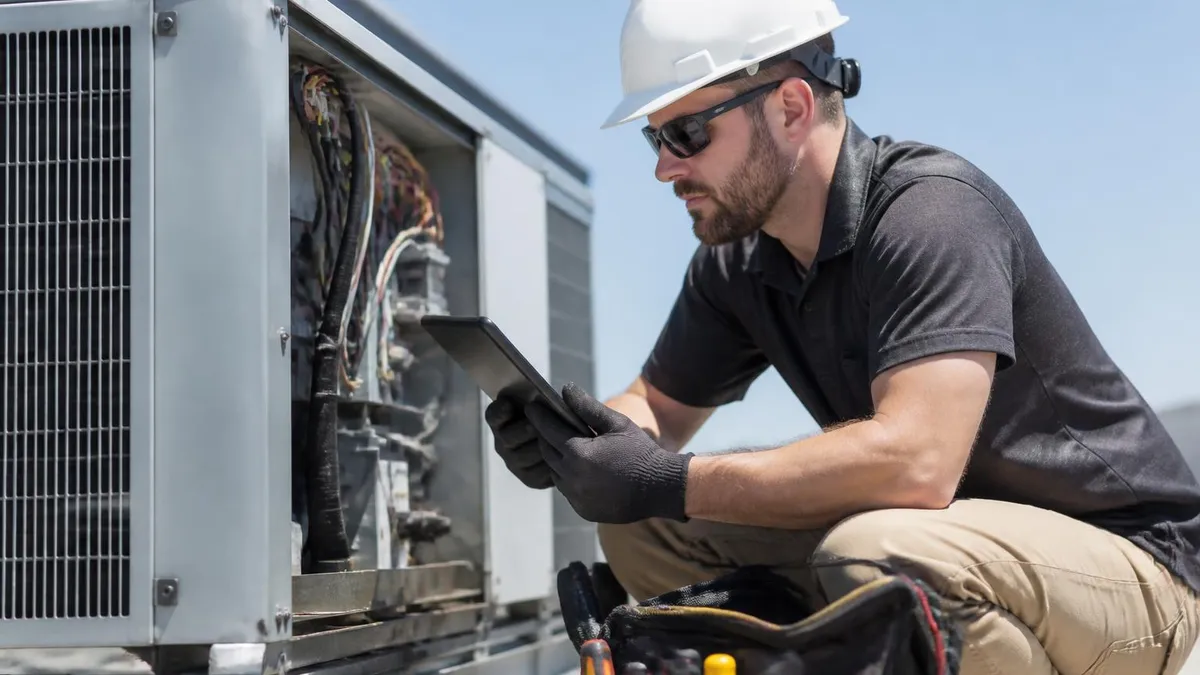
The shift away from R-410A is the most disruptive near-term regulatory change in the HVAC industry. For technicians who have spent years working with R-410A systems, the transition requires learning new refrigerant properties and safety protocols. R-454B (sold under brand names like Puron Advance and Opteon XL41) and R-32 are the dominant replacements for residential AC systems. Both are classified as A2L refrigerants — meaning they're mildly flammable, unlike the non-flammable R-410A.
A2L refrigerants require updated safety practices. They can ignite under certain conditions, though they have much lower flammability than propane (A3) refrigerants and aren't generally considered high-risk in normal HVAC service conditions. Technicians must use A2L-rated recovery equipment, manifold gauges, and leak detectors. Standard R-410A equipment isn't rated for use with A2L refrigerants. Most tool manufacturers have released compatible versions, but technicians need to verify their equipment before working on A2L systems.
The transition also creates a bifurcated service market. Existing R-410A systems — which will remain in use for 15-20 years before equipment reaches end-of-life — still need refrigerant service. R-410A for servicing existing equipment remains available, though prices have risen as supply has tightened with reduced manufacturing.
Technicians must maintain competency with both the old R-410A systems and the new A2L replacements. The regulatory knowledge required — including handling rules, certification requirements, and refrigerant-specific procedures — is tested in EPA 608 certification exams and in practical work covered by HVAC classes that have updated their curriculum for the new refrigerant landscape.
Equipment manufacturers have largely completed their R-410A to A2L transitions for new residential equipment lines. Carrier, Trane, Lennox, Rheem, and other major manufacturers now offer A2L product lines as their primary residential equipment. Contractors who bid installation jobs need to factor in whether their crews are trained and equipped for A2L work and whether their vehicles and shops have appropriate ventilation and storage requirements for mildly flammable refrigerants. The industry has been preparing for this transition for years, but the first full year under the new rules continues to reveal practical implementation challenges.
Major HVAC Industry Trends in 2026
Heat pump installations are growing rapidly, driven by IRA tax credits, state mandates, and improved cold-climate performance. Cold-climate heat pumps now operate efficiently at temperatures well below 0°F, removing the main objection for northern markets.
The shift from R-410A to A2L refrigerants (R-454B, R-32) is reshaping equipment, tools, and training. All new residential AC systems use A2L refrigerants; existing R-410A systems continue being serviced with reclaimed refrigerant.
Federal heat pump tax credits (up to $2,000/year) and state rebate programs are generating significant replacement demand. Contractors who understand IRA incentives can win more jobs by helping customers navigate available savings.
New commercial building energy codes and EPA reporting requirements are driving HVAC system upgrades in offices, retail, and industrial facilities. Building automation and controls work is growing fastest within this segment.
Smart thermostats, demand response programs, and grid-interactive HVAC systems are becoming mainstream. Technicians who can install and configure connected systems command premium rates.
The technician shortage is driving investment in apprenticeship programs, community college partnerships, and workforce development funding. States are dedicating IRA-funded workforce training dollars to HVAC and other skilled trades.
Heat Pumps: The Growing Centerpiece of HVAC
Factors driving heat pump adoption:
- Federal tax credits: IRA Section 25C provides up to $2,000/year in federal tax credits for heat pumps meeting efficiency thresholds — the largest residential HVAC credit in history
- State rebate programs: Many states are running additional rebate programs on top of federal credits, in some cases covering 50-100% of installation cost for lower-income households
- Technology improvement: Cold-climate heat pumps from Bosch, Mitsubishi, Daikin, and others now operate efficiently at -13°F to -22°F, a major improvement over older models
- Electrification policy: City and state natural gas bans in new construction are making heat pumps the default option for new building heating
- Running cost advantages: In states with moderate electricity rates, heat pumps can significantly reduce annual heating costs compared to electric resistance heating
HVAC Workforce Shortage: What's Being Done
The HVAC industry faces a structural workforce shortage that's projected to worsen before it improves. The DOL estimates over 45,000 HVAC job openings annually from both new demand and replacement of retiring technicians. The average HVAC technician is over 40 years old, meaning a substantial portion of the experienced workforce will retire within the next decade. Community college programs and apprenticeship pipelines are producing graduates, but not fast enough to keep pace with demand growth driven by equipment replacement cycles and electrification.
The IRA included significant workforce development funding. The Department of Energy allocated dollars to state energy offices specifically for skilled trades training, with HVAC technicians among the priority occupations. States are implementing programs with varying approaches: some provide direct grants to community colleges to expand HVAC programs, others subsidize apprenticeship program costs for small contractors, and others fund incumbent worker training to help existing technicians get A2L refrigerant and heat pump certifications.
Industry associations are also responding. ACCA (Air Conditioning Contractors of America), ASHRAE, and AHRI have developed training materials and certification programs specifically for the refrigerant transition and heat pump installation. Manufacturers including Carrier, Trane, and Daikin are running free or subsidized training programs for contractor partners to ensure their installer networks are competent with new equipment lines.
The technicians who invest in these certifications now position themselves well in a market where A2L and heat pump expertise commands a premium. Structured HVAC apprenticeship programs remain the most comprehensive path to full technician competency and are specifically being expanded through workforce development funding to address the shortage.
HVAC Technician: Staying Current in 2026
- ✓Get A2L refrigerant training — required for all new residential AC/heat pump installation
- ✓Verify your recovery equipment and gauges are rated for A2L refrigerants
- ✓Complete cold-climate heat pump installation training from a major manufacturer
- ✓Learn the IRA tax credit qualification requirements to advise customers on eligible upgrades
- ✓Update EPA 608 knowledge for new refrigerant safety protocols
- ✓Review SEER2 rating system to accurately compare equipment efficiency
- ✓Attend regional ACCA or ASHRAE chapter events to stay current on local market trends
- ✓Complete any available state-funded A2L or heat pump training programs
- ✓Review your state's building code changes affecting ductwork and equipment installation
- ✓Monitor refrigerant prices and availability — R-410A supply is tightening as production winds down
R-410A Phaseout: Industry Impact
- +Lower global warming potential refrigerants reduce HVAC's environmental footprint
- +A2L refrigerants are more energy efficient than R-410A in equivalent applications
- +Transition drives equipment refresh demand — good for contractors and distributors
- +Early A2L adopters build expertise that differentiates them from slower-moving competitors
- +IRA incentives timing aligns with equipment transition — customers have financial motivation to upgrade
- −Significant capital investment needed for A2L-compatible tools and equipment
- −Training costs for crews to safely handle mildly flammable refrigerants
- −R-410A system owners face higher service costs as refrigerant supply tightens over time
- −Equipment compatibility confusion — not all existing systems can use drop-in replacements
- −Transition period creates inventory management complexity for distributors and contractors
Pros and Cons at a Glance
| Pros | Cons |
|---|---|
| Lower global warming potential refrigerants reduce HVAC's environmental footprint | Training costs for crews to safely handle mildly flammable refrigerants |
| Transition drives equipment refresh demand — good for contractors and distributors | Equipment compatibility confusion — not all existing systems can use drop-in replacements |
| IRA incentives timing aligns with equipment transition — customers have financial motivation to upgrade | Transition period creates inventory management complexity for distributors and contractors |

Energy Efficiency Standards and What They Mean for Contractors
The SEER2 transition in 2023 changed the fundamental metric by which residential HVAC equipment efficiency is measured. The new test standard applies higher external static pressure during testing, which more accurately reflects real-world ductwork resistance. This means a system rated 15 SEER under the old methodology might be rated 14 SEER2 under the new — not because the equipment changed, but because the test changed. Contractors need to understand this when comparing quotes from different suppliers or explaining efficiency ratings to customers.
Regional efficiency minimums also differ under the new standards. Equipment installed in the Southeast and Southwest must meet higher minimum efficiencies than equipment installed in the North. The rationale is that cooling loads are much higher in hot climates, making efficiency improvements more impactful. This regionalization complicates equipment inventory for distributors and contractors who work across climate regions. Understanding which minimum applies in your market is essential — installing equipment that doesn't meet local minimums is a code violation with potential liability for the contractor.
Commercial buildings face their own efficiency requirements. The DOE's updated commercial building energy codes (based on ASHRAE 90.1) require HVAC systems in new commercial construction to meet significantly higher efficiency standards than previous codes. Some states have adopted codes that go even further. Building owners undertaking major renovations often trigger code compliance requirements that necessitate HVAC system upgrades. HVAC school programs that include commercial building codes and ASHRAE standards training are preparing technicians for the commercial sector, where code knowledge is as important as technical skill.
Demand response programs are an emerging area of HVAC efficiency that connects directly to grid management. Utility companies are partnering with HVAC manufacturers and smart thermostat providers to allow controlled temporary load reduction during peak demand periods. Contractors who install compatible equipment and configure demand response enrollment can offer customers bill credits while helping utilities avoid expensive peak generation. This is a growing value-add service that differentiates forward-thinking contractors from those focused only on basic installation and service work.
Ductless mini-split systems deserve special attention in the current HVAC market. Mini-splits don't require ductwork, making them ideal for additions, older homes, garages, and spaces where central ducted systems aren't practical. They're also among the most efficient HVAC systems available and qualify for IRA tax credits. Installation demand is growing rapidly — but so is the installer base, as more technicians get manufacturer training and certification. Mini-split installation quality varies significantly between contractors, creating reputational differentiation opportunities for those who invest in proper commissioning and airflow verification.
Indoor air quality (IAQ) has emerged as a significant driver of HVAC upgrade and add-on sales since the COVID-19 pandemic highlighted the role of ventilation and filtration in airborne disease transmission. HEPA filtration systems, UV-C germicidal lights, ERV/HRV ventilation systems, and upgraded MERV-rated filters are increasingly requested by both residential and commercial customers. HVAC contractors who can address IAQ concerns — and who stay current on IAQ standards from ASHRAE and EPA — add substantial value to both new installation bids and maintenance contracts.
HVAC Industry: 2026 by the Numbers
Looking Ahead: What to Watch in HVAC for 2026 and Beyond
The most consequential near-term story after the R-410A transition is the commercial refrigerant phasedown. Supermarket and cold storage systems currently using R-404A, R-507A, and R-134a face their own EPA-mandated phasedowns on an accelerating schedule. Commercial refrigeration technicians who specialize in these systems face a transition similar to what residential technicians are going through with R-410A — new refrigerant chemistries, new equipment, and updated safety training requirements. The commercial refrigerant market is smaller but technically more complex than the residential market.
Building electrification policy will continue to drive heat pump demand regardless of federal administration changes, because the state-level mandates and incentives are embedded in state budgets and programs. California's building energy codes, New York's All Electric Buildings Act, and similar legislation in Massachusetts and Washington create markets for heat pump heating systems that aren't dependent on federal policy continuation. Contractors in these states are already seeing significant heat pump replacement demand that will accelerate as gas heating systems reach end-of-life in buildings where gas has been restricted for replacements.
Artificial intelligence and advanced controls are beginning to affect HVAC operations. Predictive maintenance — using sensors and AI analysis to identify equipment degradation before failure — is being deployed in commercial buildings and will increasingly move to residential applications. Smart HVAC systems that optimize operation based on weather forecasts, occupancy patterns, and electricity pricing are generating interest from building owners seeking lower operating costs.
Technicians who understand how to configure and troubleshoot these systems will find increasing opportunities in an industry that has traditionally focused on mechanical and refrigeration skills. The HVAC jobs of 2026 and beyond will increasingly require comfort with digital controls and data interpretation alongside traditional mechanical skills.
HVAC Resources for Staying Current
The ACCA (Air Conditioning Contractors of America) is the primary professional organization for HVAC contractors and publishes guidance on regulatory changes, technical updates, and business practices. Their Quality Installation (QI) and Quality Maintenance (QM) programs are recognized standards for system performance verification that increasingly differentiate professional contractors from price-focused competitors. ACCA's advocacy team tracks EPA, DOE, and state regulatory developments and publishes updates through their member communications.
ASHRAE (American Society of Heating, Refrigerating and Air-Conditioning Engineers) publishes the technical standards that underlie building energy codes and equipment ratings. ASHRAE 90.1 is the commercial building energy standard that most state codes reference. ASHRAE's Handbook series — Fundamentals, HVAC Systems and Equipment, HVAC Applications, and Refrigeration — are the definitive technical references for the industry. While oriented toward engineers and designers, technicians who understand ASHRAE standards have a significant knowledge advantage when working on commercial and institutional systems.
RSES (Refrigeration Service Engineers Society) offers technical training specifically for HVAC/R technicians, including refrigerant certification preparation, advanced troubleshooting courses, and now A2L-specific training. Their CM designation (Certified Member) is a recognized credential for experienced technicians. Understanding EPA certification requirements is fundamental — brushing up with HVAC meaning resources and EPA 608 content keeps technicians current on both the terminology and the regulatory environment that governs their work.
Trade publications including ACHR News (Air Conditioning, Heating and Refrigeration News), Contractor Magazine, and HVACR Business track industry news, regulatory updates, and product releases. Most are available free online or via email subscription. Staying connected to these resources through regular reading — even just 15-20 minutes per week — keeps technicians and contractors informed about changes that affect their work before those changes become apparent through failed inspections or customer complaints.
Regional utility programs are an often-overlooked source of HVAC business leads. Many electric and gas utilities run equipment rebate programs that generate customer inquiries. Becoming an approved contractor for major utility programs in your area — including IRA-funded state rebate programs — puts your business in front of customers who are already motivated to upgrade and are looking for qualified installers. Utility program participation also signals technical competency that resonates with building owners and property managers who manage multiple properties.
Sample HVAC Practice Questions
Try these questions from our free HVAC practice tests. The correct answer and an explanation follow each question.
What is a 'fire damper' and what is its function in HVAC ductwork?
- A. A motorized damper that controls airflow to a zone for comfort control
- B. A passive device installed where ductwork penetrates fire-rated barriers, designed to close automatically when exposed to heat to prevent fire from spreading through ductwork
- C. A damper that reduces noise from the air handler by restricting airflow velocity
- D. A balancing damper installed to equalize airflow between duct branches
Answer: B. A passive device installed where ductwork penetrates fire-rated barriers, designed to close automatically when exposed to heat to prevent fire from spreading through ductwork
Fire dampers are passive safety devices installed at penetrations of fire-rated walls, floors, and ceilings. They contain a fusible link that melts at elevated temperatures (typically 165°F), releasing a spring-loaded blade that closes to stop fire and hot gases from passing through the duct opening.
In commercial HVAC, what is a 'cooling tower' and what process does it use to reject heat?
- A. A tall air handler that provides cooling to upper floors
- B. A heat rejection device that cools condenser water by evaporating a portion of the water into the air stream
- C. A refrigerant condenser mounted on the building's cooling tower
- D. A thermal storage vessel that holds chilled water
Answer: B. A heat rejection device that cools condenser water by evaporating a portion of the water into the air stream
A cooling tower rejects heat from the chiller's condenser water to the atmosphere through evaporative cooling—a small percentage of the circulating water evaporates, removing heat at approximately 1,000 BTU per pound of water evaporated.
In HVAC practice, what is the best approach to quality improvement in ductwork?
- A. Make changes without measuring results
- B. Use data-driven methods with measurable outcomes
- C. Wait for problems to occur before acting
- D. Copy what other organizations do without analysis
Answer: B. Use data-driven methods with measurable outcomes
Data-driven quality improvement with measurable outcomes ensures that changes actually produce the intended improvements and can be verified.
What is the value of continuing education in refrigeration for HVAC professionals?
- A. It is only needed for recertification
- B. It keeps professionals current with evolving standards and practices
- C. It is primarily a social activity
- D. It replaces workplace experience
Answer: B. It keeps professionals current with evolving standards and practices
Continuing education ensures professionals stay current with the latest developments, standards, and best practices in their field.
HVAC Questions and Answers
About the Author

NATE Certified HVAC Technician & Licensing Exam Trainer
Universal Technical InstituteMike Johnson is a NATE-certified HVAC technician and EPA 608 universal-certified refrigerant handler with a Bachelor of Science in HVAC/R Technology. He has 19 years of commercial and residential HVAC installation and service experience and specializes in preparing technicians for NATE certification, EPA 608, A2L refrigerant safety, and state HVAC contractor licensing examinations.