
HVAC Apprenticeship: How to Start Your Career in 2026 September
HVAC apprenticeship programs explained — ❓ pay, duration, requirements, and how to land your first position in the trades.
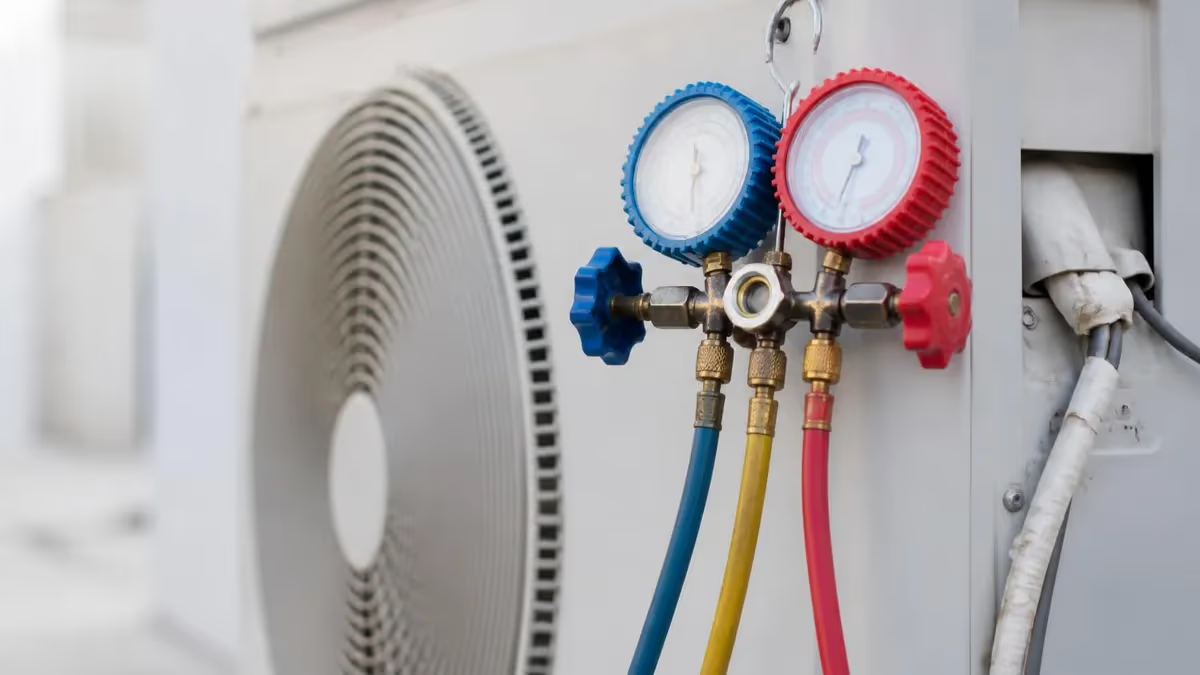
What Is an HVAC Apprenticeship?
An HVAC apprenticeship is a structured training program that combines on-the-job experience with classroom instruction. You work alongside licensed technicians, earn a wage from day one, and graduate with the skills and credentials needed to work independently. It's the fastest legitimate path into the heating, ventilation, and air conditioning trades — no four-year degree required.
Most programs run between three and five years. You'll rack up 2,000 or more hours of hands-on work per year, plus attend technical classes covering refrigeration cycles, electrical systems, combustion theory, and local code requirements. By the end, you're not just trained — you're experienced.
There's a real demand pull here. The U.S. Bureau of Labor Statistics projects HVAC employment to grow roughly 9% through 2032, faster than most other trades. Retirements are opening up slots faster than new apprentices are filling them, which means getting in now gives you serious leverage.
Types of HVAC Apprenticeship Programs
Not all programs are structured the same way. You'll mostly encounter two paths:
- Union apprenticeships — Sponsored by organizations like UA (United Association) or SMART Sheet Metal Workers. These programs have strict admission processes, competitive pay scales, strong health benefits, and a clear progression ladder. Starting wages are typically 40–50% of journeyman pay, increasing each year.
- Non-union / employer-sponsored programs — Run directly by HVAC companies or trade associations like PHCC or ACCA. Admission can be less competitive, and you'll start working faster, but benefits and pay structures vary widely.
Some community colleges also offer hybrid programs — you enroll as a student, complete your coursework, and the school connects you with employer partners for your work hours. These are worth considering if you haven't locked in a company sponsor yet.
HVAC Apprenticeship Requirements
Requirements vary by program, but here's what most expect from applicants:
- High school diploma or GED — non-negotiable for almost every program
- Minimum age of 17 or 18 (18 is more common for union programs)
- Basic math skills — you'll be tested, often with algebra and geometry questions
- Valid driver's license, since you'll travel between job sites
- Physical fitness — the work involves lifting, crouching, climbing, and working in tight spaces
- Drug screening and background check
Union programs often require an aptitude test. Don't walk in cold. Practice your math — fractions, decimals, unit conversions, and basic algebra are the core areas. Some programs weight the test heavily when ranking applicants.
How Much Do HVAC Apprentices Earn?
This is where the trades shine compared to traditional education paths. You get paid to learn.
Starting apprentice wages typically run $15–$20/hour in most regions. By year three or four, you're looking at $22–$28/hour as your skills grow. Journeyman HVAC technicians — what you become after completing your apprenticeship — average around $57,000–$65,000 per year nationally, with top earners in high-cost metro areas pulling $80,000+ and master technicians going higher still.
Compare that to finishing a four-year degree with student loan debt, and the math looks very different. Your HVAC career makes you money while you train, not after.
Overtime is common in this trade, especially during hvac emergency repair mc lean cooling season and winter heating calls. Many technicians boost their annual income significantly just through seasonal demand.
What You'll Learn During Your Apprenticeship
The curriculum is dense, and that's by design. A well-rounded HVAC technician needs to know systems from the ground up. Here's a rough breakdown of what the training covers:
- Year 1: Safety basics, hand and power tools, introduction to refrigeration theory, soldering and brazing, reading blueprints
- Year 2: Electrical fundamentals, controls and thermostats, split system installation, troubleshooting basics
- Year 3: Advanced refrigeration, heat pumps, commercial equipment, EPA 608 certification prep
- Year 4–5: Commercial systems, building automation, gas piping, advanced diagnostics, code compliance
EPA 608 certification is a milestone you'll hit during the program. It's federally required to legally purchase and handle refrigerants — you can't skip it. Many apprentices take it in year two or three. If you want to get a head start on the material, working through HVAC career preparation resources now builds the foundation you'll need before entering a program.
NATE (North American Technician Excellence) certifications are increasingly valued by employers. Some apprenticeship programs help you prep for these; others leave it to you after graduation. Either way, having a NATE cert on your resume sets you apart when you're job hunting as a journeyman.
How to Find and Apply for an HVAC Apprenticeship
Start with these channels:
- UA Local Union offices — find your regional local at ua.org, check their apprenticeship application windows (many open annually)
- Department of Labor's ApprenticeshipUSA — the federal portal at apprenticeship.gov lists registered programs by state and trade
- Local HVAC companies — call or walk in. Many smaller contractors run their own programs and prefer applicants who show initiative directly
- Community colleges with HVAC programs — staff often have direct employer connections
- Trade associations like ACCA and PHCC — both maintain contractor member directories
Apply to multiple programs at once. Acceptance rates at competitive union programs can be tough, and having backup options keeps your timeline on track. When you do apply, take the aptitude test seriously — it matters more than most applicants realize.
HVAC Apprenticeship vs. Trade School
You've probably seen ads for six-month HVAC trade school programs. They're real, and they're not necessarily bad — but they're different from an apprenticeship.
Trade school gives you the classroom knowledge fast. You learn theory, get your hands on equipment, and can finish in six months to a year. But you graduate with limited field experience, and employers know it. Entry-level hiring after trade school is common, but you often start at lower pay than an apprentice who's been working in the field for two years.
An apprenticeship is slower upfront but delivers far more field hours — and field hours translate directly into diagnostic ability, which is what separates a good technician from a great one. Most union journeyman cards are recognized across states too, which gives you portability that a trade school certificate doesn't always have.
Some people do both: complete a trade school certificate to gain basic knowledge, then use that foundation to score better on union aptitude tests. That's a solid strategy if you want to maximize your chances of getting into a competitive program.
Understanding the full scope of what the field involves — from HVAC system fundamentals to what HVAC stands for and covers — helps you walk into any interview or aptitude test better prepared.
Career Path After Your Apprenticeship
Finishing your apprenticeship isn't the end of the road — it's the beginning. Here's where most journeymen go from there:
- Journeyman technician: The immediate step. You work independently, take on service calls solo, and often specialize — residential, commercial, refrigeration, or building automation
- Master technician / master license: Most states require additional experience hours (often 2–4 years as a journeyman) and a separate licensing exam. Masters can pull permits and run their own jobs
- Service manager or foreman: Experienced techs often move into leadership, supervising crews or managing a service department
- Business owner: Many journeymen eventually go independent. The startup costs are real — tools, van, insurance, licensing — but the ceiling on your income is much higher
Commercial HVAC specialization tends to pay more than residential. Building automation and controls is a fast-growing niche as smart buildings become the norm. If you're drawn to tech, that path is worth exploring early.
Preparing for Your HVAC Apprenticeship Aptitude Test
Most union programs and many employer-sponsored ones require an aptitude test before you're accepted. It's not just a formality — scores determine your ranking against other applicants, and high-demand programs in large cities can be competitive.
The test typically covers:
- Arithmetic: Fractions, decimals, percentages, ratios — no calculators in most testing environments
- Algebra: Solving for unknowns, basic equations
- Reading comprehension: Trade-related passages followed by questions
- Spatial reasoning: Identifying shapes, visualizing how components fit together
- Mechanical aptitude: Understanding how levers, pulleys, and basic mechanical systems work
Study for at least two to four weeks before testing. Practice math daily — even 20 minutes is enough to sharpen what you may have forgotten since high school. If you've been out of school for a while, Khan Academy covers all the math topics you need at no cost.
The HVAC career path rewards people who take the entry process seriously. Technicians who score well on aptitude tests tend to have smoother apprenticeship completions — the math and reasoning skills directly translate to reading wiring diagrams and calculating load requirements on the job.
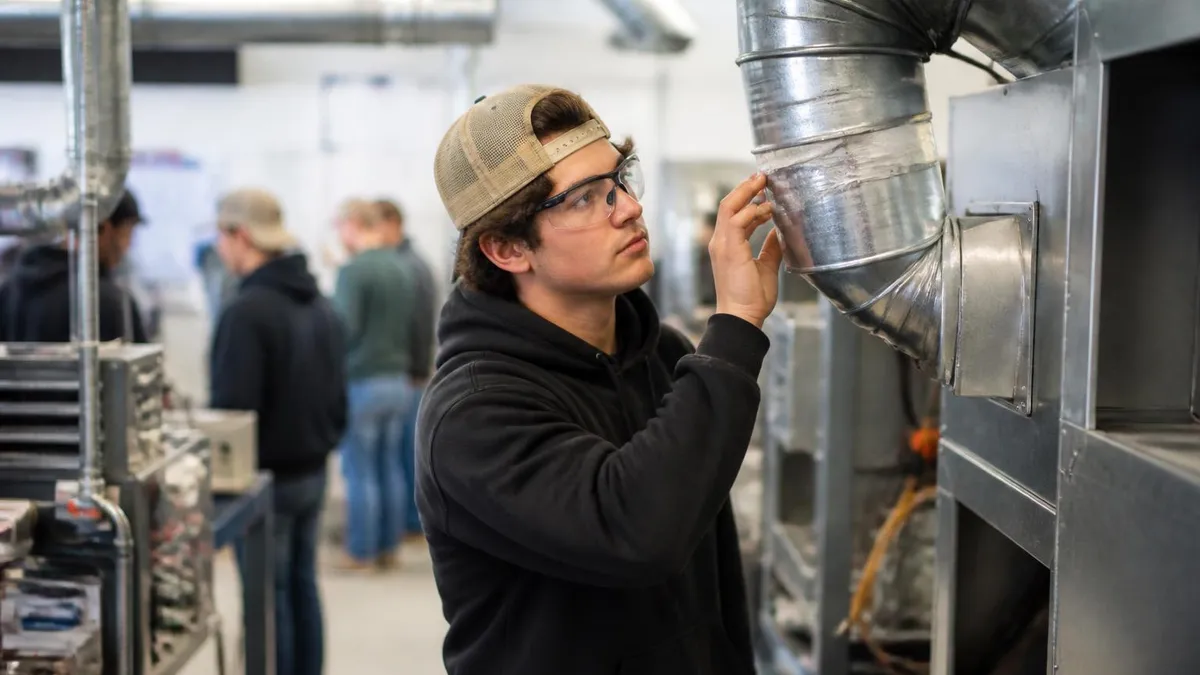
Is an HVAC Apprenticeship Right for You?
If you're practical, enjoy problem-solving, don't mind physical work, and want a career that pays well without a college degree — the answer is almost certainly yes. HVAC work is intellectually interesting (modern systems blend refrigeration, electrical, controls, and combustion), physically varied, and genuinely essential. Buildings need to be heated and cooled year-round, which means your skills will always be in demand.
The apprenticeship model is one of the last places in American work where you can earn real wages while building expertise that compounds over decades. There's no student debt. There's no entry-level humiliation of working for minimum wage with a degree in hand. You start as a paid apprentice and advance on a clear, merit-based schedule.
The work isn't always glamorous — crawlspaces, attic installations in July, and emergency calls at midnight are part of the deal. But for the right person, that's just part of the trade. If you're ready to get started, find your regional UA local, check the apprenticeship.gov database, and start preparing for that aptitude test. The sooner you apply, the sooner your journey starts.
About the Author

NATE Certified HVAC Technician & Licensing Exam Trainer
Universal Technical InstituteMike Johnson is a NATE-certified HVAC technician and EPA 608 universal-certified refrigerant handler with a Bachelor of Science in HVAC/R Technology. He has 19 years of commercial and residential HVAC installation and service experience and specializes in preparing technicians for NATE certification, EPA 608, A2L refrigerant safety, and state HVAC contractor licensing examinations.