
HVAC Certification Cost: The Complete 2026 Guide to Training, Exam Fees, and Total Investment
🆕 HVAC certification cost breakdown: training programs ($1,200-$15,000), EPA 608 fees, state licensing, NATE exams, and total investment for new technicians.
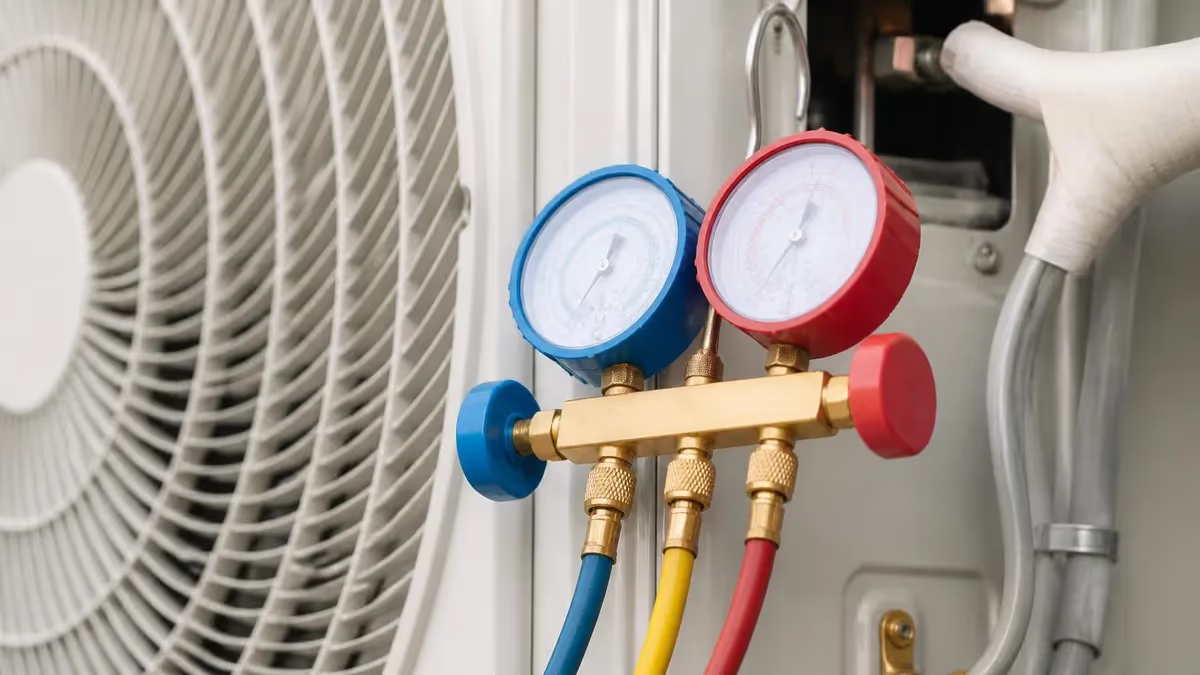
Understanding the true hvac certification cost is the first step toward launching a profitable career in heating, ventilation, air conditioning, and refrigeration. While many prospective technicians focus only on the price of a single exam, the actual investment includes training tuition, federal EPA certification, state licensing fees, optional industry credentials like NATE or HVAC Excellence, tool kits, study materials, and continuing education. Depending on the path you choose, total out-of-pocket spending can range from under $1,500 for a self-study apprenticeship route to over $20,000 for an accelerated trade school program with full certification packages. Practice with the free HVAC practice test on PracticeTestGeeks (750+ questions with answer explanations).
The good news is that HVAC remains one of the most affordable skilled trades to enter relative to the income potential. The Bureau of Labor Statistics projects 6% job growth for HVACR mechanics and installers through 2032, with median annual wages above $57,000 and top earners exceeding $84,000. When you spread the cost of certification across a 30-year career, the return on investment outperforms most four-year college degrees. The key is knowing which credentials genuinely move the needle on your earning potential versus which ones are nice-to-have additions you can pursue later.
This guide breaks down every cost component in detail, from the $24.95 EPA 608 online exam to the $4,000-$15,000 community college associate degree. We compare apprenticeships, vocational schools, online programs, and military pathways. We also clarify the difference between federally required certifications, state-mandated licenses, and voluntary industry credentials that boost your résumé. Whether you're a high school graduate weighing your options or a career-changer looking at the trades, you'll find concrete dollar figures, timelines, and decision frameworks.
One important clarification upfront: HVAC "certification" and "licensing" are not the same thing. Certifications, like EPA Section 608 or NATE, are issued by federal agencies or private industry groups and demonstrate competency in specific areas. Licensing is issued by individual states or municipalities and grants you legal permission to perform HVAC work for hire. Most working technicians need both, and the cost structure for each is completely different. Confusing these two categories is the most common mistake prospective students make when budgeting.
Geographic location dramatically affects your total spend. A technician in Texas can become fully licensed for under $200 in state fees after completing apprenticeship hours, while a contractor license in California or Florida can run $500-$1,500 in application, exam, and bond costs before you even count training. Some states like Wyoming and Colorado have no statewide HVAC license at all, leaving the question to local jurisdictions. We'll walk through the regional variations later and show you how to research your specific state's requirements before committing to any program.
Financial aid also plays a huge role in real out-of-pocket costs. Many community colleges and accredited trade schools qualify for federal Pell Grants, Workforce Innovation and Opportunity Act (WIOA) funding, GI Bill benefits, and state-specific scholarships. Registered apprenticeships often pay you a starting wage of $15-$22 per hour while training, effectively making your certification cost negative. Manufacturer-sponsored programs from Carrier, Trane, and Lennox sometimes cover tuition in exchange for a job commitment. Understanding these funding sources can transform a $15,000 sticker price into a $0 net cost.
By the end of this guide, you'll have a clear, itemized budget for your chosen pathway, a timeline showing when each fee comes due, and a checklist of credentials worth pursuing in your first five years. You'll also know how to avoid common money-wasters like overpriced cram courses, redundant certifications, and tool kits sold at 200% markup through training programs. Let's start with the numbers that matter most.
Free HVAC Study Tools
Interactive HVAC resources on PracticeTestGeeks, free to start:
- HVAC EPA 608 Refrigerant Certification — 35 questions with instant scoring and answer explanations
- HVAC flashcards — review key terms and concepts card by card
- HVAC study guide — topic-by-topic overview of what the exam covers
- HVAC cheat sheet — one-page printable summary for last-minute review
HVAC Certification Cost by the Numbers

Certification Cost Breakdown by Pathway
Training program tuition is by far the largest line item in your total hvac certification cost, and it's also the area with the widest price variation. A community college associate degree in HVAC technology typically runs $8,000 to $15,000 across two years, including lab fees and textbooks. Private trade schools and proprietary career colleges charge significantly more, often $20,000 to $33,000 for accelerated 9-to-18-month diploma programs that promise faster entry into the workforce. Online programs from providers like Penn Build or Ashworth College sit at the budget-friendly end, ranging from $900 to $2,500 for self-paced certificates.
Community colleges deliver the best dollar-for-dollar value for most students. You get hands-on lab time with real refrigeration equipment, instructors who often still work in the field, federal financial aid eligibility, and transferable credits if you later pursue a bachelor's degree in engineering technology. The downside is the two-year timeline and rigid semester scheduling. If you need to work full-time while studying, the part-time evening option can stretch the program to three or four years. Lab fees, parking, and required tool kits typically add $800 to $1,500 on top of advertised tuition.
Private trade schools like Lincoln Tech, UTI, and The Refrigeration School aggressively market accelerated programs that finish in under a year. The accelerated pace is real, and job placement assistance can be excellent, but the price tag is steep. Students often finance these programs through private student loans with higher interest rates than federal loans. Always compare the total cost of attendance including living expenses to the realistic starting wage in your area before signing enrollment paperwork. A $30,000 program followed by a $40,000 starting salary leaves a tight debt-to-income ratio.
Registered apprenticeships, sponsored by union locals like the United Association (UA Local) or merit-shop organizations like ABC and Independent Electrical Contractors, are the financial sweet spot for self-motivated students. You earn a starting wage of roughly $15 to $22 per hour while completing 144 hours of classroom instruction per year alongside 2,000 hours of paid on-the-job training. Tuition is typically covered by the joint apprenticeship training committee, and you graduate after four to five years as a fully licensed journeyman with zero student debt and several years of work experience already on your résumé.
Manufacturer-sponsored training is another underused option. Carrier University, Trane Technologies Academy, and Lennox Learning Solutions all run technician training programs, some offered free to employees of authorized dealers and others as paid certifications open to the public. These programs focus on brand-specific equipment but the underlying skills transfer broadly. If you're already working for an HVAC contractor, ask your employer about reimbursement for these courses. Many shops will pay for advanced training if you commit to staying with the company for a defined period.
Online and hybrid programs have improved dramatically since 2020. Reputable accredited online HVAC certificates from Penn Build, Ashworth, and Stratford Career Institute cost $900 to $2,500 and cover the theory portion of your education at your own pace. The catch is that HVAC is fundamentally a hands-on trade, and online-only programs cannot replicate brazing torches, vacuum pumps, or manifold gauges. Plan to combine online theory with either an apprenticeship, paid internship, or weekend lab supplement to gain the practical skills employers actually test during interviews.
Before paying any tuition, verify that the school is accredited by HVAC Excellence, PAHRA (Partnership for Air-Conditioning, Heating, Refrigeration Accreditation), or ACCSC. Accreditation matters for federal financial aid eligibility, employer recognition, and credit transfer. It also signals that the curriculum aligns with current industry standards including R-454B and R-32 refrigerant handling, smart thermostat integration, and high-efficiency heat pump technology.
Choosing an unaccredited program can leave you with a worthless certificate and no path to the credentials employers actually require. Once you complete training, you can begin connecting with Certified HVAC Contractors: How to Find, Vet, and Hire the Right Professional for Your Home or Business to explore mentorship and apprentice opportunities in your region.
HVAC Practice Test Questions
Prepare for the HVAC - Heating Ventilation and Air Conditioning exam with our free practice test modules. Each quiz covers key topics to help you pass on your first try.
HVAC Air Conditioning
HVAC Exam Questions covering Air Conditioning. Master HVAC Test concepts for certification prep.
HVAC Code Compliance
Free HVAC Practice Test featuring Code Compliance. Improve your HVAC Exam score with mock test prep.
HVAC Electrical Controls
HVAC Test Prep for Electrical Controls. Practice HVAC Quiz questions and boost your score.
HVAC Energy Efficiency
HVAC Questions and Answers on Energy Efficiency. Free HVAC practice for exam readiness.
HVAC Heating Systems
HVAC Mock Test covering Heating Systems. Online HVAC Test practice with instant feedback.
HVAC Load Calculations
Free HVAC Quiz on HVAC Load Calculations. HVAC Exam prep questions with detailed explanations.
HVAC Tools and Equipment
HVAC Practice Questions for HVAC Tools and Equipment. Build confidence for your HVAC certification exam.
HVAC Refrigeration
HVAC Test Online for Refrigeration. Free practice with instant results and feedback.
HVAC Safety Practices
HVAC Study Material on Safety Practices. Prepare effectively with real exam-style questions.
HVAC System Design
Free HVAC Test covering System Design. Practice and track your HVAC exam readiness.
HVAC Thermodynamics
HVAC Exam Questions covering Thermodynamics. Master HVAC Test concepts for certification prep.
EPA, NATE, and State License Cost Breakdown
EPA Section 608 certification is federally required for anyone who purchases, handles, or services refrigerants. The exam covers four certification types: Type I (small appliances), Type II (high-pressure systems), Type III (low-pressure systems), and Universal (all three). Online proctored exams through ESCO Institute or Mainstream Engineering cost $24.95 to $150 depending on provider, while in-person testing at training centers runs $50 to $200. The Type I segment can even be taken open-book online for as little as $24.95.
Universal certification is the smart investment for any working technician since it qualifies you for all refrigerant work without future upgrade fees. Most testing providers bundle study guides, practice exams, and the official test for $90 to $175 total. Once earned, EPA 608 never expires, making it one of the highest-value credentials per dollar in the entire trade. Without it, you legally cannot purchase refrigerant in the United States, which makes it the absolute baseline certification for any HVACR career.
Is Paying for Premium HVAC Certification Worth It?
- +NATE-certified technicians earn 10-15% higher average wages than non-certified peers
- +Universal EPA 608 certification never expires and unlocks all refrigerant work legally
- +Accredited trade school graduates qualify for federal Pell Grants and WIOA workforce funding
- +Registered apprenticeships pay you $15-$22 per hour while training, eliminating debt
- +Manufacturer certifications from Carrier, Trane, and Lennox open dealer network job opportunities
- +State contractor licenses allow you to bid independent jobs at full retail markup
- +Associate degree credits transfer toward engineering technology bachelor's programs later
- −Private trade school tuition of $20,000-$33,000 often requires high-interest private loans
- −Some manufacturer certifications only apply to one brand's proprietary equipment line
- −State license renewal fees and continuing education recur every 1-2 years indefinitely
- −NATE specialty exams require separate fees for each subject area you certify in
- −Online-only programs cannot replicate critical hands-on brazing and refrigerant handling skills
- −Contractor licensing in states like Florida requires $25,000 surety bonds before you can work
- −Cram courses marketed for $500-$1,500 often duplicate free study material from ESCO Institute
Pros and Cons at a Glance
| Pros | Cons |
|---|---|
| Accredited trade school graduates qualify for federal Pell Grants and WIOA workforce funding | Some manufacturer certifications only apply to one brand's proprietary equipment line |
| Manufacturer certifications from Carrier, Trane, and Lennox open dealer network job opportunities | NATE specialty exams require separate fees for each subject area you certify in |
| State contractor licenses allow you to bid independent jobs at full retail markup | Online-only programs cannot replicate critical hands-on brazing and refrigerant handling skills |
HVAC Certification Cost Budget Planning Checklist
- ✓Research your state's specific HVAC licensing requirements and current fee schedule online
- ✓Compare at least three accredited training programs by total cost of attendance, not just tuition
- ✓Verify school accreditation through HVAC Excellence, PAHRA, or ACCSC databases before enrolling
- ✓Apply for federal financial aid via FAFSA if attending an accredited college or trade school
- ✓Investigate registered apprenticeship openings through ApprenticeshipUSA.gov in your region
- ✓Budget $24.95 to $175 for EPA Section 608 Universal certification testing fees
- ✓Set aside $300 to $500 for initial NATE Core plus one specialty certification exam
- ✓Plan $500 to $1,500 for a basic hand tool kit, gauges, vacuum pump, and recovery machine
- ✓Confirm your state's surety bond and insurance requirements before pursuing contractor licensure
- ✓Reserve $200 to $600 annually for continuing education and license renewal fees long-term
The single highest-ROI certification is EPA 608 Universal
For under $175, you gain the legal authority to handle any refrigerant in any system size for the rest of your career. No other HVAC credential delivers more career-unlocking value per dollar. Stack it with one NATE specialty exam in your first year and you'll out-earn most uncertified peers immediately. Avoid pricey bundle programs that mark up these federal credentials with unnecessary cram courses.
Hidden costs catch most new HVAC students off guard. Beyond tuition and exam fees, you'll need a professional-grade tool kit that runs $500 to $1,500 for the basics and $3,000 to $5,000 for a complete diagnostic setup. Essential items include a four-port manifold gauge set ($150-$300), a digital micron vacuum gauge ($120-$200), a refrigerant recovery machine ($400-$700), a tank for recovered refrigerant ($150), tubing cutters and benders ($75), nitrogen regulator ($120), brazing torch and tip set ($200), digital multimeter with clamp meter ($150-$300), and a thermal imaging camera ($300-$2,000) for advanced diagnostics.
Personal protective equipment is another line item often left out of training program literature. Safety glasses, cut-resistant gloves, knee pads, steel-toe boots, and a reliable work belt easily total $250 to $400 before you set foot on your first job site. Once you start performing actual service calls, you'll also need a uniform allowance unless your employer provides one, which can add $300 to $600 annually for shirts, pants, and outerwear meeting OSHA and company branding requirements.
Transportation is a major budget category many new technicians overlook. Most field positions require you to provide reliable personal transportation to and from job sites, even if the company provides a service van during shifts. Some apprenticeships and lower-tier positions require you to use your own vehicle for service calls, with reimbursement at the federal mileage rate of 67 cents per mile.
Factor in fuel, maintenance, and the wear on your personal vehicle when comparing job offers. A position that pays $2 more per hour but requires 200 personal miles weekly may net less than a slightly lower-paying job with a company truck.
Study materials and exam prep deserve careful budgeting. The official EPA 608 prep manual from ESCO Institute costs $30 to $50, with optional online practice exams running another $25 to $75. NATE study guides and practice tests typically run $40 to $150 per specialty area.
State licensing exam prep books from publishers like Builder's Book or Construction Book Express cost $50 to $120, and full prep courses from providers like 1ExamPrep or Contractor Campus run $200 to $800. Resist the urge to buy every cram course advertised online; the free practice questions on this site, combined with one quality prep book, are sufficient for most exams.
Continuing education adds up over a career. Most state licenses require 4 to 16 hours of approved CE per renewal cycle, with course fees ranging from $15 to $40 per hour. NATE recertification requires 16 hours of CE every two years or a full retest. EPA 609 (motor vehicle air conditioning) requires recertification only if regulations change. Budgeting $200 to $600 annually for CE keeps your credentials current without scrambling at renewal time. Many employers cover these costs as a professional development benefit, so always ask during job interviews.
Insurance and bonding are major recurring costs for anyone pursuing contractor status. General liability insurance with $1 million coverage typically runs $600 to $1,800 annually for a solo HVAC contractor. Workers compensation, required in most states once you hire your first employee, adds another $2,000 to $6,000 per employee per year depending on your state's rates and claims history. Surety bonds for contractor licensing range from $5,000 to $25,000 in coverage with annual premiums of 1-3% of the bond face value for technicians with good credit.
Finally, don't forget association memberships and trade publications that keep you current with industry trends. ACCA (Air Conditioning Contractors of America) annual membership runs $300 to $600 depending on company size. RSES (Refrigeration Service Engineers Society) is $150 annually for individuals. Both include access to technical bulletins, code updates, and discounted training.
Subscriptions to publications like ACHR News or Contracting Business are free for qualified industry professionals. These soft investments pay off through networking, business referrals, and early access to manufacturer training programs. Once you're working, you may want to explore tools like the HVAC Duct Calculator: The Complete Guide to Sizing Ductwork for Airflow, Static Pressure, and System Efficiency to sharpen real-world design skills employers value.

Some for-profit trade schools aggressively recruit students with promises of six-figure salaries and guaranteed job placement, then charge $25,000-$40,000 for programs no better than $8,000 community college equivalents. Always verify graduation rates, default rates on student loans, and actual median earnings of graduates through the U.S. Department of Education's College Scorecard before signing enrollment paperwork. If a recruiter pressures you to enroll the same day, walk away.
The return on investment for HVAC certification is genuinely impressive when you run the numbers honestly. The Bureau of Labor Statistics reports a median annual wage of $57,300 for HVACR mechanics and installers in 2024, with the top 10% earning over $84,250. Master technicians, lead service writers, and small-business owners regularly clear six figures in high-cost-of-living markets. Compare that to the four-year college average debt of $37,000 producing a median starting salary of $55,000, and the trade school or apprenticeship pathway delivers superior lifetime earnings with a fraction of the debt burden.
Geographic variation matters enormously. Top-paying states for HVAC technicians in 2024 included Alaska ($86,200 median), the District of Columbia ($79,500), Washington ($72,800), Massachusetts ($71,400), and Connecticut ($70,200). Even in lower-cost states like Mississippi or Arkansas, experienced technicians regularly earn $50,000 to $65,000, which goes much further given local housing prices. Urban metros generally pay 20-40% more than rural areas, but rural technicians often face less competition and can charge premium rates for emergency service calls.
Career progression accelerates earnings substantially. A first-year apprentice typically earns 50% of journeyman scale, which in union markets means $18 to $25 per hour. By year three or four, full journeyman wages of $30 to $45 per hour kick in, often with comprehensive health and pension benefits. Service technicians who develop strong diagnostic skills can move into commission-based roles where top performers earn $90,000 to $130,000 annually. Project managers, estimators, and sales engineers in commercial HVAC commonly earn $80,000 to $140,000 with bonuses tied to project profitability.
Business ownership is where the real wealth-building happens in HVAC. A solo contractor with a fully booked schedule of residential service can gross $200,000 to $400,000 annually, with net profit margins of 15-25% after parts, vehicle costs, insurance, and taxes. Scaling to two or three trucks and crews can push gross revenues past $1 million within five years. The initial $1,500-$15,000 certification investment becomes trivial compared to building a transferable business asset worth hundreds of thousands of dollars at retirement.
Specialization further increases earning potential. Refrigeration technicians serving supermarkets, cold storage facilities, and food service customers earn 20-30% premium over standard residential HVAC. Commercial controls specialists working with building automation systems from Honeywell, Johnson Controls, or Siemens command $35-$50 per hour or more. Geothermal installers, solar-integrated HVAC technicians, and heat pump retrofit specialists are riding a multi-decade green energy wave with sustained demand and premium pricing. Each specialty typically requires one or two additional certifications costing $300-$1,500.
Job security is another major component of certification ROI that doesn't show up in salary tables. HVAC work cannot be offshored, automated, or replaced by artificial intelligence in any meaningful way. Climate change is intensifying both summer cooling and winter heating demand. Aging building stock requires continuous retrofit work. Federal Inflation Reduction Act tax credits are driving record demand for high-efficiency heat pumps and electrification projects. The 2026 outlook for HVAC technicians is exceptionally strong, with many regional contractors reporting they could hire two to three times their current staff if qualified candidates were available.
Comparing pathways head-to-head, the registered apprenticeship route consistently wins on raw ROI because you avoid all student debt while earning wages from day one. The community college associate degree route is a close second, offering more flexibility and faster classroom progress at modest cost. Private trade schools deliver value only when the accelerated timeline genuinely accelerates your earning.
Online programs work best as supplements to hands-on training rather than standalone pathways. Choose the option that fits your learning style, financial situation, and timeline rather than chasing the cheapest sticker price. When you're ready to study supply chain knowledge that helps in installation work, the HVAC Duct Supplies: The Complete Buyer's Guide to Ductwork Components, Sizing, and Installation Materials guide pairs well with certification prep.
Practical money-saving tips can shave thousands off your total certification cost without compromising the quality of your training. First, file the FAFSA even if you don't think you'll qualify for need-based aid. Federal student loans through accredited programs carry far lower interest rates than private financing, and Pell Grant eligibility often surprises applicants whose income looks too high on paper. Second, ask every school you consider about institutional scholarships specifically for trade students. Many community colleges have HVAC-specific scholarship funds endowed by retired contractors or industry associations that go unclaimed each year due to lack of applicants.
Third, investigate Workforce Innovation and Opportunity Act (WIOA) funding through your state's American Job Center. WIOA can cover 100% of tuition, books, tools, and even transportation for eligible adult workers transitioning into in-demand careers. HVAC is universally classified as in-demand, so eligibility hinges on income level and previous training rather than the field itself. Veterans should apply GI Bill benefits, which cover most accredited HVAC programs and pay a housing stipend during enrollment. The combination of WIOA and GI Bill benefits can produce zero out-of-pocket certification with full living expenses covered.
Fourth, time your EPA 608 certification strategically. Take it early in your training, ideally before your first internship or apprenticeship interview, so you can immediately handle refrigerant on the job. The $24.95 online Type I exam is the lowest barrier to entry in the entire trade, and even passing just Type I dramatically improves your hireability. Universal certification can come later once you've reviewed all four sections through hands-on work. Many entry-level techs make the mistake of waiting to pursue EPA certification until they've completed full training, costing themselves months of earning opportunity.
Fifth, build your tool kit gradually rather than buying everything upfront from a school-recommended supplier. Schools often mark up tool kit packages 30-50% above retail. Buy core hand tools from Harbor Freight or Amazon for half the cost, then invest in premium quality only for items you'll use daily like manifold gauges, vacuum pumps, and recovery machines. Used and refurbished diagnostic equipment from estate sales, retiring technicians, or marketplaces like eBay can save 40-60% on items that hold up well over decades of use. Always test used recovery machines and vacuum pumps before purchase.
Sixth, never pay for cram courses or boot camps before exhausting free study resources. The free practice exams on this site, combined with the official EPA 608 prep manual ($30) and the official state license exam preparation guide from your state's licensing board, cover everything tested. YouTube channels like AC Service Tech, HVAC School, and HVACR Videos provide thousands of hours of free training comparable to paid premium courses. Spend your study budget on one quality prep book per certification rather than on $500 boot camps that recycle the same material with a more polished presentation.
Seventh, plan your certification sequence to maximize early earning. Order: EPA 608 Type I first (open-book, $24.95), then EPA Universal upgrade, then one NATE specialty matching your employer's primary work (residential AC or gas heat), then your state's apprentice or helper card, then full state license after meeting hour requirements. This sequence allows you to start earning at each milestone rather than waiting years for the full credential stack. Some technicians double their hourly rate within 18 months by stacking certifications strategically while working full-time as a helper.
Finally, network aggressively from day one of training. Attend local ACCA chapter meetings, RSES technical seminars, and supply house product training sessions. Most are free or low-cost and attract working contractors actively looking to hire. A single connection at a quality contractor can be worth more than years of cold applications. Your training program's career services office is helpful, but your own networking will produce better job offers, higher starting wages, and faster advancement. The HVAC industry runs on relationships and referrals, and the contractors who pay the most almost never advertise openings publicly.
Sample HVAC Practice Questions
Try these questions from our free HVAC practice tests. The correct answer and an explanation follow each question.
What is the most important professional competency for HVAC certification in energy efficiency?
- A. Speed of task completion
- B. Deep knowledge combined with practical application skills
- C. Ability to work alone exclusively
- D. Memorization of all reference materials
Answer: B. Deep knowledge combined with practical application skills
Professional competency requires both deep knowledge of the subject matter and the ability to apply that knowledge in practical situations.
A technician is working on a centrifugal chiller using R-11. Which EPA 608 certification type is required?
- A. Type I
- B. Type II
- C. Type III
- D. Universal
Answer: B. Type II
Type II certification covers high-pressure and very high-pressure appliances, but centrifugal chillers using R-11 operate at low pressure, requiring Type III certification.
What is 'total volatile organic compound' (TVOC) monitoring and why is it important for IAQ management?
- A. Monitoring total refrigerant levels to detect leaks before they become safety hazards
- B. Measuring the combined concentration of all VOC species in indoor air to assess overall chemical contamination levels and guide ventilation decisions
- C. Monitoring carbon monoxide from combustion equipment only
- D. Testing for radon and other radioactive gases using TVOC sensors
Answer: B. Measuring the combined concentration of all VOC species in indoor air to assess overall chemical contamination levels and guide ventilation decisions
TVOC monitoring measures the aggregate concentration of all volatile organic compounds in indoor air, providing a single indicator of overall chemical contamination that guides source control and ventilation strategies.
What is the most important professional competency for HVAC certification in refrigeration?
- A. Speed of task completion
- B. Deep knowledge combined with practical application skills
- C. Ability to work alone exclusively
- D. Memorization of all reference materials
Answer: B. Deep knowledge combined with practical application skills
Professional competency requires both deep knowledge of the subject matter and the ability to apply that knowledge in practical situations.
HVAC Questions and Answers

HVAC Duct Supplies: The Complete Buyer's Guide to Ductwork Components, Sizing, and Installation Materials

HVAC Duct Calculator: The Complete Guide to Sizing Ductwork for Airflow, Static Pressure, and System Efficiency
Certified HVAC Contractors: How to Find, Vet, and Hire the Right Professional for Your Home or Business

HVAC Repair Philadelphia: The Complete Homeowner's Guide to Finding, Hiring, and Working With Local Heating and Cooling Pros
Best HVAC Repair in Bandon, OR: Local Services Near Me Guide
How this page was made: written with AI tools. We have not yet matched this exam's facts to an official source, so confirm fees, dates and rules with the exam body. Not reviewed by a subject-matter expert. Editorial policy