
HVAC Certification: Types, Cost & How to Get Certified 2026
✏️ Get HVAC certified with this complete guide. Learn about EPA 608, NATE, and state licenses — including cost, exam format, and how long it takes.
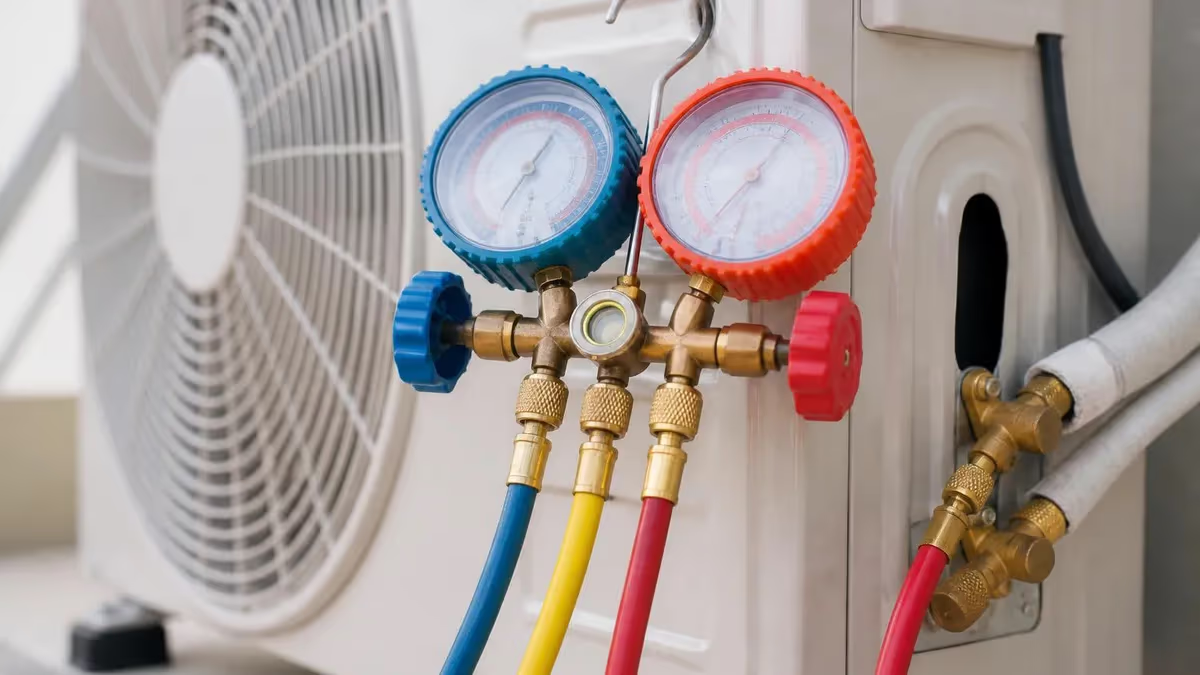
Getting certified in HVAC isn't just a career box to check — it directly affects what you earn, which jobs you qualify for, and whether you're even allowed to do certain work legally. If you handle refrigerants without an EPA 608 certification, you're breaking federal law. Full stop. Practice with the free HVAC practice test on PracticeTestGeeks (35 questions with answer explanations).
But beyond the legal requirement, certification signals competence. Employers posting HVAC technician jobs routinely list NATE certification as a preferred or required credential. Customers ask about it. Insurance companies factor it in. Your paycheck reflects it.
This guide breaks down every major HVAC certification, what each one requires, how long it takes, and exactly what you'll spend. Whether you're just starting your career, completing an HVAC apprenticeship, or looking to advance after years in the field — there's a clear path forward. The HVAC trade rewards people who invest in credentials early. The technicians earning top wages didn't stumble into those salaries — they built them systematically, starting with the right certifications at the right stages of their career.
Free HVAC Study Tools
Interactive HVAC resources on PracticeTestGeeks, free to start:
- HVAC EPA 608 Refrigerant Certification — 35 questions with instant scoring and answer explanations
- HVAC flashcards — review key terms and concepts card by card
- HVAC study guide — topic-by-topic overview of what the exam covers
- HVAC cheat sheet — one-page printable summary for last-minute review
Why HVAC Certification Matters
Three words: money, access, and trust. Certification opens doors that stay shut for uncertified technicians — literally and figuratively.
On the legal side, the EPA mandates that anyone who purchases or handles refrigerants used in HVAC systems must hold an EPA 608 certification. Violating this rule carries fines up to $44,539 per day per violation. That's not a number you want anywhere near your name. The EPA actively enforces this — cases result in real fines against real companies and individuals, not just warnings.
On the earnings side, NATE-certified technicians earn meaningfully more than non-certified peers. The gap varies by market, but studies consistently show 10–20% higher wages. In some commercial roles, the difference is even larger. When a contractor can bill a customer more because they send out NATE-certified technicians, that premium flows back to the technician — at least at companies that understand how to price their services correctly.
Employers trust certified technicians with more complex systems — and with less supervision. That matters for career growth. You'll get the better service calls, the high-end commercial accounts, and eventually the service manager track — if that's where you want to go. Certification also reduces callbacks, which is a metric employers track closely. A technician who diagnoses right the first time saves the company money on every service call.
Even if you're just exploring the field through HVAC classes or researching what the trade involves, understanding the certification landscape early helps you plan your training more strategically. Knowing you'll need EPA 608 before you finish school means you can take it while you still have instructor support around you — not scrambling on your own six months after graduation.

Types of HVAC Certifications
What it is: Federal certification required by the EPA under Section 608 of the Clean Air Act. Mandatory for any technician who purchases, recovers, recycles, or disposes of refrigerants.
Four types:
- Type I — Small appliances (refrigerators, window ACs, dehumidifiers)
- Type II — High-pressure systems (residential and commercial AC, heat pumps)
- Type III — Low-pressure systems (large centrifugal chillers)
- Universal — Covers all three types. Most technicians pursue this one.
Cost: Approximately $20 exam fee. Some HVAC school programs include it in tuition.
Format: Proctored written exam, 25 questions per section. No expiration — it's a lifetime credential.
Where to test: ESCO Institute, Mainstream Engineering, or approved test centers nationwide.
EPA 608: How to Get Certified Step by Step
EPA 608 is non-negotiable. You get it, or you can't legally do refrigerant work. Here's exactly how the process works — and it's simpler than most people expect.
First, pick your certification level. Universal is what most technicians target — it covers Type I, II, and III systems so you're not limited in the jobs you can take. If you know you'll only ever work on small appliances, Type I alone is fine. But Universal is worth the extra study time, and the cost is the same either way.
Second, study the exam content. The EPA 608 test covers core refrigerant handling rules plus type-specific content for each certification level. Study materials are widely available — ESCO Institute and Mainstream Engineering both sell prep books for under $30. Many vocational programs include exam prep as part of their HVAC classes. If yours does, use that resource fully.
Third, find an approved testing center. The EPA authorizes approved test organizations (ATOs) to administer the exam. ESCO Institute operates one of the largest networks. You can also take the test at many trade schools and community colleges. Some ATOs offer remote proctored exams online — convenient if you're in a rural area or working a schedule that makes travel difficult.
Fourth, take the exam. Each section is 25 questions, multiple choice. You need to score 70% or higher on each section to pass. The test itself takes about 90–120 minutes for Universal. Bring a photo ID. Read each question carefully — some are designed to test whether you know specific regulatory details, not just general refrigerant knowledge.
Fifth, receive your certification card. Most ATOs mail it within a few weeks. Some provide a digital certificate immediately. Keep it — you'll be asked to produce it when purchasing refrigerants from suppliers. Take a photo of it too. Lost cards can usually be replaced, but it's a hassle you don't need.
Cost is around $20, making this the most affordable professional certification you'll ever earn relative to its legal importance. No excuse to delay it.
NATE Certification: How to Get It
NATE is the gold standard for voluntary HVAC credentials. Contractors advertise it. Customers look for it. Pay scales reflect it. Here's how to earn it.
Step 1: Meet the prerequisites. You don't need a specific degree, but you do need hands-on HVAC knowledge. Most test-takers have completed a formal training program — whether through an HVAC apprenticeship or vocational school — or have at least a year of field experience. The exam tests real-world competency, not just textbook recall. Don't try to wing NATE on book knowledge alone — it'll show in your score.
Step 2: Pass the Core exam. The NATE Core exam covers fundamental HVAC knowledge shared across all specialties — safety, tools, electrical, and basic system operation. It's 50 questions and serves as a prerequisite for specialty exams. Passing score is 70%. Most candidates with solid training pass the Core on their first attempt. It's the specialty exams where the real preparation work lives.
Step 3: Choose a specialty. Pick the specialty most relevant to your current or target work — Air Conditioning for residential cooling, Gas Heating for furnace-heavy markets, Heat Pumps if that's your focus. You can add specialties later, and many experienced technicians hold two or three. Each additional specialty strengthens your position for pay negotiations and broadens the service calls you can handle.
Step 4: Register and sit for the exam. Register at natex.org. Exams are offered at authorized Prometric testing centers and some training facilities. Cost is around $100 per exam. Bring valid ID and your confirmation. Exams are available year-round, so there's no waiting for a specific test window — schedule when you're actually ready, not when it's convenient on a calendar.
Step 5: Maintain it. NATE certification expires every five years. You renew via continuing education (8 CEUs for each specialty) or by retaking the exam. Most technicians collect CEUs through manufacturer training, industry events, and online courses — so renewal is rarely a heavy lift. The key is tracking your CEUs as you go rather than scrambling at renewal time.
One important note: NATE scores report section-by-section, so you get specific feedback even on a failed attempt. That makes it easier to target weak areas on a retake. A failed first attempt isn't a setback — it's a diagnostic tool. Use the score report and come back better prepared.
State HVAC License Requirements
- Issued by: State government agencies, not trade organizations
- Legal requirement: Required to operate as a contractor or independent technician in most states
- How it differs: Licenses permit you to legally do business; certifications prove technical competency
- Who needs one: Any HVAC contractor, self-employed tech, or business owner — employees under a licensed contractor may be exempt
- California: C-20 HVAC/R Contractor license required; must pass state exam + show 4 years experience
- Florida: Certified or Registered HVAC Contractor license; state exam required
- New York: NYC requires licensing; rest of state varies by county
- Texas: TACL (Texas Air Conditioning and Refrigeration Contractor License) required for contractors
- Colorado: No statewide license; local jurisdictions may require permits
- Kansas: No statewide contractor license requirement
- Missouri: No state license; check local city/county rules
- Always check: Local city and county rules often add requirements on top of (or in place of) state rules
HVAC Certification vs. HVAC License — What's the Difference?
People mix these up constantly, and it's not hard to see why. Both involve credentials, both involve testing, and both matter for your career. But they're fundamentally different things — and confusing them can lead to real problems, like thinking you're legally covered when you're not.
A certification is issued by a trade organization or testing body — NATE, HVAC Excellence, the EPA — and validates your technical knowledge. It proves you know how systems work, how to safely handle refrigerants, and how to diagnose problems. Certifications are voluntary (except EPA 608, which is legally required for refrigerant work) and are nationally recognized. An employer in Colorado recognizes your NATE cert the same way one in Georgia does.
A license is issued by a state government. It's a legal permission — a right to operate as an HVAC contractor or independent technician in that state. Licenses typically require passing a state exam, documenting experience, carrying liability insurance, and sometimes posting a bond. They're state-specific: a Florida HVAC license doesn't let you pull permits in Texas. If you move states, you may need to get licensed again even if your technical skills are identical.
Think of it this way: certification proves you can do the work. A license proves you're legally authorized to do the work and run a business doing it. Most working HVAC technicians employed by a licensed contractor don't need their own license — they work under the contractor's license umbrella.
But if you ever want to go independent — start your own company, pull your own permits, submit your own bids — you'll need both. Some technicians spend an entire career as employees and never need a contractor license. Others have it within five years because they always planned to go out on their own. Know your path before you invest in the paperwork.
Before You Test — Certification Readiness Checklist
- ✓EPA 608: Complete at least one prep course or study guide covering all three refrigerant types
- ✓EPA 608: Know the safe handling procedures, leak detection requirements, and recordkeeping rules
- ✓NATE Core: Review electrical fundamentals, safety practices, and basic system operation
- ✓NATE Specialty: Log hands-on hours in your target specialty area before sitting for the exam
- ✓State License: Confirm your state's experience hour requirement (typically 2–4 years)
- ✓State License: Obtain required liability insurance before applying for licensure
- ✓All exams: Bring valid government-issued photo ID on test day
- ✓NATE: Register at natex.org and schedule at a Prometric test center in advance

How Long Does It Take to Get HVAC Certified?
The answer depends on which certification you're pursuing — and where you're starting from.
EPA 608: If you study consistently for two to four weeks, you're ready. The test is 25 questions per section, and the passing threshold is 70%. Most candidates who spend even a weekend reviewing solid prep materials pass on their first attempt. This is the fastest professional certification you'll ever earn.
NATE: Plan for longer. If you have a solid background from an HVAC school program plus field time, you might be ready in 3–6 months of deliberate preparation. If you're coming in with minimal formal training, give yourself 6–12 months of field experience before attempting the specialty exams. Rushing NATE and failing costs you $100 and momentum — don't guess your way into the testing room.
State license: The timeline here is driven by experience requirements more than study time. If your state requires 4 years of documented experience before you can apply, then certification prep happens in the final stretch of those 4 years — not at the beginning. Budget 3–6 months for exam prep once you meet the experience threshold.
The practical reality: most HVAC technicians get their EPA 608 first (fast, cheap, legally required), then pursue NATE during or after their apprenticeship years, and eventually pursue a state contractor license if they move toward running their own business. Understanding what HVAC means as a career — not just as an acronym — helps you map this timeline to your goals.
Don't treat certification as a one-time event. The field evolves — refrigerant regulations change, new system technologies emerge, and manufacturers regularly update their equipment and service procedures. The technicians who stay certified and keep learning are the ones who stay employed through industry shifts and command the best wages a decade into their career. Continuous education and recertification aren't just good practice; they're the foundation of a long, sustainable HVAC career.
HVAC Certification — Pros and Cons
- +EPA 608 is required by law — getting it means you can legally handle refrigerants and access a wider job market
- +NATE certification consistently correlates with higher wages — 10–20% more in many markets
- +Certified technicians receive more complex, higher-value service calls from employers
- +Certifications are portable — recognized nationwide, unlike state licenses
- +Certification preparation reinforces real skills that make you faster and safer on the job
- +Lifetime EPA 608 credential means no renewal hassle for your most essential cert
- −NATE exam and renewal fees add up over a career — budget $100+ every 5 years per specialty
- −Studying for NATE while working full-time requires serious time management
- −State licensing requirements vary wildly — what qualifies in one state may not transfer to another
- −Some certifications (HVAC Excellence, ICE) have limited recognition outside certain regions
- −Refrigerant regulation changes (R-410A phase-out) may require additional certifications going forward
- −Certification proves knowledge at a point in time — ongoing training matters just as much after you pass
Pros and Cons at a Glance
| Pros | Cons |
|---|---|
| Certified technicians receive more complex, higher-value service calls from employers | Studying for NATE while working full-time requires serious time management |
| Certifications are portable — recognized nationwide, unlike state licenses | State licensing requirements vary wildly — what qualifies in one state may not transfer to another |
| Certification preparation reinforces real skills that make you faster and safer on the job | Some certifications (HVAC Excellence, ICE) have limited recognition outside certain regions |
Career Benefits: What Certification Actually Gets You
Let's talk numbers. The Bureau of Labor Statistics reports that HVAC technicians earn a median wage of around $57,000 per year nationally — but the range runs from under $38,000 to over $87,000. Certification is one of the clearest factors that pushes you toward the upper end of that range. It's not the only factor — market, employer, and specialization all matter — but it's one you can control directly.
Employers actively prefer — and often require — EPA 608 and NATE for certain positions. Commercial HVAC roles almost universally require Universal EPA 608. Service manager positions frequently list NATE as a requirement. Facilities management contracts sometimes mandate that technicians on-site carry specific certifications. If you want to work on large commercial systems — office buildings, hospitals, industrial facilities — you need these credentials before you can even apply for most positions.
Beyond pay, certification affects the quality of work you're assigned. Certified technicians earn the complex commercial jobs, the warranty service contracts, and the supervisor-track opportunities. Uncertified techs get the straightforward residential calls — nothing wrong with that early in a career, but the ceiling is lower. Over a 20-year career, the compounding effect of higher starting wages, faster advancement, and better job selection is substantial.
Job security matters too. HVAC is recession-resistant — heating and cooling systems break regardless of economic conditions. But within the field, certified technicians weather slowdowns better than uncertified ones. When a company needs to reduce headcount, they protect their most valuable technical assets. Certification is a signal of that value.
There's also the entrepreneurial angle. If you ever want to run your own HVAC business — and many technicians do — certification is step one of a longer credentialing journey that includes state licensing and business registration. The combination of NATE certification, EPA 608, and a state contractor license makes you fully equipped to operate independently and win commercial contracts. Understanding what the HVAC meaning is at a professional level — systems, regulations, best practices — is what differentiates a business owner who succeeds from one who struggles in the first two years.
Typical HVAC Certification Timeline
Months 1–3: Start HVAC Training
Months 2–4: Get EPA 608 Certified
Months 6–18: Build Field Experience
Year 1–2: Pursue NATE Certification
Year 3–5: State Contractor License (If Applicable)
Every 5 Years: NATE Renewal
Sample HVAC Practice Questions
Try these questions from our free HVAC practice tests. The correct answer and an explanation follow each question.
Which type of EPA 608 certification covers service on centrifugal chillers using low-pressure refrigerants like R-123?
- A. Type I
- B. Type II
- C. Type III
- D. Universal
Answer: C. Type III
Type III certification is required for low-pressure appliances, including centrifugal chillers that use refrigerants like R-123 and R-11 which operate at below-atmospheric pressures.
Which EPA 608 certification type covers small appliances such as household refrigerators and window air conditioners?
- A. Type I
- B. Type II
- C. Type III
- D. Universal
Answer: A. Type I
Type I certification covers small appliances containing five pounds or less of refrigerant, including household refrigerators and window AC units.
Which type of gas valve is considered the safest for residential furnaces because it requires two independent failures to allow uncontrolled gas flow?
- A. Single-seat valve
- B. Manual shut-off valve
- C. Redundant dual-seat combination gas valve
- D. Pressure-regulating valve
Answer: C. Redundant dual-seat combination gas valve
Redundant (dual-seat) combination gas valves contain two independent operators in series; both must fail simultaneously for gas to flow uncontrolled.
What is a 'takeoff' or 'tap' in duct fabrication and what are common types?
- A. The starting point for duct installation at the air handler
- B. A fitting that branches air from a main duct to a branch run, including starting collars, conical takeoffs, and stamped tees
- C. The section of duct where the ductwork ends at a register or grille
- D. A measurement used when cutting duct to account for fittings
Answer: B. A fitting that branches air from a main duct to a branch run, including starting collars, conical takeoffs, and stamped tees
Takeoffs (taps) connect branch ducts to main trunk ducts. Types include flat-boot, starting collar, spin-in collar, conical tap, and wye/tee fittings.
HVAC Certification Questions and Answers
How this page was made: written with AI tools and published by Nathan Beja, founder of Practice Test Geeks, who is responsible for its content. We have not yet matched this exam's facts to an official source, so confirm fees, dates and rules with the exam body. Not reviewed by a subject-matter expert. Editorial policy