
Commercial HVAC Services Near Me: Colorado Springs Guide to Finding, Vetting, and Hiring Local Pros
Colorado Springs HVAC guide for commercial services near me — find local pros, compare costs, vet contractors, and book reliable maintenance. 🔎
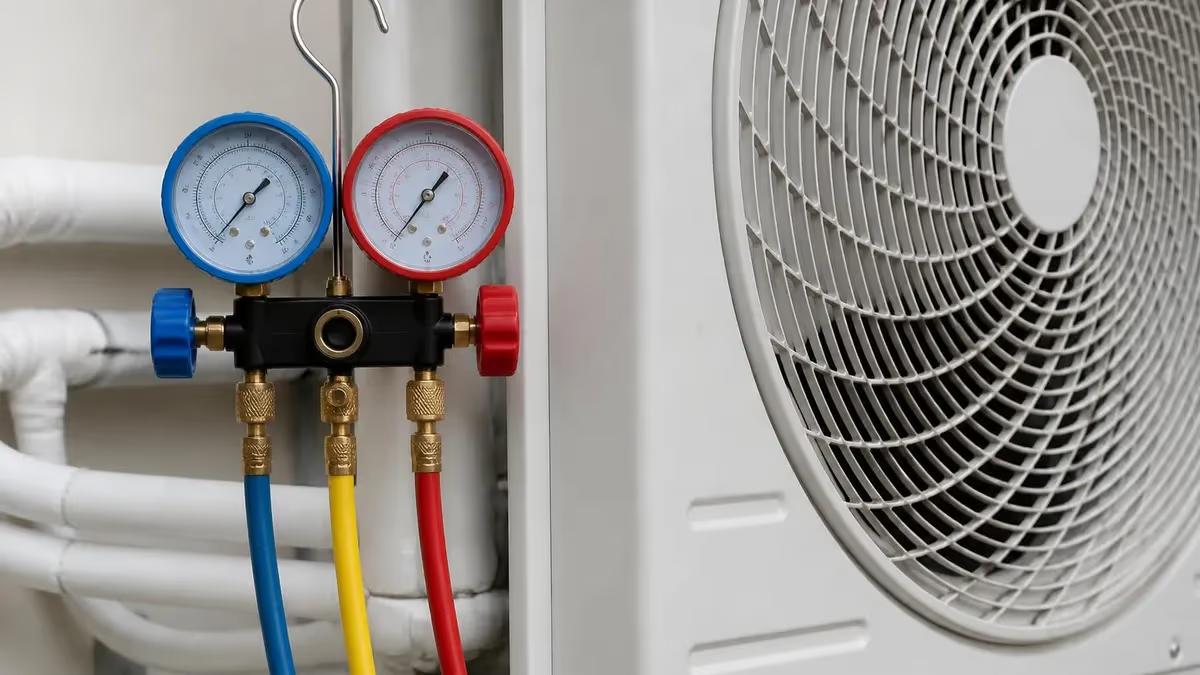
Searching for a reliable colorado springs hvac partner for your commercial building is one of those tasks that looks simple until your rooftop unit starts short-cycling on a 95-degree Tuesday afternoon. Commercial HVAC services near me is one of the most common queries facility managers, restaurant owners, and small business operators type into Google, yet the results are crowded with directory listings, ads, and generic blog posts that rarely answer the real questions. This guide walks through how to find, evaluate, and hire a local commercial HVAC company that actually shows up when you need them.
Commercial HVAC differs from residential work in scale, code requirements, refrigerant handling, and the equipment used on rooftops, in mechanical rooms, and inside walk-in coolers. A 25-ton packaged rooftop unit serving a retail store has different airflow, electrical, and combustion characteristics than the three-ton split system in a bungalow down the street. That matters when you choose a contractor: a great residential company may not have the lift, ladders, manifold gauges, or licensed technicians to safely service light commercial equipment, let alone industrial chillers or VRF systems.
Local matters more than most owners realize. A nearby contractor can typically reach your site within 60 to 90 minutes for an emergency call, carries the right parts on their service trucks, and knows the AHJ inspectors, permit clerks, and utility rebate programs in your county. National chains often subcontract local work, which adds a layer between you and the technician who actually turns the wrenches. Asking the right vetting questions up front filters out brokers and exposes the real talent in your service area.
This article covers what counts as commercial HVAC, how to search and shortlist near you, what licenses and insurance to verify, typical service and replacement costs in 2026, how to compare bids, the maintenance contracts that prevent surprise breakdowns, and the questions to ask before signing anything. We will also look at how seasonal demand, refrigerant rules, and energy codes are reshaping the commercial market — and how to use that to your advantage when negotiating.
If you operate a restaurant, medical office, light industrial space, school, church, multi-tenant retail center, warehouse, or office condo, you are the audience for this guide. The principles also apply to property managers running portfolios of small commercial buildings where each location has its own HVAC and its own service history. We will keep things practical: real numbers, real timelines, and real warning signs that separate a healthy contractor relationship from one that will leave you stranded on the hottest day of summer.
By the end, you should be able to walk into any vendor meeting with a clear scorecard, ask the questions a good facilities director asks, and understand why pricing varies so dramatically from quote to quote. You will also know when a one-off repair makes sense versus when a service agreement, retrofit, or full replacement delivers better long-term value. The goal is fewer emergencies, predictable budgets, and longer equipment life.
Even if you are outside Colorado Springs, the framework here applies to any mid-sized metro: Denver, Pueblo, Albuquerque, Salt Lake City, Phoenix, or anywhere else commercial buildings need year-round comfort. Local market rates shift, but the vetting questions, contract structures, and red flags stay the same. Use this as a working checklist the next time you search commercial HVAC services near me and the results feel overwhelming.
Commercial HVAC by the Numbers
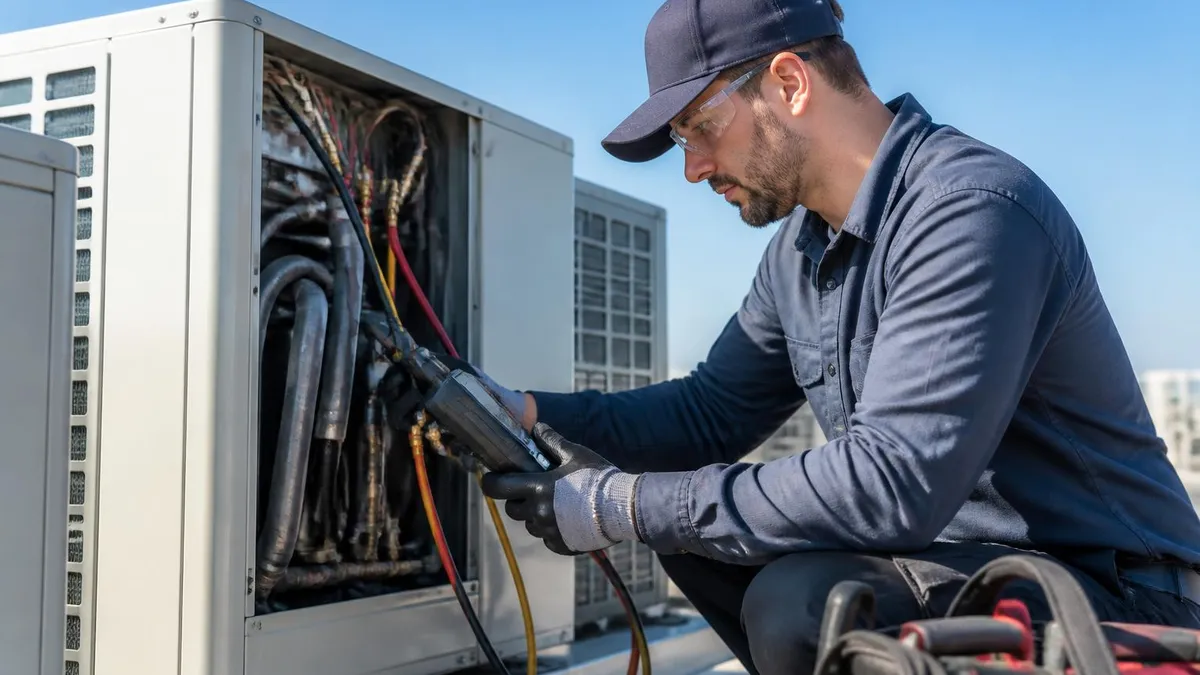
What Counts as Commercial HVAC
Self-contained units that sit on the roof and serve a single zone or a small group of zones. Common in retail, restaurants, and small offices, ranging from 3 to 50 tons of cooling.
Light commercial split systems and ductless mini-splits serve small offices, server rooms, and additions. They share components with residential equipment but use commercial-grade controls and warranties.
Larger buildings use water-cooled or air-cooled chillers paired with boilers and air handlers. These require specialized technicians with chiller certifications and often involve building automation systems.
Variable refrigerant flow systems offer zoning and efficiency for hotels, schools, and mid-sized offices. Commercial heat pumps are growing fast as electrification codes and rebates expand.
Dedicated outdoor air systems, ERVs, makeup air units, exhaust fans, and IAQ accessories like MERV-13 filtration and UV-C. Critical for code compliance and tenant health.
Finding the right commercial HVAC partner near you starts with understanding how local contractors actually structure their businesses. Most service areas have three rough tiers: large mechanical contractors who handle new construction and big institutional accounts, mid-sized service-focused companies that specialize in maintenance and replacement for existing buildings, and small shops with one to five trucks that excel at restaurants, retail, and small office work. Each tier prices differently and responds at different speeds, so match your building size and complexity to the right tier.
Begin your search with Google Maps using the query commercial HVAC services near me, then filter results by review count and rating. Anything under 25 reviews is hard to evaluate; companies with 100+ reviews and a 4.6 average or higher give you statistically meaningful data. Read the one-star and three-star reviews specifically — they tell you how the company handles problems, miscommunication, and pricing disputes. Five-star reviews are useful for confirming a baseline, but the lower-rated ones reveal patterns.
Next, cross-reference your shortlist with industry directories. ACCA (Air Conditioning Contractors of America) lists vetted member companies. The North American Technician Excellence (NATE) directory shows which firms employ NATE-certified technicians. Your state contractor license board lets you confirm the company's mechanical contractor license is active and free of recent disciplinary actions. For chillers and large equipment, manufacturer-authorized service provider lists from Carrier, Trane, Daikin, and Lennox identify firms with factory training.
Local Facebook groups for building owners, BOMA chapters, and downtown business associations are surprisingly useful. Post a simple question — "who do you use for rooftop unit service?" — and you will get 10 to 20 honest replies within a day. Real referrals from peers with similar buildings carry more weight than any star rating because they come with context: response time, pricing, communication, and follow-through over multiple service calls.
When you reach out, pay attention to how the company handles your first phone call. Professional commercial outfits answer within three rings during business hours, ask qualifying questions about your equipment and building, and either schedule a site visit or send a sales engineer within 48 hours. If you get voicemail, a residential-style dispatcher, or a vague promise to call back, that is a signal about how they will treat you when your system fails at 6 a.m. on a Saturday.
For broader context on how to evaluate technical skill across any HVAC trade, the principles behind Certified HVAC Contractors apply directly: license verification, insurance, references, and a written scope of work matter more than the lowest price. Commercial work compounds this — a poorly trained tech can damage compressors costing five figures or trip refrigerant leak penalties.
Finally, shortlist three to five companies, not just one. Even if you find a great match on the first call, having alternates protects you when your primary is booked solid in July or when a key technician leaves for a competitor. Rotate small jobs occasionally to keep secondary vendors warm. Facility managers who maintain three active relationships almost never get stranded, while those who rely on a single vendor often pay premium emergency rates during peak season.
HVAC Practice Test Questions
Prepare for the HVAC - Heating Ventilation and Air Conditioning exam with our free practice test modules. Each quiz covers key topics to help you pass on your first try.
HVAC Air Conditioning
HVAC Exam Questions covering Air Conditioning. Master HVAC Test concepts for certification prep.
HVAC Code Compliance
Free HVAC Practice Test featuring Code Compliance. Improve your HVAC Exam score with mock test prep.
HVAC Electrical Controls
HVAC Test Prep for Electrical Controls. Practice HVAC Quiz questions and boost your score.
HVAC Energy Efficiency
HVAC Questions and Answers on Energy Efficiency. Free HVAC practice for exam readiness.
HVAC Heating Systems
HVAC Mock Test covering Heating Systems. Online HVAC Test practice with instant feedback.
HVAC Load Calculations
Free HVAC Quiz on HVAC Load Calculations. HVAC Exam prep questions with detailed explanations.
HVAC Tools and Equipment
HVAC Practice Questions for HVAC Tools and Equipment. Build confidence for your HVAC certification exam.
HVAC Refrigeration
HVAC Test Online for Refrigeration. Free practice with instant results and feedback.
HVAC Safety Practices
HVAC Study Material on Safety Practices. Prepare effectively with real exam-style questions.
HVAC System Design
Free HVAC Test covering System Design. Practice and track your HVAC exam readiness.
HVAC Thermodynamics
HVAC Exam Questions covering Thermodynamics. Master HVAC Test concepts for certification prep.
Commercial HVAC Costs and Pricing
Most commercial HVAC companies in mid-sized markets charge a diagnostic or trip fee between $125 and $225, which usually covers the first 30 to 60 minutes onsite. After that, labor runs $145 to $225 per hour for a journey-level technician, with overtime rates of 1.5x to 2x for after-hours, weekend, and holiday calls. Some firms bill in 15-minute increments, while others round up to the half hour. Always ask in advance.
Parts are typically marked up 30 to 60 percent over wholesale, which is industry standard. A capacitor that costs $18 wholesale might appear on your invoice at $45 to $65. Compressors, contactors, and control boards range from $200 to $2,500 installed. For predictability, ask for flat-rate pricing on common repairs and an itemized invoice that separates labor, parts, refrigerant, and any disposal or environmental fees.
Hiring a Local Commercial HVAC Company vs. a National Chain
- +Faster emergency response, typically under 90 minutes in metro areas
- +Same technicians return to your building, building system knowledge over time
- +Direct access to the owner or service manager for escalations
- +Better familiarity with local code officials, permits, and utility rebates
- +More flexibility on pricing, scheduling, and custom maintenance scope
- +Stronger word-of-mouth accountability in tight-knit business communities
- +Faster invoicing and clearer billing without corporate red tape
- −Smaller parts inventory may delay obscure or specialty repairs
- −Limited after-hours coverage if the shop only has two or three technicians
- −May lack factory authorization for certain chiller or VRF brands
- −Vacation, illness, or turnover can leave gaps in coverage
- −Less sophisticated reporting and online portals for multi-site portfolios
- −Insurance limits may be lower than what enterprise customers require
Pros and Cons at a Glance
| Pros | Cons |
|---|---|
| Same technicians return to your building, building system knowledge over time | Smaller parts inventory may delay obscure or specialty repairs |
| Direct access to the owner or service manager for escalations | Limited after-hours coverage if the shop only has two or three technicians |
| Better familiarity with local code officials, permits, and utility rebates | May lack factory authorization for certain chiller or VRF brands |
| More flexibility on pricing, scheduling, and custom maintenance scope | Vacation, illness, or turnover can leave gaps in coverage |
| Stronger word-of-mouth accountability in tight-knit business communities | Less sophisticated reporting and online portals for multi-site portfolios |
| Faster invoicing and clearer billing without corporate red tape | Insurance limits may be lower than what enterprise customers require |
Commercial HVAC Contractor Vetting Checklist
- ✓Verify active state mechanical contractor license and check for any disciplinary actions
- ✓Confirm general liability insurance of at least $1M per occurrence and $2M aggregate
- ✓Request workers' compensation certificate listing your building as additional insured
- ✓Ask for EPA Section 608 universal certification for all refrigerant-handling technicians
- ✓Check for NATE-certified or factory-trained technicians on staff, not just owners
- ✓Request three references from commercial customers with similar building size
- ✓Confirm 24/7 emergency dispatch with a target response time in writing
- ✓Get a written scope of work, not just a dollar figure, on every quote
- ✓Verify they pull permits and schedule AHJ inspections for replacement work
- ✓Ask which brands they are factory-authorized to service under warranty
- ✓Request sample preventive maintenance reports to evaluate documentation quality
- ✓Confirm they carry common parts (capacitors, contactors, motors) on every truck
One Avoided Failure Pays for a Decade of Service
A single compressor replacement on a 10-ton rooftop unit runs $3,500 to $6,500 installed. A full preventive maintenance contract for that same unit costs $400 to $600 a year. Owners who skip maintenance see compressor failures 3 to 4 times more often than those on quarterly plans. Run the math: even one prevented failure pays for eight to ten years of contracted service, ignoring the cost of business interruption while your tenants sweat.
Preventive maintenance agreements are the single highest-ROI decision a building owner makes around commercial HVAC. The reason is mechanical: rotating equipment, refrigerant circuits, and combustion appliances degrade in predictable ways. Dirty coils raise head pressure, which raises compressor amp draw, which shortens compressor life. Worn belts increase static pressure and burn out fan motors prematurely. Plugged drain pans cause water damage that ruins ceiling tiles, drywall, and inventory. Each of these failures is preventable with a one- to two-hour visit twice a year.
A strong commercial PM agreement covers a defined task list per visit. Typical spring cooling visits include cleaning condenser and evaporator coils, checking refrigerant pressures and superheat, inspecting electrical connections and amp draws, cleaning drain lines, replacing filters, calibrating thermostats, and verifying economizer operation. Fall heating visits add heat exchanger inspection, burner cleaning, flame sensor checks, gas pressure verification, and combustion analysis. The technician should leave behind a written condition report with photos and a list of recommended repairs.
Beware of plans that look cheap on paper but exclude the work that actually matters. Some companies sell a $150-per-unit annual plan that covers only filter changes and a visual inspection — no coil cleaning, no refrigerant work, no combustion analysis. That is not maintenance; it is a sales call dressed up as a service. Always compare the line-item task list and time-on-site between proposals, not just the headline price.
Frequency matters. Most office buildings do well with semi-annual visits. Restaurants, with their grease-laden exhaust and 24/7 operation, need quarterly attention. Medical offices, labs, and data closets often warrant monthly filter changes and quarterly full PMs because air quality and uptime are mission-critical. Match the schedule to the load, the environment, and the consequence of a failure. A bakery that loses cooling for half a day during peak summer can lose tens of thousands in spoiled product.
Service agreements also unlock priority dispatch, and this is where the relationship pays off in July. When the temperature hits 95 and 40 buildings call the same contractor at the same time, contract customers get triaged first. Non-contract customers wait, sometimes for days. Many shops formalize this with tiered response SLAs: 4 hours for diamond contracts, 24 hours for gold, and 72+ hours for non-contract calls. Ask what tier you are buying and get the response window in writing.
The relationship extends beyond breakdowns. A good service company tracks every unit by serial number, logs every visit, and builds a multi-year history of refrigerant additions, part replacements, and amp draws. That data informs capital planning: when a 14-year-old rooftop needs its third compressor, the report makes the case for replacement instead of another repair. Sophisticated contractors deliver this through online portals; smaller shops still email PDF reports, which is fine as long as you receive them.
Finally, build a working relationship with the technician assigned to your building. Learn their name, give them access codes, point out quirks like the breaker that trips during startup or the rooftop ladder that needs a key. Technicians who feel respected and prepared do better work. Owners who treat the trade with respect get the trade's best people. That single soft skill — being a good customer — separates buildings that run smoothly from those that lurch from crisis to crisis.

The AIM Act phaseout of high-GWP refrigerants is now driving up R-410A prices and forcing manufacturers to ship new equipment with A2L refrigerants like R-454B and R-32. Service technicians need updated certifications, leak detection equipment, and training. Expect higher refrigerant costs on older equipment and ask any contractor whether their team is trained and equipped for A2L systems before signing a long-term agreement.
At some point every commercial HVAC system reaches the replace-or-repair decision. The rule of thumb is straightforward: if a single repair exceeds 40 percent of replacement cost on equipment older than 12 years, replace it. Apply the rule with judgment — a 14-year-old unit with a failed compressor and rusted cabinet is a replacement candidate even if the compressor swap is technically cheaper, because the next failure is months away, not years.
Replacement projects benefit enormously from competitive bidding, but only when each bidder is quoting the same scope. Write a one-page request for proposal that specifies tonnage, efficiency rating (SEER2 or IEER), refrigerant type, controls integration, economizer requirements, electrical specifications, curb adapter approach, crane access, demo and disposal, permits, startup, and warranty. Send the identical RFP to three contractors and you get apples-to-apples bids. Send vague phone requests and you get bids that vary by 40 percent because each contractor is solving a different problem.
Energy efficiency upgrades almost always pay back faster than owners expect. Replacing a 10-year-old 10-ton rooftop with an 11.5 EER unit with a 14+ IEER variable-speed unit cuts cooling energy 25 to 35 percent. Add economizer optimization, ECM motors, and smart thermostats and you can hit 40 percent reductions. Utility rebates from Xcel, Black Hills Energy, and similar regional providers often cover $500 to $3,000 per ton, dropping payback periods to four to seven years on equipment that lasts 15 to 20.
Retrofits offer middle-ground options when full replacement is not yet justified. Variable frequency drives on supply fans, economizer rebuilds, advanced controls retrofits, condenser fan upgrades to ECM motors, and demand-controlled ventilation can each save 8 to 20 percent of HVAC energy at a fraction of replacement cost. Many of these qualify for rebates and accelerate the eventual full-replacement decision by deferring it three to five years.
Electrification is now part of nearly every replacement conversation. Heat pump rooftop units and VRF systems are replacing gas-fired equipment in jurisdictions with carbon goals or all-electric mandates. The economics are improving fast: federal investment tax credits, state rebates, and rising natural gas prices have flipped the math in many markets. Ask your contractor to model both a like-for-like gas replacement and a heat pump alternative, including 15-year energy costs and maintenance differences.
For broader context on how individual technicians develop the skills behind these projects, the path described in HVAC Technician Jobs Near Me shows why factory-trained, NATE-certified technicians are the ones you actually want on your roof. Investing in a contractor whose people are trained and tenured costs slightly more on the front end and saves significantly over the equipment's life.
Finally, do not let financing options drive a worse decision. Many contractors offer financing through Synchrony, Wells Fargo, or in-house programs. Financing has its place — particularly for emergency replacements when capital is tight — but understand the rate, term, and any dealer fees baked into the equipment price. A 0% promotional rate often hides a 10 to 15 percent premium on the equipment. Sometimes paying cash and negotiating hard saves more than the financing convenience is worth.
The last mile in any commercial HVAC engagement is communication, not technical skill. The best contractor in town is useless if they don't pick up the phone, return emails, or send invoices that match the scope of work. Set up the relationship for clarity from day one: confirm who your point of contact is during business hours and after hours, where to send dispatch requests, and how change orders are approved. Get this in writing, even if it is just an email summary after the kickoff meeting.
Standardize the way you submit service requests. Email is better than text for traceability. Include your building name and address, the unit number or location, a description of the symptom, when it started, and whether the issue is urgent or can wait. Photos of error codes, thermostat displays, or visible damage shave 20 minutes off the diagnostic phase and let dispatch send the right technician with the right parts on the first trip.
Hold a quarterly review with your contractor's account manager or service manager. Walk through the work performed, money spent, equipment condition, and capital plan for the next 12 to 36 months. A good account manager will bring a printed summary, identify aging equipment, and flag rebate opportunities. If they don't, take the initiative — facility owners who run these reviews catch problems early and consistently spend less per square foot than reactive customers.
Train your staff on basic checks before calling for service. Many "emergency" calls turn out to be tripped breakers, flipped float switches, plugged filters, or thermostats stuck in the wrong mode. A 15-minute internal walkthrough of how to check the breaker panel, look at the thermostat, and inspect the air filter saves real money over a year. Your contractor will appreciate it too — they make more money working on real problems than chasing nuisance calls.
Document everything. Keep a binder or shared folder per location with equipment make, model, serial numbers, install date, warranty terms, service history, refrigerant additions, and a copy of every invoice. When you sell the building, refinance, or hand off to a new property manager, that documentation is gold. It also resolves disputes quickly when a contractor claims work was authorized that you don't remember.
Build redundancy into critical environments. Server rooms, medical refrigeration, walk-in coolers, and labs need either backup cooling or rapid response plans. Spot coolers, portable chillers, and rental units are available within hours in most metros, but only if you know the local rental provider and have a purchase order workflow ready. Pre-stage relationships before you need them. The day your chiller dies is not the day to start cold-calling rental yards.
The bottom line: a commercial HVAC relationship is a long game. The mechanical equipment lasts 15 to 25 years. The technicians who service it tend to stick around if their employer treats them well, and they become a kind of extended team member for your building. Choose a contractor you respect, pay invoices on time, communicate clearly, and your buildings will run quieter, cheaper, and more predictably than the competition's. That is the unglamorous secret behind every well-run commercial property portfolio.
HVAC Questions and Answers
HVAC Technician Jobs Near Me: How to Find, Land, and Grow in Local HVAC Careers
CFM HVAC Basics: How Airflow, Sizing, and System Performance Work Together
Certified HVAC Contractors: How to Find, Vet, and Hire the Right Professional for Your Home or Business

Ameristar HVAC: Complete Guide to Units, Reliability, Costs, and Buyer Considerations
Best HVAC Repair in Bandon, OR: Local Services Near Me Guide
About the Author

NATE Certified HVAC Technician & Licensing Exam Trainer
Universal Technical InstituteMike Johnson is a NATE-certified HVAC technician and EPA 608 universal-certified refrigerant handler with a Bachelor of Science in HVAC/R Technology. He has 19 years of commercial and residential HVAC installation and service experience and specializes in preparing technicians for NATE certification, EPA 608, A2L refrigerant safety, and state HVAC contractor licensing examinations.