
How Far Can a 5 Watt Ham Radio Transmit? Complete Guide to Ham Radio Range
How far can a 5 watt ham radio transmit? Learn range by band, antenna, and terrain. Get your ham radio license fast. 🎯

If you have ever wondered how far can a 5 watt ham radio transmit, the answer depends on far more than raw power. A handheld 5-watt radio on the 2-meter VHF band typically covers 2 to 5 miles in flat urban terrain, but the same radio parched on a hilltop or connected to a repeater can reach 50 to 100 miles or beyond. Understanding this range puzzle is one of the most practical skills you will develop while studying for your ham radio license, and it shapes every equipment decision you make as a new operator.
Power output is only one variable in the propagation equation. Antenna height, antenna gain, terrain, atmospheric conditions, and the frequencies you choose all multiply or divide your effective range dramatically. A 5-watt radio with a high-gain directional antenna can outperform a 50-watt radio running a rubber duck antenna in many real-world scenarios. This counterintuitive reality is why the Technician exam spends considerable time on antenna theory, ham radio frequencies, and propagation modes.
Ham radios operate across a wide spectrum, from the low-frequency bands at 1.8 MHz all the way up to microwave frequencies above 300 GHz. Each segment of that spectrum behaves differently. HF bands below 30 MHz can skip signals around the globe using ionospheric reflection, while VHF and UHF signals above 30 MHz travel in more predictable line-of-sight paths. The choice of band determines whether your 5-watt radio talks across town or across continents.
The repeater network is the secret weapon that makes VHF and UHF ham radios punch well above their weight class. A repeater receives your signal on one frequency and simultaneously retransmits it on another, often from a high hilltop or tower with a powerful antenna system. That infrastructure can extend a 5-watt handheld's effective range from a few miles to an entire metropolitan region. Accessing repeaters is one of the first practical skills every new Technician licensee learns, and the hro ham radio outlet community maintains extensive repeater directories to help you find local infrastructure.
Digital modes and satellite communication add yet another dimension to range. Weak-signal digital protocols like FT8 allow a 5-watt HF station to contact operators on other continents routinely, because the software can decode signals that are completely inaudible to the human ear. Meanwhile, the amateur satellite service gives VHF and UHF operators access to orbital relays that can link stations thousands of miles apart during a single pass lasting only ten minutes or so.
Before you can legally transmit on any of these fascinating pathways, you need a valid ham radio license issued by the FCC. The Technician class license is the entry point, earned by passing a 35-question exam drawn from a published pool of questions. The license grants full privileges on all amateur bands above 30 MHz and limited privileges on certain HF bands. Preparing for that exam is the first concrete step toward exploring everything ham radio has to offer, from local emergency nets to worldwide digital contacts.
This guide walks through every factor that shapes ham radio range, explains how different bands and power levels interact, and connects the theory directly to what the FCC Technician exam actually tests. Whether you are brand new to the hobby or preparing to sit your ham radio license test for the first time, understanding range fundamentals will make you a more confident and effective operator from your very first transmission.
Ham Radio Range by the Numbers

Key Factors That Determine Ham Radio Transmit Range
Transmitter Power Output
Antenna Height and Gain
Operating Frequency and Band
Terrain and Obstructions
Propagation Mode and Conditions
The band you choose is the single biggest range multiplier available to a ham radio operator, and understanding how each band behaves is central to both practical operating and passing the ham radio license test. The amateur spectrum is divided into ham radio bands, each with distinct propagation characteristics that make them suited for different communication goals. New Technician licensees get full privileges on all bands above 30 MHz, which includes the highly useful 2-meter and 70-centimeter bands, plus limited privileges on the 10-meter HF band that can occasionally support worldwide contacts.
The 2-meter band, centered at 144–148 MHz, is the workhorse of local ham radio communication in the United States. Under typical conditions, a 5-watt handheld on 2 meters reaches 2 to 5 miles on simplex, meaning direct radio-to-radio contact without any repeater infrastructure. Elevate that same 5-watt radio to a rooftop with a decent vertical antenna and you might cover 15 to 25 miles to another similarly equipped station. The 2-meter band also supports the densest network of repeaters in North America, which is why most beginners start here.
The 70-centimeter band at 420–450 MHz offers shorter natural range than 2 meters due to higher atmospheric absorption, but it supports wide bandwidth modes including amateur television and high-speed digital links. A 5-watt UHF radio typically covers 1 to 3 miles on simplex in urban environments. However, UHF repeaters are nearly as common as VHF repeaters in most metropolitan areas, so practical coverage remains comparable. UHF also penetrates some building materials better than VHF, which matters in dense urban environments.
HF bands below 30 MHz operate by a completely different physics. Signals on the 10-meter band (28–29.7 MHz), the highest HF band where Technicians have privileges, can travel thousands of miles by reflecting off the ionosphere during periods of high solar activity. When the 10-meter band is open, a 5-watt station running a simple wire dipole can make contacts across the Atlantic or Pacific. During solar minimum, that same band might be dead for months. Learning to predict and exploit band openings is a skill that advanced operators spend years refining.
Digital weak-signal modes have completely changed what low-power HF operation means. FT8, developed by Nobel Prize-winner Joe Taylor (K1JT), allows stations running as little as 1 watt to make contacts at distances that would require hundreds of watts using traditional voice or Morse code. A 5-watt FT8 station on 20 meters (14 MHz) can routinely work stations in Europe, Asia, and South America during normal band conditions. This has made low-power or QRP operating one of the fastest-growing segments of the amateur radio hobby.
Satellite communication through amateur satellites, known as OSCARs (Orbiting Satellites Carrying Amateur Radio), provides yet another range pathway for VHF and UHF operators. Most amateur satellites use 2-meter uplinks and 70-centimeter downlinks or vice versa. A 5-watt radio with a handheld directional antenna can access many of these satellites as they pass overhead at roughly 400 miles altitude.
A single 10-minute satellite pass can connect an operator in the eastern United States with someone in Europe or South America, demonstrating that range is ultimately about using the right propagation mode, not just raw power. For historical perspective on how radio communication has shaped events, the famous reagan weinberger achille lauro conversation ham radio saga illustrates how even voice radio links across thousands of miles were possible using military-grade HF equipment, a precursor to the public amateur radio capabilities available today.
Understanding band propagation is not just trivia — it directly affects your exam score. The Technician question pool includes multiple questions on VHF and UHF propagation, ionospheric skip, and how to choose the right frequency for a given communication goal. Knowing that the 2-meter band is primarily line-of-sight while 10 meters can support worldwide contacts during solar maximum is the kind of practical knowledge the FCC expects every licensed amateur to carry.
Ham Radio Frequencies: Range by Operating Mode
Simplex operation means two radios communicating directly on the same frequency without any repeater in between. On 2-meter VHF, a 5-watt handheld achieves 2 to 5 miles in typical suburban terrain with a rubber duck antenna. Upgrading to a half-wave vertical antenna and elevating it to rooftop height can extend that range to 15 to 25 miles under flat, open conditions. Hilly terrain and dense urban canyons reduce these numbers significantly, sometimes to under a mile between stations that are only 3 miles apart on a map.
The practical ceiling for simplex VHF operation between two well-equipped fixed stations is roughly 50 miles under flat terrain and favorable atmospheric conditions. Beyond that, curvature of the earth and terrain losses dominate. Operators who want consistent local coverage beyond 25 miles almost always turn to the repeater network rather than attempting to overcome physics with more power alone. National Simplex Calling Frequencies — 146.520 MHz on 2 meters and 446.000 MHz on 70 centimeters — are the standard starting points for initiating simplex contacts in North America.

Low Power (5W) vs. High Power (100W+) Ham Radio Operation
- +Compact, affordable handheld radios cost $30–$100 and fit in a jacket pocket
- +Battery-powered operation ideal for emergency preparedness and portable activations
- +5W is sufficient for full repeater and satellite access, covering entire metro regions
- +Lower interference footprint is considerate to other operators sharing frequencies
- +QRP digital modes like FT8 enable worldwide HF contacts with 5W and a simple wire antenna
- +Lightweight 5W gear encourages outdoor operating, hiking, and summits-on-the-air activities
- −Simplex range of 2–5 miles requires repeater infrastructure for broader local coverage
- −HF voice contacts at 5W are difficult during average conditions — strong stations dominate
- −Emergency communication in disaster zones may require more power if repeaters are down
- −Marginal signal quality can result in missed exchanges during contests or nets
- −Weak signals degrade quickly with poor antenna installations common in apartment living
- −HF DX pileups are nearly impossible to break with 5W when hundreds of stations compete
Getting Your Ham Radio License: 10-Step Action Checklist
- ✓Register for a free FRN (FCC Registration Number) at the FCC CORES website before your exam session.
- ✓Study the official Technician question pool, which is publicly available and contains every possible exam question.
- ✓Use a free ham radio prep app or website to take timed practice exams until you consistently score above 80%.
- ✓Locate an ARRL-accredited Volunteer Examiner (VE) session in your area or register for an online proctored exam.
- ✓Pay the $15 FCC application fee online after passing — your license will not be granted until this is paid.
- ✓Download a free repeater directory app (RepeaterBook) to find local 2-meter and 70-centimeter repeaters.
- ✓Purchase a basic dual-band handheld radio capable of 2-meter and 70-centimeter operation as your first radio.
- ✓Program your local repeaters into your radio using the correct offset and CTCSS tone for each repeater.
- ✓Check into a local net to practice proper operating procedures, phonetic alphabet use, and signal reporting.
- ✓Explore ham radio equipment options at a hamfest or through online outlets to plan your station upgrades.
Antenna Height Beats Raw Power Every Time on VHF
On VHF and UHF frequencies, doubling your antenna height increases range more than doubling your transmitter power. A 5-watt radio at 50 feet elevation will consistently outperform a 50-watt radio at 6 feet elevation in flat terrain. Before spending money on a more powerful radio, invest in a better antenna location — it is free physics and the most cost-effective range improvement available to any ham radio operator.
Repeaters are the invisible backbone of VHF and UHF amateur radio in the United States, and understanding how they extend range is essential knowledge both for practical operating and for the Technician exam. A repeater is an automatically controlled station that listens on one frequency, called the input, and simultaneously retransmits everything it hears on another frequency, called the output.
The difference between these two frequencies is called the offset — typically 600 kHz on 2 meters and 5 MHz on 70 centimeters. Your radio must be programmed with both the output frequency and the correct offset direction to use a repeater properly.
Most repeaters also require an access tone, formally called a CTCSS (Continuous Tone-Coded Squelch System) tone or a DCS (Digital-Coded Squelch) code. These sub-audible tones, transmitted continuously while you speak, tell the repeater that your signal is legitimate and should be retransmitted. Without the correct tone, the repeater simply ignores your transmission. Repeater directories like RepeaterBook list the frequency, offset, and required tone for thousands of repeaters across North America, making it straightforward to program your radio before visiting a new area.
The physical siting of a repeater dramatically affects its coverage area. A repeater antenna mounted at 100 feet above average terrain can cover a circle roughly 50 to 70 miles in diameter under typical conditions. The same equipment at 500 feet might cover 100 to 150 miles in favorable terrain. This is why repeaters are often found on mountaintops, tall buildings, or commercial radio towers — operators lease antenna space specifically to maximize coverage for their local amateur radio community and emergency services partners.
Linked repeater systems have become increasingly important in emergency communications planning. Systems like the Amateur Radio Emergency Service (ARES) networks interconnect multiple repeaters across a region so that a single net control station can communicate simultaneously with operators spread across hundreds of miles. During disasters that damage commercial infrastructure, these linked repeater networks often remain operational because individual repeaters can run on battery backup or generator power for days or weeks without commercial electricity.
Wide-coverage digital repeater systems based on DMR (Digital Mobile Radio), D-STAR, or System Fusion add data capabilities alongside voice. A DMR repeater connected to the internet via a Brandmeister hotspot can link to talk groups accessed by operators around the world, effectively eliminating the concept of a maximum range. Two operators on opposite sides of the planet can have a crystal-clear digital voice conversation through a chain of internet-linked repeaters, each accessed by a 5-watt handheld within a few miles of a local repeater site.
Understanding what is ham radio and how these infrastructure layers work together helps new operators make smarter choices about which bands, modes, and equipment to prioritize. The what is ham radio question has a richer answer than most newcomers expect — it encompasses everything from local emergency nets run through a single hilltop repeater to global digital contacts made with a smartphone-sized device and a folded wire antenna. The range limitations of a 5-watt radio are largely limitations of imagination rather than physics when the full repeater and digital network is taken into account.
Exam questions about repeaters typically focus on the concept of offset, the purpose of CTCSS tones, and why repeaters are sited at high elevations. Understanding the practical reasons behind these technical details makes the correct answers obvious rather than memorized. A question asking why a repeater antenna is placed at a high elevation has an intuitive answer once you understand that VHF radio waves travel line-of-sight and that height directly extends the radio horizon, just as standing on a hilltop lets your eyes see farther across a flat plain.
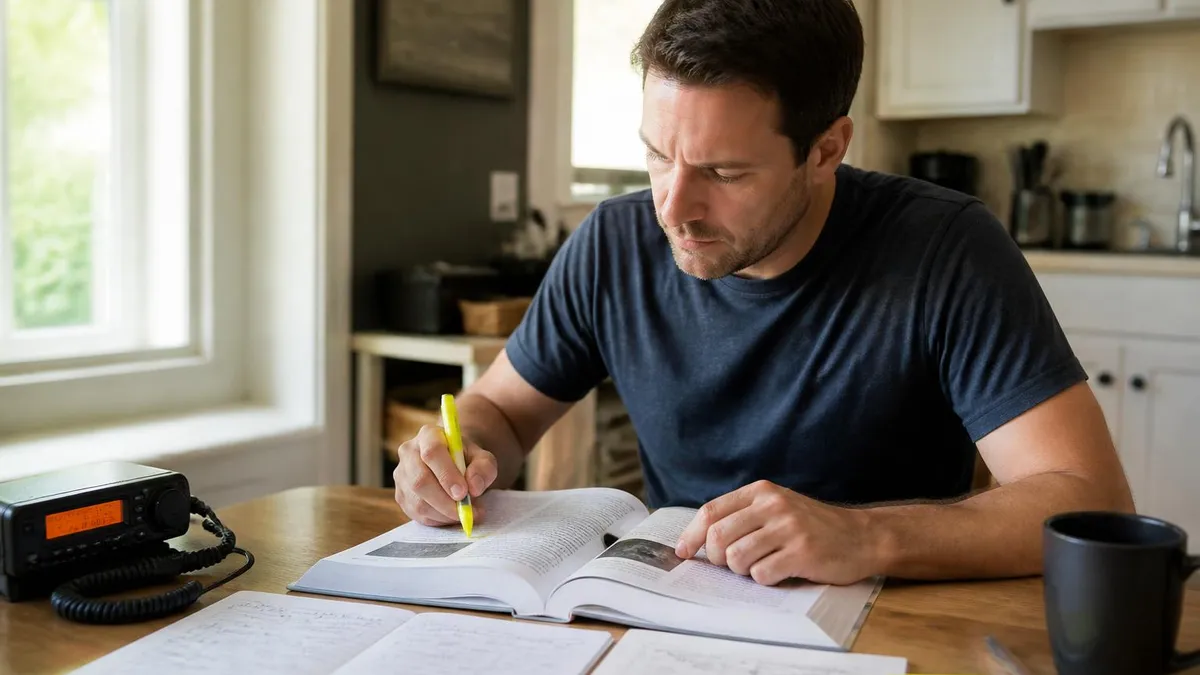
Operating a ham radio transmitter on amateur frequencies without a valid FCC license is illegal and can result in fines of up to $10,000 per violation and equipment forfeiture. The FCC actively uses direction-finding techniques to locate unlicensed transmitters, and amateur operators frequently assist in tracking interference sources. Always obtain your Technician license before transmitting — the exam is straightforward, free study materials are abundant, and the license itself costs only $15.
Preparing for the ham radio license test is straightforward because the FCC publishes the entire Technician question pool — every single question that could appear on your exam, along with the four multiple-choice answers and the correct one. There are no surprises on exam day. The pool currently contains 423 questions, and the 35-question exam is drawn randomly from that pool, organized into topic groups. You need to answer 26 correctly (74%) to pass. With focused study using free practice tools, most people are ready to test within two to four weeks of starting preparation.
The Technician question pool is organized into ten major topic areas: FCC rules and regulations, station operation and special operations, licensing structure, amateur radio practices, electrical principles, circuit components, practical circuits, signals and emissions, antennas and feedlines, and RF safety. Questions about ham radio range, propagation, and frequencies fall primarily into the signals and emissions section and the antennas section, which together account for a substantial portion of the exam. Understanding the physics behind range — why VHF is line-of-sight, how gain antennas work, what decibels measure — makes these questions natural rather than forced memorization.
Online practice exam sites like HamStudy.org and AA9PW offer free, unlimited practice tests drawn from the actual question pool. These sites track which questions you answer correctly and which you miss, focusing your review time on weak areas. A common and effective strategy is to take a full 35-question practice test daily until you consistently score above 80%, then sit for the real exam. Most online practice tools also offer flashcard modes and question-by-question explanations that reinforce understanding rather than rote memorization.
Volunteer Examiner (VE) sessions are held by amateur radio clubs throughout the country, typically on weekends at libraries, community centers, or club meeting spaces. You can find sessions through the ARRL's online exam session locator or through local club websites. Online proctored exams offered through organizations like Anchorage Amateur Radio Club or GLAARG allow you to test from home with a webcam and proctors watching via video call — a convenient option that became widely available during the COVID-19 pandemic and has remained popular since.
On exam day, bring a government-issued photo ID, your FRN number, and the $15 exam session fee in cash or check depending on the session. Some sessions now accept digital payment. No calculators with memory functions are permitted, though simple four-function calculators are usually allowed for the math questions involving Ohm's law and power calculations. The math on the Technician exam is genuinely simple — basic multiplication and division using formulas that are straightforward to apply once you understand what each variable represents.
After passing the exam, your information is submitted electronically by the VE team to the FCC. The FCC typically grants the license within one to three business days, and you can look up your call sign on the FCC Universal Licensing System website. You cannot legally transmit until your license appears as granted in the FCC database — not merely after passing the exam.
The $15 FCC application fee must be paid through the FCC website within ten days of your exam, or the application will be dismissed and you will need to retest. Resources like andy's ham radio linux iso and similar community study guides can also supplement your preparation with video explanations and alternative approaches to the trickier exam topics.
Once licensed, consider joining a local amateur radio club immediately. Clubs provide access to experienced Elmers — the traditional term for a mentor in amateur radio — who can help you get your first radio on the air, program your repeaters correctly, and navigate the social norms of on-air operating. Most clubs also participate in ARES emergency communications groups, Field Day competitions, and public service events that give new operators hands-on experience with the full range of amateur radio capabilities far beyond what any study guide can convey.
Choosing your first ham radio equipment wisely can make the difference between a frustrating start and an immediately rewarding one. The most popular entry point is a dual-band handheld transceiver covering both 2-meter VHF and 70-centimeter UHF. These radios range from under $30 for Chinese-made brands like Baofeng to $150 or more for Japanese brands like Yaesu, Icom, and Kenwood. The quality difference is real — name-brand radios offer better receiver selectivity, more durable construction, and easier programming — but a budget radio is perfectly adequate for getting started and learning the basics.
The stock rubber duck antenna that comes with most handheld radios is the weakest link in your station. Replacing it with an aftermarket antenna of the same form factor can increase your range by 30 to 50 percent at no additional power cost.
A telescoping whip or a Diamond SRH series antenna costs $20 to $40 and makes a noticeable difference in both transmit range and received signal quality. For home or vehicle use, a roof-mounted mag-mount antenna connected to your handheld via a coax adapter is even better — antenna height and ground plane contribute significantly to performance on VHF and UHF.
Mobile ham radio operation in a vehicle offers significantly more range than handheld operation because vehicle-mounted antennas are higher, have better ground planes, and can be connected to radios running 25 to 50 watts rather than 5 watts. A typical 2-meter mobile setup in a car can reach repeaters 30 to 50 miles away under normal conditions, turning your vehicle into a genuinely capable communication station. Many operators use their vehicle as their primary ham radio station for months before investing in a fixed home station, which often requires more complex antenna installation and FCC compliance considerations around antenna towers.
Ham radio equipment costs vary widely depending on how deep into the hobby you want to go. A starter handheld costs $30 to $150. A quality dual-band mobile radio runs $150 to $400. An entry-level HF transceiver capable of worldwide communication on all amateur bands costs $700 to $1,500 new.
Used equipment available through hamfests, eBay, and QRZ.com classifieds can reduce these costs by 40 to 60 percent, and the amateur radio community has a strong tradition of helping newer operators find quality used gear at fair prices. Visiting a ham radio outlet or attending a local hamfest is one of the best ways to see equipment in person, compare options, and get advice from experienced operators before spending money.
Power supplies, coaxial cables, connectors, and antenna hardware add to the initial investment but are largely one-time costs that serve you for years. A quality 30-amp DC power supply for a mobile radio used at home costs $80 to $150.
Coaxial cable losses affect your effective range, so investing in low-loss cable for longer runs is worthwhile — LMR-400 cable loses significantly less signal per foot than standard RG-58, and for a 50-foot run on 70 centimeters, the difference can be 3 to 5 dB, which translates to meaningful range improvement. Understanding feedline loss is another topic covered directly on the Technician exam.
Digital voice and data modes require modest additional investment. A $30 to $50 interface cable connecting your radio to a computer sound card opens up WSPR, FT8, and other digital HF modes that dramatically extend effective range on limited power. For DMR digital repeater access, many inexpensive Chinese DMR handhelds are compatible with the global Brandmeister network and cost $60 to $100. The barrier to entry for digital operating has dropped dramatically in the past decade, and digital modes are now accessible to any new Technician licensee with basic computer skills and a modest equipment budget.
Portable and emergency operating deserves special attention when choosing equipment. Lithium-ion battery packs have revolutionized portable ham radio operation — modern LiPo batteries can power a 5-watt 2-meter radio for 8 to 12 hours on a single charge while weighing less than a pound. Solar charging panels sized for backpack use can extend that indefinitely in daylight conditions.
Building a go-bag with a handheld radio, spare battery, earpiece, and portable antenna allows any licensed operator to maintain communication capability during power outages, natural disasters, or outdoor adventures where cellular coverage is unavailable — demonstrating that the practical value of an amateur radio license extends well beyond the hobby itself.
Ham Radio Technician Questions and Answers

How Far Can Ham Radio Reach? Complete Guide to Ham Radio Range, Frequencies, and Getting Your License

Ham Radio Mobile: Complete Guide to Getting Your Ham Radio License and Operating on the Go
Ham Radio License Renewal: How to Keep Your Technician License Active, Avoid the Grace Period, and Renew Through the FCC
Ham Radio Technician

Do Ham Radios Need Electricity? Complete Guide to Ham Radio Power Requirements
About the Author

Educational Psychologist & Academic Test Preparation Expert
Columbia University Teachers CollegeDr. Lisa Patel holds a Doctorate in Education from Columbia University Teachers College and has spent 17 years researching standardized test design and academic assessment. She has developed preparation programs for SAT, ACT, GRE, LSAT, UCAT, and numerous professional licensing exams, helping students of all backgrounds achieve their target scores.
Join the Discussion
Connect with other students preparing for this exam. Share tips, ask questions, and get advice from people who have been there.
View discussion (3 replies)