
Esthetician State Board California: Licensing, Exam & Scope Guide 2026 October
California esthetician state board: 🎯 600-hour requirement, BBC application, written exam, scope of practice, fees, renewal & SB 803 changes.
Board of Barbering and Cosmetology (BBC) Quick Facts
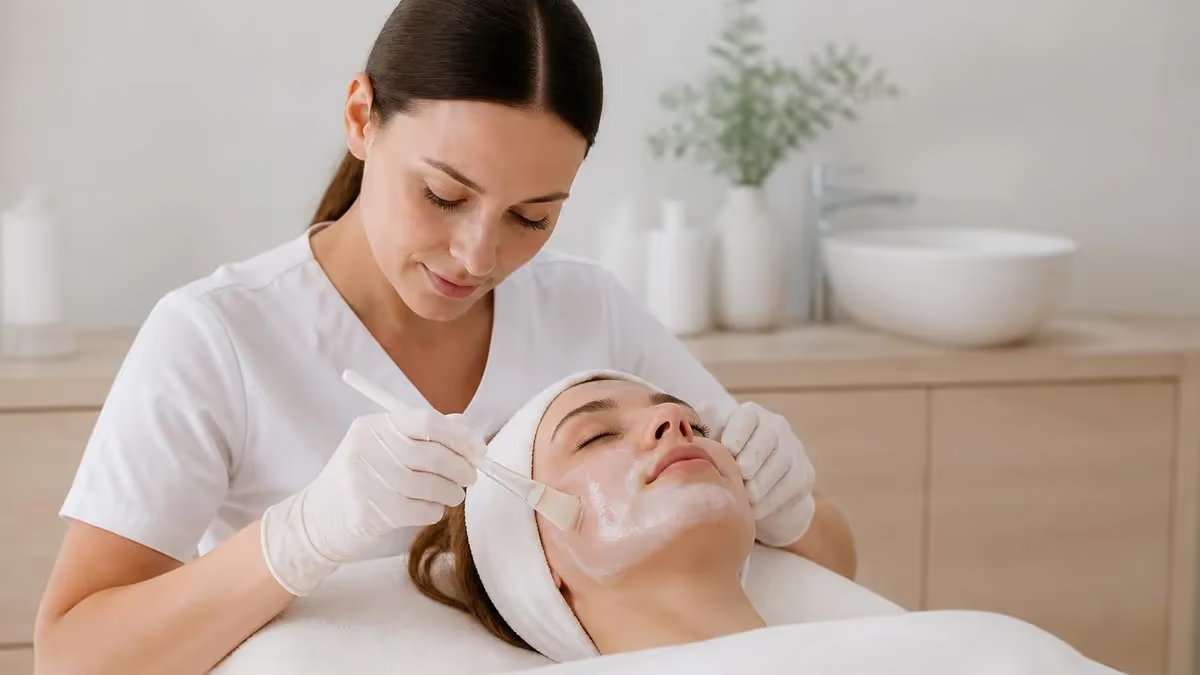
The California Board of Barbering and Cosmetology (BBC) regulates esthetician licensing under the Department of Consumer Affairs. California requires only 600 hours of approved training, one of the lowest hour totals in the country, and as of SB 803 most candidates take only a written exam. License renewal happens every two years with no mandatory continuing education. Scope of practice is narrow: facials, waxing, lash extensions, basic makeup and superficial peels — no microneedling, lasers, injections or chemical peels beyond the most superficial.
California Written Exam Snapshot
PSI Services administers California's esthetician written examination at testing centers across the state.
Esthetician State Board California: Complete Licensing, Exam, and Scope Guide
If you want to legally perform facials, waxing, lash extensions or skincare services anywhere in California, you need a license from the California Board of Barbering and Cosmetology, usually called the BBC. The board sits inside the Department of Consumer Affairs in Sacramento. It sets every rule that affects your training, your testing, your renewal and what you can do behind the treatment table.
The BBC publishes its rulebook in Title 16 of the California Code of Regulations, sections 900 through 994. Those numbers will follow you for your entire career. Inspectors quote them by section in violation notices, exam questions reference them, and salon owners post them on the wall near sanitation stations.
California is unusual in three big ways. First, the training requirement is short — only 600 hours of board-approved instruction, while many other states demand 1,000 or 1,500 hours. Second, since Senate Bill 803 took effect in 2022, the hands-on practical exam was removed for most applicants. You sit a written exam and that is it.
Third, California imposes a strict scope of practice. The board draws a clear line between esthetics and medical procedures, and it enforces that line aggressively through unannounced salon inspections by BBC investigators. Crossing the line costs fines, license suspension, or worse. Knowing exactly what you can and cannot do is half the job.
This guide walks through every step of the California pathway. Who qualifies. How to enroll in an approved 600-hour program. How to apply through the BreEZe online portal. What the written exam covers and how PSI delivers it. How the fees stack up. What you can legally do as a licensed esthetician. And how to keep your license active long-term.
For broader test prep beyond California, the esthetician license compares national formats, and the esthetician practice exam hub offers free question sets that mirror the BBC subject weighting closely. Both resources stay updated as the BBC content outline evolves over time.
Why the BBC Matters Before You Spend a Dollar
Every esthetician school, every exam fee, every salon job in California ties back to BBC rules. Enrolling in a non-approved program is the single most common rookie mistake. The board publishes an approved schools list, and only hours earned at those schools count toward the 600-hour requirement.
If you trained in a different state or country, you must still file proof of those hours with the BBC. In most situations you also must pass California's written exam before you can legally work, even if you already hold a valid esthetician license somewhere else.
The board also handles complaints and disciplinary action. A client who alleges a bad burn from a wax, a botched lash service, or unsanitary tools can file a complaint online. The BBC investigates and can suspend or revoke licenses. Civil fines run several thousand dollars per violation.
This is why understanding the rules matters as much as understanding skin science. Knowing exactly what you can and cannot do — and being able to cite Title 16 sections during inspections — protects your livelihood from day one.
Who Is Eligible to Apply in California
The eligibility bar is intentionally low. You must be at least 17 years old to begin training, and 18 to receive your license. You must have completed at least a 10th-grade equivalent education, or demonstrate the ability to read English at the 8th-grade level on a BBC-acknowledged assessment.
There is no residency requirement for licensure. Out-of-state and international students can train in California and apply for the license, though you will need a valid California mailing address on file with the BBC to receive correspondence and the physical license card itself.
Criminal-history disclosures get reviewed individually. Minor offenses rarely cause denial. Felony convictions related to fraud, violence, or controlled substances can trigger additional review. Always disclose truthfully — the BBC checks LiveScan results against your application and discrepancies cause automatic rejection.
Five California Esthetician Eligibility Rules
- Minimum age: 17 to start, 18 to be licensed
- Education: 10th-grade equivalent OR ability to read English at 8th-grade level
- Required hours: 600 board-approved
- Apprenticeship option: 3,200 hours (rare for estheticians)
- Portal: BreEZe online
- Required docs: Proof of training, ID, LiveScan, fees
- Format: Written only (SB 803 removed practical for most)
- Provider: PSI Services
- Fingerprinting: LiveScan mandatory
- Fee: Approximately $51 plus rolling fee
The 600-Hour Training Requirement Explained
California's 600-hour curriculum is set in regulation. Your school must dedicate specific hours to skin science, sanitation, chemistry, facial procedures, hair removal, makeup, and electricity as it applies to skincare. The school certifies your hours on a BBC proof-of-training form once you finish.
Programs are typically eight to twelve months full-time, or up to two years part-time. Schools must keep written records of every clock hour you complete. The full breakdown of program lengths nationally is covered in how long is esthetician school.
Choosing the right program matters more than the brand name. Approved chains like Paul Mitchell, Aveda Institute, Marinello and Bellus Academy each operate California campuses, and dozens of independent schools also exist. Before you sign, verify the school appears on the BBC approved list and tour the clinic floor.
Ask about the student-to-instructor ratio, request the most recent BBC pass-rate report, and check how many hours you spend on real clients versus mannequins. The esthetician school overview compares program structures.
Tuition varies wildly. Community colleges run roughly $4,000 to $7,000 for the full 600-hour program. Private and brand-name institutes charge $10,000 to $14,000 or more. Federal financial aid is available at accredited schools through FAFSA, and many private schools offer monthly payment plans.
Always confirm the school's most recent license pass-rate before enrolling — anything below 65 percent on first attempt is a red flag. The state average tends to sit between 70 and 75 percent, so a strong school should be at or above that line consistently across recent cohorts. The esthetician school near me page filters by ZIP and shows current pass rates.
Inside the California Written Exam
The written exam contains 110 multiple-choice questions delivered on a PSI computer. You get 90 minutes and need 75 percent to pass. The BBC publishes the content outline on its website, and PSI mirrors it directly.
Roughly 49 percent of items focus on scientific concepts: skin histology, anatomy, infection control, disorders, electricity, and chemistry. The other 51 percent cover practical service knowledge — facials, hair removal, machines, and the chemistry of cosmetic ingredients you actually use at the station.
Expect at least 25 questions on sanitation alone. California weights this section heavily because Title 16 §979–994 of the regulations governs every disinfectant, towel, and implement in your station. Knowing approved EPA disinfectants and contact times verbatim will score you easy points.
Test centers operate in cities like Fresno, San Diego, Los Angeles, Sacramento, Oakland, and Glendale. You schedule through PSI's portal after the BBC approves your eligibility. Bring two forms of ID — one government-issued with a photo. Phones, smart watches, and notes are prohibited at every PSI center.
PSI scores immediately and emails a pass/fail notification the same day. The official license arrives in the mail four to six weeks later. For broader exam strategy, the esthetician classes guide reviews study formats, and the medical esthetician school page explains the next-tier pathway many California estheticians explore after licensure.
If you fail on the first attempt, you can retest. You do not need additional schooling between attempts unless your school's pass rate triggers BBC remediation review. You do pay the application fee again, and you must wait for PSI to release a new scheduling window.
Most candidates who fail score in the 65 to 74 percent range on their first try. That is close enough that one more focused study cycle on weak areas pushes them over the line. Retesting estheticians have a roughly 80 percent success rate when they target their weakest two domains during the gap between attempts.
How California Compares to Other States
Texas requires 750 hours. Florida requires 260 hours and uses a more aggressive practical model. New York demands 600 hours plus a hands-on practical exam. Washington and Utah have separate master esthetician tiers that allow chemical peels and laser work after additional training and exams.
California sits in the middle on hours but at the strict end on scope. Massachusetts and a few northeastern states allow microneedling under supervision; California does not. Nevada requires 600 hours but mandates a practical exam too.
California Licensing in Four Tabs
- Verify you are 17+ and have 10th-grade or equivalent reading ability.
- Enroll in a BBC-approved 600-hour esthetician program.
- Complete the LiveScan fingerprint background check.
- File your BBC application on BreEZe with school proof-of-training and $75 fee.
- Wait for BBC eligibility approval (typically two to four weeks).
- Schedule the written exam with PSI Services.
- Sit and pass the written exam at 75% or higher.
- Pay the initial license fee and receive your wall certificate in the mail.
Application-to-License Timeline
Month 1
Months 2-9
Month 9 or 10
Weeks 2-4 after filing
Exam week
4-6 weeks post-pass
California Esthetician License Fees
Key California Numbers
Key Facts at a Glance
| Item | Value | Details |
|---|---|---|
| Required training hours | 600 | |
| Written exam questions | 110 | |
| Passing score | 75% | |
| Renewal cycle | 2 yrs |
California vs Other States: Pros and Cons
- +Only 600 training hours — among the lowest in the country.
- +No practical exam required for most applicants (SB 803, 2022).
- +No mandatory continuing education for renewal.
- +Massive job market across LA, SF Bay, San Diego and Sacramento.
- +BreEZe online portal is efficient and largely paperless.
- +Single license — no separate master esthetician tier to chase.
- −Scope of practice is narrow — no microneedling, lasers, or medium peels.
- −Microblading requires a separate body art license, not your esthetics license.
- −Reciprocity is limited; most out-of-state estheticians must re-test.
- −Cost of living in licensure cities is high relative to typical entry pay.
- −Strict Title 16 sanitation rules invite frequent inspections and fines.
- −Advanced services require medical supervision or a different credential.
Senate Bill 803 removed the hands-on practical exam for most California esthetician applicants in 2022, but it did not reduce training hours. You still need the full 600 hours from a BBC-approved school. Some older guides and YouTube videos still describe the obsolete two-part practical and written format — ignore them. Always verify with the BBC website for the most current requirements before you apply or schedule.
Pre-Application Document Checklist
- ✓Government-issued photo ID (driver license, state ID, or passport)
- ✓Social Security Number or ITIN
- ✓Completed LiveScan fingerprint request form with BBC ATI code
- ✓Proof of training certificate signed by your BBC-approved school
- ✓School transcript showing 600 completed clock hours by subject
- ✓Application fee of $75 payable inside BreEZe by card or e-check
- ✓Current mailing address — license is mailed, not emailed
- ✓Email address you check daily for PSI scheduling instructions
Top BBC-Approved Esthetician School Networks in California
- Locations: San Diego, Costa Mesa, Sacramento, Modesto
- Program length: Approximately 8 months full-time
- Locations: Los Angeles, San Francisco, San Diego
- Notable: Strong product line training, salon partnerships
- Locations: Poway, Chula Vista, El Cajon, Manhattan Beach
- Notable: Advanced electrical equipment hours
- Locations: Various rebranded campuses statewide
- Notable: Verify current BBC approval before enrolling
- Examples: American River College, Sacramento City College, Cypress College
- Notable: Cheapest tuition path; financial aid available
How to File Through the BreEZe Portal Step by Step
Every California application now runs through BreEZe at breeze.ca.gov. Create your account first — the BBC links your application history to that login forever. After your school certifies your hours, choose Apply for a License, select Board of Barbering and Cosmetology, then Esthetician.
Upload your proof of training, fill the contact and demographic fields, and attest to the criminal-history questions truthfully. Pay the $75 application fee with a debit card, credit card, or bank e-check. Most applications process in two to four weeks once everything is uploaded correctly.
After submission, your status moves from Received to Under Review to Eligible. Once you reach Eligible, PSI emails you a scheduling link within one to two business days. If documents are missing, the BBC posts a Notice of Deficiency to your BreEZe inbox — check it weekly.
For salary expectations once you finish all this, check the esthetician salary data by state and city before you sign your first salon contract. Pay varies dramatically between metro Los Angeles, the Bay Area, and inland California, so know your local market.
LiveScan Fingerprinting Without Hassle
Fingerprinting must be done electronically at an approved LiveScan vendor. UPS Stores, sheriff's offices, and many private LiveScan locations qualify. Bring the BBC's ATI request form (downloadable from the board site) plus a government ID and the rolling fee, usually $20 to $40 on top of the $51 state and federal fee.
Your prints submit electronically to the DOJ. Results return to the BBC within days. Out-of-state applicants who cannot LiveScan must use a manual fingerprint card with extra processing time, sometimes adding three to five weeks to the timeline.
Once your background clears and your hours are verified, BreEZe flags your application Eligible and PSI takes it from there. Any criminal record disclosure triggers a separate review; minor offenses rarely cause denials but unresolved convictions can delay licensure significantly.
Renewal, Reciprocity, and Career Strategy
Your license expires on the last day of your birth month every two years. BreEZe emails reminders 90 and 30 days out, but it is your responsibility to renew on time. The $50 renewal fee is the same online or by mail.
California does not require continuing education for estheticians. That is an unusual perk compared to states like Texas, Louisiana, or Washington, all of which mandate annual CE hours. Many California estheticians still take CE voluntarily to stay current with skincare science.
If you let your license lapse, you have 60 days to renew with a $25 delinquency fee. After five years expired, you must re-apply, re-test, and document any new training. The BBC also requires you to display your wall license at every workplace and to update your address within 30 days of any change.
Inspectors check both license display and address compliance during routine visits. For day-to-day operational basics — kit, supplies, sanitation, and product cost — see esthetician supplies and esthetician license for state-by-state comparisons.
California's reciprocity rules are conservative. The BBC does not have automatic reciprocity with any state. If you trained elsewhere, you submit your out-of-state license and training certificate to the BBC for review. If you fall short on hours, you must make up the difference at an approved California school.
Most new California estheticians start in spas, day-spa chains, dermatology offices, or lash studios. Specialization pays. Lash artists, brow shapers, advanced facialists in medical practices, and waxing specialists all command premium pricing in California metros — often two to three times entry-level rates.
For a clear path into the profession, the how to become an esthetician roadmap walks through every step from school to first paycheck. Plan early, study deliberately, and stay inside the BBC scope rules. California rewards estheticians who treat the license like the legal contract it is.
California Esthetics Industry Snapshot
Long-Term Career Health and Earning Power
The single biggest predictor of California esthetics earnings is not where you went to school. It is how aggressively you specialize during the first three years on the floor. Generalists tend to stall in the $35,000 to $45,000 range, while specialists in lashes, advanced facials, or medical practice work routinely clear $70,000 to $90,000.
Voluntary credentials matter. CIDESCO or NCEA after your first year opens doors to international spa positions and luxury resort jobs. Even though California does not require continuing education, tracking voluntary CE hours impresses clients and helps you negotiate higher commission splits at high-end spas.
Keep a sterile, organized station for every inspection. BBC violations follow your license number forever and surface in future background checks. Photograph your work, save before-and-after consent forms, and build a portfolio on Instagram or TikTok — California is a digital-first market and social presence directly drives bookings.
Treat your license number like a bank account. Renew on time. Update your address promptly. Display your wall license. Track every continuing education hour. Years from now, when you want to open your own studio, those small, boring habits will be the difference between a clean approval and a slow review.
California is the largest esthetics market in the United States. Demand for licensed, properly credentialed estheticians is projected to grow more than nine percent through 2032, faster than the average occupation. The state rewards skill, professionalism, and rule-following with stable income and long careers.
California Written Exam Format
| Section | Questions | Time | Weight | Notes |
|---|---|---|---|---|
| Scientific Concepts | 54 | Combined | 49% | Anatomy, histology, disorders, infection control, electricity, chemistry |
| Skin Care and Services | 35 | Combined | 32% | Facials, peels, machines, masks, client consultation |
| Hair Removal | 12 | Combined | 11% | Waxing, sugaring, threading, tweezing |
| Makeup and Lash | 9 | Combined | 8% | Application, lash extensions, brow services |
| Total | 110 | 90 minutes | 100% |
Eight-Week California Written Exam Study Plan
- ▸Read Milady chapters 1–7
- ▸Build flashcards for skin layers
- ▸Take diagnostic quiz to set baseline
- ▸Memorize disinfectant requirements
- ▸Drill PPE and station sanitation
- ▸Take 50-question infection-control quiz
- ▸Study common dermatoses with images
- ▸Categorize lesions: primary vs secondary
- ▸Take 25-question disorders set
- ▸Review galvanic, high-frequency, LED
- ▸Memorize contraindications
- ▸Quiz on machine settings
- ▸Study facial sequence steps
- ▸Learn ingredient categories
- ▸Take 40-question services quiz
- ▸Memorize temperatures and patch-test rules
- ▸Review waxing contraindications
- ▸Quiz on hair-removal section
- ▸Study color theory basics
- ▸Memorize lash-extension safety
- ▸Drill makeup application rules
- ▸Take three full 110-question mock exams
- ▸Re-drill weakest two topics
- ▸Sleep, hydrate, schedule PSI exam
Aim for 70+ on every mock before sitting the real exam. Pair these weeks with the free PTG question banks.
Final Day-of-Exam Checklist
- ✓Government-issued photo ID matching your BBC application name
- ✓Second form of ID (credit card, school ID) — PSI rules
- ✓PSI confirmation email with appointment time and address
- ✓Arrive 30 minutes early to clear security and storage
- ✓No phones, watches, hats, food, or notes inside the testing room
- ✓Eat a real meal — 90 minutes of computer testing is mentally taxing
- ✓Bring a sweater — many PSI rooms are cold
- ✓Be ready to view your unofficial pass/fail score on-screen before you leave
Sample Esthetician Practice Questions
Try these questions from our free Esthetician practice tests. The correct answer and an explanation follow each question.
During a client consultation, an esthetician learns the client has a history of Hepatitis B. According to the principles of Universal Precautions, how should the esthetician proceed with the service?
- A. Refuse service to the client to avoid any risk.
- B. Use extra-strong disinfectants on all surfaces.
- C. Proceed with the service, treating all clients as if they have a potential bloodborne pathogen.
- D. Wear two pairs of gloves throughout the entire service.
Answer: C. Proceed with the service, treating all clients as if they have a potential bloodborne pathogen.
Universal Precautions, a concept from OSHA's Bloodborne Pathogens Standard, requires treating all human blood and certain body fluids as if they are known to be infectious for HIV, HBV, and other bloodborne pathogens. This means standard infection control procedures, like wearing gloves and proper disinfection, should be consistently applied to every client, regardless of their known health status. Refusing service based on this history would be discriminatory and is not the correct protocol.
According to state board regulations, what information must be documented on a client consultation card before providing services?
- A. The client's insurance provider and policy number
- B. The client's medical history, allergies, and current medications
- C. The client's preferred social media handles
- D. The client's previous esthetician's contact information
Answer: B. The client's medical history, allergies, and current medications
Client consultation cards must include medical history, allergies, and medications to ensure safe treatment and identify any contraindications.
An esthetician accidentally spills a chemical peel solution. To find detailed information about the product's hazards and proper cleanup procedures, the esthetician should consult the:
- A. Occupational Safety and Health Administration (OSHA) website
- B. Product's marketing brochure
- C. Safety Data Sheet (SDS)
- D. Salon's service menu
Answer: C. Safety Data Sheet (SDS)
A Safety Data Sheet (SDS), formerly known as MSDS, is a document required by OSHA that provides comprehensive information about a chemical substance. It includes details on potential hazards, handling and storage instructions, and emergency procedures, making it the correct resource for a chemical spill.
According to a state board sanitation standards document, which of the following correctly describes the difference between sanitation and sterilization?
- A. Sanitation eliminates all microbial life; sterilization reduces microbial count to a safe level
- B. Sanitation and sterilization are interchangeable terms in cosmetology regulations
- C. Sanitation reduces the number of pathogens to a safe level; sterilization destroys all microbial life including spores
- D. Sterilization uses chemical disinfectants; sanitation uses heat-based methods only
Answer: C. Sanitation reduces the number of pathogens to a safe level; sterilization destroys all microbial life including spores
Sanitation lowers microbial counts to safe public health levels, while sterilization is the complete destruction of all microorganisms, including bacterial spores — a critical distinction in state board regulations.
Esthetician Questions and Answers
Related Esthetician Resources

Esthetician Practice Exam 2026
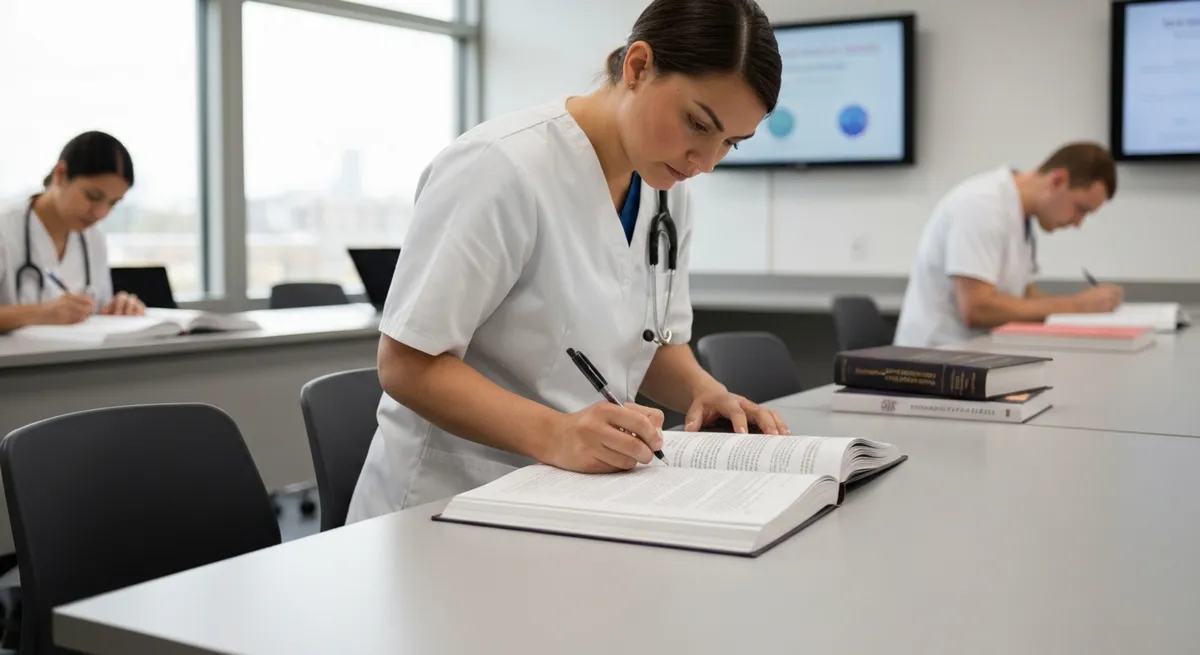
Esthetician State Board Exam Guide: Written and Practical Test Format, Study Tips
Esthetician License: Requirements, Training Hours, and Path by State
Esthetician School: Programs, Costs, and Licensing Steps
Esthetician School Near Me: How to Find Local Programs by ZIP, City, and State
Esthetician Supplies: Starter Kit, Equipment, and Where to Buy
Esthetician Classes: Pre-Licensing, CE, Online & Specialty Courses
Esthetician Salary: Pay by State, Setting, and Experience (2026)
How to Become an Esthetician: Complete Guide
Medical Esthetician School: Programs, Cost, and Career Path 2026
About the Author
Licensed Cosmetologist & Beauty Licensing Exam Specialist
Paul Mitchell SchoolsMichelle Santos is a licensed cosmetologist with a Bachelor of Science in Esthetics and Salon Management from Paul Mitchell School. She has 16 years of salon industry experience and 8 years preparing students for state cosmetology board exams in theory, practical skills, and sanitation. She specializes in licensure preparation for cosmetologists, estheticians, and nail technicians.
Join the Discussion
Connect with other students preparing for this exam. Share tips, ask questions, and get advice from people who have been there.
View discussion (4 replies)