
Esthetician Supplies: Starter Kit, Equipment, and Where to Buy 2026 October
🧠 Esthetician supplies guide: starter kit, professional equipment, disposables, retail lines, where to buy, and budget tiers from $500 to $10K+.
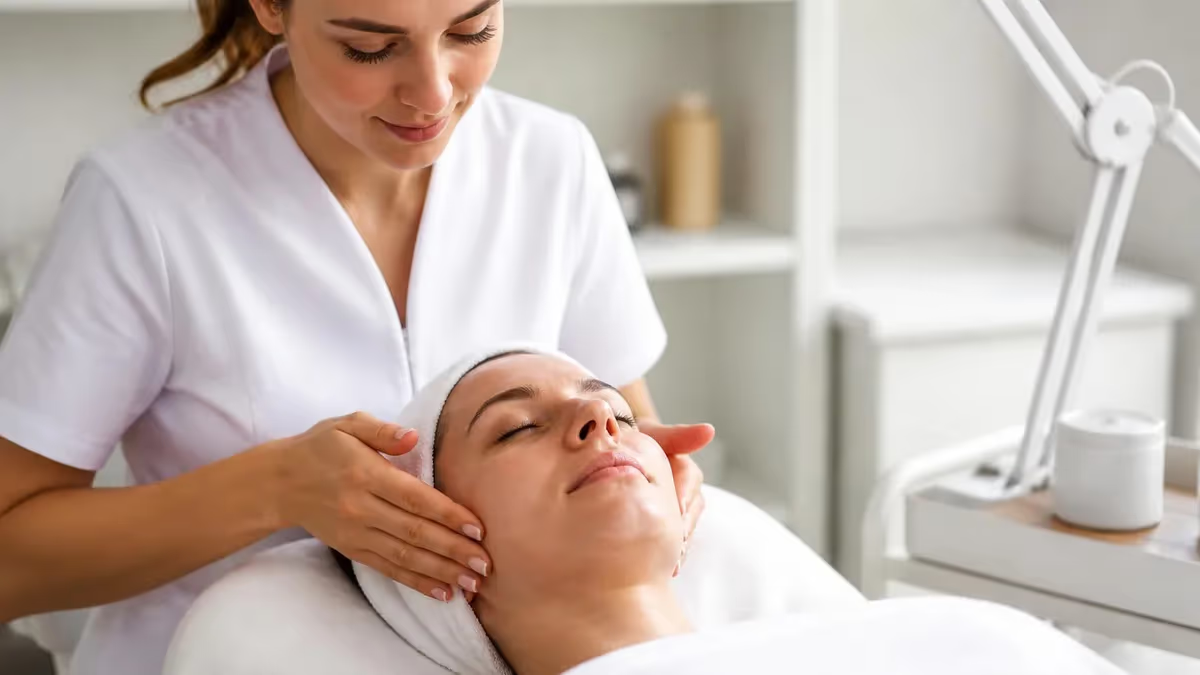
The right supplies decide your first-year profit
New esthetician supplies fall into four buckets: fixed equipment (bed, lamp, cart), back-bar product (cleansers, masks, serums you use during services), retail product (what clients take home), and disposables (gloves, headbands, wipes). A solo studio can open the doors for $1,500. A full medical-spa setup runs $25,000+. The trick is matching your spend to your service menu and licensing scope. This guide breaks down every category, with realistic price ranges, where licensed pros buy, and what schools usually leave out of the kit.
Esthetician Supplies: The Complete 2026 Buying Guide
Every esthetician supplies list starts with the bed and the lamp, but those two items are only the beginning. A working treatment room needs about 80 distinct items before you can legally see a paying client. The difference between a $600 starter kit and a $6,000 starter kit comes down to which equipment you skip versus which you buy professional-grade up front. Most graduates underestimate the disposables budget and over-spend on machines they will not use for six months.
This is not a wish list. It is the actual inventory licensed estheticians stock in salon suites, medical spas, and home studios across the country. Whether you are still in school, three months from your esthetician license, or already booked, the categories below match how professional distributors organize their catalogs. Use it as a checklist before you sign a lease or order your first wholesale bundle.
The Four Esthetician Supply Categories
Professional distributors split inventory into four working categories, and your purchase order should follow the same split. Fixed equipment is the longest-lasting and most expensive line item, accounting for 40 to 60 percent of opening costs. Back-bar product is what you consume during services, depleting faster than retail.
Retail is product clients carry out the door, usually marked up 2x from your wholesale cost. Retail margins are where most working estheticians earn their second income stream, often pulling 20 to 30 percent of total monthly revenue from over-the-counter sales rather than services. Treat it as a separate profit center with its own opening budget, not an afterthought to the service menu.
Disposables are the silent profit drain. Gloves alone cost a busy esthetician about $40 a month. Add headbands, lash strips, lancets, wax strips, sanitation wipes, and sheet masks and you are looking at $150 to $300 a month before you have paid for actual treatment product. Build that into your service pricing from day one, because most new graduates forget it entirely and run a thin margin for the first quarter.
Two other categories sit outside these four: furniture and decor (chairs, mirrors, signage, retail display, sound system) and business operations (point-of-sale hardware, intake tablets, label printer, scheduling software subscriptions). They are easy to forget on opening day because nothing touches a client's skin, but a working studio cannot operate without them. Budget another $500 to $2,000 for the operational layer depending on whether you are running a single chair or a four-chair studio.
What Schools Actually Include in Your Kit
Esthetician school kits cost $400 to $1,200 and are folded into tuition at most accredited programs. They typically include a magnifying lamp, basic facial steamer, sample-size cleansers and masks, a few brushes, headbands, spatulas, and a small product carry-case. Some schools also throw in a textbook, gloves, and starter waxing supplies. You can read more about program contents in our esthetician school breakdown.
What schools do not include: a treatment bed, professional-grade machines (high-frequency, galvanic, LED panels), bulk back-bar product, retail product, or any business supplies like point-of-sale, intake forms, or liability paperwork. The kit is for passing your practical exam. Real practice requires a separate purchase round, and most new licensees end up spending another $2,000 to $5,000 within the first 90 days of opening.
Smart graduates use the final 60 days of school to scout brands, attend distributor trade shows, and apply for wholesale accounts that take 2 to 4 weeks to clear. Approval requires your license number, which most states issue within 10 to 14 days of passing the state board exam. If you wait until you have the license in hand to apply, your treatment room sits empty for nearly a month while accounts get verified.

Esthetician Supplies by the Numbers
Build Your Inventory by Category
The foundation room. Buy these before you book a single client. Total: roughly $1,200 to $2,000 for entry-level pro grade.
- Treatment bed or electric facial chair ($350 - $1,200)
- Magnifying lamp with 5x or 10x diopter ($85 - $300)
- Facial steamer with ozone option ($90 - $250)
- Stainless rolling cart with drawers ($120 - $280)
- Wax warmer (hard wax + soft wax pots) ($45 - $150)
- UV towel warmer or hot towel cabbie ($120 - $200)
- Adjustable stool with backrest ($85 - $180)
- Magnifying mirror for client review ($30 - $60)
- Linen set: sheets, blankets, headbands ($80 - $150)
- Brush set: mask, fan, cleansing ($35 - $70)
- Stainless implements: tweezers, comedone extractors, lancets ($60 - $120)
- Sanitation jar with Barbicide ($25)
Where Licensed Estheticians Actually Buy
Professional product is sold through three channels. Direct from the brand is the slowest to set up but offers the best margins, training, and protected territory. Most brands require proof of license, a resale tax ID, and a minimum opening order between $200 and $800.
Multi-line distributors like Pure Spa Direct, The Spa Outlet, Universal Companies, and SkinCareSupply carry hundreds of brands under one roof and ship faster, but with thinner discounts. ASCP and ASCP Discounted is a membership-only network with deep markdowns on equipment and supplies for working pros.
Amazon and big-box retailers carry consumer versions of professional brands, but these are not the same SKUs your distributor sells, and using consumer-grade Dermalogica or PCA in a treatment room violates most brand contracts. Stay on the licensed-only channels for everything that touches a client. Disposables and basic furniture are the only categories where Amazon delivers real savings without quality risk. For anyone still researching the field, the what is an esthetician primer covers scope of practice in detail.
Professional vs Retail: Why the Channel Matters
Manufacturers split their lines into back-bar (used during your service) and retail (sold to your client). Back-bar SKUs are usually larger, more concentrated, and not approved for home use because they require professional knowledge to apply safely. Retail SKUs are the smaller, gentler, brand-marketed versions you place on a shelf. Selling back-bar to a client is a contract violation that can revoke your account, so keep them physically separated.
Most licensed-only brands also enforce minimum advertised pricing, which protects your retail margin from undercutting Amazon sellers. The trade-off is paperwork: you upload your license once a year, you commit to opening minimums, and you usually agree to feature the brand exclusively or near-exclusively in one product category. Smaller indie brands like Skin Script and Bioelements have looser rules and welcome new graduates earlier in their career, which is why they show up often on first-job back-bars.
Licensing and Resale Certificates
Two documents unlock professional purchasing. First, your state esthetician license, which proves you completed required training hours and passed the state-board exam. Most states require 600 to 1,000 hours. The how to become an esthetician guide breaks down state-by-state hours. Second, a sales-tax resale certificate from your state revenue department, which lets you buy retail inventory wholesale without paying sales tax, then collect tax from clients at the register.
Medical estheticians who work under a doctor's license have access to a fifth tier of supply: prescription-strength peels, injectable adjuncts, and medical-grade lasers. Most states require physician supervision for these. Read the medical esthetician school overview if you plan to pursue the medical-spa track, since the supply list is dramatically different. Standard estheticians cannot legally purchase or use Schedule-II or Rx-only product, even from a pro distributor.
Sanitation, Safety, and Implements
State boards inspect treatment rooms unannounced. Stainless implements must be sanitized in a wet sanitizer (Barbicide or hospital-grade equivalent), and many states now require a true autoclave for any tool that pierces skin, including lancets and dermaplane blades. Single-use disposables are the safer, audit-proof choice for anything that contacts blood or broken skin. Failed inspections can suspend a license and shut down a treatment room for 30 days.
Your kit should include a covered sanitation jar, a UV sanitizer cabinet (optional but inspector-friendly), color-coded brushes for clean versus used, and a dedicated linen hamper. Sheets, towels, and headbands need to be washed in hot water after every client, never re-used between sessions. Build a sanitation routine into your between-client turnaround time, usually 10 to 15 minutes, and it becomes invisible overhead instead of a panic at inspection time.
Budget Tiers: Three Realistic Starter Packages
5 Must-Have First Purchases for a New Esthetician
- Why First: Anchors the entire room. Sets working height for every other purchase.
- Spend Range: $350 - $1,200 for adjustable hydraulic with face cradle
- Avoid: Massage tables - too narrow, no head support, no recline
- Why First: Required for skin analysis on practical exam and every facial
- Spend Range: $85 - $300 with 5x or 10x diopter
- Avoid: Cheap clip-on lamps with no real magnification
- Why First: Used in 90% of facial protocols for pore softening
- Spend Range: $90 - $250 with ozone option
- Avoid: Travel humidifiers sold as steamers - they cannot generate true vapor
- Why First: Determines your service menu - cleansers, toners, masks, serums
- Spend Range: $400 - $900 for one full pro line opening order
- Avoid: Mixing brands - protocols are formulated to stack within one line
- Why First: Waxing is the fastest service to add and one of the highest-margin
- Spend Range: $45 - $150 for dual hard/soft warmer plus $80 in starter wax and sticks
- Avoid: Single-temperature warmers - hard wax and soft wax require different heat
Building Your Service Menu Around the Equipment
Every machine you buy should unlock a service that adds at least $20 to your average ticket. A $300 high-frequency unit pays for itself in 15 facials at a $20 add-on. A $1,800 microdermabrasion device needs 60 to 90 sessions at $35 to $50 add-on to break even.
Plan the menu first, then buy the equipment to support it. New graduates often reverse this and end up with a $400 LED panel they use twice a month while a galvanic device would have generated steady revenue every single session. The right service-to-equipment match is the difference between a quiet treatment room and a fully booked schedule by month three.
Look at what your local market will pay for. Acne facials, peels, dermaplaning, and waxing are reliable in every market. Hydrafacial, RF, and microcurrent require higher disposable income and a base of returning clients.
Many estheticians in smaller markets open with peels and dermaplaning, then add LED and microcurrent in year two as bookings fill. Browse local esthetician jobs postings to see which services employers feature. The menu signals what clients in your region are paying for.
Run a simple payback calculation on every machine before you click buy. Take the device cost, divide by the per-service add-on margin, and you have the number of sessions to break even. Under 100 sessions is reasonable for year one. Over 200 sessions should wait. Spreadsheet this every quarter and your lineup will reflect real demand instead of distributor pitches.
Another smart move: rent advanced devices through ASCP or local equipment-rental services for the first month after launch. Hydrafacial-style and RF machines often rent for $200 to $400 a week. If the new service books out, buy the device. If it sits idle, you learned the lesson without losing $3,000 in capital.
Disposables Spend by Studio Size
Disposables Math: The Hidden Profit Drain
A solo esthetician seeing 25 clients a week burns through $200 to $300 in disposables monthly. That breaks down to about $50 in gloves, $40 in headbands and bed roll, $60 in wax strips, $40 in sheet masks if used 4x a week, and the rest in cotton, gauze, and lancets. Triple that for a 3-chair studio and disposables jump to $700 monthly.
Build a $5 to $8 disposables surcharge into every service. Most clients accept it without comment, and over 1,200 clients a year that one line generates $6,000 to $9,000 of pure margin. Skipping it means subsidizing client gloves out of labor. The esthetician salary piece shows how disposables eat into take-home pay.
Order disposables in bulk every 6 to 8 weeks rather than monthly. A case of 1,000 gloves costs roughly $80 versus the $15 ten-pack at the local supply shop, and bulk wax sticks drop to under a penny each. Distributor minimums ($75 to $150 for free shipping) make bulk buying the obvious choice. Keep two weeks of buffer stock so a shipping delay never cancels a service.
Business Supplies You Will Need On Day One
Treatment supplies are the obvious purchase. Business supplies are what nobody mentions until you are halfway through opening week. You need a point-of-sale system (Square, GlossGenius, Vagaro, or Boulevard are most common), printable intake and consent forms tailored to each service, a HIPAA-compliant storage system for client records, and professional liability insurance through ASCP or a state-specific policy.
Most working estheticians also keep a folder of state-board documentation visible in the treatment room: a copy of your license, your last inspection certificate, MSDS sheets for every chemical product, and a written sanitation protocol. Inspectors ask for these documents on every visit. The esthetician school near me guide explains state-by-state requirements.
The tax side of supply purchases pays off if you track receipts from day one. Equipment over $2,500 typically qualifies for Section 179 immediate deduction in the year purchased. Back-bar product, retail inventory, and disposables are all standard write-offs. A working esthetician with $15,000 in opening supplies can legitimately reduce taxable income by that full amount. Open a separate business bank account before your first order.

Trade Shows, Education, and Restocking Cycles
Distributors host regional trade shows twice a year, and these are the best time to buy advanced equipment. Show-floor pricing usually beats catalog by 15 to 30 percent, plus brand reps include free training that would otherwise cost $200 to $500 per machine. The largest US shows are International Beauty Show New York, IBS Las Vegas, and Premiere Orlando.
Restocking rhythm matters as much as the initial buy. Most working studios reorder back-bar every 4 to 6 weeks, retail every 6 to 8 weeks, and disposables every 2 to 3 weeks. Set automatic reorder reminders in your point-of-sale system, and keep one master spreadsheet with par levels per product. When stock drops below par, reorder.
Continuing education credits also count toward the supply budget. Most states require 6 to 16 hours of CEU every license-renewal cycle, and brand training (Dermalogica, PCA, Image) qualifies. Free brand-led classes cover everything from chemical peels to LED protocols. Stacking CEUs through your supplier covers product, education, and license renewal in one transaction.
Some estheticians attend trade shows before they graduate, since admission is free with a school ID at most events. Walking the show floor, collecting sample-size product, and shaking hands with brand reps shortens the post-graduation account-approval cycle from 4 weeks to 1 week. Reps remember faces and fast-track wholesale applications once your license clears.
Build a single document that lists every supplier, every account number, your sales-rep contact, opening-order minimum, and next reorder date. Update it after every purchase. After two years of operation, this supplier ledger is worth more than any single piece of equipment in the room, because it represents the relationships, payment terms, and discounts you cannot rebuild overnight if you change locations or expand to a second studio. Treat it as core business infrastructure, backed up monthly.
Sanitation and State-Board Inspection Checklist
- ✓Wet sanitizer with Barbicide changed daily and labeled with date
- ✓UV sanitizer or autoclave for piercing implements (lancets, blades)
- ✓Single-use disposable lancets and dermaplane blades sealed until use
- ✓Color-coded brushes: clean vs used, separated visually
- ✓Linens (sheets, blankets, towels) washed in hot water between every client
- ✓Headbands disposable or fully laundered between clients
- ✓Sharps container present and not over half-full
- ✓EPA-registered surface disinfectant used between every appointment
- ✓Sealed sterilization pouches for stainless tools
- ✓MSDS sheets accessible for every chemical product on premises
- ✓Hand-wash sink with soap and single-use towels
- ✓License and inspection certificate posted visibly in treatment room
- ✓Closed-toe shoes worn by practitioner
- ✓Long hair tied back during all services
- ✓Client intake and consent forms signed before service begins
- ✓Allergy and contraindication review documented in client file
Buying New vs Buying Used Equipment
- +New equipment carries a warranty (1 to 3 years on most professional brands)
- +Latest safety features and certifications meet current state-board standards
- +Manufacturer training included on most premium devices
- +Eligible for Section 179 tax deduction in the year of purchase
- +Resale value holds for the first 2 to 3 years
- −New high-frequency, microcurrent, and LED cost 2x to 3x used pricing
- −Long lead times on premium equipment (some imports run 6 to 12 weeks)
- −Brand-name machines lock you into the manufacturer's consumables
- −Depreciation hits 30% in the first 12 months of ownership
- −Used equipment from working pros is often barely scratched and fully functional
Esthetician Questions and Answers
More Esthetician Career Resources
Esthetician School: Programs, Costs, and Licensing Steps
Esthetician License: Requirements, Training Hours, and Path by State
Esthetician Salary: Pay by State, Setting, and Experience (2026)
Esthetician Jobs: Where to Work and What You Can Earn
How to Become an Esthetician: Complete Guide
Medical Esthetician School: Programs, Cost, and Career Path 2026
About the Author

Licensed Cosmetologist & Beauty Licensing Exam Specialist
Paul Mitchell SchoolsMichelle Santos is a licensed cosmetologist with a Bachelor of Science in Esthetics and Salon Management from Paul Mitchell School. She has 16 years of salon industry experience and 8 years preparing students for state cosmetology board exams in theory, practical skills, and sanitation. She specializes in licensure preparation for cosmetologists, estheticians, and nail technicians.
Join the Discussion
Connect with other students preparing for this exam. Share tips, ask questions, and get advice from people who have been there.
View discussion (4 replies)