
Medical Esthetician School: Programs, Cost, and Career Path 2026 October
Medical esthetician school explained: top programs, cost, curriculum, salary, and how to advance from licensed esthetician to clinical med spa work 🏆
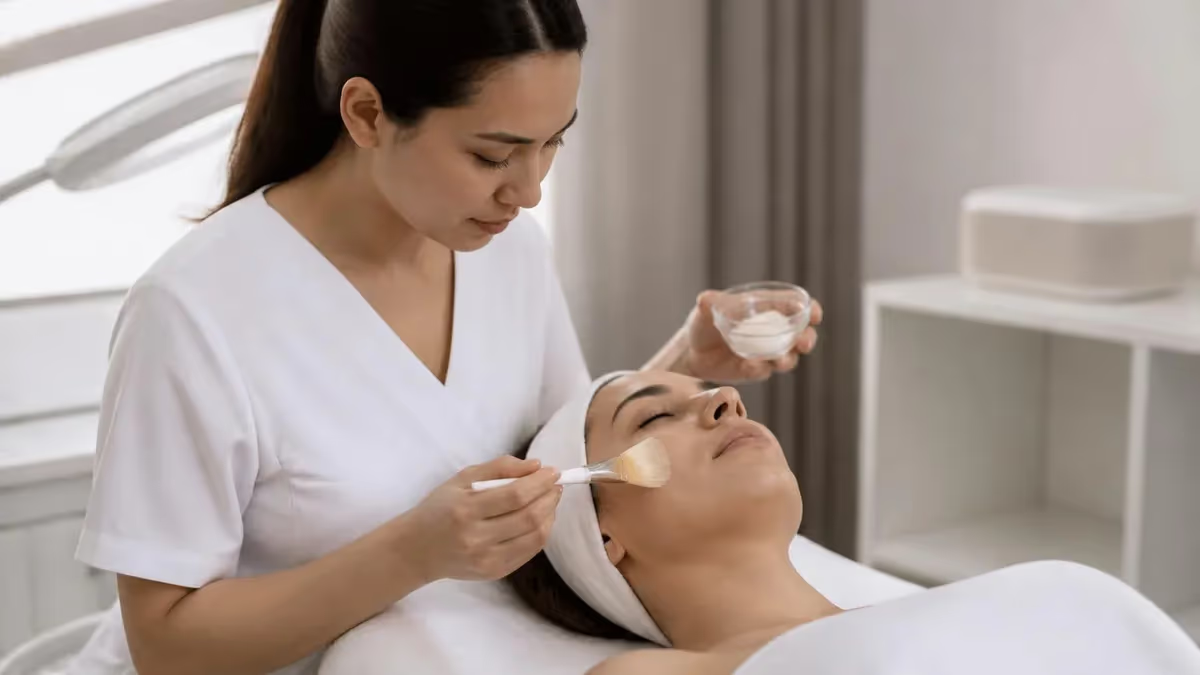
So you've got your esthetician license requirements sorted, you're a few years into spa work, and now you want more. More money, more advanced procedures, and a more clinical setting. That's where medical esthetician school comes in. But here's the catch most people miss: in most US states, there isn't a separate "medical esthetician" license at all. The pathway is a licensed esthetician plus advanced clinical training, often delivered through specialty schools, vendor certifications, or master esthetician tracks in the handful of states that offer them.
This guide walks you through what medical esthetician school actually means in 2026, what you'll learn, what it costs, where to study, and the kind of career it leads to. If you're a working spa esthetician sizing up the jump to clinical work, this is your roadmap.
One thing to keep in mind from the start: the medical aesthetics industry has exploded over the past decade. The US market is now over $20 billion annually and growing 15%+ year over year. That growth has created demand for trained estheticians who can handle medical-grade treatments under physician supervision, which is exactly what medical esthetician school prepares you to do.

Medical esthetician school isn't a single degree. It's advanced clinical training stacked on top of your basic esthetician license. You'll learn chemical peels, lasers, microdermabrasion, microneedling, and dermaplaning in a medical setting under physician supervision. Programs run 200-1,200 hours, cost $1,500-$20,000, and lead to med spa, dermatology, or plastic surgery jobs paying $55,000-$95,000+ at mid-career. Only Washington, Virginia, Utah, and DC offer a true "master esthetician" license. Everywhere else, you stack certifications on your standard license.
Let's clear up the biggest source of confusion first. A regular esthetician works in a spa setting doing facials, basic peels, waxing, makeup, and lash extensions. A medical esthetician (sometimes called a paramedical or clinical esthetician) does all of that plus deeper chemical peels, laser-assisted treatments, microneedling, dermaplaning, and post-procedure care. The work happens in a med spa, dermatology office, or plastic surgery clinic under a physician's supervision.
Both roles require the same starting point: a state esthetician license. If you want to know what is an esthetician at the foundation level, that's your launching pad. Medical esthetics is the next floor up, not a parallel track. You can't skip the foundation and go straight to medical work.
The other point worth nailing down: "medical esthetician school" is a marketing term more than a regulatory one. When schools advertise that phrase, they're typically offering one of four things. An add-on specialty program at an existing esthetics school. A master esthetician license track if your state offers it. Post-license certification courses (NCEA, ASCP, paramedical training providers). Or in-house training at a med spa under a supervising physician. Each path has trade-offs, and the right one depends on your state, your budget, and where you want to work.
Medical Esthetician School: Programs, Curriculum, Career Paths
Most medical esthetician programs run 200 to 1,200 hours depending on whether you're doing a short specialty intensive or a full master esthetician track. National Laser Institute offers 1-2 week intensives in laser, IPL, and injectables theory. Aviva Institute in Texas runs comprehensive multi-month programs. The Aesthetic Sciences Institute in California runs 6+ month deep-dive paths. Washington, Virginia, Utah, and DC offer state-recognized master esthetician licensure that bundles these advanced skills into a single 1,200+ hour credential.
Vendor-specific certifications (Hydrafacial University, Cynosure laser training, Sciton device cert) typically run 1-3 days each and stack on top of your base credential. Many working estheticians build their advanced toolkit one vendor cert at a time over a year or two while continuing to work full-time at a spa.
Before you enroll anywhere, get your prerequisites straight. Schools won't accept you into advanced training without proof you've done the foundational work. If you're still figuring out the basic pathway, the how to become an esthetician guide covers that ground. Medical esthetician programs assume you're already past it.
The standard ask is a high school diploma, an active esthetician license in your state, and at least a year (often two or three) of hands-on experience. Some programs are stricter and want references from a supervising spa director or proof of specific service hours. Don't wing this part — call admissions before you fill out the application and confirm your specific situation qualifies.
Prerequisites for Medical Esthetician School
- ✓High school diploma or GED
- ✓Completed accredited basic esthetician program (300-1,000 hours, varies by state)
- ✓Passed your state esthetician licensing exam (written and practical)
- ✓Active, in-good-standing state esthetician license
- ✓1-3 years of hands-on esthetician work experience (required by many advanced programs)
- ✓Up-to-date CPR/first aid certification (often required for clinical settings)
- ✓Liability insurance (some programs require proof before clinical hours start)
- ✓Background check clearance (standard for medical settings)
Now for the question everyone asks: how much will this cost you, and what should you actually spend? The honest answer is it depends on which path you take. A handful of vendor certifications can run you a couple thousand dollars total. A full master esthetician program in Washington or Virginia can hit $20,000. Most working estheticians land somewhere in the middle: $3,000-$8,000 spread across two or three years of stacked certifications.
Don't just chase the cheapest option. A $500 weekend laser certification from a no-name provider may not be recognized by employers or your state board. Conversely, paying $20,000 for a full master license only makes sense if you live in (or plan to move to) one of the four states that recognize it.
The smart play is to match the program to your state's rules and your target employer's hiring requirements. Talk to local med spa managers before you enroll anywhere — they'll tell you which credentials they actually look for on a resume. Word-of-mouth in this industry is more reliable than any marketing brochure, so ask around at conferences, on industry forums, and in regional Facebook groups for licensed estheticians before you commit a single dollar of tuition. Here's the spread broken down by program type.

Medical Esthetician Training Costs (2026)
Where you train matters almost as much as what you train in. Some schools have national reputations and strong med spa hiring pipelines. Others are regional but produce graduates who get hired locally with no friction. The list below covers the most-recognized providers in 2026, but always cross-check with your state board before you pay tuition.
A program approved in Arizona may or may not count toward Washington master esthetician hours, for example. Ask the school directly: do graduates from your state get hired? Which med spas hire from this program? Can I see a list of recent placements? Schools with good outcomes will answer those questions readily. Programs that dodge them are usually hiding poor placement rates.
Top Medical Esthetician Training Providers
- Locations: Scottsdale AZ + multiple US cities
- Format: 1-2 week intensives
- Cost: $1,500-$5,000
- Best for: Laser, IPL, injectables theory
- Location: Texas
- Format: Multi-month comprehensive
- Cost: $3,000-$8,000
- Best for: Full medical esthetics path
- Location: California
- Format: 6+ month programs
- Cost: $4,000-$12,000
- Best for: California-licensed students
- Location: Online + select campuses
- Format: Modular advanced courses
- Cost: $500-$3,000 per module
- Best for: Working estheticians stacking skills
- Body: National Coalition of Estheticians Associations
- Format: Accredited program network
- Cost: Varies by school
- Best for: National portability of credential
- States: WA, VA, UT, DC
- Hours: 1,200+ total
- Cost: $5,000-$20,000
- Best for: Real "medical" license credential
State recognition matters because it controls what you can legally do once you're trained. Washington, Virginia, Utah, and DC have a separate master esthetician license that explicitly authorizes advanced procedures. Outside those states, you're a licensed esthetician with extra training, and your scope is whatever your state board says it is. The exact same chemical peel certification can be fully legal in one state and grounds for a license suspension in the next state over.
Some states (like Texas, Florida, and California) allow well-trained estheticians to do quite a lot under physician supervision. Others restrict advanced services more tightly. New Jersey, for example, takes a stricter view of what falls under "medical practice" vs cosmetology. Always check with your state board before booking a single client for a procedure you learned in school. The training itself is portable, but the legal scope is not.
One more wrinkle: even within a permissive state, the supervising physician's specialty can affect what services you're allowed to perform under their license. A medical director who's a dermatologist may green-light more aggressive peels than one who's an OB/GYN moonlighting at the med spa for extra income. Vet your supervising physician carefully, both for legal coverage and for the quality of mentorship you'll get. A weak medical director arrangement is one of the most common reasons new med spas get shut down by state boards.
Critical: Completing a medical esthetician program does not automatically give you the legal right to perform every technique you learned. Your state board defines your scope. A graduate of a national laser program in Arizona may still be barred from operating an IPL device solo in their home state. Verify scope, supervision rules, and any device-specific certification requirements with your state cosmetology and medical boards before performing any advanced service. Practicing outside your scope can cost you your license and trigger civil liability.
Wondering how the timing compares to your original esthetician path? If you're trying to figure out how long is esthetician school in your state, that's typically 300-1,000 hours of basic training. Medical esthetician training stacks on top, adding anywhere from a few weeks of intensives up to another 1,200 hours for a full master license. The hours-to-payoff ratio varies wildly depending on which certs you choose and which state you practice in.
Most working estheticians spread training out over 1-2 years while continuing to work. The smartest students attack the most lucrative certifications first (laser, chemical peels, microneedling) since those carry the biggest pay bumps. Niche certs like LED therapy or specific Hydrafacial protocols can wait until you're already employed at a med spa that uses those tools. Don't waste tuition on equipment you won't touch.

Path From Beginner to Working Medical Esthetician
High school + age 17
Basic esthetician school
State licensing exam
Build experience
Choose your path
Complete advanced training
Apply at med spa or derm office
Build clientele and advance
What can a medical esthetician actually do once trained? Quite a lot, and it depends on your state. Here's the realistic scope. You can perform medium-depth chemical peels (TCA, Jessner's, deeper glycolic), microdermabrasion with both crystal and diamond systems, dermaplaning, microneedling (manual roller in most states, electric pens where allowed), LED light therapy, Hydrafacial treatments, and acne extractions at an advanced level. Many states allow laser hair removal and IPL photofacials with extra certification.
You'll also handle pre-procedure skin prep, post-procedure recovery care, product retail consultations, and follow-up assessments to track results across multi-session treatment plans. The day-to-day is far more clinical than spa work, with documentation requirements that resemble a healthcare setting more than a beauty business.
What you cannot do anywhere in the US: inject Botox or dermal fillers (those are RN, NP, PA, or MD only), perform deep phenol peels, diagnose skin conditions, or prescribe medications. You also can't use ablative CO2 lasers without direct physician supervision, and cutting or piercing the skin beyond limited microneedling depth is off-limits.
If injectables are your career goal, you'll need to go back to nursing school. Many medical estheticians do exactly that: a few years in a med spa, save up, then enroll in an RN program. Combining esthetics training with a nursing license is one of the most lucrative paths in the industry, with senior aesthetic nurses earning $100,000+ in major metros and full-cosmetic NPs clearing $150,000.
Pros and Cons of Becoming a Medical Esthetician
- +Higher pay than spa esthetician roles ($55K-$95K mid-career)
- +Wider variety of services and treatments
- +Structured medical environment with physician oversight
- +Strong career advancement track to lead, manager, or owner
- +High demand in a $20B+ growing US aesthetics market
- +Continuing education funded by many employers
- +Flexible per diem and part-time options
- +Recognized credential boosts career portability
- −Significant added training cost ($1,500-$20,000)
- −Requires existing license plus 1-3 years of experience
- −Med spas concentrated in larger metro areas
- −Higher liability and insurance requirements
- −State scope rules may limit what you can perform
- −Physically demanding (long hours standing, repetitive motions)
- −Working with anxious post-op patients is emotionally heavy
- −Less autonomy than spa work (you operate under a physician)
Salary is usually the deciding factor. Spa estheticians average $35,000-$50,000 in 2026. Entry-level medical estheticians start at $40,000-$58,000, with mid-career pros pulling $55,000-$80,000 and lead/manager roles hitting $65,000-$95,000. Specialty paths (oncology esthetics, MOHS surgery prep) sit in the $50,000-$75,000 range. Self-employed mobile medical estheticians can clear $120,000+ in good markets, though that comes with the usual self-employment risks.
Highest-paying states are California, New York, Hawaii, Massachusetts, and Washington. Tips and commissions are common on top of base pay, and many med spas offer service-volume bonuses. Top performers in major metros routinely double their base income through commission on package sales and product retail.
Geography matters more than people realize. A medical esthetician in Manhattan or San Francisco might earn 50-70% more than the same person in a small Midwest city, but cost of living eats most of that difference. The real win is finding a fast-growing secondary metro (Nashville, Austin, Phoenix, Charlotte) where med spa demand is exploding but wages haven't fully caught up. That's where new grads can punch above their experience level.
How to Choose the Right Medical Esthetician Program
- ✓Verify state board accreditation (this is non-negotiable)
- ✓Check hands-on clinical hours (more is better, aim for 50%+ practical)
- ✓Review faculty credentials (look for physicians, master estheticians, RNs)
- ✓Confirm equipment is current generation (not 10-year-old lasers)
- ✓Ask about job placement rate and where graduates land
- ✓Check vendor relationships (Hydrafacial, Cynosure, Sciton partnerships)
- ✓Read student reviews on multiple platforms (not just the school site)
- ✓Compare cost against typical starting salary in your metro
- ✓Confirm continuing education credit acceptance in your state
- ✓Visit campus in person if possible before enrolling
Want to compare the medical pathway against the basic spa route? Read up on what regular esthetician school covers first. The two paths share the same foundation, but where you go after licensure is where the income and career divergence begins. A spa esthetician five years in might be doing $45,000 with a steady client list. A medical esthetician five years in is often pulling $70,000+ with stronger benefits, paid CE, and a clearer ladder up to lead or manager.
That said, spa work isn't lesser. Some estheticians genuinely prefer the calmer pace, the relationships with regular clients, and the autonomy of running their own room or booth. Medical work is more clinical, more fast-paced, and more regulated. Pick the lane that fits your temperament, not just the paycheck. The best medical estheticians I've met treat the clinical setting like a craft, not a career escape hatch.
One smart middle path: work part-time at a med spa while keeping a smaller spa gig on the side. You get the medical training and pay bump without giving up the longer client relationships that make spa work satisfying. Many estheticians run this hybrid for years before fully committing to one or the other.
One area new medical esthetician students consistently underestimate: continuing education requirements. Most states mandate 16-32 hours of CE every one to two years just to keep your basic license active. Stack a master license or specialty certifications on top, and you're looking at additional vendor-specific renewal cycles.
Hydrafacial certification, for instance, often requires annual recertification. Laser device certs from Cynosure or Sciton frequently need refresh courses every two years. The good news is most med spa employers cover CE costs as a benefit, but you'll burn evenings and weekends on the actual coursework.
The other underestimated factor is liability insurance. As a basic spa esthetician, a $200-$400 annual policy is fine. Once you're doing chemical peels, lasers, and microneedling, your insurance jumps to $600-$1,500 per year. Some employers carry coverage for you under a clinic-wide policy, but freelancers and mobile pros need their own. Budget for it before you start advertising medical-grade services. Skipping coverage to save a few hundred dollars is the kind of mistake that ends careers when one bad reaction leads to a lawsuit.
Medical Esthetician School Questions and Answers
Bottom line: medical esthetician school is the next step for licensed estheticians who want higher pay, more advanced procedures, and a clinical setting. It's not a separate license in most states, but the specialized training is essential and the credential is recognized industry-wide. Start with your state esthetician license, build 1-3 years of experience, then pick a training path that fits your budget, schedule, and state scope rules. The order matters: rushing into advanced training without the experience layer underneath usually leads to wasted tuition and weak job prospects.
The med spa industry is growing 15%+ annually with 5,500+ med spas operating across the US in 2026, and 88% of them hire estheticians (not just RNs). Demand is real, the pay jump is real, and the work itself is far more varied than the day-to-day spa grind.
If you're ready to move up, this is the most accessible path. Pick your program with care, verify scope with your state board, and don't be afraid to start small with a single vendor cert before committing to a full master program. Many of the most successful medical estheticians today started with one $1,500 chemical peel certification and built their resume one credential at a time over three or four years. Slow and steady wins this race more often than the all-in $20,000 bet does.
About the Author
Licensed Cosmetologist & Beauty Licensing Exam Specialist
Paul Mitchell SchoolsMichelle Santos is a licensed cosmetologist with a Bachelor of Science in Esthetics and Salon Management from Paul Mitchell School. She has 16 years of salon industry experience and 8 years preparing students for state cosmetology board exams in theory, practical skills, and sanitation. She specializes in licensure preparation for cosmetologists, estheticians, and nail technicians.
Join the Discussion
Connect with other students preparing for this exam. Share tips, ask questions, and get advice from people who have been there.
View discussion (4 replies)