
What Is an Esthetician? Definition, Duties, and Career Guide 2026 October
An esthetician is a licensed skincare professional trained in facials, waxing, and skin treatments. ⏳ Learn what estheticians do, what they earn, and
What Is an Esthetician?
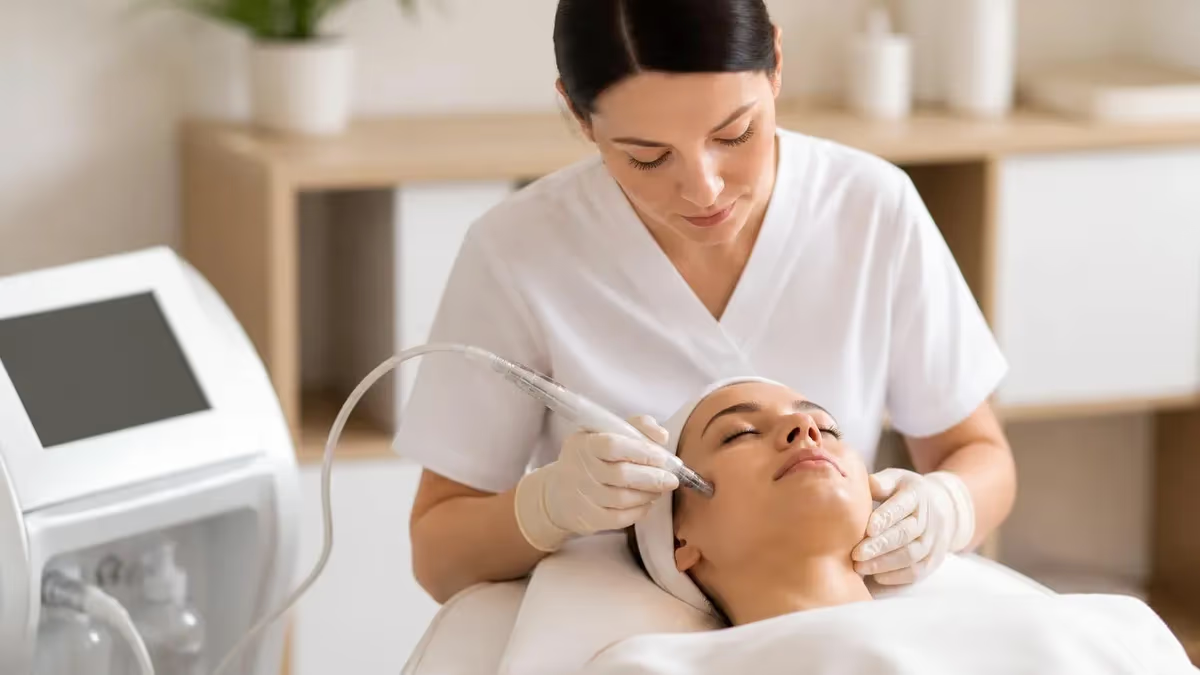
An esthetician — sometimes spelled aesthetician — is a licensed skincare professional trained to analyse skin conditions, perform cosmetic treatments, and recommend products to improve skin health and appearance. The word comes from the Greek aisthētikos, meaning perception through the senses, which reflects the discipline's focus on how the skin looks and feels. In practical terms, an esthetician definition covers anyone who has completed a state-approved cosmetology or esthetics program and passed a licensing examination authorised by the state board.
The esthetician meaning in everyday use is broader than the legal definition. Many people associate the title with facial treatments at a day spa, but estheticians work across a wide range of settings — from medical clinics performing pre- and post-surgical skin prep to resorts offering luxury body treatments to product companies training retail staff. The core skill set stays consistent: knowledge of skin anatomy, familiarity with cosmetic ingredients and their actions, and practical competence in hands-on treatment techniques.
Understanding what an esthetician does — and doesn't do — matters because scope of practice is legally defined and varies by state. Estheticians are not dermatologists. They cannot diagnose skin conditions, prescribe medications, or perform procedures that break the skin without specific advanced licensing. What they can do is deliver non-medical skincare treatments, provide education about skin health, and help clients build routines that support longer-term results. That specialised-but-accessible position makes esthetics one of the most client-facing roles in the beauty and wellness industry.
If you're preparing for the esthetician employment opportunities and the state board exam, understanding what the profession actually covers — the technical scope, the regulatory framework, and the range of career paths — gives you a strong foundation before you start practice-test preparation. The licensing exam tests both theoretical knowledge and practical competency, and both are grounded in exactly the principles covered in this guide.
- Definition: A licensed skincare professional trained in cosmetic skin treatments, skin analysis, and product application
- Also spelled: Aesthetician (both spellings are correct; 'esthetician' is more common in the US)
- License required: Yes — every US state requires a state board license to practise professionally
- Training hours: Typically 260–1,500 hours depending on state requirements; most states fall between 500–1,000 hours
- Key services: Facials, waxing, exfoliation, eyebrow/lash services, skin consultations, product education
- Work settings: Day spas, resort spas, dermatology clinics, medical spas, salons, cruise ships, product companies
- Exam required: Written theory exam + practical demonstration; administered by state boards (most use Pearson VUE or PSI)
What Estheticians Do: A Day in the Career
Client consultation and skin analysis
Treatment planning and client education
Hands-on treatment delivery
Post-treatment care and home routine recommendations

Esthetician vs Aesthetician: Is There a Difference?
The words 'esthetician' and 'aesthetician' refer to the same profession and are used interchangeably across the industry. The spelling difference is regional: 'esthetician' (without the leading 'a') is the more common spelling in the United States and appears on most state licensing documentation. 'Aesthetician' is more common in the UK, Canada, and Australia, and is also used by some US professionals who feel the original Greek spelling better reflects the field's roots. Neither spelling is more correct than the other — what matters for licensing purposes is the exact phrasing on your state's license application forms.
Where a real distinction does exist — and this one matters professionally — is between an esthetician and a medical esthetician (also called a clinical esthetician). A standard esthetician license covers cosmetic treatments for healthy skin.
A medical esthetician works in a clinical setting under the supervision of a physician or nurse practitioner, providing treatments like pre-surgical skin preparation, post-procedure wound care support, and advanced services like microneedling or laser-adjacent treatments that require additional certification beyond the standard license. The scope of practice for medical esthetics varies significantly by state, and some states require additional advanced licensure or specific physician delegation protocols for clinical work.
There's also a distinction between a basic esthetician and a master esthetician in states that offer that distinction. Master esthetician programs typically require 750–1,500 hours of training (compared to 260–600 for a basic license in the same state) and cover more advanced techniques including deeper chemical peels, microdermabrasion, and lymphatic drainage. Not all states use this tiered structure — some have a single esthetician license covering a broader scope, while others separate the roles formally. If you're considering esthetician near me programs, confirm which level of license your state offers and what scope of practice each covers before enrolling.
Types of Esthetician Work Settings
The most common entry-level setting for new estheticians. Day spas offer standalone facial and body treatment services without overnight accommodation. Salon-spas combine hair and nail services with esthetics under one roof. These settings build practical speed and client communication skills quickly, and commissions or tips can supplement hourly base pay significantly in high-traffic locations.
Resort spas typically offer more comprehensive treatment menus, often including body wraps, hydrotherapy, and specialty rituals alongside standard facial services. Pay structures often include hourly base plus commission, and working in an upscale property can mean larger tips and exposure to premium product lines. Resort locations may require relocating or willingness to work weekend and holiday schedules.
Medical esthetics is one of the fastest-growing practice settings. Med spas operate under physician oversight and offer services that cross into clinical territory — chemical peels, laser treatments, injectables (performed by licensed medical providers), and skin consultations with a stronger diagnostic component. Pay scales are typically higher than day spas, and the clinical environment suits estheticians interested in the science side of skin care.
Estheticians work for skincare brands as educators, account managers, or retail consultants. The role focuses on training retail staff, demonstrating products to customers, and representing the brand at events or professional trade shows. This path suits estheticians with strong communication skills who prefer a less physically demanding setting than hands-on treatment work.
Esthetician vs Related Skin Professionals
Estheticians and dermatologists both focus on skin, but the scope of practice is entirely different:
- Dermatologist: Medical doctor (MD or DO) who diagnoses and treats skin diseases, prescribes medications, and performs medical and surgical procedures. Requires medical school + residency (typically 12+ years of education and training)
- Esthetician: Licensed skincare technician who performs cosmetic treatments for healthy or mildly problematic skin. Cannot diagnose conditions, prescribe treatments, or perform medical procedures. Requires state-approved esthetics program (typically 6–12 months)
- Overlap: Some dermatology practices employ estheticians to perform cosmetic facials, post-procedure care, and patient education — working under physician supervision and within a defined clinical protocol
- When clients need both: Clients with active skin diseases (severe acne, psoriasis, eczema flares, skin cancer screening) need a dermatologist first. Clients who want to maintain and improve healthy skin, prevent ageing, or receive cosmetic treatments are well-served by an esthetician
How to Become an Esthetician
Becoming an esthetician follows a structured path that includes education, hands-on training, and state licensing — but the total time from starting school to working professionally is typically six months to one year for a basic license, making it one of the faster routes into a licensed healthcare-adjacent career.
The first step is completing a state-approved esthetics program. These programs are offered at cosmetology schools, community colleges, and dedicated esthetics academies. Program length varies significantly by state — Texas requires 750 hours, California requires 600 hours, and some states accept programs as short as 260 hours for a limited license. The curriculum covers skin anatomy and physiology, chemistry of cosmetic ingredients, sanitation and infection control protocols, practical treatment techniques (facials, waxing, exfoliation), and client consultation skills. Most programs include both classroom instruction and supervised clinic hours where students practise on real clients.
After completing the program, you apply to your state board to sit the licensing examination. Most states use Pearson VUE or PSI as their testing provider. The exam typically has two components: a written theory test covering the academic content from your program, and a practical skills examination where you demonstrate techniques on a model under examiner observation. Passing both components earns your esthetician license.
The theory exam tests knowledge of skin anatomy, product chemistry, sanitation standards, and professional ethics — all material covered in your program and testable through structured practice questions. For the written portion, systematic practice-test preparation improves both confidence and retention of the exact terminology the exam uses. Check your state board's candidate handbook to confirm the exact subject weighting before you start studying.
Once licensed, building an initial client base is the most practical early challenge. Many new estheticians start as employees in a spa or salon setting to develop speed, client communication skills, and a loyal following before considering independent practice. Esthetician salary typically starts between $30,000 and $40,000 annually for entry-level spa employment, with earnings rising significantly as you build your client list, add specialty certifications, and move into higher-paying markets or clinical settings.
Steps to Become a Licensed Esthetician
- ✓Research your state's hour requirement and confirm which board oversees esthetics licensing (cosmetology board or separate esthetics board)
- ✓Enrol in a state-approved esthetics program — compare program length, cost, clinic hours, and job placement rates before choosing a school
- ✓Complete all required hours including both classroom instruction and supervised clinic practice
- ✓Apply to your state board for your licensing examination — gather transcripts, school completion documentation, and application fees
- ✓Study for the written theory exam using practice tests covering skin anatomy, product chemistry, sanitation protocols, and professional ethics
- ✓Pass both the written and practical components of the state board exam
- ✓Receive your license and apply for positions at spas, salons, medical spas, or dermatology offices
- ✓Begin building your client base — early career growth depends heavily on client communication, treatment quality, and product knowledge
Esthetician Career: Advantages and Challenges
- +Relatively short training path — most estheticians are licensed within 6–12 months of starting school, compared to multiple years for medical or dental licensing
- +Flexible work arrangements — estheticians can work as employees in spas or salons, rent booth space independently, or build private practice clientele with flexible scheduling
- +High client satisfaction — skin care results are often visually apparent quickly, and building long-term relationships with returning clients is one of the most rewarding aspects of the profession
- +Growing industry — medical esthetics and non-surgical cosmetic treatment demand continue to expand, creating opportunities beyond traditional spa settings
- −Physical demands — estheticians spend most of their working hours standing, using repetitive hand and arm movements, and working in a climate-controlled but physically active environment. Repetitive strain injuries are a real occupational hazard
- −Income variability — base pay in entry-level spa positions is modest; income growth depends on building a client following, developing specialty skills, and working in higher-paying markets or clinical settings
- −Licensing complexity — scope of practice varies by state, and advanced services (clinical peels, laser, microneedling) require additional certifications that may or may not be recognised across state lines

Esthetician Salary and Earning Potential
Esthetician earnings vary considerably based on setting, location, experience, and service specialisation. Bureau of Labor Statistics data puts the median annual wage for skincare specialists (the BLS occupational category that includes estheticians) at approximately $39,000–$42,000 nationally, but this figure understates what experienced estheticians in high-demand markets actually earn. Tip income, retail commissions, and self-employment arrangements can significantly increase total compensation above the reported base wage figures.
Entry-level estheticians working in day spa employment typically earn $28,000–$38,000 in their first two years, depending on state and whether the compensation structure is hourly, commission-based, or a hybrid. Urban markets — particularly major cities in California, New York, Texas, and Florida — pay meaningfully higher than rural markets, reflecting both cost of living and client spending power. Estheticians who develop a strong repeat client base and optimise their retail recommendation conversion can bring total income into the $45,000–$65,000 range without leaving the day-spa setting.
Medical esthetics represents the highest-earning segment of the esthetician field. Med spas frequently offer salaries 20–40% higher than equivalent day-spa positions, with the trade-off that the clinical environment requires more technical knowledge and often more formal professional conduct. Laser technician certifications, advanced chemical peel training, and microdermabrasion certifications — often available as post-licensing continuing education — expand both scope and earning potential in clinical settings.
Self-employed estheticians who build independent client bases — either renting booth space in a salon suite or operating a home-based studio — can earn more per service hour than employed estheticians, but they absorb overhead costs (supplies, rent, booking software, esthetician insurance for liability coverage) that reduce the net advantage. Most estheticians spend several years building their client base as employees before transitioning to full independence, and many maintain partial employment throughout their careers.
Specialty certifications consistently have the most measurable impact on earnings. Estheticians who complete post-licensing training in advanced chemical peels, dermaplaning, eyelash extensions, or brow microblading can charge premium service prices that significantly outperform general facial work. Medical esthetics certifications — particularly in laser safety and operation — open clinical roles that offer both higher hourly rates and more predictable employment structures than tip-dependent spa work. Many esthetics schools and product companies offer these advanced certifications as weekend or short-course programs that don't require additional full-time enrollment, making it practical to expand your credential portfolio while working.
Esthetician Industry at a Glance
National Esthetician Day and Professional Recognition
National Esthetician Day is observed on November 1st each year in the United States. The day was established to recognise licensed skincare professionals and highlight the technical training and client care expertise that the profession requires. Many spas and schools use the date to offer promotional treatments, host open houses for prospective students, or run community education events about skin health. For working estheticians, it's also a day of professional visibility — a reminder that esthetics is a regulated, licensed profession with real educational and examination requirements, not simply a hobby-based service industry.
The recognition matters in a context where unlicensed practice remains a genuine problem. Because skin care sounds accessible and low-risk to the general public, some individuals offer facials, waxing, or chemical peel services without holding a state license — creating risks for clients who receive treatments from practitioners who haven't been trained in contraindication screening, sanitation protocols, or chemical ingredient safety. State boards across the US actively investigate unlicensed practice complaints, and the penalties for practising esthetics without a license can include significant fines and prohibition from future licensing.
For licensed estheticians, professional development doesn't stop at initial licensing. Most states require continuing education hours for license renewal — typically every one to two years. These continuing education requirements cover updated sanitation guidelines, new product chemistry, advanced technique training, and changes to the regulatory environment. Staying current with continuing education not only satisfies the legal renewal requirement but also keeps practitioners competitive in a field where treatment technologies and product formulations evolve quickly.
Professional associations play a meaningful role in the esthetics industry's sense of identity and standards. Organisations like the Associated Skin Care Professionals (ASCP) and the National Coalition of Estheticians, Manufacturers/Distributors and Associations (NCEA) offer membership benefits including liability insurance options, continuing education resources, industry publications, and advocacy on scope-of-practice issues before state legislatures.
The NCEA also administers the Certified Esthetician credential, a voluntary national certification that demonstrates competency beyond the minimum state licensing standard — a useful differentiator in competitive markets or when applying to clinical positions that attract candidates from multiple states. Joining a professional association is not required to practise, but active members consistently report better access to advanced training and stronger peer networks than solo practitioners who stay outside organised professional communities.
The esthetics industry is also shaped by ongoing product and technology innovation. New skincare ingredients — peptides, growth factors, next-generation retinoids — enter the professional market regularly, and treatment technologies like LED light therapy, high-frequency devices, and microcurrent tools become standard equipment in forward-looking spa practices.
Estheticians who follow industry developments through trade publications, brand educator trainings, and professional trade shows like IECSC or Face and Body develop a working knowledge of emerging treatments that separates them from practitioners who rely only on what they learned in school. The state board exam tests foundational knowledge — chemistry, anatomy, sanitation — but real career longevity depends on continuing to learn well beyond the initial license.
One of the most important concepts in esthetics practice is knowing where the licensed scope ends. Estheticians are not permitted to diagnose skin conditions, recommend prescription treatments, or perform procedures that go beyond their state-defined scope of practice. When a client presents with a skin condition that may have a medical cause — cystic acne that hasn't responded to topical treatments, an unusual growth or lesion, severe rosacea, or symptoms that suggest an allergic reaction — the correct professional response is to refer the client to a dermatologist rather than attempting to treat the condition. Practising outside your license scope creates legal liability for you and genuine health risk for your client. The scope-of-practice boundaries are taught in every approved esthetics program, and they appear on licensing examinations because violating them is a real professional risk.
Is an Esthetician Career Right for You?
Esthetics suits people who combine genuine interest in skin science with strong interpersonal skills. The technical side of the profession — understanding how skin cells turn over, what retinoids do at the cellular level, why certain acids exfoliate differently than others — rewards curiosity and a willingness to keep learning as the science evolves.
The client-facing side rewards warmth, good listening, and the ability to make people feel genuinely cared for during a treatment session. Both matter equally: a technically skilled esthetician with poor client communication will struggle to retain clients; a warm esthetician with inadequate product knowledge can't get the results that make clients return.
The physical demands of the career are worth considering honestly. Standing for six to eight hours per day, performing repetitive movements with hands and wrists, and working in consistently low-light treatment rooms creates specific physical wear over a long career. Estheticians who work sustainably over decades typically develop habits that protect against repetitive strain — proper table height adjustment, wrist positioning during massage techniques, and awareness of postural alignment during treatments. Schools that address ergonomics explicitly in their training produce practitioners who think about these issues from the start rather than developing problems first.
For those ready to move from 'what is an esthetician' to 'I want to become one,' the next concrete step is researching state-approved programs in your area, comparing program quality and cost, and confirming which license level your career goals require.
The state board examination follows program completion, and thorough preparation for the written theory component — the portion that most surprises students who excelled in clinical practice — is what separates candidates who pass on the first attempt from those who need additional study time. Practice questions that mirror the exam's structure and terminology make that preparation significantly more efficient. Many candidates underestimate the theory component after feeling confident in the clinic — dedicated written exam practice closes that gap reliably and ensures you don't need to retake the exam on a second attempt.
Sample Esthetician Practice Questions
Try these questions from our free Esthetician practice tests. The correct answer and an explanation follow each question.
An esthetician is performing an ultrasonic facial using a skin scrubber. To ensure proper function and effective exfoliation, what is the correct way to hold the device and what must be present on the skin?
- A. At a 90-degree angle on dry skin
- B. Flat against the skin with a thick oil
- C. At a 45-degree angle on wet skin
- D. At a 25-degree angle with a clay mask
Answer: C. At a 45-degree angle on wet skin
For an ultrasonic skin scrubber to work correctly for exfoliation (desincrustation), the skin must be kept wet. The device is held at approximately a 45-degree angle to the skin, allowing the ultrasonic vibrations to pulverize the water and gently push out impurities from the pores.
A new client schedules a full leg waxing service. During the consultation, she mentions she has been taking an oral medication, isotretinoin, for severe acne for the past four months. What is the most appropriate course of action for the esthetician?
- A. Perform a patch test with the wax on a small, discreet area to check for sensitivity.
- B. Proceed with the service but use a hard wax formulated for sensitive skin.
- C. Advise the client that waxing is contraindicated and decline to perform the service until she has been off the medication for at least one year.
- D. Recommend she take an antihistamine before the appointment and proceed with the service.
Answer: C. Advise the client that waxing is contraindicated and decline to perform the service until she has been off the medication for at least one year.
Isotretinoin (commonly known by brand names like Accutane) is an oral retinoid that makes the skin extremely fragile, thin, and prone to lifting or tearing. Performing a waxing service on a client taking this medication can cause significant skin damage. The standard professional protocol is to wait for a minimum of one year after the client has stopped taking the medication before performing any waxing services.
During a facial treatment, a client mentions they are using tretinoin. What should the esthetician avoid?
- A. Applying a hydrating mask
- B. Using chemical exfoliants or aggressive peels
- C. Performing a basic cleansing routine
- D. Applying SPF moisturizer
Answer: B. Using chemical exfoliants or aggressive peels
Tretinoin already increases skin cell turnover and sensitivity, so adding chemical exfoliants or aggressive peels can cause severe irritation, burns, or damage.
During the tactile (touch) portion of a skin analysis, what is the esthetician primarily assessing?
- A. The client's pain threshold.
- B. Skin texture, elasticity, and hydration levels.
- C. The presence of subsurface melanin.
- D. The client's Fitzpatrick skin type.
Answer: B. Skin texture, elasticity, and hydration levels.
The tactile examination involves physically touching the skin to gather information. By feeling the skin, an esthetician can assess its texture (roughness or smoothness), elasticity (how quickly it returns to place when lightly pinched), and moisture levels (oiliness or dryness), which are key indicators of skin health and condition.
Esthetician Questions and Answers
About the Author
Licensed Cosmetologist & Beauty Licensing Exam Specialist
Paul Mitchell SchoolsMichelle Santos is a licensed cosmetologist with a Bachelor of Science in Esthetics and Salon Management from Paul Mitchell School. She has 16 years of salon industry experience and 8 years preparing students for state cosmetology board exams in theory, practical skills, and sanitation. She specializes in licensure preparation for cosmetologists, estheticians, and nail technicians.
Join the Discussion
Connect with other students preparing for this exam. Share tips, ask questions, and get advice from people who have been there.
View discussion (4 replies)