
Esthetician Classes: Pre-Licensing, CE, Online & Specialty Courses 2026 October
Esthetician classes guide: pre-licensing programs, online courses, weekend CE, and specialty certs in chemical peels, microneedling, and lashes. 🟢
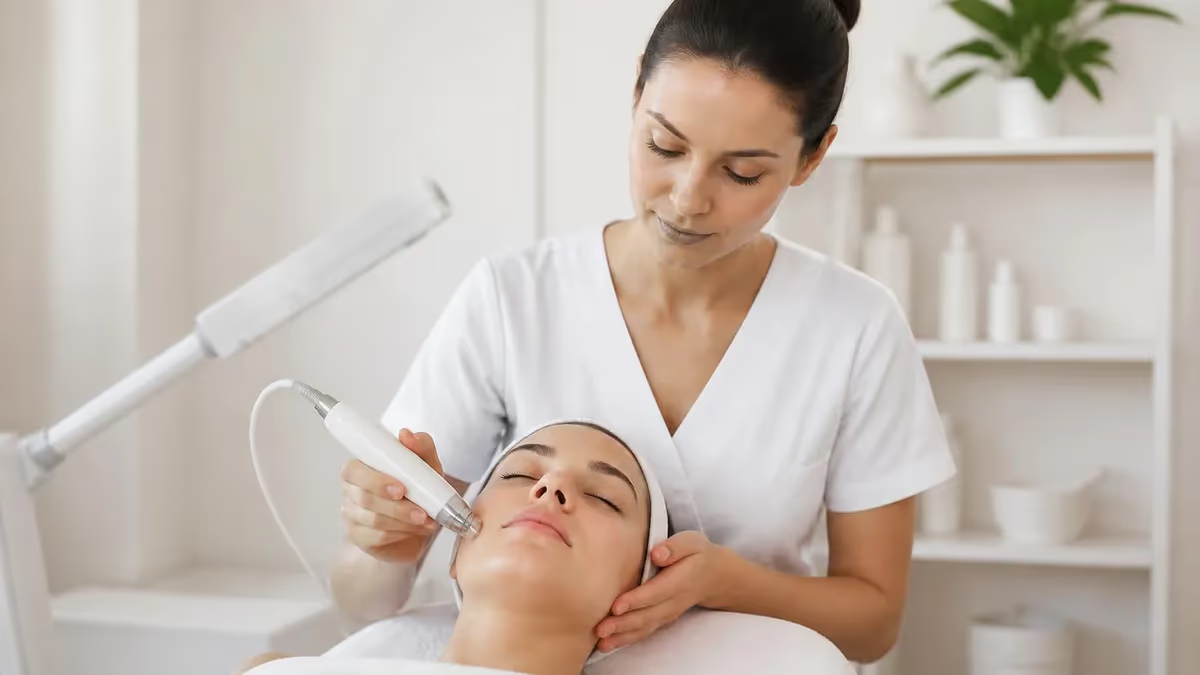
Pre-licensing, CE, and specialty — three different tracks
Esthetician classes fall into three buckets: pre-licensing programs (260–1,600 hours, leading to your state license), continuing education (CE) classes (5–30 hours every 1–2 years, required to keep your license active), and advanced specialty courses (1-day to 8-week certs in chemical peels, microneedling, lash extensions, hydrafacial, and oncology esthetics). Costs run $150–$500 for a single CE class, $1,000–$3,000 for a specialty certificate, and $4,000–$25,000 for a full pre-licensing program. Clinical hours must be in-person — theory can be online.
Esthetician Classes: The Complete 2026 Guide to Courses, Costs, and Certificates
"Esthetician classes" means different things at different career stages. A high-school graduate searching for esthetician classes usually means a state-approved pre-licensing program. A working spa pro searching for the same phrase means a weekend CE class or an advanced cert in microneedling. Knowing which track you need saves money and stops you from enrolling in the wrong thing.
This guide separates the three tracks. We cover pre-licensing programs that fulfill state hour requirements, continuing education classes that renew your license, and specialty courses that boost your service menu and income. We also show schedule formats (full-time day, evening, weekend, online theory), accreditation checks, and real cost ranges from leading providers across the U.S.
If you are still deciding whether to start at all, read our broader esthetician school overview or check how long is esthetician school for state-by-state hour breakdowns. Already enrolled and shopping for a campus? See esthetician school near me for finding programs by ZIP and city.
The Three Types of Esthetician Classes
1. Pre-licensing programs are full curriculums that prepare you for the state board written and practical exam. Required hours run from 260 (Florida) to 1,000 (Alabama, Tennessee), with most states landing at 600. You cannot work as a licensed esthetician without finishing one. Cost is the highest of the three tracks because you are paying for clinical kit, supplies, and a full instructor-led curriculum.
2. Continuing education (CE) classes are short courses (often 4 to 16 hours) that licensed estheticians must complete to renew. Texas requires 12 hours every two years. Florida wants 10 hours. Washington asks for 8 every renewal cycle. CE classes cover infection control updates, new device safety rules, and refresh content already on your license — they are not new procedures you can suddenly perform.
3. Advanced specialty classes are where licensed estheticians level up their service menu. A microneedling cert lets you charge $300 per face treatment. A lash-extension cert opens a side business. A chemical-peel class qualifies you to use stronger acids than your basic license covers. These are the classes that change your income.
The bulk of demand searches — "esthetician classes near me", "esthetician classes online", and "esthetician courses" — actually map to the first two tracks. Most searchers are either prospective students looking for their first program or working pros looking for cheap CE hours. The third track (specialty) draws the most career-ROI for licensed pros, even though it gets fewer searches. Picking the wrong track wastes $500–$5,000. The next sections show how to spot the difference at a glance and which class providers serve which track.

Compare the Three Esthetician Class Tracks
Pre-Licensing Programs
Who it is for: New students with no esthetics license.
Hours required: 260 hours (FL) to 1,600 hours for master esthetician (WA). Most states: 600 hours.
Format: Full curriculum — anatomy, skin disorders, facials, hair removal, sanitation, business law, and state board prep.
Cost: $4,000–$25,000.
Duration: 4 months (full-time, FL 260-hour) to 18 months (part-time, 1,000-hour state).
Outcome: Eligible to sit the state board written and practical exam.
5 Specialty Classes That Boost Esthetician Income
- Duration: 1–2 day hands-on workshop
- Cost: $800–$1,800
- Service revenue: $250–$400 per treatment
- Top providers: Dermapen, SkinPen, Eclipse
- Duration: 1–3 day course
- Cost: $400–$1,200
- Service revenue: $100–$250 per peel
- Top providers: PCA Skin, Image Skincare, Glo Skin Beauty
- Duration: 2–5 day intensive
- Cost: $500–$2,500
- Service revenue: $120–$300 full set
- Top providers: Bella Lash, NovaLash, Borboleta
- Duration: 3–7 day course (some require apprenticeship)
- Cost: $1,800–$4,500
- Service revenue: $400–$800 per session
- Top providers: Phibrows, World Microblading Academy
- Duration: 5-day course or 30-hour online
- Cost: $700–$2,200
- Service revenue: $110–$180 per treatment
- Top providers: Oncology Spa Solutions, Touch for Cancer Online
What Esthetician Classes Cost in 2026

Class Schedule Formats — Day, Evening, Weekend, Online
The biggest decision after picking a track is the schedule. Pre-licensing programs are the most flexible — most accredited campuses run full-time day classes (Monday to Friday, 9 AM to 4 PM), evening classes (5 PM to 10 PM, three nights a week), and weekend cohorts (Saturday and Sunday, 8 AM to 6 PM). Day cohorts finish a 600-hour program in 4 to 6 months. Evening cohorts take 9 to 12 months. Weekend cohorts run 12 to 18 months.
CE classes come in three formats: live webinar (1 to 4 hours, scheduled), self-paced online (you have 30 days to finish), and in-person weekend seminar (Saturday only). State boards accept all three formats as long as the provider is state-approved.
Check the provider list on your state board website before paying. "Approved by ASCP" or "approved by a national body" is not the same as your state board approval. Many estheticians lose CE hours every year because they paid for a class that did not appear on their specific state list.
Specialty classes are almost always live, in-person, weekend or weekday intensives. Manufacturers like Dermalogica and PCA Skin host their own training events in major cities — you fly in for 2–3 days, train, and fly home with the cert and product kit. The hands-on requirement is non-negotiable for any class that touches a device or needle. Some product brands also offer free in-house training when you commit to a wholesale account, but you should treat the cert as brand-specific rather than universally portable.
Online vs In-Person Classes — Which Hours Count?
Online has limits. State cosmetology boards classify esthetician program hours into theory (lecture content) and clinical/practical (hands-on hours with a live model or mannequin). Theory hours can be completed online in most states. Clinical hours cannot. This is a hard rule across all 50 states. A program advertising "100% online esthetician license" is misleading — at best it is the theory portion only, and you must complete clinical at a partner campus before sitting any state board exam.
CE classes are an exception. Most CE topics (sanitation rules, OSHA updates, business law, ingredient chemistry) are pure theory and fully online-eligible. CE webinars are the easiest way to clock hours without disrupting client schedules. Always confirm the provider is on your state board's approved CE list before paying. Many providers sell "national CE bundles" — read the fine print to verify your state is included.
How to Verify a Class Is Legitimate
Three checks before you pay any tuition. First, state board approval — every state has a public list of approved schools and CE providers. If the class is not on the list, your hours will not count toward licensing or renewal.
Second, NACCAS or ABEC accreditation — these are the two main national accreditors for cosmetology and esthetics programs. Accredited schools qualify for federal student loans and are widely recognized by employers. Third, certificate of completion — ask in advance what document you receive. A manufacturer cert from Dermalogica is recognized industry-wide. A printable PDF from an unknown website is worthless on a resume.
A fourth check worth doing for pre-licensing programs: pass rates. NACCAS-accredited schools must publish their state board pass rate on their site. A pass rate below 70% is a red flag — the school is admitting students who are not ready and the curriculum is not adequately covering exam content. Above 85% is excellent. Most reputable schools land in the 75–88% range.
If you are using esthetician classes to prepare for your state board exam, also pair the curriculum with a written exam practice set. Our esthetician practice exam covers all 7 exam domains and is a free way to test theory recall before licensing day. For the test format itself, see our esthetician state board exam guide.
Online vs In-Person Esthetician Classes
- +Online theory saves $1,000–$3,000 on tuition versus full in-person
- +Self-paced online lets you keep your current job while studying
- +Weekend hybrid programs work around family schedules
- +Online CE classes can be done in pajamas — perfect for renewal cycles
- +Recordings let you re-watch ingredient chemistry and skin disorder lectures
- −Clinical hours MUST be in-person — no exceptions in any state
- −Online students miss real-time instructor feedback on hand technique
- −100% online programs do not qualify for any state license
- −Some employers prefer hires from accredited in-person campuses
- −Hybrid schedules can stretch program length from 4 months to 12+
Pros and Cons at a Glance
| Pros | Cons |
|---|---|
| Self-paced online lets you keep your current job while studying | Clinical hours MUST be in-person — no exceptions in any state |
| Weekend hybrid programs work around family schedules | Online students miss real-time instructor feedback on hand technique |
| Online CE classes can be done in pajamas — perfect for renewal cycles | Some employers prefer hires from accredited in-person campuses |
Before You Enroll — Verify These 8 Things
- ✓Confirm the school or CE provider is on your state board's approved list
- ✓Check NACCAS or ABEC accreditation status on the accreditor website (not just the school's own page)
- ✓Ask what document you receive on completion — state-board-eligible diploma, CE certificate, or manufacturer cert
- ✓For pre-licensing: confirm clinical hours, kit inclusion, and state board exam prep is part of tuition
- ✓For CE: confirm the class topic counts toward your state's required hours (not all topics qualify)
- ✓For specialty: confirm instructor credentials and how many live models you will work on
- ✓Ask about refund policy — most states require schools to publish a withdrawal refund schedule
- ✓Verify the school's state board pass rate — accredited schools must publish this on their site

Esthetician Class Facts at a Glance
Where to Find Esthetician Classes
Your state board website is the first stop — every state lists approved cosmetology and esthetics schools, plus approved CE providers. For pre-licensing programs, the major national chains are Aveda Institute, Paul Mitchell Schools, Empire Beauty Schools, Tricoci University, and Bellus Academy. Most metro areas also have community college programs at lower tuition (often $4,000–$8,000 vs $15,000+ at private chains). Community colleges typically take longer because schedules are part-time, but the diploma is identical from the state board's view.
For continuing education, the most-used national CE providers are ASCP (Associated Skin Care Professionals), Esthetician's Edge, CIDESCO USA, and the International Spa Association (ISPA). All four offer state-board-approved CE bundles you can complete online before your renewal deadline. ASCP membership also includes liability insurance and free monthly CE webinars — see our esthetician insurance guide for why this matters for working pros.
For specialty classes, follow the manufacturer. Dermalogica, PCA Skin, Image Skincare, and BioElements all run their own training programs across major U.S. cities. Microneedling certs come from device makers (SkinPen, Dermapen, Eclipse). Lash extension certs come from product brands (Bella Lash, NovaLash, Borboleta). Microblading is usually taught by independent master trainers — verify the trainer's portfolio and Phibrows or World Microblading Academy affiliation before paying.
National esthetician certification programs from CIDESCO and the National Coalition of Estheticians Associations (NCEA) sit somewhere between CE and specialty. NCEA Certified is the most respected voluntary national credential in the U.S. It requires you to be licensed, complete 1,200 hours of qualifying experience, and pass a comprehensive exam.
CIDESCO is the international equivalent, recognized in 33+ countries. Neither replaces your state license, but both add credibility on a resume — especially in resort and medical-spa hiring. Renewal cycles for both are 2 years and require ongoing CE hours, similar to your state license.
National Conferences and Event-Based Classes
Two industry conferences run dozens of classes under one roof. IECSC (International Esthetics, Cosmetics, and Spa Conference) hits Las Vegas, New York, and Florida annually, with 200+ classes in a single weekend. The Skin Inc Face & Body Conference offers similar volume on the West Coast. Conference passes run $200–$500 and let you knock out CE hours plus sample specialty trainings in one trip. For working pros, this is the most efficient way to update skills.
Regional events from ASCP, ISPA, and state associations are smaller (5–20 classes) but often free with membership. State cosmetology board meetings sometimes include free workshops on new regulations — worth attending especially when state laws change for microneedling, lash, or peel scope. Local distributor reps (Salon Centric, Cosmoprof) also host free quarterly product trainings that occasionally count toward CE.
Scholarships and Free Class Options
Most esthetician classes are paid, but real free options exist. Federal Pell Grants cover up to $7,395 per year (2025–2026) for accredited pre-licensing programs. The school must accept Title IV funding, which most NACCAS-accredited campuses do.
State workforce programs (WIOA grants) fund vocational training for unemployed and underemployed workers; ask your local workforce office. Industry associations like ASCP and AIA offer annual scholarships ($500–$2,500) — application deadlines are typically March and September. Veterans qualify for GI Bill benefits at most accredited schools, often covering 100% of tuition plus a monthly housing stipend.
Manufacturer free training is the easiest "free" — product brands like Hydrafacial, Eminence Organics, and Sothys host free hands-on training when you purchase their starter kit (kit cost $300–$1,500). The class is genuinely free; you are paying for product. Some chain employers (Massage Envy, European Wax Center, Hand & Stone) also fully reimburse CE class costs once you hit 90 days of employment — ask during interviews.
From Classes to Licensure to Career
Classes are just the start. After pre-licensing comes the state board exam (written + practical), then the license, then deciding where to work — spa, medspa, or solo booth rent.
Read our esthetician license guide for the licensing process, and medical esthetician school if you want to work in dermatology, plastic-surgery, or laser-clinic settings. Master esthetician credentials (1,200+ hours, required in Washington, Utah, and Virginia) are essentially extended pre-licensing programs with additional specialty hours baked in.
Typical Esthetician Class Journey
Month 0
Month 1
Month 3
Month 5–9
Post-Exam
Year 1+
Comparing Esthetician Courses Across Major Cities
Tuition and class availability vary widely by city. New York City has the most options but also the highest cost — pre-licensing tuition in NYC averages $11,000–$18,000 at private schools, with 600 hours required by the state board. Esthetician classes NYC searches typically lead to schools like Aveda Institute New York, Christine Valmy International School, and Atelier Esthetique. Weekend cohorts are common because rent makes part-time work essential for students.
Los Angeles offers similar volume at slightly lower tuition — $9,000–$15,000 for the 600-hour California program. Marinello, Paul Mitchell LA, and the Marinello School of Beauty have multiple campuses across Southern California. LA students often combine pre-licensing with film and TV makeup add-ons.
Miami students benefit from Florida's lowest-in-the-nation 260-hour requirement, which means tuition is also among the lowest at $4,000–$8,000 for the full program. Esthetician course Miami searches usually surface Miami International University of Art & Design and La Belle Beauty Academy. Florida is also the easiest state to add a Master Esthetics specialty cert.
Chicago, Dallas, Houston, Atlanta, and Phoenix sit in the middle — 750–1,000 hours typically required, tuition $6,000–$12,000, with strong community college options keeping costs in check. Online theory plus in-person clinical is standard at every metro school now, which means relocating for a program is rarely necessary if there is an approved campus within 50 miles.
Choosing the Right Class for Your Career Goal
If your goal is to become a licensed esthetician, pick a pre-licensing program that matches your state hours and accept that you cannot legally start earning without finishing it. If your goal is to keep an existing license active, pick the cheapest state-approved CE bundle that covers your renewal hours — most working pros spend under $200 every two years on CE.
If your goal is to add a specific service, pick a specialty cert from the brand whose products you plan to sell. Microneedling cert from SkinPen if you will use the SkinPen device. Lash cert from Bella Lash if you will buy their adhesive. The cert and the supplier match because both reduce friction in your daily work.
One last note on timing. The single most common mistake we see is taking a specialty cert before completing pre-licensing. State boards do not let unlicensed students perform microneedling, chemical peels, or any invasive service on paying clients — even with a manufacturer cert. Finish pre-licensing first, pass your state board, then stack specialty certs in the first 12 months after licensure. That sequencing is what turns esthetician classes into a real career.
Sample Esthetician Practice Questions
Try these questions from our free Esthetician practice tests. The correct answer and an explanation follow each question.
A client presents with visible telangiectasia on the cheeks and nose, frequent flushing, and reports sensitivity to spicy foods. What condition should the esthetician suspect?
- A. Contact dermatitis
- B. Rosacea
- C. Seborrheic dermatitis
- D. Lupus erythematosus
Answer: B. Rosacea
Telangiectasia, facial flushing, and sensitivity to dietary triggers such as spicy foods are hallmark signs of rosacea.
A client arrives for a chemical peel. During the consultation, she mentions she has been using an over-the-counter retinol serum for the past month and went to a tanning bed two days ago. What is the most appropriate course of action for the esthetician?
- A. Perform the chemical peel as scheduled, but use a lower percentage acid.
- B. Proceed with the peel but advise the client to stop using retinol afterward.
- C. Reschedule the appointment and advise the client to discontinue retinol use for 5-7 days and avoid tanning for at least 2 weeks prior to the service.
- D. Apply a soothing mask before the peel to minimize sensitivity.
Answer: C. Reschedule the appointment and advise the client to discontinue retinol use for 5-7 days and avoid tanning for at least 2 weeks prior to the service.
Both recent use of retinoids and recent tanning are contraindications for a chemical peel. Retinoids increase skin sensitivity, and tanned skin is at a higher risk for adverse reactions like burns and post-inflammatory hyperpigmentation. The safest and most professional action is to reschedule the appointment and provide the client with proper pre-treatment instructions.
A client with inflamed, grade III acne has an appointment for a signature facial. Which step of the service should the esthetician significantly modify or completely avoid?
- A. Applying a clay-based mask.
- B. Performing a double cleanse.
- C. Vigorous massage movements over the affected areas.
- D. Using a high-frequency wand after extractions.
Answer: C. Vigorous massage movements over the affected areas.
Vigorous massage is contraindicated for inflamed or cystic acne as it can exacerbate irritation, spread bacteria to other areas of the face, and increase inflammation.
An esthetician is analyzing a client's skin and notes several small, white, keratin-filled cysts around the eyes and on the cheeks. These are most likely:
- A. Comedones
- B. Milia
- C. Papules
- D. Sebaceous hyperplasia
Answer: B. Milia
Milia are small, white, pearl-like cysts of trapped keratin under the skin's surface. They are common around the eyes, cheeks, and nose. Comedones are clogged pores (blackheads/whiteheads), papules are raised bumps without fluid, and sebaceous hyperplasia involves enlarged oil glands.
Esthetician Questions and Answers
Related Esthetician Guides
Esthetician School: Programs, Costs, and Licensing Steps
Esthetician Schools: Complete Guide to Programs and Licensure
Esthetician School Near Me: How to Find Local Programs by ZIP, City, and State
How Long Is Esthetician School: State Hours and Real Timelines
Medical Esthetician School: Programs, Cost, and Career Path 2026
Esthetician License: Requirements, Training Hours, and Path by State
Esthetician Supplies: Starter Kit, Equipment, and Where to Buy
About the Author
Licensed Cosmetologist & Beauty Licensing Exam Specialist
Paul Mitchell SchoolsMichelle Santos is a licensed cosmetologist with a Bachelor of Science in Esthetics and Salon Management from Paul Mitchell School. She has 16 years of salon industry experience and 8 years preparing students for state cosmetology board exams in theory, practical skills, and sanitation. She specializes in licensure preparation for cosmetologists, estheticians, and nail technicians.
Join the Discussion
Connect with other students preparing for this exam. Share tips, ask questions, and get advice from people who have been there.
View discussion (4 replies)