
Esthetician Schools: Complete Guide to Programs and Licensure 2026 October
📝 Esthetician schools guide — program length, tuition, state licensure, curriculum, accreditation, and career paths after esthetics training.
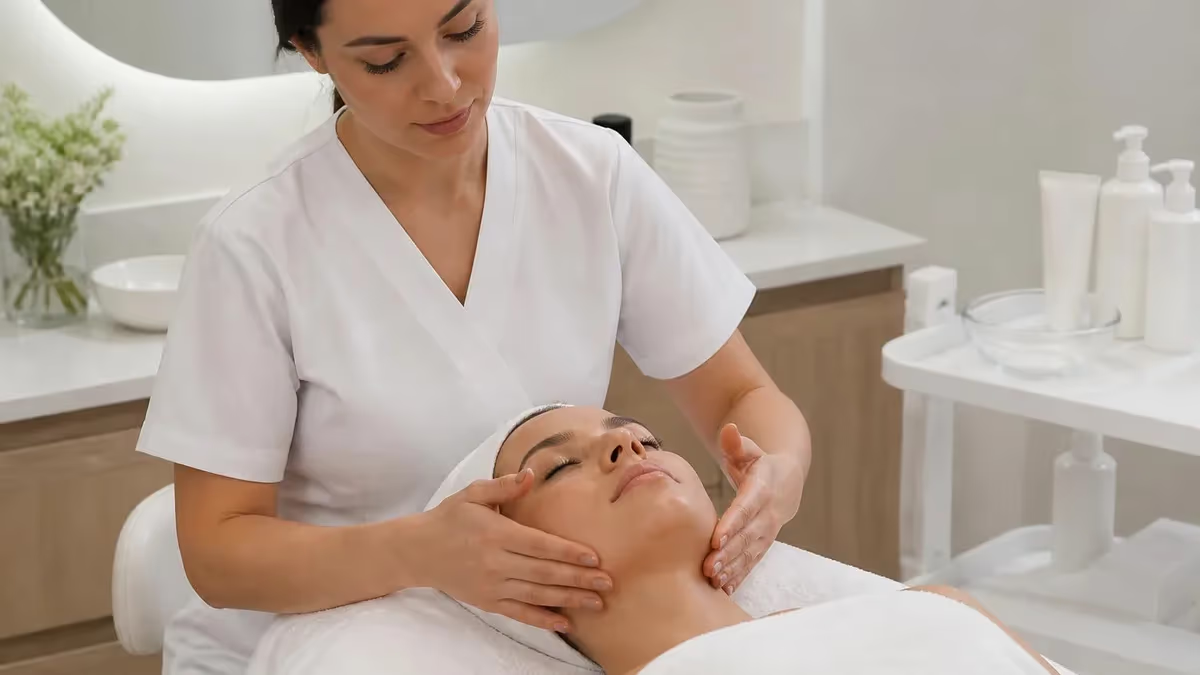
Esthetician schools provide the foundational education and clinical training required to enter one of the fastest-growing personal care professions in the United States. Whether you're considering a new career, transitioning from a related beauty or wellness field, or pursuing skincare expertise as a long-held passion, choosing the right esthetician school is a significant decision that shapes your career trajectory for years to come.
This guide walks through what esthetician schools teach, how to evaluate programs, what licensure requirements look like across different states, the financial investment involved, and the practical considerations that distinguish strong programs from weaker ones. Information here applies broadly across the United States, with specific notes where state requirements vary substantially in hours, examinations, scope of practice, or other regulatory details.
The esthetics field has expanded substantially in recent decades as consumer interest in skincare, anti-aging treatments, and medical spa services has grown. Licensed estheticians work in day spas, dermatology offices, medical spas, salons, resorts, and increasingly in independent practice as solo entrepreneurs serving private clienteles.
The career path offers genuine flexibility — full-time salaried positions, commission-based salon work, hourly day spa employment, and entrepreneurial booth-rental arrangements all represent legitimate options for licensed estheticians depending on personal preferences, market location, and career stage. The growing medical spa segment has substantially increased earning potential for skilled estheticians willing to pursue advanced training, while traditional day spas continue to offer steady entry points for new licensees seeking structured environments.

Esthetician Schools Quick Facts
Program length: 600-1,500 hours depending on state requirements; typically 6-12 months full-time. State licensure: All states require completing approved program plus passing state exam. Tuition range: $3,000-$15,000 typical for esthetics-only programs. Master esthetics: Some states (e.g., Washington, Virginia) offer master/advanced esthetics with extended training (1,200-1,500+ hours). Career outlook: Above-average growth projected by Bureau of Labor Statistics. Median pay: Approximately $40,000-$50,000 with substantial variation by location and experience.
What esthetician schools teach varies somewhat by state requirements but covers a consistent core of skincare science and practical techniques. Curriculum typically begins with skin anatomy and physiology, the structure and function of the integumentary system, common skin conditions and disorders, and the science of cosmetic chemistry. Students learn how to analyse skin types, identify concerns, and recommend appropriate treatments based on individual client needs and contraindications. This foundational science distinguishes professional skincare practice from casual product application that consumers do at home.
Practical training builds on the science foundation through extensive hands-on practice. Students learn facial techniques including cleansing, exfoliation, extraction, mask application, and massage. Hair removal training covers waxing for various body areas, plus introduction to threading, sugaring, and tweezing. Makeup application instruction covers daytime, evening, and special-event makeup including bridal services. Body treatment training may include body scrubs, wraps, and basic body-care services.
Sanitation and infection control receive substantial attention because esthetics involves working with skin that can be compromised by improper hygiene practices. Many programs also include modules on aromatherapy, basic nutrition for skin health, and the role of lifestyle factors in skin appearance to give graduates a more comprehensive consultative ability when working with clients seeking long-term skin improvement rather than just one-time treatments.
Esthetician School Curriculum Areas
Anatomy, physiology, common conditions, skin analysis, cosmetic chemistry foundations.
Cleansing, exfoliation, extraction, masks, massage techniques across skin types.
Waxing (face, brow, body), threading basics, sugaring, tweezing, contraindications.
Daytime, evening, bridal, photo, special-effects makeup; product knowledge.
Infection control, equipment sanitation, blood-borne pathogen awareness.
Client consultations, retail sales, professional ethics, salon business basics.
State licensure requirements drive much of esthetician school program length and curriculum specifics. Most states require between 600 and 1,500 hours of training to qualify for the basic esthetician license, with the median falling around 600-750 hours. Texas requires 750 hours, California requires 600 hours, Florida requires 260 hours (one of the lowest in the country), and Pennsylvania requires 300 hours. Some states distinguish between basic esthetics and master or advanced esthetics, with master esthetics typically requiring 1,200-1,500+ hours and authorising practice of more advanced services like microdermabrasion, chemical peels at higher strengths, and laser treatments under physician supervision.
Before enrolling in any esthetician school, verify that the program is approved by your state board of cosmetology or board of barbering and cosmetology. State-approved programs satisfy state licensure requirements; non-approved programs do not, regardless of how comprehensive their curriculum may appear. State boards typically maintain searchable lists of approved programs on their websites, and any reputable program will readily provide proof of state approval upon request from prospective students considering enrollment.
Reciprocity between states is important if you plan to relocate or work across state lines. Some states have reciprocity agreements allowing license transfer with relatively minor additional requirements; others require complete reapplication including additional training hours or examinations. If interstate practice is a possibility, research the states you might work in and choose a program with hours and curriculum that satisfy the most demanding state in your potential career path. This forward-looking approach prevents expensive return-to-school requirements if you later relocate to a state with stricter training requirements than your original training state required at the time.
Description: Cosmetology schools offering esthetics as one program track among multiple beauty programs. Pros: Established institutions, larger student pools for peer learning, career services, financial aid options. Cons: May offer less specialised esthetics content, larger class sizes, broader focus dilutes esthetics depth. Examples: Aveda Institutes, Empire Beauty Schools, Paul Mitchell Schools.

Tuition costs for esthetician schools vary substantially across program types and geographic markets. Community college programs typically run $3,000-$8,000 in total tuition for esthetics certificates. Established beauty schools often charge $8,000-$15,000+ for esthetics programs. Esthetics-only specialty schools occupy a similar range to established beauty schools, sometimes higher for premium programs with substantial brand recognition. Master esthetics programs cost more proportionally given longer hour requirements and typically run $12,000-$25,000+ depending on hours required and the institution.
Beyond tuition, students should budget for kit costs (typically $1,000-$2,500 for required tools and supplies), textbooks, exam preparation materials, state board exam fees ($75-$200+ depending on state), and licensing application fees ($50-$200+). Total program costs including all expenses commonly reach $5,000-$20,000 for basic esthetics programs and $15,000-$30,000+ for master esthetics programs. Federal financial aid (Pell grants, Direct Loans) is available at accredited institutions; at non-accredited schools or programs, students typically rely on institutional payment plans, private loans, or self-financing.
Job placement services and outcomes vary substantially across schools. Better programs publish job placement statistics, license pass rates, and employer relationships. Ask prospective schools about their license pass rates on the state board exam, percentage of graduates employed in skincare-related positions within 6-12 months, and which local employers regularly hire from their programs. These outcome data points help distinguish programs delivering genuine career value from programs that primarily collect tuition without supporting graduates' transitions into employment after completing program coursework.
Two separate concepts often confused: State approval is required for graduates to qualify for state licensure. Accreditation by NACCAS (National Accrediting Commission of Career Arts and Sciences) or similar accreditors is required for federal financial aid eligibility. Both matter but serve different purposes. Verify both: A school must be state-approved for licensure eligibility AND accredited if you need federal financial aid (Pell grants, federal student loans).
Accreditation and state approval are two separate concepts that prospective students must understand. State approval comes from the state cosmetology or barbering and cosmetology board and authorises a program to satisfy state licensure training requirements. Accreditation comes from independent agencies like the National Accrediting Commission of Career Arts and Sciences (NACCAS) and verifies institutional standards. Federal financial aid eligibility depends on accreditation, while licensure eligibility depends on state approval. Both matter but for different reasons, and both should be verified before enrolling.
Schedule flexibility differs across program types. Most esthetician schools offer both full-time programs (typically 5-6 months for 600-hour states) and part-time programs (typically 9-12 months). Some larger schools offer evening and weekend schedules accommodating students with work or family commitments during weekday daytime hours. Confirm specific schedule options before enrolling to ensure the program fits your life situation. Programs with limited schedule flexibility sometimes lose students who initially enroll without fully understanding scheduling constraints once classes begin.
Class size and student-instructor ratios affect quality of practical training. Lower ratios (1:10 or better) provide more individual attention during hands-on practice. Higher ratios (1:20+) limit individual feedback and can leave students feeling neglected during critical skill development. Visit prospective schools and observe classes if possible — quality of student work, level of instructor engagement, and overall learning environment become apparent during in-person visits in ways that marketing materials cannot convey accurately to prospective students considering programs in the area.
Choosing an Esthetician School Checklist
- ✓Verify state approval through your state cosmetology board's official program list
- ✓Confirm NACCAS or other accreditation status if you need federal financial aid
- ✓Compare total program hours to your state's licensure requirements (and target states for relocation)
- ✓Request license pass rates and graduate employment statistics from prospective schools
- ✓Tour schools in-person to assess facilities, equipment quality, and class atmosphere
- ✓Compare total costs including tuition, kit, books, exam fees, and licensing application fees
- ✓Ask about kit contents and quality of tools/products provided to students
- ✓Discuss schedule options (full-time, part-time, evening, weekend)
- ✓Investigate job placement services and employer connections in your region
- ✓Talk to recent graduates about their experience and post-graduation outcomes
Beyond program length and price, what distinguishes excellent esthetician schools from average ones is the quality of clinical training environment. The best programs operate active student clinics where members of the public book appointments and receive treatments at reduced rates from advanced students under instructor supervision. This exposure to real clients with diverse skin types, concerns, and personalities prepares students for licensed practice in ways that practice on classmates alone cannot match. Programs without active clinic environments may produce graduates who struggle with the realities of professional client interactions in their first months after licensure.
Equipment exposure matters substantially in modern esthetics where treatments increasingly involve technology beyond basic facials. Programs that train students on devices commonly used in current spa and medical spa practice — microdermabrasion machines, LED light therapy, ultrasonic skin scrubbers, basic chemical peel application, dermaplaning — produce graduates more prepared for entry-level professional roles than programs limited to manual techniques alone. Ask prospective schools what equipment students train on and how often students get hands-on practice with each device throughout their program.
The instructor team's professional experience shapes the educational quality. Instructors with substantial recent industry experience bring practical wisdom about client management, business operations, product knowledge, and current trends that purely academic instructors cannot match. Ask about instructor backgrounds, years of practical experience, and continuing professional development.
Schools where instructors actively practice esthetics in addition to teaching tend to provide richer educational experiences than schools whose instructors haven't practiced professionally in years and may not be aware of how the field has evolved. Some students specifically seek programs where instructors actively maintain private practices alongside teaching, since these instructors bring fresh client experiences directly into classroom demonstrations and discussions throughout the semester.

Career outcomes after esthetician school depend substantially on the regional market and individual hustle. Median pay for licensed estheticians runs approximately $40,000-$50,000 nationally, but substantial variation exists. New graduates in major metropolitan markets often start at hourly rates of $15-$20 in salon employment plus retail commission, with experienced estheticians in established positions earning $50,000-$80,000+ at the high end. Independent estheticians who build private clienteles can earn substantially more — successful private practice estheticians in affluent markets sometimes earn $100,000+ annually after several years of building reputation and clientele.
The medical spa segment has grown rapidly and offers some of the highest-paying positions for licensed estheticians. Working in dermatology offices or medical spas typically requires additional training in laser treatments, advanced chemical peels, and medical-grade skincare, but compensation often runs $50,000-$70,000+ for skilled practitioners in these settings. Some states require master esthetics licensure (an advanced credential beyond basic licensure) for medical spa practice, while others permit medical spa work with basic esthetics licensure under physician supervision in those facilities.
Continuing education is important throughout an esthetics career. Skincare science evolves continuously with new ingredients, techniques, and equipment. Successful estheticians invest in regular continuing education across their careers — manufacturer training programs, advanced technique workshops, business and marketing courses, and increasingly, specialty certifications in areas like oncology esthetics, lash extensions, microneedling, and various energy-based skin treatments. Many states require minimum continuing education hours for license renewal; even where not required, ongoing learning distinguishes practitioners with growing careers from those whose careers stagnate over time.
Esthetician Schools by the Numbers
After Esthetician School: Career Paths
Most common entry path. Hourly + commission, structured schedules, walk-in and appointment clients.
Skincare services within hair salon. Often booth rental or commission. Build personal clientele.
Higher pay, advanced services with physician supervision. May require master esthetics licensure.
Pre-treatment prep, post-care, basic facials. Stable hours but less treatment variety.
Tourist clientele, treatment menus emphasising relaxation. Often seasonal demand.
Booth rental or solo practice. Higher earning potential after building clientele over years.
Some prospective students wonder whether esthetics is the right path versus alternatives like cosmetology, nail technology, or massage therapy. Cosmetology programs include hair, skin, and nails but spend less time on each compared to specialty programs. Esthetics programs focus exclusively on skin, providing deeper expertise but limited scope of practice (cannot legally cut or chemically treat hair). Massage therapy is a separate licensed profession focused on body work without skin treatment scope. Each path has different earning patterns, work environments, and required physical capabilities that suit different individuals based on their interests and physical considerations.
For students considering esthetics as a career change from another field, several factors matter. Standing for long periods is part of esthetics work — most treatments involve standing or working in awkward positions for extended periods. Clear communication skills with diverse clients matter substantially because consultation and product recommendations are core to professional practice.
Comfort with close contact and various body areas (face, back, sometimes other body areas during waxing or body treatments) is essential. People who thrive in esthetics careers typically have genuine interest in skincare science and patient interaction, not just an interest in the products and services as consumers.
The licensing exam after completing esthetician school typically includes both written knowledge and practical skill demonstration components. Written exams cover skin science, sanitation, regulations, product knowledge, and client safety. Practical exams require demonstrating skills like basic facials, hair removal, makeup application, and sanitation procedures on either live models or mannequins depending on state requirements. Pass rates for first-time test takers from approved programs typically run 80-90%+, with substantial variation across schools. Prospective students should specifically ask schools about their license pass rates as a key indicator of program quality and effectiveness in preparing graduates for licensure.
Long-term career outlook for licensed estheticians remains positive. Bureau of Labor Statistics projects above-average employment growth for skincare specialists through 2032, driven by aging population demographics, sustained consumer interest in personal care services, and expansion of medical spa services into mainstream healthcare. Estheticians who develop strong technical skills, build loyal clienteles, and continually expand their service offerings tend to enjoy substantial career longevity with growing earnings over decades of practice.
The combination of technical skill development, genuine client relationships, and entrepreneurial flexibility makes esthetics an attractive career for those who match the temperament and physical demands of the work. Many estheticians find lifelong fulfillment in the work, building practices that evolve over decades from initial entry-level employment through eventual senior practitioner roles, specialty practitioner positions, and sometimes ownership of their own spa businesses or training schools that pass knowledge to subsequent generations of practitioners entering the field.
The combination of practical skill, lifelong learning, and entrepreneurial possibilities continues to attract diverse career changers and first-time professionals every year, making esthetics a strong and growing professional pathway with substantial opportunity available across diverse markets.
Pursuing Esthetics: Pros and Cons
- +Relatively short training program vs other healthcare careers
- +Multiple work environment options (spa, salon, medical, independent)
- +Above-average projected job growth
- +Entrepreneurial flexibility for independent practice
- +Continuous learning opportunities in evolving field
- −Physically demanding (standing, repetitive motions)
- −Entry-level pay often modest until clientele builds
- −Income often commission-based with variable hours
- −Continuing education and license renewal costs ongoing
- −Saturated markets in some metropolitan areas
Esthetician Questions and Answers
About the Author
Licensed Cosmetologist & Beauty Licensing Exam Specialist
Paul Mitchell SchoolsMichelle Santos is a licensed cosmetologist with a Bachelor of Science in Esthetics and Salon Management from Paul Mitchell School. She has 16 years of salon industry experience and 8 years preparing students for state cosmetology board exams in theory, practical skills, and sanitation. She specializes in licensure preparation for cosmetologists, estheticians, and nail technicians.
Join the Discussion
Connect with other students preparing for this exam. Share tips, ask questions, and get advice from people who have been there.
View discussion (4 replies)