
Esthetician Career — Pay, Licensing, Specialties & Path (2026 October)
✅ Esthetician career guide: pay $30K-$60K+, 600-1500 hour training, state licensing, master tracks, lash, laser, and how to grow a real beauty business.
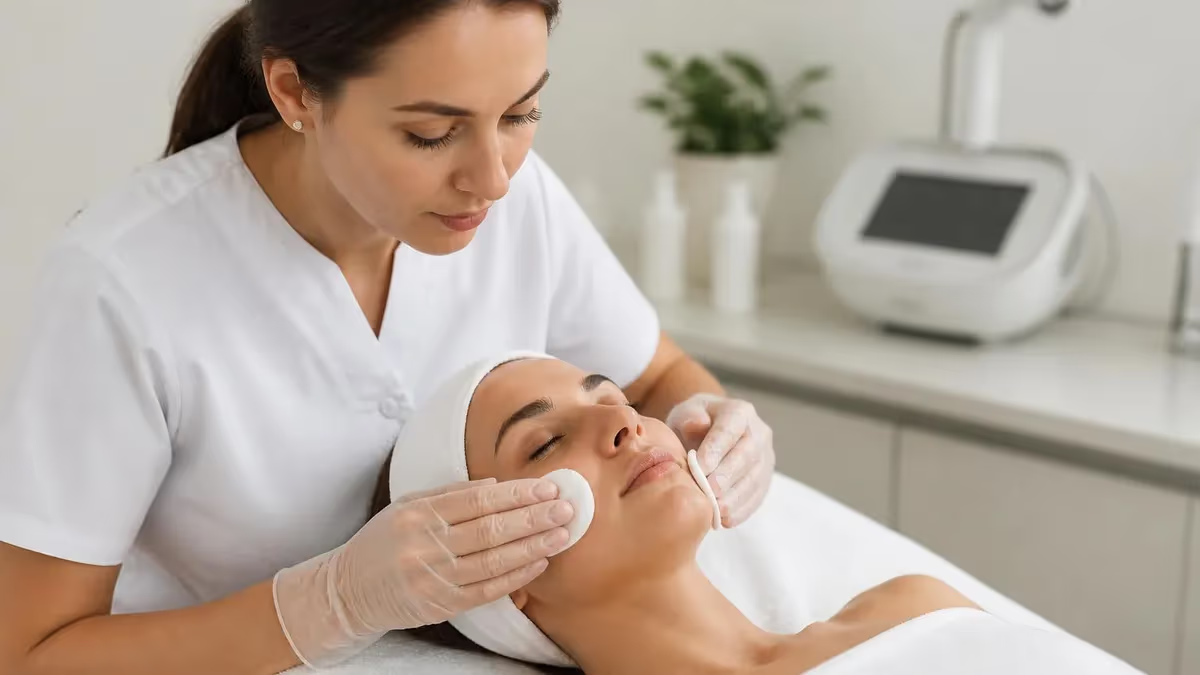
Esthetician Career — Pay, Licensing & Real-World Paths
So you want to work with skin. Maybe a friend started doing facials out of a rented room and now she books out three weeks ahead. Maybe you keep getting compliments on your own routine and wonder if there's money in it. There is — but the picture isn't the spa fantasy people post on TikTok. An esthetician is a licensed skincare professional, and the job sits somewhere between healthcare, retail, and small-business ownership.
Day-to-day, the work covers facials, chemical exfoliation, extractions, body and brow waxing, makeup, and — depending on your state license — lash extensions. Some states let you go further: laser hair removal, microcurrent, light microneedling, and dermaplaning. You'll work on real human faces, not perfect Instagram skin, and you'll learn to read texture, redness, sun damage, and acne grade fast.
Most people picture a spa. The truth is broader. Estheticians work in day spas, salon suites, dermatology offices, plastic surgery practices, med spas, hotels, cruise ships, brand counters, and increasingly inside their own LLC. Pay swings the same way — a hotel resort esty in Phoenix and a master esty inside a Seattle dermatology clinic do different jobs for different money.
This guide walks the full path. Licensing hours by state, what the written and practical exams actually test, salary ranges by setting, the master license tracks in CO, WA, VA, and OR, advanced specialties you can layer on, and what it really costs to open a treatment room of your own. Before you read further: skim our how to become an esthetician walkthrough — it's the prerequisite, this is what comes after.
One thing to set straight up front. The term gets used a few different ways. "Esthetician" and "aesthetician" mean the same job in the US — just two accepted spellings of the same license. "Medical esthetician" usually refers to someone working inside a clinical environment (derm office, plastic surgery practice, med spa) regardless of state. "Master esthetician" is the actual legal license tier — but only in CO, WA, VA, and OR. Everywhere else, it's marketing. Knowing the difference saves you from enrolling in the wrong program.
You cannot work as an esthetician anywhere in the US without a state license. Hours range from 260 in Florida to 1,500+ in Alabama. Check your state board's exact requirements before enrolling in any school — out-of-state credits do not always transfer.
Education Hours & the Licensing Exam
Every state regulates esthetics. You can't just take a weekend course and start booking clients. Each state board sets a minimum classroom-and-clinic hour count, and you have to graduate from a board-approved program before you can sit the exam. The hours range wildly: Florida is 260, Texas is 750, California is 600, and several states demand 1,000 to 1,500 hours for the basic license alone.
Most full-time programs run six to ten months. Part-time tracks stretch to twelve or fifteen. Tuition follows the same pattern as esthetician school generally — anywhere from $4,000 at a community college to $20,000 at a brand-name beauty institute. The cheaper public option teaches the same exam content. The expensive private one tends to add product-line training, business modules, and job-placement support. Both can get you licensed.
The licensing exam is a two-part test administered in most states by a national vendor (commonly NIC, PSI, or DL Roope). The written portion is multiple choice and covers infection control, anatomy, skin disorders, product chemistry, and state law. The practical portion is hands-on. You'll set up a sanitary station, perform a basic facial, do a wax removal, demonstrate makeup application, and follow draping and disinfection rules to the second.
Pass rates run between 70% and 85% nationally depending on the school. Schools that drill clinic hours and mock practicals push closer to 90%. The state board issues your license once you pass both parts, pay the fee, and clear any background check. After that the license itself renews every one to two years with continuing education — usually four to ten CE hours per cycle.
One quirk: state licenses do not transfer automatically across state lines. Move from Florida (260 hours) to Texas (750 hours), and Texas will likely require you to complete the hour gap before reissuing a license. Some boards offer reciprocity for licensees with two-plus years of work history. Most don't. Plan school enrollment around the state you actually intend to work in — not just the cheapest one nearby.

Esthetician Career Snapshot
Pay: What Estheticians Actually Earn
This is the question everyone asks first, and the honest answer is: it depends almost entirely on setting. The Bureau of Labor Statistics median sits near $40,000, but that flattens a huge range. Entry-level chair work in a low-cost state pays $14 an hour plus commission. A booked-out master esty inside a dermatology office bills $150 a facial and clears six figures. Both are estheticians.
Hourly chair positions in chain salons and budget med spas pay $12-$18 base, with 10-30% product commission. Most workers in these roles land near $28,000-$38,000 a year before tips. Dermatology and plastic surgery clinics pay better and offer benefits — typically $42,000-$58,000 salaried, sometimes more in major metros. Hotel and resort spas pay a mix: solid base, lighter commission, plus heavy tipping from out-of-town guests. Resort estys often clear $50,000-$70,000 in tourist markets.
Booth renters earn the most per hour but assume all the risk. You rent a room for $300-$1,000 a month, set your own prices, keep 100% of revenue, and pay your own taxes and supplies. A solo esty doing four facials a day at $90 each grosses around $7,500 a month before rent and product cost. Net take-home usually lands $50,000-$80,000 once it stabilizes. Our esthetician salary breakdown digs deeper into state-by-state numbers and tipping norms.
Tips matter. A 20% tip on a $120 facial is $24 — and a busy resort esty might book five of those a day. That's $120/day in cash on top of base pay. Many estys under-report tips, but the IRS treats them as taxable income. Smart practitioners track tips daily and set aside 25-30% for quarterly tax estimates. The ones who get burned at tax time are almost always booth renters who forgot self-employment tax exists.
Quick math: Four facials a day at $90 each, 20 working days a month, 50% commission = $3,600/month employed. Same volume as a booth renter paying $600 rent = $6,600/month net. The renter doubles the take-home — but only after building a full book of returning clients.
Basic License vs Master Esthetician
Four states — Colorado, Washington, Virginia, and Oregon — operate a two-tier system. The basic license covers the standard scope: facials, waxing, makeup, brow tinting, basic peels. The medical esthetician or "master" license, available only in those four states, opens up a much larger menu: deeper chemical peels, light-based hair removal, microdermabrasion at clinical depths, microcurrent, ultrasound, and in some cases laser tattoo removal and IPL.
Getting there isn't fast. Master tracks usually require the basic 600-1,000 hours plus an additional 600-1,200 hours of advanced training. Total hours can reach 1,800 in Washington. Tuition for the master add-on runs $8,000-$15,000. The payoff is real: master estys in Seattle, Denver, Portland, and Northern Virginia routinely bill $120-$200 per service and walk into six-figure ranges inside dermatology and plastic surgery offices.
Outside those four states, "master esthetician" isn't a legal title — it's a marketing one. Spas may call themselves master-level, but legally you're still operating under the basic license. To perform laser, microneedling, or injectables in most states you need a nurse, PA, or physician on staff supervising the procedure. The nurse esthetician path — RN plus esthetics certification — sidesteps that limit entirely.
Master Esthetician States — License Tiers
Two-tier license. Basic + advanced certificate adds laser, microcurrent, deeper peels.
- Basic Hours: 600
- Master Hours: 1,200 total
- Scope Adds: Laser, IPL, microcurrent
Highest training requirement in the country. Master license unlocks the widest service menu.
- Basic Hours: 750
- Master Hours: 1,800 total
- Scope Adds: Light-based, ultrasound, microneedling
Two-tier system tied to dermatology and plastic surgery employment in NoVA and Richmond.
- Basic Hours: 600
- Master Hours: 1,200 total
- Scope Adds: Advanced peels, microdermabrasion
Strong master-license market in Portland med spas. Lash and brow work folded into the basic scope.
- Basic Hours: 500
- Master Hours: 1,200 total
- Scope Adds: Laser, IPL, advanced peels

Specialties: Makeup, Lash Tech, and Med-Spa Tracks
The license is just the entry ticket. The estys who earn well almost all niche down. A general facialist who also does bridal makeup, holiday brow events, and spray tans makes a fine living. A lash tech and esthetician combo who's mastered classic and volume lash extensions can charge $150-$250 per full set and rebook every three weeks at $75-$100 a fill. That's a high-margin, repeating-revenue specialty.
The makeup esthetician path leans into bridal, editorial, special-event, and content-creator work. Bridal trial plus wedding-day usually packages at $350-$700 in mid-size markets and $900-$1,500 in major metros. Brand counter work (Nars, MAC, Sephora, Bobbi Brown) doesn't pay as well but builds product knowledge fast and is a known feeder into freelance careers.
The medical track — laser, IPL, microneedling, chemical peels at clinical strength — sits inside dermatology and plastic surgery offices. You won't get to perform these on your own license outside of CO/WA/VA/OR, but you can absolutely work the consult, prep, post-care, and product-sales side of every appointment. That role pays $45-$60K with benefits and becomes the standard launchpad for estys who eventually go back to school for RN or PA.
Less obvious specialties pay well too. Oncology esthetics — trained skin care for chemo and radiation patients — is undersupplied almost everywhere. Acne-focused practices (Face Reality, Sorella, or independent acne specialists) build wait-list businesses by saying no to everything except acne protocols. Lymphatic drainage and post-surgical recovery work has exploded since the BBL boom; estys with a manual lymphatic certification charge $150-$250 a session and book months out. Generalists rarely break out. Specialists almost always do.
Where Estheticians Actually Work
The classic setting. Hourly base plus commission and tips. Steady client flow, gift-card volume around holidays, often retail-heavy. Expect $14-$22 an hour base, 20-30% retail commission, and 15-20% tips. Health benefits on full-time only. Best for new license holders who want to build speed and confidence on real clients.
Going Solo: Renting a Room or Opening Your Own Space
Almost every esty who stays in the field five years either rents a room or opens their own studio. The math is straightforward: an employer takes 50-65% of your service revenue. Booth rent at $400-$800 a month means you keep almost all of it once you're booked. The catch is filling the calendar.
Booth rental is the standard first step. You sign a license-or-rental agreement with a salon suite operator (Sola, Phenix, Indie, or local boutique), you bring your own clients, you pay rent monthly, and you operate as an independent contractor with your own LLC. Most estys do this for two to four years before considering their own dedicated space.
Opening a true studio is a bigger jump. Buildout for a single-room treatment space runs $25,000-$60,000 — plumbing, electrical, treatment bed, steamer, hot towel cabby, sterilization gear, retail shelving, and signage. Add another $10,000 for opening product inventory. Most owners take a small SBA loan or use a HELOC. Breakeven typically hits 12-18 months in. The esthetician supplies guide breaks down what equipment is actually worth buying day one versus what can wait. Read our esthetician insurance piece before you open the doors — every state requires professional liability coverage and most leases require a general policy on top.
Continuing Education, Renewal & Staying Current
Every state requires continuing education to keep your license. The range is four to ten hours per renewal cycle, with cycles running one to two years depending on the board. CE hours cover infection control, new product chemistry, ingredient safety, and state-specific scope-of-practice updates. Most working estys handle CE online in a weekend — the courses are cheap ($30-$120) and approved providers post them year-round.
The real continuing ed, though, is the unofficial kind. New ingredient launches, new modalities (microneedling pens, LED panels, exosome treatments), and shifting product trends move fast. The estys who stay relevant put a few hundred dollars a year into brand training — Dermalogica, SkinCeuticals, ZO, PCA, Eminence — because that's what employers and clients ask for. Many specialty certificates (oncology esthetics, advanced lash, lymphatic drainage) sit outside the state license but command premium pricing once you have them.
Track your CE proof carefully. State boards audit. If you miss a renewal deadline, most states impose a late fee and a re-instatement process. Skipping renewal for more than two years usually means re-testing — practical and written — which nobody wants to do twice. The esthetician license guide spells out renewal dates and fees per state if you need a quick reference.

Your First-Year Esthetician Career Checklist
- ✓Confirm your state's exact training hours and approved school list
- ✓Choose a school — compare tuition, schedule, and clinic-hours volume
- ✓Pass the state written exam (infection control, anatomy, chemistry, law)
- ✓Pass the practical exam — facial, wax, makeup, sanitation
- ✓Submit license application + fee + background check to the state board
- ✓Decide your first setting: spa, med spa, resort, or booth
- ✓Get professional liability insurance ($150-$300/year)
- ✓Set up your business entity (LLC) if booth-renting or freelancing
- ✓Build a 90-day client-acquisition plan (referrals, Instagram, Yelp)
- ✓Schedule first continuing-education courses before the renewal deadline
Career Outlook & The Long Game
BLS projects roughly 9% job growth for skincare specialists through 2032 — faster than average. The drivers are the obvious ones: aging Boomers, the millennial-into-forties skincare obsession, and the steady expansion of medical aesthetics into mid-size cities. Demand is real, but demand alone doesn't make you money — positioning does.
The estys who build sustainable income do three things. They pick a specialty within twelve months of licensing (lash, oncology, acne, bridal, medical post-care) instead of staying a generalist forever. They take care of their hands and back — repetitive motion injuries end more careers than burnout. And they treat the business side seriously: pricing, retention, retail, and tax planning every quarter.
If you're still on the fence, work a day with a booked esthetician before you enroll. Watch six facials back-to-back. See the cleaning between clients, the back-to-back schedule, the standing, the small-talk, the retail close at the end. If you like that pace and want to do it for the next decade, the license is worth getting. If the answer's no, the $4K-$20K tuition is the cheapest way to find out. Compare timelines on our how long is esthetician school page before you sign anything.
Esthetician Career — Honest Pros & Cons
- +Short, affordable training compared to nursing or medical paths
- +Real career flexibility — spa, med spa, freelance, your own studio
- +Clear income upside via specialization (laser, lash, master license)
- +Hands-on, creative, varied work — not desk-bound
- +Strong job growth (~9%) and broad geographic demand
- +Low barrier to self-employment via booth rental
- −Entry-level pay is low ($12-$18/hr) in most states
- −Physical job — standing, leaning, repetitive hand/wrist motion
- −State licensing rules vary, transferring across state lines is painful
- −Booking gaps and seasonality hit income hard early on
- −Booth rent + supplies + insurance mean real overhead day one
- −Continuing-ed and product expenses never stop
Pros and Cons at a Glance
| Pros | Cons |
|---|---|
| Short, affordable training compared to nursing or medical paths | Physical job — standing, leaning, repetitive hand/wrist motion |
| Real career flexibility — spa, med spa, freelance, your own studio | State licensing rules vary, transferring across state lines is painful |
| Clear income upside via specialization (laser, lash, master license) | Booking gaps and seasonality hit income hard early on |
| Hands-on, creative, varied work — not desk-bound | Booth rent + supplies + insurance mean real overhead day one |
| Low barrier to self-employment via booth rental | Continuing-ed and product expenses never stop |
Next Steps
If you've read this far you have a realistic picture of what the work looks like, what it pays, where it grows, and what it costs to get in. The next call is yours: enroll, work-shadow first, or pick a specialty track. The esthetician school near me finder is a fast way to start the school short-list. Once you're enrolled, our practice exam is built specifically around the NIC and state board questions you'll see on test day — it's free, and it catches the infection-control and anatomy gaps that fail most candidates the first time around.
Estheticians who plan their first three years deliberately — pick a setting, pick a specialty, pick a financial structure — almost always end up clearing real money inside year four. The ones who drift between part-time jobs without specializing tend to stay near minimum wage forever. The license alone doesn't decide that. Your plan does.
Sample Esthetician Practice Questions
Try these questions from our free Esthetician practice tests. The correct answer and an explanation follow each question.
A client arrives with an undiagnosed, weeping skin rash on their forearm. Under infection control principles, what should the esthetician do?
- A. Refer the client to a physician and decline to perform services on the affected area until cleared
- B. Apply a barrier cream and proceed with the service
- C. Cover the rash with gauze and continue the treatment
- D. Proceed normally, as rashes are not considered contagious in a salon setting
Answer: A. Refer the client to a physician and decline to perform services on the affected area until cleared
Any undiagnosed, open, or weeping skin condition is a contraindication for esthetic services because it may indicate a contagious infection. The esthetician must refer the client to a licensed healthcare provider and not perform services on the affected area until a physician confirms it is safe to do so.
A new client's intake form indicates they have a history of cold sores (Herpes Simplex Virus). They currently do not have an active lesion. How should the esthetician proceed with a scheduled facial treatment?
- A. Refuse service, as the virus is always contagious.
- B. Proceed with the treatment but avoid the lip and mouth area entirely.
- C. Perform the facial as planned without any modifications.
- D. Require a doctor's note before proceeding with any facial.
Answer: B. Proceed with the treatment but avoid the lip and mouth area entirely.
Herpes Simplex is a viral infection, and while it is most contagious during an active outbreak, it can still be present. To prevent stimulating an outbreak and for safety, it is standard practice to avoid treating the area around the mouth, even if no active lesion is visible.
When reviewing a Material Safety Data Sheet (MSDS) for a chemical peel solution, the esthetician should first look for which section to determine safe handling procedures?
- A. Section 1: Product Identification
- B. Section 7: Handling and Storage
- C. Section 11: Toxicological Information
- D. Section 15: Regulatory Information
Answer: B. Section 7: Handling and Storage
Section 7 of an MSDS covers Handling and Storage, which provides the esthetician with direct guidance on how to safely work with and store the chemical product.
A new client schedules a full leg waxing service. During the consultation, she mentions she has been taking an oral medication, isotretinoin, for severe acne for the past four months. What is the most appropriate course of action for the esthetician?
- A. Perform a patch test with the wax on a small, discreet area to check for sensitivity.
- B. Proceed with the service but use a hard wax formulated for sensitive skin.
- C. Advise the client that waxing is contraindicated and decline to perform the service until she has been off the medication for at least one year.
- D. Recommend she take an antihistamine before the appointment and proceed with the service.
Answer: C. Advise the client that waxing is contraindicated and decline to perform the service until she has been off the medication for at least one year.
Isotretinoin (commonly known by brand names like Accutane) is an oral retinoid that makes the skin extremely fragile, thin, and prone to lifting or tearing. Performing a waxing service on a client taking this medication can cause significant skin damage. The standard professional protocol is to wait for a minimum of one year after the client has stopped taking the medication before performing any waxing services.
Esthetician Practice Exam Questions and Answers
About the Author
Licensed Cosmetologist & Beauty Licensing Exam Specialist
Paul Mitchell SchoolsMichelle Santos is a licensed cosmetologist with a Bachelor of Science in Esthetics and Salon Management from Paul Mitchell School. She has 16 years of salon industry experience and 8 years preparing students for state cosmetology board exams in theory, practical skills, and sanitation. She specializes in licensure preparation for cosmetologists, estheticians, and nail technicians.
Join the Discussion
Connect with other students preparing for this exam. Share tips, ask questions, and get advice from people who have been there.
View discussion (4 replies)