
Driving Theory Test Centres: Everything You Need to Know 2026
📚 Find driving theory test centres near you, learn what to expect on test day, and discover how to book your DVSA theory test with confidence.
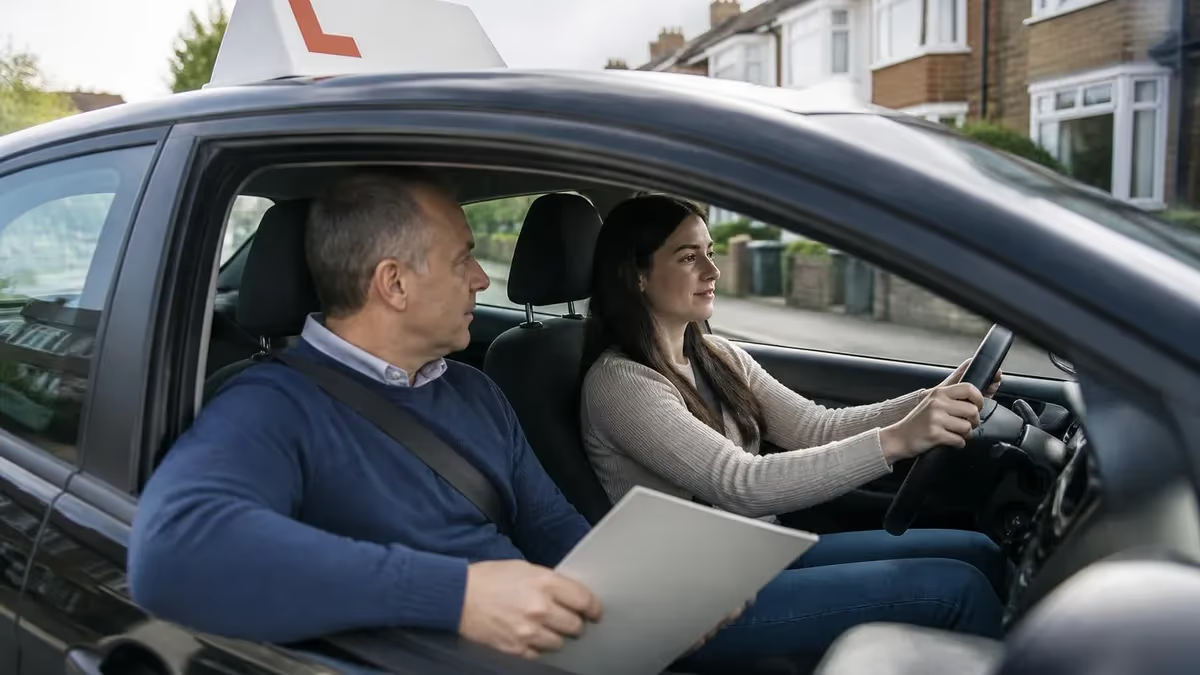
If you are preparing to get your driving licence in the United Kingdom, one of the first major milestones you will face is passing the DVSA driving theory test. Knowing where to sit the test, what to expect when you arrive, and how the process works at driving theory test centres across the country can make a significant difference to how confident and prepared you feel on test day. Practice with the free DVSA UK Driving Theory practice test on PracticeTestGeeks (7 questions with answer explanations).
The UK has over 160 approved test centres managed by Pearson VUE on behalf of the Driver and Vehicle Standards Agency (DVSA), meaning there is almost certainly one within a reasonable distance of wherever you live.
Driving theory test centres are purpose-built or adapted facilities designed to deliver a consistent, secure, and fair testing experience for every candidate. Each centre follows strict DVSA guidelines covering everything from the physical layout of the testing room to the software used to deliver the multiple-choice questions and hazard perception clips. When you walk through the doors, you can expect the same standardised environment whether you are sitting your test in London, Manchester, Edinburgh, or Cardiff.
Understanding the geography of test centres is useful when you are planning your preparation timeline. Some centres are located in busy city areas and book up weeks in advance, especially during peak periods such as spring and autumn when large numbers of learners are preparing to drive. Rural or smaller-town centres may have more availability at short notice, so it is worth searching broadly rather than fixating on the closest possible location to your home address.
The test itself is administered on a computer terminal and is split into two distinct parts: the multiple-choice theory section and the hazard perception section. Both parts must be passed in the same sitting. You cannot carry a pass in one section forward to a future attempt — if you fail either part, you must retake the entire test from scratch. This is a crucial detail that many learners overlook when they begin booking their test appointment.
Test centres operate Monday to Friday during standard business hours, and a limited number also offer Saturday appointments at a slightly higher fee. Understanding the opening patterns of your local centre helps you plan around work, school, or college commitments. Early morning slots are popular among candidates who want to complete the test before the working day begins, while mid-morning and early afternoon slots tend to have slightly lower demand.
Accessibility is a priority across the DVSA testing network. Candidates with disabilities, learning differences such as dyslexia, or other support needs can request reasonable adjustments when booking. These adjustments may include extra reading time, a screen reader, or a larger font size on the test terminal. You must declare the need for adjustments at the point of booking rather than on the day, so plan ahead if this applies to you.
This guide covers everything from how to find and book a centre, what identification documents to bring, what happens when you arrive, and how to make the most of your preparation time so that when you sit down at the test terminal, you feel fully ready to pass first time.
Free DVSA UK Driving Theory Study Tools
Interactive DVSA UK Driving Theory resources on PracticeTestGeeks, free to start:
- DVSA UK Driving Theory flashcards — review key terms and concepts card by card
- DVSA UK Driving Theory study guide — topic-by-topic overview of what the exam covers
- DVSA UK Driving Theory cheat sheet — one-page printable summary for last-minute review
Driving Theory Test Centres by the Numbers
Key Facts at a Glance
| Item | Value | Details |
|---|---|---|
| Theory Test Fee | £23 | Standard weekday booking fee in 2026 |
| Total Test Duration | 57 mins | Multiple-choice + hazard perception combined |
| Pass Mark (Multiple Choice) | 86/100 | You must score 43/50 on the theory questions |
How to Find and Book a Driving Theory Test Centre
Search for Test Centres Online
Compare Availability by Location
Create or Log In to Your GOV.UK Account
Select Your Preferred Date and Time
Pay the Test Fee
Confirm and Plan Your Journey
When you arrive at your driving theory test centre on test day, the process follows a clearly defined sequence designed to maintain exam security and ensure every candidate is treated equally. Understanding each step of the arrival procedure removes a major source of test-day anxiety, because nothing you encounter should come as a surprise. The staff at test centres are accustomed to nervous candidates and are trained to guide you through the process calmly and efficiently from the moment you walk through the door.
You must present a valid form of photo identification when you check in at the reception desk. For most candidates, this will be their provisional driving licence — the pink photocard version issued by the DVLA. If you do not have your provisional licence card with you, you will not be permitted to sit the test, and you will forfeit your test fee. Some overseas candidates may be able to use a valid passport alongside additional documentation, but the provisional licence is by far the most straightforward option and eliminates any risk of being turned away.
After your identity has been verified, you will be asked to place all personal belongings — including your mobile phone, jacket, bag, and any food or drink — into a secure locker provided by the centre. You are not permitted to take any items into the testing room, and this rule is strictly enforced. The only exceptions are medically necessary items, such as an insulin kit, which must be declared in advance when making your booking. Staff will conduct a palm vein scan at many centres, which is used as a biometric identifier to prevent impersonation fraud.
Before entering the testing room, you will receive a brief orientation from the invigilator. They will explain the layout of the computer terminal, how to navigate the test software, and where to find the help function if you experience a technical problem during the sitting. Take the time to listen carefully to this briefing even if you feel familiar with the process — the invigilator may mention specific details relevant to that day's session, such as the procedure for raising your hand if you need assistance mid-test.
The testing room itself consists of individual computer terminals separated by privacy screens. The environment is quiet and climate-controlled. Invigilators monitor the room throughout the entire duration of the test, and CCTV cameras record each session as an additional security measure. If any candidate is found to be using an unauthorised device or communicating with another candidate, their test will be immediately terminated and their result invalidated.
Once you are seated and the invigilator has confirmed that all candidates are ready to begin, you will be given a brief practice exercise on the computer to familiarise yourself with the interface. This practice does not count towards your result and lasts only a few minutes. Use it to get comfortable with clicking through questions, flagging items to review later, and navigating between the multiple-choice section and the hazard perception section when the time comes.
The multiple-choice questions are presented one at a time on your screen. You can move freely between questions, flag any you are unsure about, and return to flagged questions before submitting your answers. The hazard perception section then follows automatically after a short break with its own set of instructions. Altogether, the two sections take approximately 57 minutes to complete, though you are not under a strict per-question time limit in the multiple-choice section — the overall time allocation gives most candidates more than enough opportunity to work carefully through every question.
DVSA Practice Test Questions
Prepare for the DVSA - UK Driving Theory Test exam with our free practice test modules. Each quiz covers key topics to help you pass on your first try.
DVSA Eco-Friendly Driving and Vehicle Loading
DVSA Exam Questions covering Eco-Friendly Driving and Vehicle Loading. Master DVSA Test concepts for certification prep.
DVSA Hazard Awareness
Free DVSA Practice Test featuring Hazard Awareness. Improve your DVSA Exam score with mock test prep.
DVSA Incidents, Accidents and First Aid
DVSA Mock Exam on Incidents, Accidents and First Aid. DVSA Study Guide questions to pass on your first try.
DVSA Motorway Rules and Smart Motorways
DVSA Test Prep for Motorway Rules and Smart Motorways. Practice DVSA Quiz questions and boost your score.
DVSA Rules of the Road (Highway Code)
DVSA Questions and Answers on Rules of the Road (Highway Code). Free DVSA practice for exam readiness.
DVSA - UK Driving Theory Hazard Awareness ...
DVSA Mock Test covering - UK Driving Theory Hazard Awareness and Perception. Online DVSA Test practice with instant feedback.
DVSA - UK Driving Theory Motorway Rules an...
Free DVSA Quiz on - UK Driving Theory Motorway Rules and Regulations. DVSA Exam prep questions with detailed explanations.
DVSA - UK Driving Theory Road and Traffic ...
DVSA Practice Questions for - UK Driving Theory Road and Traffic Signs. Build confidence for your DVSA certification exam.
DVSA - UK Driving Theory Rules of the Road
DVSA Test Online for - UK Driving Theory Rules of the Road. Free practice with instant results and feedback.
The Driving Theory Test Format Explained
The multiple-choice section consists of 50 questions drawn from the official DVSA question bank, which covers topics including road signs, the Highway Code, vehicle safety, hazard awareness, and environmental responsibility. You have 57 minutes to complete the multiple-choice section, and the pass mark is 43 out of 50 — that is 86%. Each question presents a scenario followed by four answer options, and you must select the single best answer unless the question specifically asks you to select more than one.
Questions are drawn at random from a large bank of several hundred approved items, meaning no two candidates will sit exactly the same test. However, the topics covered are consistent, and thorough revision of the Highway Code and the DVSA's official revision materials ensures you will be prepared for any combination of questions you encounter. You can flag difficult questions and return to them before submitting, which is a useful strategy if you encounter a question that requires more thought than usual.
Advantages and Disadvantages of the UK Theory Test Centre System
- +Over 160 centres nationwide means most candidates can find a location within a reasonable travelling distance
- +Standardised testing environments ensure every candidate receives an equal and fair experience regardless of location
- +Immediate computer-generated results mean you know whether you have passed within seconds of completing the test
- +Online booking is available 24 hours a day, seven days a week, making it easy to schedule around other commitments
- +Accessible adjustments including extra time, larger text, and screen readers are available for candidates with disabilities or learning differences
- +Saturday morning appointments are offered at most centres, giving flexibility to candidates who cannot attend on weekdays
- −Popular urban centres can have waiting times of four to six weeks, particularly during busy periods in spring and autumn
- −The £23 test fee is non-refundable if you miss your appointment without giving at least three clear working days' notice
- −Failing either the multiple-choice or hazard perception section means the entire test must be retaken, including the section you passed
- −You must wait three clear working days before you can rebook after a failed attempt, which can delay your progress
- −No personal belongings are permitted in the testing room, which some candidates find stressful if they rely on comfort items
- −Saturday appointments carry a small price premium, making frequent retakes on weekends noticeably more expensive over time
Theory Test Day Preparation Checklist
- ✓Bring your original pink photocard provisional driving licence — photocopies are not accepted
- ✓Arrive at the test centre at least 15 minutes before your scheduled appointment time
- ✓Leave your mobile phone, smartwatch, and all electronic devices in a secure locker at the centre
- ✓Review your booking confirmation email the evening before and double-check the centre address and appointment time
- ✓Plan your route to the test centre in advance, including parking options if you are travelling by car
- ✓Get a full night of sleep before the test — mental fatigue significantly impairs your ability to spot hazards in the video clips
- ✓Eat a balanced meal before attending so that hunger does not distract you during the 57-minute session
- ✓Complete at least one full timed practice test the day before to confirm you are consistently scoring above the pass marks
- ✓If you have requested accessibility adjustments, confirm your booking includes them by checking your confirmation email
- ✓Bring a valid booking confirmation reference number in case there are any issues at check-in
Your Theory Pass Certificate Lasts Only Two Years
Many learners are surprised to discover that a theory test pass is not a permanent qualification. Your certificate expires exactly two years from the date you sat the test. If you do not pass your practical driving test within those two years, you must retake and pass the theory test again before you can attempt the practical. Book your practical test as soon as possible after passing the theory to avoid this situation.
Accessibility and inclusivity are core commitments of the DVSA and Pearson VUE, and the driving theory test centre network has been designed with a wide range of candidate needs in mind. If you have a disability, a medical condition, or a recognised learning difference such as dyslexia or ADHD, you are entitled to request reasonable adjustments to the standard test conditions. These adjustments do not give you any advantage over other candidates — they simply level the playing field by removing barriers that are unrelated to your actual driving knowledge and ability.
The most commonly requested adjustment is additional reading time, which doubles the standard time allocation for the multiple-choice section from the usual 57 minutes to a longer supervised period. This is particularly valuable for candidates with dyslexia who may read at a slower pace than average. To qualify for additional time, you will typically need to provide evidence from a qualified professional such as an educational psychologist or an occupational therapist. This evidence must be submitted at the time of booking rather than on the day of the test.
Screen reader software is available at all DVSA test centres for candidates with visual impairments. The software reads each question and the answer options aloud through headphones, allowing candidates who cannot read standard text comfortably to complete the multiple-choice section independently. If you rely on a screen reader, notify DVSA when booking so that the centre can confirm the correct hardware and software will be configured on your terminal before you arrive.
Candidates who are deaf or hard of hearing can request a BSL (British Sign Language) version of the hazard perception instructional video. The standard video is accompanied by a spoken voiceover that explains how the section works, and the BSL version presents the same information in signed format. This adjustment should also be requested at the time of booking. Lip-reading candidates may additionally request to be seated facing the invigilator during the pre-test briefing, though this is a less formal arrangement.
Some candidates with conditions such as epilepsy, photosensitive reactions, or anxiety disorders may have concerns about the hazard perception video clips, which are filmed footage of real driving scenarios and do not contain any deliberately distressing content. However, if you have a specific medical concern about exposure to moving video footage, speak with your doctor before booking and contact the DVSA accessibility team for guidance. In some cases, a modified version of the test or an alternative assessment arrangement may be available.
Candidates whose first language is not English can request to sit the theory test in one of 19 alternative languages offered by the DVSA. These include Punjabi, Urdu, Hindi, Gujarati, Polish, Turkish, Arabic, and several other widely spoken languages in the UK. The hazard perception section is language-neutral, as it involves watching video clips and clicking a mouse rather than reading text. Only the multiple-choice section changes language. You must select your preferred language at the time of booking — it cannot be changed on the day.
If you are unsatisfied with the accessibility provisions at your test centre, or if you believe you were not provided with the adjustments you requested, you can raise a formal complaint with the DVSA directly through the GOV.UK website. Complaints about centre facilities, staff conduct, or test administration are taken seriously and are investigated against the standards set out in the DVSA's Customer Service Charter. Keeping a record of your booking confirmation, including any accessibility adjustments listed, provides useful evidence if a complaint becomes necessary.

If you need to cancel or reschedule your theory test, you must give at least three clear working days' notice to receive a refund of your £23 fee. Cancelling with less than three working days' notice — or simply not showing up — means you lose the full fee and must pay again to rebook. Log in to your GOV.UK account to manage your booking, and set a reminder on your phone well in advance of the deadline.
After you complete your theory test and receive your result, the next phase of your journey towards a full driving licence begins in earnest. If you passed, you will be eager to book your practical driving test as soon as possible, and it is important to understand that demand for practical test slots is even higher than demand for theory test slots.
In many parts of the UK, the waiting time for a practical test can stretch to three months or longer, particularly in cities such as London, Birmingham, and Bristol. This makes early booking essential — do not wait until you feel completely ready before searching for available slots.
Your theory test result letter contains your theory test certificate number, and this number is mandatory when booking the practical test. Without it, the online booking system will not allow you to proceed. The certificate number proves to the DVSA that you hold a valid theory pass, and the system automatically checks that your pass has not expired. If you have misplaced your result letter, your theory test pass certificate number can be retrieved by logging in to your GOV.UK account and accessing your test history.
Some learners choose to book the practical test speculatively — that is, they reserve a slot even before they feel fully confident behind the wheel, intending to continue practising right up until the test date. This approach makes sense given the long waiting times and the fact that you can cancel or rebook with sufficient notice without losing your fee. Your driving instructor will be best placed to advise you on whether your current skill level is realistic for a test booking in the near future.
It is worth noting that the practical driving test is held at a separate network of practical test centres managed by the DVSA, which is distinct from the Pearson VUE theory test centre network.
Practical test centres are located at or near DSA driving test centres and are typically on the outskirts of towns rather than in city centres, to allow test routes to include a range of road types including dual carriageways, rural lanes, and urban traffic environments. You do not need to take your practical test at a location geographically linked to your theory test centre — they are independent bookings.
While you are waiting for your practical test date, continue revising the theory and hazard perception material even after your theory pass. The knowledge tested in the theory exam is directly applicable on the road and will inform your decision-making during the practical driving test. Many candidates find that reviewing the Highway Code and watching hazard perception clips in the weeks before the practical test helps reinforce good habits and improves their commentary drive if required by the examiner.
If you failed your theory test, use the three-day mandatory waiting period productively. Analyse the areas where you scored lowest from your result letter, and create a focused revision plan that targets those specific topic clusters. Use official DVSA revision materials such as the Highway Code book and the DVSA's own app, supplemented by reputable online practice test platforms. Aim to be consistently scoring 47 or 48 out of 50 on timed practice tests before you rebook — a margin above the pass mark of 43 provides a meaningful buffer against test-day nerves.
Finally, do not underestimate the value of preparation beyond the test itself. Every question in the driving theory test reflects a real-world principle that will keep you and others safe on UK roads once you are driving independently. Approaching the theory test as a genuine learning experience — rather than simply a hurdle to pass — creates safer, more aware drivers who are better equipped to handle the unpredictable situations that real road use presents every single day.
Effective preparation for the driving theory test is as much about strategy as it is about raw revision time. Many candidates who fail their first attempt do so not because they lack knowledge, but because they have not practised under realistic timed conditions that mimic the pressure of the actual test centre environment. Sitting at home reading the Highway Code is a valuable starting point, but it must be supplemented by regular timed practice tests that replicate the format, pace, and challenge level of the real examination.
Start your revision at least six to eight weeks before your intended test date. In the first two weeks, focus on building foundational knowledge by reading the official Highway Code from cover to cover and making notes on any rules or signs you find unfamiliar.
The Highway Code is not a long document — most people can read it in two or three sittings — and it forms the basis of the majority of the theory test questions. Pay particular attention to sections covering stopping distances, speed limits, road markings, traffic signals, and priority rules, as these topics appear frequently in the question bank.
From week three onwards, introduce timed practice tests into your daily routine. Aim to complete at least one full timed 50-question test per day, reviewing every answer — both correct and incorrect — at the end. Understanding why a wrong answer is wrong is often more instructive than simply knowing the right answer. Many reputable websites and apps offer access to the full DVSA question bank in a randomised test format, which is the closest available simulation of the real centre experience.
Hazard perception requires a different kind of practice. The skill being tested is the speed and accuracy of your perception of developing hazards — a skill that improves with repetition and genuine engagement rather than passive watching. When practising, actively narrate to yourself what you are looking for as you watch each clip: pedestrians stepping towards the kerb, cyclists wobbling, vehicles pulling out of side roads, or drivers braking unexpectedly. This verbal processing technique trains your brain to stay alert throughout a clip rather than waiting passively for something obvious to happen.
In the final week before your test, switch your revision focus from learning new material to consolidating and refreshing what you already know. Avoid cramming large volumes of new information in the 48 hours before the test, as this can increase anxiety and cause knowledge to become muddled under pressure. Instead, complete two or three light practice tests each day, maintain a regular sleep schedule, and limit caffeine intake on the evening before the test to ensure you sleep well.
On the morning of the test itself, eat a nutritious breakfast but avoid a very heavy meal that might make you feel lethargic. Review a few road signs or Highway Code summaries briefly, but do not spend hours revising immediately before you leave the house. Trust the preparation you have done over the preceding weeks. Give yourself plenty of travel time to reach the test centre so that you arrive calm rather than rushed, and use the 15 minutes before your appointment to settle your nerves with slow, steady breathing rather than last-minute cramming.
Once you are seated at the test terminal and the practice exercise begins, take the time to read every question carefully — do not rush through multiple-choice questions simply because the subject seems familiar. Misreading a question under time pressure is one of the most common avoidable causes of incorrect answers. For questions you find genuinely difficult, flag them and move on, returning to them once you have answered the questions you are confident about. This approach ensures you collect all the straightforward marks before spending time on the harder items.
For a fuller set of questions on this topic, see our driving theory test centres resource.
For a fuller set of questions on this topic, see our driving theory test centres resource.
Sample DVSA UK Driving Theory Practice Questions
Try these questions from our free DVSA UK Driving Theory practice tests. The correct answer and an explanation follow each question.
What is the most eco-friendly action to take when you know you will be stationary for more than a couple of minutes?
- A. Switch to neutral but keep the engine running
- B. Turn the engine off
- C. Keep the engine running to warm the cabin
- D. Rev the engine gently to avoid it stalling
Answer: B. Turn the engine off
Switching the engine off when stationary for more than a minute or two prevents unnecessary fuel burn and reduces exhaust emissions.
You have just bought a brand-new car. When will it need its first MOT test?
- A. On the first anniversary of its registration.
- B. After it has been driven 12,000 miles.
- C. On the third anniversary of its registration.
- D. When the manufacturer's warranty expires.
Answer: C. On the third anniversary of its registration.
A new car in the UK does not require an MOT test until the third anniversary of its first registration date. After this, it must be tested annually.
At a roundabout, you should give way to traffic from which direction?
- A. The left
- B. The right
- C. Straight ahead
- D. All directions equally
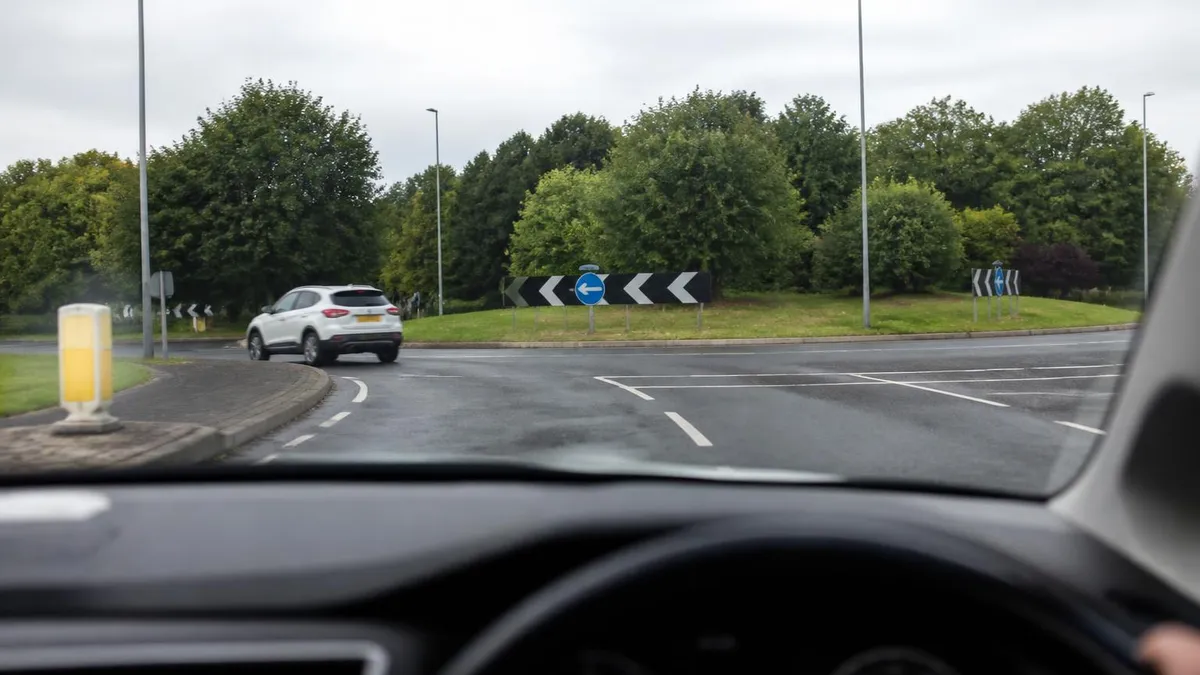
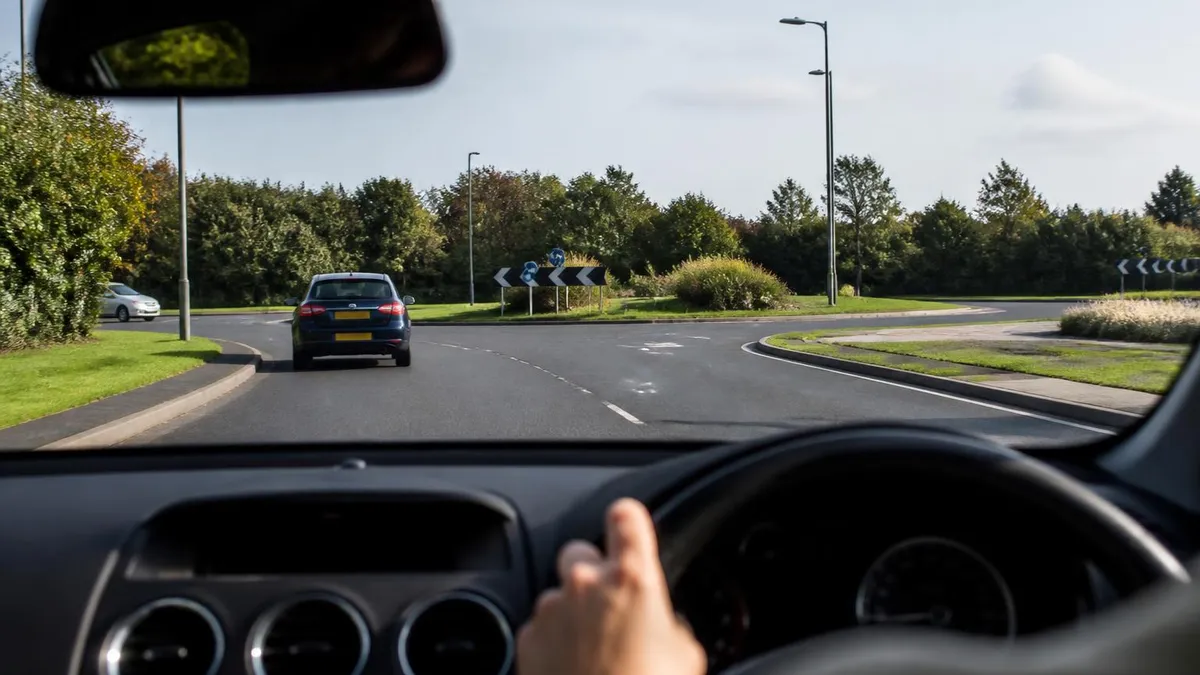
Answer: B. The right
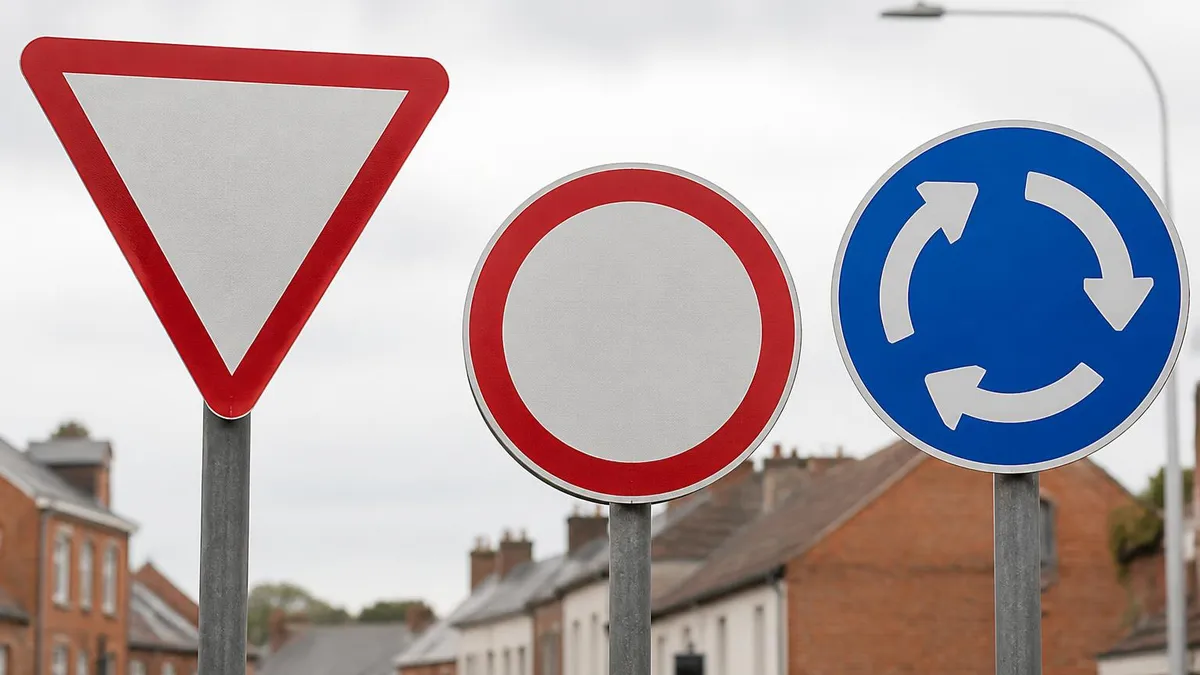
At a roundabout, you must give way to traffic approaching from your right. You should watch for vehicles already on the roundabout and wait for a safe gap before joining.
What is the overall stopping distance at 60 mph on a dry road?
- A. 53 metres (175 feet)
- B. 73 metres (240 feet)
- C. 96 metres (315 feet)
- D. 120 metres (394 feet)
Answer: B. 73 metres (240 feet)
At 60 mph, the typical overall stopping distance on a dry road is 73 metres (240 feet). This includes 18 metres thinking distance and 55 metres braking distance. In wet conditions, these distances at least double.
DVSA Questions and Answers
DVLA Theory Test Booking: Complete Step-by-Step Guide for UK Learners
Driving Theory Test App: The Complete Study Guide for UK Learners
How to Book Your DVSA Practical Driving Test: Complete UK Guide

Learn to Drive in the UK: Complete Beginner's Guide to Getting Your Licence

DVSA Car Practical Test: Complete Guide to Passing First Time
About the Author

Licensed Driving Instructor & DMV Test Specialist
Penn State UniversityRobert J. Williams graduated from Penn State University with a degree in Transportation Management and has spent 20 years as a certified driving instructor and DMV examiner consultant. He has personally coached thousands of applicants through written knowledge tests, skills assessments, and commercial driver licensing programs across more than 30 states.