
How Long Is the Wait for Theory Test in 2026 October: UK Booking Times, Delays and How to Get an Earlier Slot
How long is the wait for theory test in the UK? Current waiting times, tips to get earlier slots, and what to do while you wait. ⏳
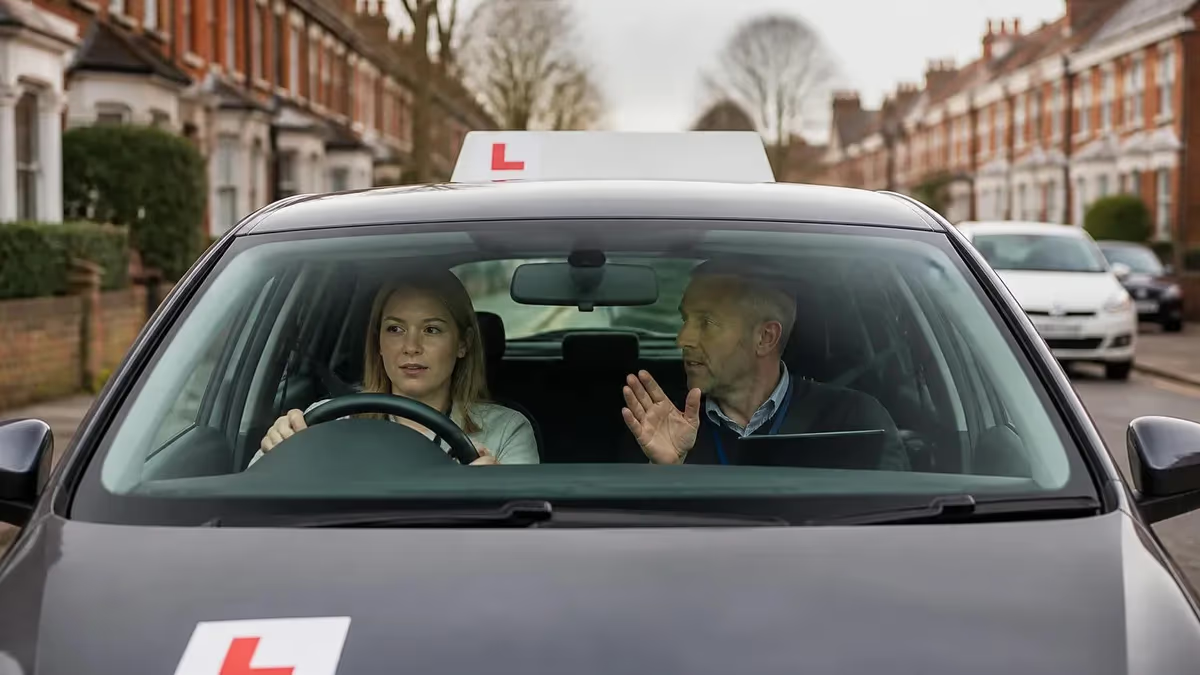
If you are asking how long is the wait for theory test in 2026, the honest answer depends heavily on where you live and when you search. Across most of England, Scotland and Wales, candidates are currently waiting between four and ten weeks from the date they book to the date of their actual test appointment. In some urban test centres — particularly London, Birmingham and Manchester — waits can stretch to twelve weeks or beyond during peak periods such as summer and the post-Christmas rush when learner numbers spike sharply.
The DVSA (Driver and Vehicle Standards Agency) manages all theory test bookings through its official portal and through approved booking providers. Demand for slots has remained improved since the post-pandemic backlog began clearing in 2022, and although the DVSA has expanded capacity at many centres, the growth in learner numbers has largely kept pace. Understanding the rhythm of availability — and knowing a few practical strategies — can shave weeks off your personal theory test wait time without resorting to third-party cancellation hunters.
The theory test itself is a prerequisite for booking your practical driving test, so every extra week of waiting is a week added to your overall journey towards a full driving licence. Many learners underestimate this dependency and book their theory test too late, then find they must pause practical lessons while waiting for their result. Planning ahead — ideally booking the theory test within the first two or three weeks of starting lessons — is the single most effective way to keep your learning journey on track and avoid costly gaps between the two tests.
It is also worth understanding that waiting times are not fixed. The DVSA regularly releases cancelled or rescheduled appointments back into the live booking system, often at short notice. Candidates who check the booking portal frequently — or who set up alerts through legitimate tools — regularly find slots that are weeks earlier than what was originally available. This dynamic availability means that the quoted wait at the time of booking is rarely the minimum possible wait; it is simply the minimum available at that snapshot in time.
Certain days of the week and certain times of day tend to release slots more frequently. Early morning searches, particularly between 6am and 8am, often catch freshly released cancellations before other candidates snap them up. Similarly, checking on weekday mornings shortly after the DVSA's systems update tends to yield better results than searching on weekend afternoons. Developing a brief daily habit of checking the portal can dramatically reduce your effective wait, even in busy metropolitan areas.
This guide breaks down exactly what drives theory test waiting times, how they vary by region and season, and the practical steps you can take right now to secure an earlier appointment. We also cover what you should be doing during the waiting period so that when your test date finally arrives, you walk in fully prepared and ready to pass on the first attempt, avoiding the need to rebook and face another wait all over again.
UK Theory Test Wait Times by the Numbers
Current Waiting Times by Region
London & South East
Midlands & North West
Yorkshire & North East
Scotland & Wales
South West & East Anglia
Cancellation Slots Nationwide
Several interconnected factors drive the variation in theory test waiting times across the UK, and understanding them helps you make smarter decisions about when and where to book. The most fundamental driver is the simple ratio of demand to supply: the number of candidates wanting a test in a given area versus the number of available slots at local centres. This ratio fluctuates considerably across the calendar year and is sensitive to external events that encourage more people to take up driving lessons simultaneously.
Seasonal demand is one of the clearest patterns in the data. January and September traditionally see large influxes of new learner drivers — January due to New Year resolutions and September due to the academic calendar bringing new students and school leavers into the system. These cohorts book their theory tests roughly four to eight weeks into their learning journey, creating a predictable demand surge approximately six to ten weeks after the seasonal intake begins. Savvy candidates who anticipate this pattern and book early can avoid the worst of these peaks.
The geographical distribution of test centres also plays a major role. England has 43 theory test centres in total, and their locations do not always align neatly with population density. Some rapidly growing commuter towns and new housing developments lack a nearby centre, pushing large numbers of candidates towards the same few urban locations. This concentration effect is particularly pronounced in parts of the Home Counties and in newer urban extensions around cities like Milton Keynes, Reading and Peterborough, where demand at the nearest centre consistently outstrips available slots.
Post-pandemic structural changes have also had a lasting effect on waiting times that many candidates do not fully appreciate. During the 2020 and 2021 lockdowns, both theory and practical tests were suspended entirely, creating a massive backlog of would-be drivers. Even after centres reopened with reduced capacity to meet social distancing requirements, this backlog took years to clear. The resulting uplift in overall demand has partly persisted because many people who had planned to learn to drive earlier in their lives simply delayed, compressing multiple years of demand into a shorter window once restrictions lifted.
Instructor availability is a secondary but important factor. When driving instructors are in high supply in a given area, more people learn to drive simultaneously, which directly increases theory test demand. Conversely, in areas where instructors are scarce, fewer people progress to the theory test stage at any given time. This instructor-driven variation adds another layer of unpredictability to regional waiting times that the raw DVSA statistics do not always capture clearly.
Finally, the DVSA's own operational capacity matters. Staffing levels at individual centres, the number of workstations available for the hazard perception section, and IT system maintenance windows all affect how many tests can be administered per day. Understanding that these operational constraints exist helps explain why waiting times can occasionally spike suddenly even at centres that have historically been fast, as a temporary staffing issue or system upgrade can reduce daily throughput significantly for days or weeks at a time.
How to Get an Earlier Theory Test Slot
The most reliable and safest method for finding an earlier slot is to check the official DVSA booking portal regularly at gov.uk/book-theory-test. Log in with your booking reference, select the option to change your appointment, and search for availability. The system shows the earliest available date in real time, which changes continuously as other candidates cancel or rebook. Checking once in the morning and once in the evening dramatically increases your chances of spotting a newly released cancellation before other candidates claim it.
When searching on the official portal, try adjusting your search radius to include test centres slightly further from home. Many candidates restrict themselves to their nearest centre out of convenience, but travelling an extra twenty or thirty minutes by public transport can often yield appointments that are four to six weeks earlier. The cost of an extra bus or train journey is trivial compared to the value of getting your licence sooner and avoiding additional weeks of driving lessons while you wait for a test slot.
Booking Early vs. Waiting for a Cancellation Slot
- +Securing any slot immediately gives you a firm target date to study towards
- +Having a confirmed booking reduces anxiety and keeps your learning on schedule
- +Early booking gives you maximum time to prepare using practice tests and revision apps
- +You avoid the risk of prices increasing if the DVSA adjusts fees during your wait
- +A confirmed date lets your instructor plan your lesson schedule more effectively
- +You can still catch an earlier cancellation after booking, so nothing is lost by booking ahead
- −Booking the first available slot may mean a ten to twelve week wait in busy areas
- −Circumstances can change, making you need to cancel and rebook — potentially losing your fee
- −A long gap between booking and test date can create false security and reduce study urgency
- −You may end up with a slot at an inconvenient time or day if you book quickly without checking
- −Waiting for cancellations requires daily monitoring and can become stressful and time-consuming
- −Last-minute cancellation slots may fall on dates that clash with work, school or other commitments
What to Do While You Wait for Your Theory Test
- ✓Complete at least one full DVSA mock theory test every day to build speed and accuracy.
- ✓Study the official Highway Code from cover to cover, paying particular attention to road signs and rules.
- ✓Watch at least three hazard perception practice videos per day to train your click-timing instincts.
- ✓Download a reputable theory test app and use it during commutes, lunch breaks and spare moments.
- ✓Focus extra revision time on your weakest topic areas by tracking scores across different question categories.
- ✓Book additional driving lessons during the wait so your practical skills keep pace with your theory knowledge.
- ✓Ask your driving instructor to explain the real-world application of theory test topics during your lessons.
- ✓Join an online learner driver community to share tips, ask questions and stay motivated throughout your wait.
- ✓Check the DVSA booking portal each morning for earlier cancellation slots at your preferred or nearby centres.
- ✓Prepare your ID documents in advance so you are not scrambling for your passport or provisional licence on test day.
Don't Let Your Certificate Expire Before You Pass Your Practical
Your theory test certificate is valid for exactly two years from the date you pass. If you do not pass your practical driving test within that window, your theory certificate expires and you must sit the theory test again from scratch — paying the full fee and facing another wait. Always aim to pass your practical test well within the two-year validity period, and keep your pass date noted in your calendar so you are never caught out by an approaching expiry.
Making the most of the waiting period is not just about completing practice questions — it is about building the kind of deep, automatic knowledge that lets you answer confidently under test conditions without second-guessing yourself. The theory test comprises 50 multiple-choice questions on topics including road signs, the Highway Code, vehicle safety, eco-friendly driving, and responding to incidents. You need to score at least 43 out of 50 to pass the multiple-choice section, and you must also pass the hazard perception section in the same sitting.
The hazard perception section is where many candidates who have done plenty of multiple-choice revision still fall short. It consists of 14 video clips, each showing a developing road situation from the driver's perspective, and you must click to identify emerging hazards. One clip contains two scoreable hazards, giving a maximum of 75 marks, and you need at least 44 to pass. The scoring window opens as the hazard begins to develop — clicking too early or too late reduces your score for that clip, and clicking repeatedly in a pattern is penalised as cheating by the computer system.
Many candidates make the mistake of treating hazard perception as an afterthought, focusing almost all their revision energy on the multiple-choice questions. In practice, hazard perception failure is responsible for a significant proportion of overall theory test failures.
Dedicating at least a third of your total revision time specifically to watching and responding to hazard perception practice clips is the most efficient way to protect your pass chances. The more clips you watch, the better your brain becomes at spotting the subtle early cues — a pedestrian stepping towards the kerb, a car's brake lights illuminating ahead, a cyclist wobbling slightly — that indicate a developing hazard.
Beyond the official DVSA revision materials, reading about real driving scenarios significantly enriches your theoretical understanding. Articles and forums where experienced drivers discuss tricky situations, road rage incidents, motorway driving challenges and bad weather advice all reinforce the principles behind the theory test questions in a memorable, contextual way. This kind of contextual learning helps you answer genuinely ambiguous questions — where two answers seem plausible — by drawing on a richer mental model of real driving rather than just memorised facts.
Your driving instructor is one of your most underutilised theory revision resources during the waiting period. Many learners treat their practical lessons as entirely separate from theory study, but the two inform each other continuously. Ask your instructor to narrate hazard-rich situations during lessons — pointing out where hazards are developing, why certain road signs are placed where they are, and how the theory behind stopping distances or vehicle checks applies in real conditions. This dual-channel learning, connecting the abstract theory to real sensory experience, produces much stronger retention than passive reading alone.
It is also worth taking a structured approach to your revision schedule rather than studying randomly. The DVSA theory test draws questions from a bank covering 14 distinct topic areas, from alertness and attitude to vehicle handling and motorway rules. Candidates who track their mock test scores by category and deliberately focus revision on underperforming areas improve faster than those who simply repeat general practice tests. Most good theory test apps and websites display your category-by-category performance automatically, making it easy to identify and target your gaps systematically over the weeks of your wait.
Finally, consider what test-day readiness actually means and start building it long before your appointment date. This includes practical preparation such as knowing exactly how to reach the test centre, what identification documents to bring, and how much time to allow for travel.
It also includes mental preparation — practising the test under realistic conditions, including timed sessions without pausing or looking up answers, so that the time pressure on the day feels familiar rather than alarming. Candidates who have simulated full test conditions multiple times before their actual appointment consistently report feeling calmer and more focused when it matters most.

Several unofficial websites charge fees to book theory test appointments on your behalf, sometimes marking up the official DVSA fee of £23 significantly. These services are not endorsed by the DVSA, and using them does not guarantee a faster appointment. In some cases, bookings made through unofficial channels have been cancelled by the DVSA when irregular booking patterns were detected. Always book directly through the official gov.uk portal to protect your payment and ensure your booking is valid.
Avoiding common booking mistakes can save you weeks of additional waiting and prevent unnecessary financial losses. The most frequent error candidates make is booking too hastily without comparing availability across multiple test centres. Because the DVSA portal defaults to showing your nearest centre first, many people simply accept the first date shown without checking whether a centre slightly further away has a significantly earlier slot. Taking five extra minutes to search two or three nearby centres before confirming your booking can routinely save four to eight weeks of waiting time.
A closely related mistake is failing to monitor for cancellations after booking. Many candidates book an appointment, feel relieved, and then stop checking the system entirely until a few days before their test. This means they miss dozens of earlier cancellation slots that could have moved their test date forward considerably. The correct approach is to book the earliest slot you can find to secure a firm date, then continue checking the portal daily for cancellations at the same or nearby centres, ready to move your appointment forward if an earlier slot appears.
Candidates also frequently underestimate the cost of failing and having to rebook. The theory test fee is currently £23 for car drivers, but the real cost of a failed attempt is far higher when you factor in the additional weeks of waiting for a resit date, the continued cost of driving lessons during that extended period, and the delayed start to driving independently.
At average lesson costs of around £35 to £40 per hour, even two extra weeks of lessons due to a delayed test adds £280 to £320 to your overall learning cost. This makes thorough preparation during the waiting period a genuinely high-return investment.
Many learners are also unaware that they can reschedule their theory test appointment without losing their fee, provided they give at least three clear working days' notice before the test date. This flexibility means there is no reason to sit the test if you feel genuinely underprepared on the day it is due — you can reschedule to a later date rather than attending and failing, as long as you act in time. Knowing this safety valve exists removes some of the anxiety around the booking but should not be used as a substitute for proper preparation.
Another often-overlooked consideration is the impact of your theory test timing on your overall driving lesson expenditure. Most experienced driving instructors suggest that learners should aim to pass their theory test at a point when they are approximately halfway through their expected lesson count.
This timing means that when you book your practical test after passing the theory, you still have lessons remaining to sharpen your skills further, but you have enough foundational ability to make the most of those remaining sessions. Learners who pass the theory test very early often find their skills stagnate during the long practical test wait, while those who pass it late struggle to fit in enough post-theory practical preparation.
It is also worth noting that the DVSA operates a strong system for candidates with specific access needs. If you have a reading difficulty, disability or other need that affects how you take the test, you can request reasonable adjustments when booking, such as extra time, a voiceover for the questions, or a private testing room.
These adjustments must be requested in advance and may affect which centres or time slots are available to you. Candidates who require adjustments should always call the DVSA contact centre directly when booking rather than relying solely on the online portal to ensure their needs are fully accommodated from the outset.
Understanding what happens after you pass your theory test is equally important for planning your overall timeline. Once you have your pass certificate, you can book your practical driving test, which currently has its own waiting time of roughly eight to fourteen weeks depending on your region.
This means your total journey from starting the theory booking process to sitting your practical test could span five to six months in busy areas. Planning both bookings in a coordinated way — including anticipating the practical test wait — helps you maintain momentum and avoid the demoralising experience of passing your theory only to face another extended wait before you can attempt the practical.
When your theory test date finally arrives, the preparation you have done during the waiting period will either pay off or reveal itself as insufficient. Experienced candidates consistently recommend arriving at the test centre at least fifteen minutes before your appointment, as late arrivals risk having their booking cancelled without a refund.
Bring your provisional driving licence as your primary identification — the DVSA does not accept alternative ID such as a passport on its own for car theory tests, so your provisional licence is non-negotiable. If you have lost your provisional licence or it is being renewed, contact the DVSA well in advance of your test date to discuss your options.
On the day, you will be asked to empty your pockets and store your belongings in a locker before entering the testing room. You cannot take in notes, phones, food or drink, so ensure you have eaten beforehand and are not relying on a quick revision glance at your phone in the waiting room.
The test is conducted on a touchscreen computer with clear, simple controls. Before the questions begin, you are given a practice section to familiarise yourself with how the interface works, including how to flag a question for review, how to navigate between questions, and how to confirm your final answers.
During the multiple-choice section, a reliable strategy is to answer the questions you are confident about first, flagging any uncertain questions for review rather than spending excessive time on them. Once you have answered all the questions you know, return to the flagged ones with fresh eyes and the remaining time budget.
Avoid changing an answer unless you have a specific, concrete reason to do so — research consistently shows that first instincts in multiple-choice tests are correct more often than second-guessing. If two answers seem equally plausible, re-read the question carefully for any qualifier words such as "most likely", "least likely", "always" or "never" that can disambiguate the correct response.
The hazard perception section follows the multiple-choice questions after a short break. Watch each clip carefully from the start, as developing hazards can begin very early in some scenarios. Keep your clicking hand relaxed and natural — you do not need to click frantically, but you do need to react promptly when you spot a hazard beginning to develop. After each clip ends, you cannot go back and change your response, so treat each one as its own self-contained challenge rather than worrying about how you did on previous clips.
After completing both sections, you will receive your result immediately at the centre. If you pass, you will be given a pass certificate showing your name, date of birth, test date and the certificate number you will need when booking your practical test.
Keep this document safe — losing it is not catastrophic, as the DVSA can look up your pass record, but it adds a step to the practical test booking process. If you fail, the result printout will show your score for both sections and indicate which topic areas you answered incorrectly in the multiple-choice section, giving you targeted guidance for your resit preparation.
Planning your resit promptly if needed is important both psychologically and practically. Many candidates who fail feel disheartened and delay rebooting, only to find that waiting times have extended further or that their practical lesson momentum suffers.
The DVSA requires a waiting period of three days before you can resit the theory test, but it makes sense to book your resit as soon as possible after a failure to secure the earliest available slot. Use the topic breakdown from your result printout to focus your resit preparation precisely on the areas where you lost marks rather than repeating general revision you have already mastered.
Ultimately, the theory test is not designed to trick candidates who have studied diligently. The questions test practical knowledge that directly relates to safe driving on UK roads, and candidates who approach revision as learning to be a better driver — rather than just memorising answers to pass an exam — consistently perform more strongly.
The weeks of waiting for your test appointment, when used well, are more than enough time to reach the level of knowledge the DVSA is testing for. The key is starting early, revising systematically, and maintaining a consistent daily practice habit right up until the morning of your test.
DVSA Questions and Answers
UK Theory Test Pass Mark: Car, Bike, LGV, PCV & ADI Scores

Free Theory Test App: The Complete UK Guide to Choosing, Using and Passing With Mobile Practice in 2026

Cancelling Driving Test: The Complete UK Guide to Refunds, Rebooking and Avoiding Lost Fees in 2026
Theory Test Certificate: Complete UK Guide to Passing and Using Your DVSA Pass Letter in 2026
How To Pass Theory Test: Free DVSA Practice & Pass First Time (2026)
About the Author

Licensed Driving Instructor & DMV Test Specialist
Penn State UniversityRobert J. Williams graduated from Penn State University with a degree in Transportation Management and has spent 20 years as a certified driving instructor and DMV examiner consultant. He has personally coached thousands of applicants through written knowledge tests, skills assessments, and commercial driver licensing programs across more than 30 states.