
Best Driving Theory App: Top Picks to Pass Your DVSA Theory Test in 2026 September
Find the best driving theory app to pass your DVSA test in 2026 September. Compare top UK apps, features, and free practice tools. ⏳
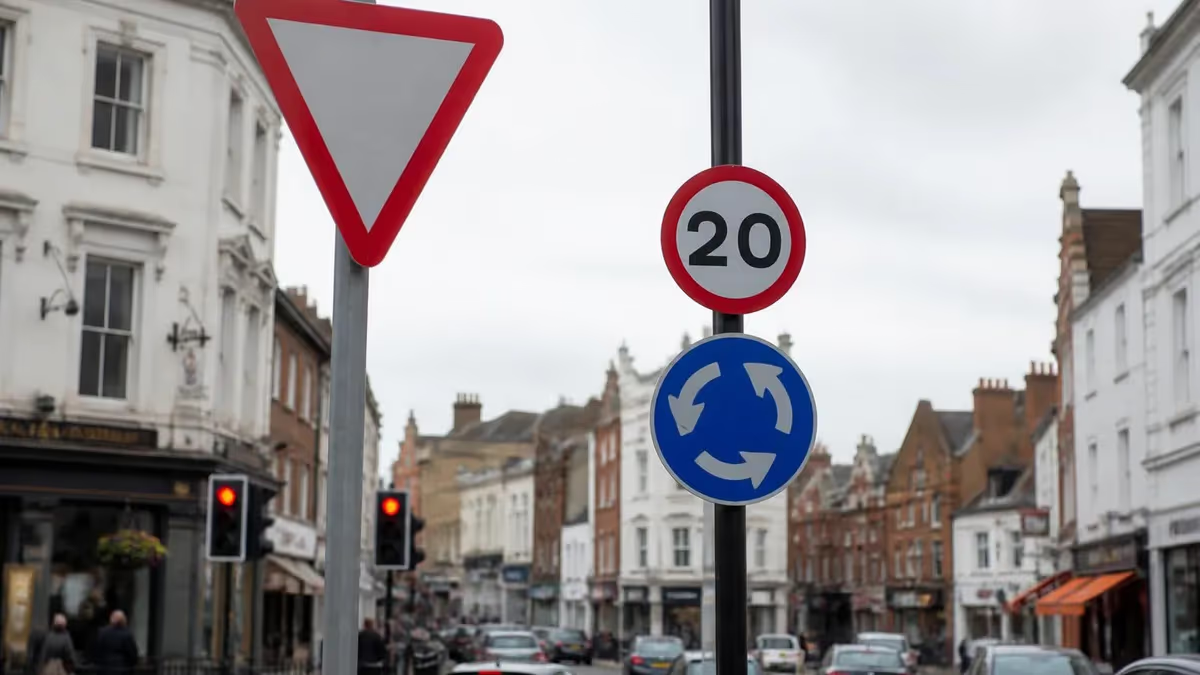
Finding the best driving theory app is one of the most important steps you can take before sitting your DVSA theory test. The UK driving theory test has a national pass rate of around 47–49%, meaning more than half of candidates fail on their first attempt. Much of this failure comes down to poor preparation rather than lack of intelligence — and the right app can make the difference between walking out with a pass certificate or having to rebook and wait another few weeks.
A good driving theory app puts the entire official DVSA question bank at your fingertips. The DVSA officially licenses its question bank to third-party developers, so the best apps contain the same multiple-choice questions you will face on test day. Rather than simply memorising answers, a high-quality app will explain the reasoning behind each question, helping you build genuine road knowledge that serves you well beyond the test centre.
Beyond the multiple-choice section, the theory test includes a hazard perception component where you must click on developing hazards in video clips. Many learners are caught off guard by this section because it demands a completely different kind of attention from the question-and-answer format. The best theory apps include hazard perception video simulations that closely mirror the real CGI-based clips used by the DVSA, giving you repeated practice in identifying risks early.
When choosing a theory test app, it pays to consider several practical factors. First, does the app use the current official DVSA question bank, updated to reflect 2025–2026 changes? Second, does it offer mock tests that replicate the exact format — 50 questions in 57 minutes, requiring 43 correct to pass? Third, does it track your progress over time, highlighting weak topics so you can focus your revision efficiently rather than going over questions you already know well?
Cost is another consideration. Some apps are entirely free and supported by advertising; others charge a one-off fee of around £4–£10 or a small monthly subscription. Free apps can be perfectly adequate for many learners, but paid apps often offer a cleaner interface, offline access, and more detailed performance analytics. It is worth reading recent reviews in the App Store or Google Play before committing, as question bank accuracy is the single most important feature.
The category of app you choose may also depend on which licence class you are aiming for. The standard car theory test is covered by all mainstream apps, but if you are preparing for a motorcycle (CBT or full A licence), LGV, or PCV test, you will need an app that specifically covers the relevant question bank and hazard perception clips for that category. Not all apps cater to every licence type, so check carefully before downloading.
In this guide we cover what to look for in a driving theory app, compare the most popular options available to UK learners in 2026, discuss their pros and cons, and share a practical revision plan to help you build from zero to test-ready confidence. Whether you have six weeks or six months to prepare, the right app — used consistently — is the foundation of a successful theory test revision strategy.
UK Driving Theory Test by the Numbers
Key Features Every Great Theory Test App Must Have
The app must use the current, officially licensed DVSA question bank — over 700 questions covering all 14 topic categories. Outdated or unofficial questions waste your revision time and can cause you to learn wrong answers.
Authentic CGI hazard perception clips, as close as possible to the real DVSA test format. The app should teach you the scoring system — up to 5 points per developing hazard — and let you replay clips to understand what you missed.
Realistic mock exams replicating the exact conditions of test day: 50 questions, 57 minutes, randomised from the full question bank. Mock tests build mental stamina and reveal which topic areas still need work before you book the real thing.
Detailed stats showing your score history, weak topics, and improvement over time. A good app surfaces your lowest-scoring categories automatically so you spend revision time where it matters most, not repeating questions you already know.
Each question should come with a clear explanation of why the correct answer is right and why the distractors are wrong. Apps that only show you the answer without explaining the underlying rule produce rote memorisers who panic when question wording changes slightly.
When comparing the most popular driving theory apps available in the UK in 2026, several stand out as consistently reliable choices. The DVSA's own Theory Test Kit app is the official option, containing the complete licensed question bank and hazard perception clips directly from the examining body. Because it comes straight from the source, it is always up to date and its question wording matches exactly what you will see on test day. It is available free on iOS and Android, though some users find the interface less polished than third-party alternatives.
Driving Theory Test 4 in 1 by Halfords is one of the most-downloaded paid options in the UK and covers car, motorcycle, LGV, and PCV categories in a single app. The name refers to its four test types rather than four separate products. It charges a one-off fee of around £4.99 and offers offline access, which is useful for revising during commutes without using mobile data. User reviews consistently praise its question explanations and the quality of its hazard perception clips, which are described as among the most realistic available outside of the official DVSA kit.
Theory Test Pro is a browser-based and app-based platform favoured by many driving instructors who recommend it to their pupils. It is subscription-based at around £9.99 for three months and includes a feature where your instructor can monitor your progress remotely — particularly valuable if your instructor wants to ensure you are revising between lessons. The platform covers the full question bank, features a clean study mode, and includes a smart algorithm that prioritises the questions you get wrong most often.
AA Driving Theory is another well-regarded option, backed by the AA brand and regularly updated. It includes both multiple-choice and hazard perception practice and is available at a modest one-off cost. The AA's reputation for road safety gives many learners extra confidence in the accuracy of its content. It also includes a "study mode" for each topic category, so you can focus on, for example, just road signs or just motorway rules before taking a full mock test.
For learners on a tight budget, Practice Test Geeks offers free online DVSA-style practice questions covering all the major topic categories. While it functions primarily as a web platform rather than a dedicated native app, it is fully mobile-optimised and allows you to tackle topic-specific quizzes at any time. This is especially useful for targeted revision — if your mock tests reveal weakness in, say, hazard awareness or eco-friendly driving, you can go directly to that category and practise questions until your confidence improves.
Choosing between these options ultimately comes down to your personal learning style and budget. If you prefer a structured course format with instructor oversight, Theory Test Pro is hard to beat. If you want a polished offline experience at a low one-off cost, Driving Theory Test 4 in 1 is excellent value. If you want free, high-quality targeted practice with no subscription required, combining the official DVSA kit for hazard perception with free online quiz platforms gives you everything you need without spending a penny.
Whatever app you choose, the single most important factor is consistency of use. Research into spaced repetition learning shows that revising for 20–30 minutes daily over four to six weeks produces significantly better retention than cramming for several hours the night before your test. The best app in the world is only as effective as the learner's commitment to using it regularly — so build revision into your daily routine and track your mock test scores to ensure you are genuinely improving week by week.
Hazard Perception, Multiple Choice, and Mock Test Strategies
The multiple-choice section consists of 50 questions drawn from 14 topic categories including alertness, attitude, safety and your vehicle, safety margins, hazard awareness, vulnerable road users, motorway rules, rules of the road, road and traffic signs, documents, accidents, and vehicle loading. You have 57 minutes to complete the section, and you need 43 correct answers to pass. The questions include text-based questions, questions accompanied by images of road signs or situations, and case studies — short scenarios followed by three related questions.
The most effective strategy for this section is to study by category rather than randomly. Start with your weakest areas identified from early practice tests, then move to high-volume categories like road signs and hazard awareness. Use an app's explanation feature rigorously — never simply accept that you got a question wrong without reading why. Many questions use very similar wording with subtle differences that change the correct answer entirely, so understanding the underlying rule is more valuable than memorising individual questions.

Pros and Cons of Using a Dedicated Theory Test App
- +Access the full official DVSA question bank any time, anywhere on your mobile device
- +Timed mock tests build the mental stamina and exam technique needed for test day
- +Progress tracking pinpoints weak topic categories so revision is targeted and efficient
- +Hazard perception video clips simulate the real test format far better than text descriptions
- +Spaced repetition algorithms surface questions you struggle with more frequently
- +Many apps offer offline access, making it easy to revise during commutes or without Wi-Fi
- −Free apps often display adverts that interrupt concentration during timed mock tests
- −Some apps use outdated or unofficial question banks that do not match the current DVSA content
- −Hazard perception clip quality varies widely between apps — poor clips can build bad habits
- −Over-reliance on apps can lead to rote memorisation without genuine road knowledge understanding
- −Screen fatigue after long sessions on a small phone screen reduces retention and focus
- −No app can replicate the psychological pressure of sitting in a real test centre environment
Theory Test Revision Checklist: 10 Steps to Exam-Day Confidence
- ✓Download the official DVSA Theory Test Kit or a highly-rated third-party app with the current licensed question bank.
- ✓Complete an initial diagnostic mock test before any revision to identify your genuine baseline score.
- ✓Review your diagnostic results and list the three topic categories where you scored lowest.
- ✓Study those three weak categories using topic-mode questions, reading every explanation carefully.
- ✓Complete at least 15–20 minutes of hazard perception clip practice every single day.
- ✓Sit a full timed mock test at the end of each week to track overall score improvement.
- ✓Revisit any question you answered incorrectly in mock tests and understand the rule behind it.
- ✓Study all UK road signs, including those you rarely see on your local roads, as they appear frequently.
- ✓Target a consistent mock test score of 47 or above before booking your real test date.
- ✓In the final 48 hours before your test, do one light revision session and avoid cramming — rest is essential.
Score 47+ on three consecutive mocks before you book your test
Most candidates who fail the theory test were scoring borderline 43–45 on practice mocks. Aim for a consistent buffer of at least four marks above the pass mark before sitting the real exam. This margin accounts for the psychological pressure of the test environment, which typically drops performance by two to four marks compared to home practice.
Getting the most from your theory test app requires more than simply downloading it and answering questions at random. The learners who pass on the first attempt treat their app as a structured study tool rather than a casual game. A clear revision plan — even an informal one written in a notebook — transforms scattered app use into purposeful preparation that builds genuine knowledge over time rather than creating the illusion of readiness.
Start your first week by working through every topic category in study mode, not quiz mode. Study mode presents questions one at a time with the answer and explanation immediately visible. This is not about testing yourself yet — it is about building familiarity with the full scope of theory content. Many learners are surprised to discover how many topic categories they know almost nothing about, from rules for towing vehicles to regulations around motorway driving for newly qualified drivers.
From week two onwards, switch to timed topic quizzes where you answer questions without seeing the answers immediately. Focus on your three weakest categories from your initial diagnostic. The human brain consolidates knowledge most effectively when it must retrieve information under mild pressure, which is exactly what a timed quiz provides. Research consistently shows that this retrieval practice approach is far more effective than re-reading notes or passively watching explanations.
Use your app's bookmarking feature — most good apps allow you to flag questions you find particularly tricky — so you can return to them in later sessions. These bookmarked questions form a personal revision bank of your specific trouble spots. Revisiting them after a gap of several days exploits the spacing effect: information recalled after a delay is encoded more durably in long-term memory than information recalled immediately after learning.
For hazard perception, the most effective practice technique is to watch clips twice. On the first viewing, try to spot and click on the developing hazard naturally. On the second viewing, observe where the hazard begins to develop — often 10–20 seconds before it becomes obvious — and check whether you clicked early enough to score maximum points. This double-viewing habit trains your eye to spot early hazard cues, which is the key skill that separates high scorers from those who barely scrape the 44-point pass mark.
Do not neglect case study questions, which are a specific format introduced to the DVSA multiple-choice section where you are given a short scenario and then asked three questions based on it. Case studies test your ability to apply theory to realistic driving situations rather than recall isolated facts. Practise these by focusing on what the scenario is asking you to prioritise — safety, legality, courtesy, or efficiency — as the correct answers consistently favour safe and legal behaviour over convenience.
In the final week before your test, shift from learning mode to performance mode. Take one full mock test per day under strict exam conditions: quiet room, no distractions, no pausing. Review only the questions you got wrong, spending no more than 30 minutes on post-mock review. Avoid introducing new material in the final 48 hours — at this stage, rest, sleep, and confidence management matter more than squeezing in extra questions. Arrive at the test centre having eaten properly, with your provisional licence ready, and trusting the preparation you have put in.

Some apps on the App Store and Google Play use unofficial question sets that do not match the current DVSA-licensed content. Using these can lead you to learn incorrect information or prepare for questions that no longer appear in the real test. Always verify that an app explicitly states it uses the official DVSA question bank before spending time revising with it — the DVSA updates its question bank periodically, and any app last updated more than 12 months ago may be missing recent additions.
Common mistakes in theory test preparation are remarkably consistent across candidates who fail, and understanding them in advance gives you a significant advantage. The most widespread mistake is beginning revision too late — many learners assume the theory test is straightforward and start preparing only one or two weeks before their booking. The pass mark of 43 out of 50 is demanding: it means you can only afford to get 7 questions wrong out of 50, which requires solid knowledge across all 14 topic categories, not just the most familiar ones.
The second most common mistake is focusing exclusively on the multiple-choice section and neglecting hazard perception. The DVSA requires you to pass both sections in the same sitting — if you pass multiple choice but fail hazard perception, you fail the whole test and must rebook and repay the £23 fee. Because hazard perception feels more intuitive to many learners, it receives less deliberate practice time. The reality is that many candidates who feel confident about hazard perception are surprised by their actual score on test day because they have never properly studied the DVSA's scoring criteria.
Misunderstanding how hazard perception is scored is itself a trap. Clicking rapidly throughout a clip — a strategy some candidates adopt thinking "more clicks = higher chance of scoring" — triggers the fraud detection algorithm and results in a score of zero for that entire clip. You must click deliberately, only when you genuinely observe a developing hazard. Each clip is scored independently, so a zero on one clip due to clicking patterns does not affect other clips, but it does significantly damage your total score out of 75.
Another frequent error is treating road sign revision as optional because many signs seem obvious from everyday driving experience. In practice, the theory test includes many signs that learners rarely encounter — contraflow systems, level crossing signals, signals used by school crossing patrols, and various information signs used only on motorways and dual carriageways. Dedicating even two or three focused sessions specifically to road signs using your app's sign-recognition category can add two or three extra correct answers to your score on test day.
Over-confidence after a few good mock test scores is also a recognised risk. Candidates who score 48 or 49 in one mock sometimes assume they are fully prepared and stop revising. The random nature of question selection means that any given test can pull heavily from your weaker categories, producing a lower score than your average. Sustained preparation — continuing to revise until test day rather than declaring yourself ready after a single strong performance — is the habit that separates consistent passers from those who fall just short on the day.
Finally, many candidates fail to read questions carefully on test day, rushing through familiar-looking questions without noticing subtle differences in wording. Test anxiety and time pressure cause many learners to answer the question they expect rather than the question that is actually being asked. This is especially common with questions that contain words like "not", "except", or "least" — a missed negative word completely inverts the correct answer. Practising slow, deliberate reading of every question during mock tests builds the habit of careful attention that is essential under exam conditions.
If you are aiming to avoid these pitfalls entirely, start your revision at least six weeks before your test date, allocate equal practice time to both test sections, study road signs as a dedicated topic, keep your mock test expectations realistic, and read every question word-for-word. Combined with a reliable, up-to-date theory test app used consistently throughout your preparation period, these habits give you a strong statistical likelihood of passing on your very first attempt.
Practical revision tips can meaningfully accelerate your progress beyond what app use alone provides. One of the most underrated techniques is to revise theory content in context — that is, as you travel around as a passenger in a car, on a bus, or as a cyclist, actively observe road signs, junctions, pedestrian crossings, and other road features and mentally apply the theory rules you have been studying. This real-world reinforcement makes abstract rules feel concrete and dramatically improves your ability to recall them under test conditions.
Another effective technique is to explain theory rules aloud, as if teaching them to someone else. This "teach-back" method reveals gaps in your understanding more reliably than simply re-reading a correct answer. If you cannot explain clearly and in plain language why a give-way rule applies at a particular junction type, you do not fully understand it yet — and the theory test will expose that gap. Use your app's explanation feature as a starting point, then try to restate the rule in your own words without looking.
Using the DVSA's own Highway Code alongside your theory app adds depth that apps alone cannot provide. The Highway Code is the source document that theory questions are drawn from, and reading around a topic — rather than just practising isolated questions — gives you the contextual understanding needed to handle unfamiliar question phrasings. The Highway Code is available free online and as a low-cost DVSA publication. Pay particular attention to the sections on road signs, motorways, and vulnerable road users, as these are heavy-tested areas.
Group revision with other learners — friends, classmates, or members of online learner driver forums — can also boost your performance. Testing each other on tricky questions, discussing why answers are correct, and sharing tips on hazard perception clips makes revision less isolating and introduces perspectives you might not have considered. Online communities of learner drivers on platforms like Reddit's r/LearnerDriversUK are active and supportive, with regular discussions about app recommendations and question bank accuracy.
For learners who are dyslexic, have ADHD, or have other learning differences, it is worth noting that the DVSA offers reasonable adjustments for the theory test, including extra time, the option to have questions read aloud via voiceover software, and testing in a separate room. If you think you may qualify for these adjustments, apply through the DVSA's special requirements process well before your test date — you will need supporting documentation from a qualified professional, and processing takes time.
On the morning of your theory test, keep your routine as normal as possible. Eat a proper meal, leave early enough to arrive at the test centre without rushing, and bring your provisional driving licence with the photograph intact — the DVSA will refuse entry if your licence is damaged or if you cannot produce it. You are not allowed to bring any notes, revision materials, a mobile phone, or smart watches into the test room. All personal items are stored in a locker provided at the test centre.
Remember that a theory test pass is valid for two years from the date you pass. You must pass your practical driving test within that two-year window, or your theory pass expires and you must take the theory test again. Booking your practical test promptly after receiving your theory pass certificate is wise, particularly given current DVSA waiting times in many areas of the UK, which can stretch to three to six months at busy test centres. Plan your timeline accordingly so you do not find yourself having to resit the theory test unnecessarily.
DVSA Questions and Answers
DVSA Theory Test: What It Covers, How to Prepare, and What to Expect on Test Day

How to Change Theory Test Date: Complete DVSA Rebooking Guide for 2026
Driving Test Centre Near Me: How to Find, Book, and Prepare for Your Local DVSA Centre (2026)
UK Theory Test Pass Mark: Car, Bike, LGV, PCV & ADI Scores
Driving Lessons Intensive Course Birmingham: Complete UK Guide to Fast-Track Your Licence in 2026
About the Author

Licensed Driving Instructor & DMV Test Specialist
Penn State UniversityRobert J. Williams graduated from Penn State University with a degree in Transportation Management and has spent 20 years as a certified driving instructor and DMV examiner consultant. He has personally coached thousands of applicants through written knowledge tests, skills assessments, and commercial driver licensing programs across more than 30 states.