
Book Theory Test Cost: Complete UK Guide to DVSA Fees, Refunds and Saving Money in 2026
How much does it cost to book your theory test? 🎯 Full UK DVSA fee breakdown, refund rules, retake costs and money-saving tips for 2026.
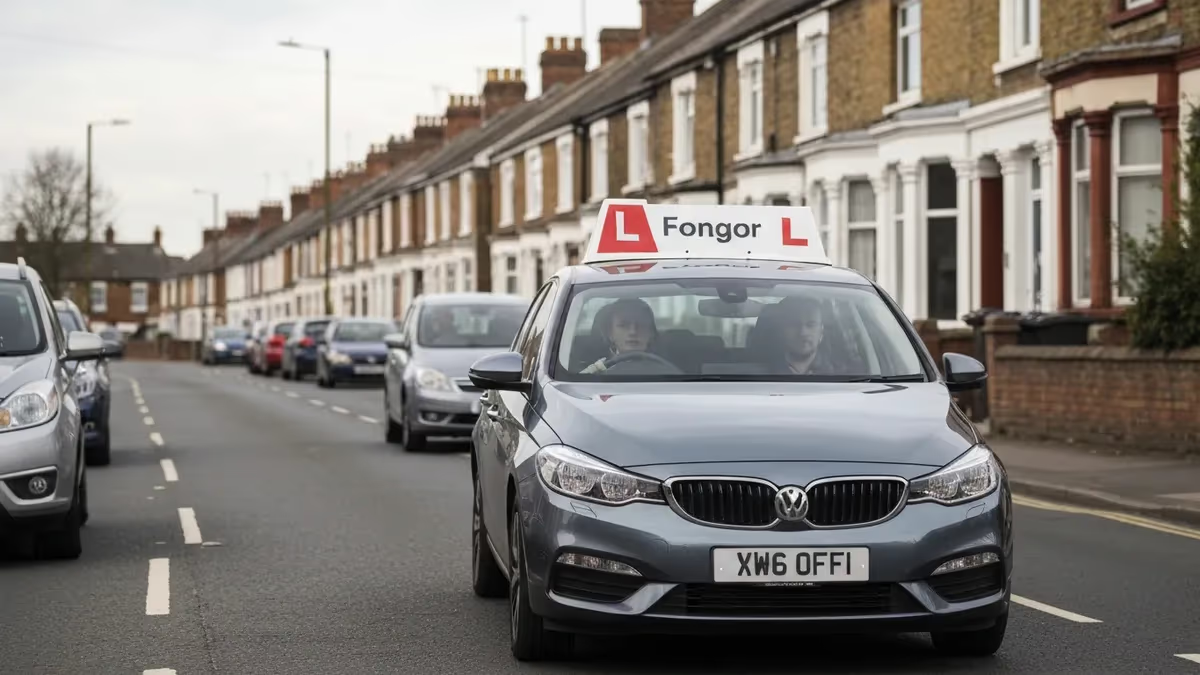
Understanding the book theory test cost is one of the first practical steps every UK learner driver must take. As of 2026, the DVSA charges £23 for a car theory test booked online through the official GOV.UK service. This fee covers both the multiple-choice section and the hazard perception clip assessment, so there is no separate charge for either component. Knowing exactly what you will pay before you book helps you budget confidently and avoid any surprises on the day. Practice with the free DVSA UK Driving Theory practice test on PracticeTestGeeks (7 questions with answer explanations).
Many learners are surprised to discover that the theory test fee has remained relatively stable over recent years despite broader cost-of-living pressures. The DVSA sets fees to recover the operational costs of running test centres across England, Scotland and Wales, without making a profit. Northern Ireland operates under a separate system administered by the Driver & Vehicle Agency (DVA), and its fee structure differs slightly. If you are booking in Northern Ireland, always check the DVA website directly, as the figures quoted in this guide apply to Great Britain only.
The category of vehicle you intend to drive also affects what you pay. Car and motorcycle theory tests both cost £23, while tests for lorry, bus and coach drivers — collectively known as large goods vehicle (LGV) or passenger carrying vehicle (PCV) tests — are priced at £26. Approved Driving Instructor (ADI) part one theory tests are also £26. These differences reflect the additional complexity of the question banks and the specialist hazard perception footage used in commercial vehicle assessments.
One of the most important things to plan for is the possibility of a resit. Nationally, around 50% of candidates fail the theory test on their first attempt, meaning many learners will need to pay the fee more than once. Building this potential resit cost into your revision budget from the very start is sound financial planning. The good news is that with thorough preparation using quality practice materials, your chances of passing first time improve dramatically, making that initial £23 investment work much harder for you.
Booking through any channel other than the official GOV.UK website or by phone on 0300 200 1122 is risky and potentially costly. Third-party booking sites sometimes charge inflated fees or administrative premiums on top of the standard DVSA charge. The DVSA itself has issued warnings about unofficial booking services that collect personal data and payments without guaranteeing a genuine test slot. Always verify you are on a GOV.UK domain before entering any payment information or personal details.
Timing your booking strategically can also help you manage costs indirectly. Test slots vary in availability depending on your region and the time of year. Booking at least four to six weeks in advance gives you more choice of dates and locations, which in turn gives you adequate revision time. Rushing into a test slot before you are properly prepared is one of the most common reasons candidates incur the expense of a retake, so patience at the booking stage almost always pays off financially.
This guide walks you through every aspect of the theory test cost in 2026: what the fee covers, how to pay safely, what happens to your money if you cancel or fail, and practical strategies to ensure your first attempt is your last. Whether you are a first-time car learner, a motorcycle rider, or a professional driver seeking a commercial licence, understanding the full fee picture puts you in control of both your revision plan and your budget.
Free DVSA UK Driving Theory Study Tools
Interactive DVSA UK Driving Theory resources on PracticeTestGeeks, free to start:
- UK Car Theory Test Attitude and Driving Behaviour 1 — 7 questions with answer explanations
- DVSA UK Driving Theory flashcards — review key terms and concepts card by card
- DVSA UK Driving Theory study guide — topic-by-topic overview of what the exam covers
- DVSA UK Driving Theory cheat sheet — one-page printable summary for last-minute review
UK Theory Test Cost by the Numbers
- The DVSA hazard perception test shows 14 video clips of everyday road scenes. (Driver and Vehicle Standards Agency)
- The DVSA car theory test multiple-choice part has 50 questions to answer in 57 minutes. (Driver and Vehicle Standards Agency)
- In the DVSA car practical driving test you drive for around 35 minutes. (Driver and Vehicle Standards Agency)
- The independent driving section of the DVSA car driving test lasts 20 to 35 minutes. (Driver and Vehicle Standards Agency)
- The pass mark for the DVSA hazard perception test is 44 out of 75 points. (Driver and Vehicle Standards Agency)
- The pass mark for the DVSA car theory test multiple-choice part is 43 out of 50. (Driver and Vehicle Standards Agency)
- The DVSA car practical driving test costs £75 on evenings, weekends and bank holidays. (Driver and Vehicle Standards Agency)
- The DVSA car practical driving test costs £62 on weekdays. (Driver and Vehicle Standards Agency)
- If you fail the DVSA theory test, you must retake both parts and wait at least 3 working days. (Driver and Vehicle Standards Agency)
Facts verified Oct 15, 2026 against Driver and Vehicle Standards Agency. Dates that have passed are removed automatically.
DVSA Exam at a Glance
| Item | Detail | Official source |
|---|---|---|
| Number of questions (Hazard perception) | 14 video clips | Driver and Vehicle Standards Agency |
| Number of questions (Multiple-choice questions) | 50 multiple-choice questions | Driver and Vehicle Standards Agency |
| Time limit (Car practical driving test) | Around 35 minutes of driving | Driver and Vehicle Standards Agency |
| Time limit (Independent driving) | 20 to 35 minutes | Driver and Vehicle Standards Agency |
| Time limit (Multiple-choice questions) | 57 minutes | Driver and Vehicle Standards Agency |
| Passing score (Hazard perception) | 44 out of 75 | Driver and Vehicle Standards Agency |
| Passing score (Multiple-choice questions) | 43 out of 50 | Driver and Vehicle Standards Agency |
| Exam fee (Car practical driving test (evenings, weekends, bank holidays)) | £75 evenings, weekends and bank holidays | Driver and Vehicle Standards Agency |
| Exam fee (Car practical driving test (weekday)) | £62 on weekdays | Driver and Vehicle Standards Agency |
| Exam fee (Car theory test) | £23 | Driver and Vehicle Standards Agency |
| Retake policy | Retake the full test after at least 3 working days | Driver and Vehicle Standards Agency |
| Validity | 2 years | Driver and Vehicle Standards Agency |
| Delivery | In person at a DVSA theory test centre | Driver and Vehicle Standards Agency |
| Eligibility | Age 17+ (16 with higher-rate PIP mobility), provisional licence required | Driver and Vehicle Standards Agency |
| Testing window (Car practical driving test) | Released 24 weeks ahead, 6am every Monday | Driver and Vehicle Standards Agency |
Facts verified Oct 15, 2026 against Driver and Vehicle Standards Agency. Dates that have passed are removed automatically.
Theory Test Fees by Vehicle and Licence Category
The standard fee for learner car drivers. Covers both the 50-question multiple-choice section and the 14-clip hazard perception test. Booked online at GOV.UK or by phone. The most common test taken in the UK each year.
Same price as the car test. The question bank and hazard perception clips are tailored to two-wheel riding scenarios. Riders upgrading between subcategories (A1, A2, A) must pass the relevant test for each stage of progression.
Lorry, bus, coach and Approved Driving Instructor part one tests attract a slightly higher fee of £26. These assessments use specialist question banks and longer hazard perception sequences, reflecting the greater complexity of commercial vehicle operation.
The DVA administers tests separately in Northern Ireland. Fees and booking processes differ from Great Britain. Always visit the nidirect.gov.uk website for accurate, up-to-date DVA pricing before booking a theory test in the province.
Booking your theory test safely and correctly is just as important as understanding the cost. The only official booking channels in England, Scotland and Wales are the GOV.UK theory test booking service (accessible at gov.uk/book-theory-test) and the DVSA contact centre telephone line on 0300 200 1122. Both channels charge exactly the same £23 fee for car and motorcycle tests. There are no discounts for booking by phone versus online, but the online route is available 24 hours a day and is generally faster.
To complete your booking you will need your provisional driving licence number, your theory test centre preference, and a valid debit or credit card. The DVSA accepts Visa, Mastercard and Maestro cards. Payment is processed securely at the point of booking and you will receive an email confirmation immediately afterwards. Keep this confirmation email safe — it contains your booking reference, the date and time of your test, and the address of your test centre, all of which you will need on the day.
When selecting a test centre, consider not just proximity to your home but also public transport links and parking availability. Some test centres in busy city areas are only accessible by public transport, which could add travel costs to your overall outlay. Rural test centres sometimes have more appointment availability but may require a longer journey. Weighing these practical factors alongside the headline booking fee gives you a more accurate picture of the true total cost of your test day.
The DVSA strongly advises against using third-party booking websites. These sites are not authorised by the DVSA and commonly charge fees above the standard £23, sometimes adding "service charges" or "booking fees" of £10 to £30 on top of the official amount. In some documented cases, candidates have paid third-party sites and received no confirmation of a genuine test slot at all, losing both their money and valuable revision time. The official GOV.UK service has no additional charges whatsoever.
Once your booking is confirmed, the DVSA will send reminder communications as your test date approaches. You are responsible for arriving at the test centre on time with your provisional licence. If you arrive without your licence, you will be turned away and will forfeit the full £23 fee with no right to a refund. This means your original payment is lost and you must pay again to rebook — effectively doubling your cost for that sitting. Check your licence expiry date and address details before your test day.
It is worth noting that theory test centres can get extremely busy, particularly during school holiday periods and in large urban areas. Slots in London, Birmingham and Manchester are sometimes fully booked six to eight weeks in advance. If you find that your preferred centre has no availability, the DVSA booking system allows you to set up an alert for cancellations, which can free up slots at much shorter notice. Using this alert feature is free and could save you weeks of waiting.
Accessibility requirements should also be factored into your booking process. The DVSA offers a range of adjustments for candidates with dyslexia, visual impairments, hearing difficulties or other conditions that may affect test performance. These adjustments include additional time, screen reader software, and the option to have questions read aloud. There is no additional charge for any accessibility adjustments — you simply need to declare your requirements at the time of booking so the test centre can make the necessary preparations before your arrival.
Cancellations, Refunds and Rescheduling Your Theory Test
If you cancel your theory test with at least three clear working days' notice before your appointment, the DVSA will refund the full £23 fee to your original payment card. "Clear working days" excludes weekends and public holidays, so if your test is on a Monday, you must cancel by midnight on the preceding Wednesday at the latest. Cancellations made after this three-day window result in the full fee being forfeited — you receive nothing back and must pay again to rebook.
Refunds are processed automatically to the card used at the time of booking and typically appear within five to ten working days, depending on your bank or card issuer. If you paid by debit card the credit is usually faster than for credit cards. The DVSA does not issue cheque refunds or bank transfers, so if your original payment card has since expired or been replaced, contact your bank proactively to ensure the refund can still be credited to your account.
Is the UK Theory Test Worth the Cost? Pros and Cons
- +Relatively affordable at £23 — one of the lowest theory test fees in Europe
- +Fee covers both multiple-choice and hazard perception in a single sitting
- +No additional charges for accessibility adjustments or special equipment
- +Refund available with sufficient notice, protecting learners who need to cancel
- +Online booking is free of service charges — no hidden costs on GOV.UK
- +Pass certificate valid for two years, giving flexibility around practical test timing
- −Fee is fully non-refundable with fewer than three working days' notice
- −Failing means paying the full £23 fee again for every resit attempt
- −No discounts available for low-income candidates or young learners under 17
- −Third-party booking sites create risk of paying inflated fees for the same slot
- −LGV and PCV candidates pay £26, adding up quickly if multiple attempts are needed
- −Popular test centres can be booked up six to eight weeks ahead, delaying progress
Pre-Booking Checklist: Everything to Confirm Before You Pay
- ✓Confirm your provisional driving licence is valid and shows your current address before booking.
- ✓Decide on your preferred test centre and check its public transport links or parking options.
- ✓Use only the official GOV.UK booking service or the DVSA phone line — never a third-party site.
- ✓Have your debit or credit card ready; check the card is not expired and has sufficient funds.
- ✓Allow at least four to six weeks of revision time before selecting your test date.
- ✓Declare any accessibility requirements during the booking process, not on the day of your test.
- ✓Save your booking confirmation email and note the exact address of your test centre.
- ✓Mark the three-clear-working-days cancellation deadline in your calendar from the date you book.
- ✓Check that your theory test certificate will not expire before you can sit your practical test.
- ✓Budget for a potential resit by setting aside an additional £23 before your first attempt.
Factor in Hidden Costs When Budgeting for Your Theory Test
Beyond the £23 resit fee, failing your theory test costs you revision time, travel expenses and potentially weeks of delay before your practical test. Candidates who fail typically wait three to five weeks for the next available slot, pushing back their entire learning schedule. Investing in quality practice materials now — including free tools like this site's DVSA practice tests — is almost always cheaper than the combined cost of a second sitting.
Understanding retake costs is essential for any learner who wants to manage their driving education budget effectively. When a candidate fails the theory test, there is a mandatory waiting period before they can rebook: you must wait at least three working days before making a new appointment. This cooling-off period is designed to encourage additional study rather than immediate rebooking, but in practice it often means waiting considerably longer because test centre slots are not always immediately available at short notice.
The financial impact of multiple retakes can be significant. A learner who sits the theory test three times pays £69 in test fees alone before they achieve their pass certificate. Add travel costs to your nearest test centre — which could be a bus fare, train ticket or petrol and parking — and the total outlay rises further. In some cases, learners living in rural areas spend more on getting to the test centre than the test itself costs, making geographical location a real financial consideration when planning your driving education.
The most reliable way to avoid retake costs is to treat your first attempt as the only one you intend to make. This means being genuinely ready before you book, not booking with the idea that you will just see how you get on.
The theory test requires a score of at least 43 out of 50 on the multiple-choice section and 44 out of 75 on the hazard perception section. Both thresholds must be met in the same sitting — if you pass one section but fail the other, you must resit the entire test and pay the full fee again.
Consistent practice with realistic mock tests is the single most effective way to reduce your probability of a resit. Research consistently shows that learners who complete at least 20 to 30 full mock tests before their sitting are significantly more likely to pass first time compared to those who rely only on reading the Highway Code. Mock tests build not just knowledge but also the exam-taking stamina required to maintain concentration through all 50 questions without rushing or second-guessing correct answers under time pressure.
Hazard perception is the section most commonly responsible for a failed sitting among learners who feel confident on the multiple-choice questions. The scoring system penalises candidates who click too frequently — a pattern of rapid, repeated clicking on a single clip is interpreted as cheating the system and results in a score of zero for that clip. Understanding the scoring mechanics before your test day is therefore not just useful revision strategy; it is a direct way to protect your £23 investment and avoid the cost of a resit caused by a misunderstood rule.
Some driving schools include the theory test fee in their all-in-one lesson packages, covering the cost of the test alongside a set number of lessons. If you are working with an instructor on a structured package, it is worth asking explicitly whether the theory test booking fee is included and, if so, how many attempts are covered. Packages that include one theory test attempt but charge separately for retakes may actually cost more than booking independently if your first attempt is unsuccessful, so read the terms carefully before committing.
Free resources can dramatically reduce the likelihood of a paid resit. The DVSA's own practice materials, combined with high-quality free websites like PracticeTestGeeks, provide extensive question bank coverage without any upfront cost. Using these free tools consistently in the weeks before your test means you arrive fully prepared, confident in both the content and the format of the assessment. The return on investment from free revision is effectively infinite — every hour spent practising for free is an hour that reduces your probability of spending another £23 on a resit.
For a fuller set of questions on this topic, see our theory test practice resource.
For a fuller set of questions on this topic, see our practical driving test questions quiz resource.

Your theory test pass certificate is valid for exactly two years from the date of your test. If you do not pass your practical driving test within this window, your theory test certificate expires and you must book and pay for the theory test again from scratch — even if you have already paid for and sat the practical test multiple times. Plan your practical test bookings carefully to avoid this costly situation, particularly if you anticipate delays in your practical lessons.
Saving money on your theory test starts well before the day you book. The most impactful saving is simply passing first time, but there are several other strategies that reduce the total financial burden of obtaining your licence. Starting with a clear revision plan four to six weeks before your intended test date gives you the time to cover all 14 topics in the DVSA question bank methodically, identify weak areas early, and address them before they cost you a resit fee.
Choosing your test centre wisely is another overlooked cost-saving measure. If you live equidistant between two test centres, compare not just the distance but the travel cost. A test centre that is five miles further but accessible by a direct bus route might be significantly cheaper to reach than a closer centre that requires two bus changes or a taxi. Over multiple attempts — whether one, two or three — these travel cost differences compound and can exceed the price of the test itself.
Early morning or midweek test slots are often more readily available than weekend or evening appointments. While the fee is identical regardless of the time slot you choose, securing a slot that is not in peak demand means you have more flexibility to pick a date that aligns with your revision schedule. Avoiding the pressure of booking whatever slot is available just because time is running short prevents the scenario where you sit the test underprepared purely because a convenient slot came up.
If you are a student or under 25, check whether your driving school or college has any partnership arrangements with the DVSA or local motoring organisations. Some schemes provide subsidised revision materials or discounted lesson packages that indirectly offset the theory test cost. While the DVSA itself does not offer fee concessions based on age or income, ancillary costs such as revision books, hazard perception DVDs and mock test subscriptions may be available at a reduced rate through educational institutions or motoring charities.
Group study with friends who are also learning to drive is a completely free and surprisingly effective preparation strategy. Quizzing each other on Highway Code rules, discussing common hazard perception scenarios, and comparing mock test scores creates accountability and surfaces knowledge gaps that solo study sometimes misses. Candidates who study with peers and discuss the reasoning behind correct answers — not just memorise them — tend to perform more consistently under real test conditions, reducing the risk of a costly mistake in the actual examination room.
Taking advantage of the full range of free online practice resources, including the six DVSA-aligned practice tests available on this site covering eco-friendly driving, vehicle loading, hazard awareness and first aid, ensures your preparation spans the breadth of topics the DVSA examines. Each practice session reinforces the knowledge needed to clear both the multiple-choice threshold of 43 and the hazard perception threshold of 44, meaning you approach your paid test booking from a position of measured confidence rather than hopeful guesswork.
Finally, keep a record of your mock test scores in the final two weeks before your booking. If you are consistently scoring 47 or above out of 50 on multiple-choice mocks and 60 or above on hazard perception, you are performing well above the pass threshold and are genuinely ready to book.
If your scores are still hovering near the pass mark, a few more days of targeted practice is a much cheaper investment than the £23 fee for a resit. The data from your own practice sessions is the most honest indicator of whether you are ready — trust it over gut feeling alone.
On the day of your theory test, a few practical habits can protect both your performance and the money you have already invested. Arrive at the test centre at least 15 minutes early. Late arrivals who miss the check-in window are turned away and forfeit their fee with no recourse. Bring your provisional driving licence — both the photocard and, if applicable, the paper counterpart — and ensure both are in date. Test centre staff will refuse entry if your documents are not in order, and the fee will be lost.
During the multiple-choice section, use the full 57 minutes available. Many candidates who fail do so not because they lack knowledge but because they rush. The test interface allows you to flag questions for review and return to them before submitting, so take advantage of this feature. Reviewing flagged questions in the final ten minutes of the session is a sound exam technique that catches errors made under early-session nerves, potentially converting a fail into a pass without any additional cost.
For the hazard perception section, remember that each clip contains at least one developing hazard and one clip contains two. Click once as soon as you identify a developing hazard — a situation that would cause a driver to take action. Clicking earlier (when the hazard is still developing) scores more points than clicking late. Do not click repeatedly in quick succession on the same clip, as the system flags this as an attempt to game the scoring algorithm and awards zero for that clip. Understanding this mechanics quirk is worth as many marks as hours of additional study.
After the test, your result is displayed on screen immediately. If you pass, you receive a pass certificate number which your driving instructor and practical test examiner will need. Store this number securely — losing it does not invalidate your pass, but requesting a replacement pass letter from the DVSA involves contacting their customer service team and waiting for a new document to be issued. If you fail, the screen shows which sections you performed below the threshold, giving you targeted feedback for your next revision cycle before you rebook.
Between a failed sitting and your resit, use the topic-level feedback from your result to focus your revision rather than simply repeating general practice. If your multiple-choice score was 40 — just three marks below the threshold — you need targeted work in the specific categories where you dropped points, not a broad review of everything. The DVSA clusters its questions into 14 categories; knowing which categories you underperformed in turns a £23 resit fee into a structured learning investment rather than a demoralising repeat of the same preparation.
Practical test readiness and theory test readiness are connected. Your theory knowledge directly supports your on-road decision making, and examiners during the practical test sometimes probe candidates verbally on topics covered in the theory test, such as stopping distances, motorway rules and vehicle safety checks. Approaching the theory test as foundational knowledge for real driving — rather than a box-ticking exercise to get through as cheaply as possible — produces better prepared drivers who pass their practical test more efficiently too.
The total cost of a UK driving licence, from provisional application through to a full licence, typically ranges from £1,500 to £2,500 when you include lessons, tests and administrative fees. In this context, the £23 theory test fee is a very small proportion of the overall investment. Managing it well — by preparing thoroughly, booking through official channels and understanding the cancellation policy — is a straightforward way to ensure this small but important step in your driving journey goes smoothly and does not need to be repeated unnecessarily.
Sample DVSA UK Driving Theory Practice Questions
Try these questions from our free DVSA UK Driving Theory practice tests. The correct answer and an explanation follow each question.
What is the national speed limit on a motorway for a car not towing a trailer?
- A. 60 mph
- B. 70 mph
- C. 80 mph
- D. There is no set limit
Answer: B. 70 mph
The national speed limit on motorways for cars, motorcycles, car-derived vans, and dual-purpose vehicles is 70 mph. Cars towing trailers or caravans have a lower limit of 60 mph on motorways.
What is the purpose of emergency refuge areas (ERAs) on smart motorways?
- A. For drivers to stop and make phone calls
- B. To provide a safe place to stop in an emergency when there is no hard shoulder
- C. For HGV drivers to take rest breaks
- D. For police speed checks
Answer: B. To provide a safe place to stop in an emergency when there is no hard shoulder
Emergency refuge areas are orange-surfaced bays on smart motorways that provide a safe place to stop when the hard shoulder has been removed. They contain an SOS phone connected to Highways England. They are spaced approximately every 1.5 miles.
A casualty is bleeding heavily from an arm wound. What is the most effective immediate action?
- A. Apply a tourniquet above the wound
- B. Elevate the arm and apply firm pressure
- C. Pour cold water over the wound
- D. Give the casualty a warm drink
Answer: B. Elevate the arm and apply firm pressure
Elevating the injured limb and applying firm direct pressure is the recommended first aid for controlling severe bleeding.
At a Puffin crossing, the green figure for pedestrians has turned off while someone is still crossing. What will the traffic lights for vehicles show?
- A. A flashing amber light.
- B. A steady green light as soon as the figure goes out.
- C. A steady red light until the crossing is clear.
- D. A steady amber light.
Answer: C. A steady red light until the crossing is clear.
Puffin crossings (Pedestrian User-Friendly Intelligent crossings) use sensors to detect if pedestrians are on the crossing. The traffic light will remain red for vehicles until the pedestrian has safely reached the other side, even if the green figure has gone out. Unlike older Pelican crossings, there is no flashing amber phase for drivers.
DVSA Questions and Answers
UK Theory Test Pass Mark: Car, Bike, LGV, PCV & ADI Scores

Free Theory Test App: The Complete UK Guide to Choosing, Using and Passing With Mobile Practice in 2026

Cancelling Driving Test: The Complete UK Guide to Refunds, Rebooking and Avoiding Lost Fees in 2026
Theory Test Certificate: Complete UK Guide to Passing and Using Your DVSA Pass Letter in 2026
Driving Test Nerves: The Complete UK Guide to Calming Anxiety and Passing First Time in 2026
How this page was made: written with AI tools and published by Nathan Beja, founder of Practice Test Geeks, who is responsible for its content. Exam facts are checked against the official sources listed below. Not reviewed by a subject-matter expert. Editorial policy
Sources & references
Exam facts on this page (fees, format, dates, passing scores) are checked against these official sources; the date is our last check. Editorial policy
- gov.uk — Eligibility, registration, test dates, passing score, retake policy, score release, score validity, time limit, exam format · verified Oct 2026