
Reading STAAR Test Practice: Complete Guide to Acing Texas Reading Assessments
Master reading STAAR test practice with free questions, study strategies, and released tests. 📚 Boost your Texas assessment score today.

If you are searching for reading STAAR test practice that actually moves the needle, you have landed in the right place. The State of Texas Assessments of Academic Readiness — known universally as the STAAR test — is the gateway exam every Texas student must pass to demonstrate grade-level proficiency in English Language Arts and Reading. Understanding how the test is structured, which skills it targets most heavily, and how to build a focused practice routine can mean the difference between a passing score and retesting in the summer.
The Texas Education Agency releases official STAAR practice materials each year, and savvy students use those staar released tests as the backbone of their preparation. These released exams are identical in format, question type, and difficulty distribution to the live assessment, making them the single most valuable free resource available. Pairing released tests with targeted skill drills creates a complete preparation system that addresses both conceptual weaknesses and test-taking stamina.
Reading on the STAAR exam is not the same as reading a novel for pleasure. The assessment demands active, analytical engagement with every passage. Students must synthesize information across multiple texts, identify the author's purpose and craft decisions, analyze how figurative language contributes to meaning, and draw evidence-based conclusions — all under strict time pressure. Many students who are strong readers in class still struggle on STAAR because they have not practiced the specific question formats the test uses.
One common misconception is that reading practice means simply reading more books. While wide reading certainly builds vocabulary and background knowledge, purposeful STAAR preparation means working with the exact types of paired passages, literary excerpts, and informational texts that appear on the real exam. It means practicing how to annotate efficiently, identify main ideas in dense academic prose, and eliminate wrong answer choices using textual evidence rather than personal opinion.
Grade-level expectations vary significantly across the STAAR Reading assessments. Third graders focus on foundational comprehension and basic literary analysis, while eighth graders must handle complex synthesizing tasks across multiple genres. High school students taking the STAAR English I and English II exams face full-length literary and expository texts with sophisticated vocabulary and multi-layered inference questions. Knowing your specific grade-level standards is the first step to building an efficient study plan.
Consistent, structured practice sessions of 30 to 45 minutes are far more effective than marathon cramming sessions the week before the test. Research in cognitive science consistently shows that spaced repetition — revisiting concepts at increasing intervals — leads to durable long-term retention. Set aside dedicated practice time three to four days per week, rotate through different skill categories, and always review your errors with the same analytical attention you would give a science experiment: what went wrong, why, and what strategy would have led to the correct answer?
This guide walks you through every dimension of reading STAAR test practice, from understanding the exam format and released test resources to proven study strategies, common pitfalls, and a week-by-week preparation checklist. Whether the test is eight weeks away or eight days away, the frameworks here will help you make the most of every hour you invest in preparation.
STAAR Reading by the Numbers

STAAR Reading Exam Format Overview
| Section | Questions | Time | Weight | Notes |
|---|---|---|---|---|
| Literary Text Comprehension | 20 | ~60 min | 38% | Fiction, poetry, drama excerpts |
| Informational Text Analysis | 18 | ~55 min | 35% | Expository, persuasive, multi-source |
| Paired Passage Synthesis | 8 | ~25 min | 15% | Compare/contrast across two texts |
| Vocabulary in Context | 6 | ~20 min | 12% | Figurative language, word meaning |
| Total | 52 | 4 hours (untimed within session) | 100% |
The Texas Education Agency publishes official STAAR released test materials on its website every year following the spring administration. These documents are the gold standard for preparation because they reflect the current blueprint, passage complexity, and question rigor of the live exam. Each released test includes an answer key and, in many cases, explanations that detail which TEKS standard each question assesses. Working through an entire released test under timed conditions before reviewing your answers is one of the highest-impact practice activities available.
Students can access the full archive of released assessments as a staar released test PDF, which is downloadable for offline use and classroom distribution. Teachers across Texas routinely use these documents for diagnostic purposes at the beginning of a unit and as formative checkpoints throughout the semester. For home preparation, printing a released test and completing it at the kitchen table — without interruptions, phones, or outside resources — closely mimics the real testing environment and produces the most diagnostic feedback.
Beyond the official released tests, the TEA also provides STAAR practice questions organized by reporting category. These category-level question sets are particularly useful for targeted remediation. If a student consistently misses questions in the Author's Craft and Structure category, for example, they can drill specifically on that reporting category rather than spending equal time on areas where they are already proficient. This targeted approach is dramatically more efficient than generic test-prep workbooks that cover all skills uniformly.
Online practice platforms have proliferated in the STAAR preparation market, ranging from free state-provided resources to subscription-based adaptive systems. The advantage of adaptive platforms is that they adjust question difficulty based on student performance in real time, ensuring that practice remains in the productive struggle zone — challenging enough to promote growth but not so difficult that students disengage. The disadvantage is that some commercial platforms use questions that do not accurately mirror the authentic STAAR experience, either in passage quality or question construction.
For students using digital practice resources, it is important to verify that the passages are grade-appropriate in both length and complexity. STAAR passages at grades 6 through 8 typically run 700 to 1,000 words, while high school English I and II passages can reach 1,500 words or more. Practice materials that use significantly shorter or simpler texts may build some foundational skills but will leave students underprepared for the sustained reading demands of the actual assessment.
One often-overlooked resource is the STAAR Vocabulary List, which the TEA publishes alongside the assessment frameworks. These lists compile the academic and domain-specific vocabulary terms that students are expected to know at each grade level. Systematic vocabulary study using these lists — combined with contextual reading practice — addresses one of the most common sources of error on STAAR Reading: misinterpreting a passage because an unfamiliar term derailed comprehension of a key sentence or argument.
Finally, students preparing for the STAAR Reading exam should take advantage of teacher feedback on in-class assessments throughout the school year. Teachers design classroom reading tasks and essays to align with TEKS standards, which directly correspond to STAAR reporting categories. Asking your teacher to identify which TEKS you missed on a graded assignment and then revisiting the corresponding STAAR practice materials creates a powerful feedback loop between classroom learning and standardized test preparation.
STAAR Practice Test Strategies by Grade Band
Elementary STAAR Reading assessments emphasize foundational comprehension skills: identifying the main idea, understanding story elements such as character and plot, and recognizing basic text features in informational passages. At this stage, practice should focus on reading aloud and then answering questions in writing, because verbalizing comprehension helps students track their own understanding. Passages are shorter — typically 300 to 500 words — so students have time to reread key sections before answering.
One highly effective strategy for grades 3 through 5 is the "Read–Cover–Recall" method. After reading a passage, students cover the text and try to recall the main events, key details, and the author's purpose in their own words. This active retrieval practice dramatically strengthens memory encoding and mirrors the cognitive demands of answering STAAR questions without looking back at every detail. Students who practice this technique consistently report feeling more confident during the actual exam because they have internalized the habit of active comprehension monitoring.
STAAR Reading Practice: Official Released Tests vs. Third-Party Prep Materials
- +Official released tests perfectly mirror the real exam's passage complexity and question format
- +Released tests are free to download directly from the TEA website
- +Each question is tagged to a specific TEKS standard for targeted remediation
- +Third-party adaptive platforms adjust difficulty in real time to keep practice productive
- +Commercial prep books often include detailed explanations that released answer keys lack
- +Online platforms provide instant scoring and progress tracking across multiple sessions
- −Only a limited number of official released tests are available per grade level
- −Released test PDFs cannot adapt to individual student weaknesses automatically
- −Some commercial platforms use passages that are shorter or simpler than authentic STAAR texts
- −Subscription-based platforms can be expensive for families without school district support
- −Third-party explanations occasionally contain errors or misattribute TEKS standards
- −Over-reliance on one resource type can leave blind spots in preparation coverage
Pros and Cons at a Glance
| Pros | Cons |
|---|---|
| Official released tests perfectly mirror the real exam's passage complexity and question format | Only a limited number of official released tests are available per grade level |
| Released tests are free to download directly from the TEA website | Released test PDFs cannot adapt to individual student weaknesses automatically |
| Each question is tagged to a specific TEKS standard for targeted remediation | Some commercial platforms use passages that are shorter or simpler than authentic STAAR texts |
| Third-party adaptive platforms adjust difficulty in real time to keep practice productive | Subscription-based platforms can be expensive for families without school district support |
| Commercial prep books often include detailed explanations that released answer keys lack | Third-party explanations occasionally contain errors or misattribute TEKS standards |
| Online platforms provide instant scoring and progress tracking across multiple sessions | Over-reliance on one resource type can leave blind spots in preparation coverage |
STAAR Reading Test Practice Prep Checklist
- ✓Download at least two official TEA released tests for your specific grade level and complete them under timed conditions.
- ✓Score your released test attempts and categorize every error by STAAR reporting category.
- ✓Create a vocabulary flashcard set using the TEA STAAR vocabulary list for your grade.
- ✓Practice the Read–Cover–Recall technique on every new passage you encounter during study sessions.
- ✓Complete at least one timed paired-passage practice set per week to build synthesis skills.
- ✓Review your teacher's feedback on in-class reading assessments and map comments to TEKS standards.
- ✓Use a consistent annotation system (star, question mark, underline) on every practice passage.
- ✓Simulate a full-length test session once per week in the six weeks leading up to the exam.
- ✓Drill your weakest reporting category for at least 20 minutes at the start of each practice session.
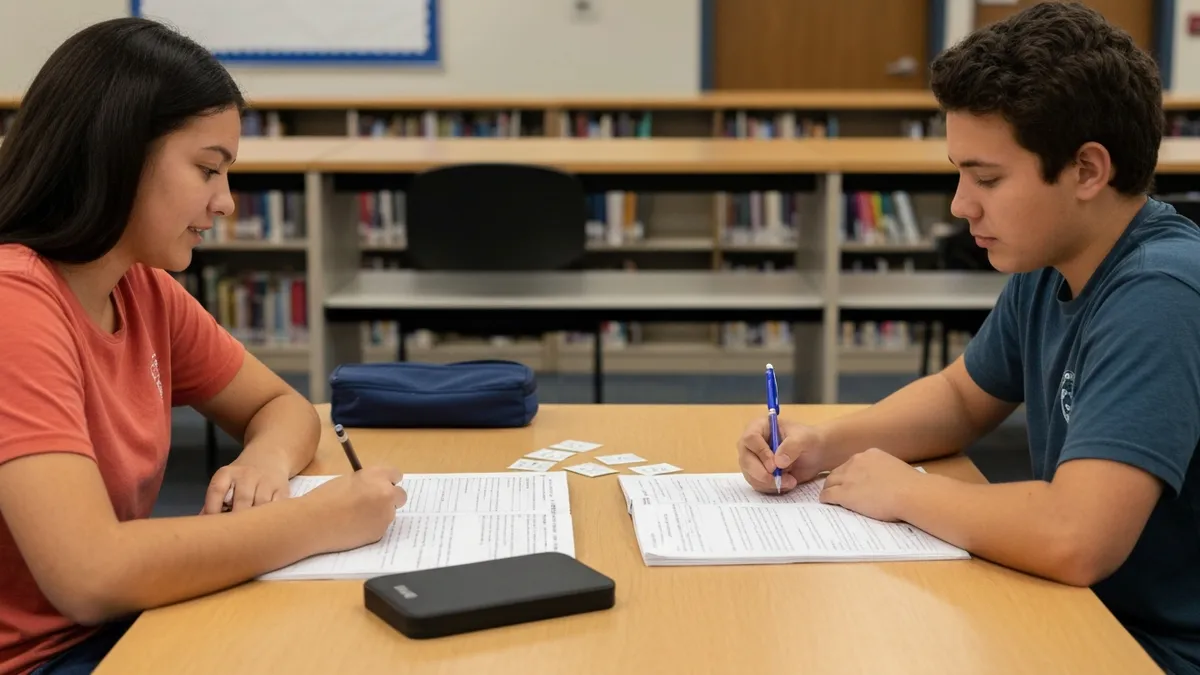
- ✓Discuss your reasoning on at least three practice questions per session with a parent, tutor, or study partner.

Evidence-Based Elimination Is Your Most Powerful Tool
On the STAAR Reading exam, every correct answer is directly supported by text evidence. If you cannot point to the specific sentence or paragraph that justifies your choice, you are guessing. Train yourself to eliminate answer options that require assumptions the passage never makes — this single habit accounts for most of the score gains seen in students who improve by one or two performance levels on a retest.
Scoring well on the STAAR Reading exam requires mastering a set of specific cognitive strategies that go well beyond simply understanding words on a page. The most fundamental of these is purposeful annotation. Students who annotate actively — marking main ideas, noting shifts in tone or perspective, and flagging evidence that supports an argument — consistently outperform students who read passively. Annotation transforms reading from a receptive act into an analytical conversation with the text, which is precisely the cognitive stance STAAR questions are designed to reward.
The second critical strategy is question-stem analysis. Before reading an answer choice, read the question stem slowly and identify exactly what it is asking.
Many STAAR questions contain precision language: "according to the passage," "the reader can conclude," "the author most likely includes this paragraph to" — each of these phrasings signals a different type of thinking. "According to the passage" demands a directly stated fact. "The reader can conclude" requires an inference supported by multiple text details. "The author most likely includes" demands understanding of purpose and craft. Misreading the question stem is one of the leading causes of errors on STAAR Reading.
Process of elimination is the third pillar of high-scoring STAAR strategy. On a four-option multiple-choice question, even eliminating one clearly wrong answer raises your probability of selecting the correct answer by 33 percent. Train yourself to evaluate each answer choice against the text evidence rather than against your general knowledge or intuition.
Wrong answers on STAAR typically share one of three characteristics: they are true statements that do not answer the specific question asked, they are partially correct but contain one detail that contradicts the passage, or they use language that is more extreme or absolute than what the text actually supports.
Time management during the STAAR Reading exam deserves serious attention during practice. The exam is technically untimed in the sense that students can use up to four hours, but most testing sessions operate within a standard school-day window. Students who linger too long on a single difficult question risk running out of focused cognitive energy for the remaining passages.
A useful heuristic is to spend no more than two minutes on any single question during the first pass. Mark questions you are unsure of and return to them after completing the full exam — often, information from later passages triggers the insight needed to answer an earlier question correctly.
Vocabulary in context questions are a distinct question type that rewards a specific approach. When encountering an unfamiliar word, do not rely solely on prior knowledge of the word's definition. Instead, read the full sentence and the sentences immediately before and after it to identify context clues: synonyms, antonyms, examples, and explanatory phrases that the author provides to help readers understand the term.
STAAR vocabulary questions frequently offer answer choices that represent real definitions of the word but in a different context — the correct answer is always the meaning that fits the specific passage context, not the most common dictionary definition.
For students preparing for the high school STAAR English I or English II exam, literary analysis skills require particular attention. These exams include passages from recognized works of American literature and from diverse contemporary authors, and questions frequently ask about theme, symbolism, narrative perspective, and the effect of specific stylistic choices.
Reading a range of short stories, poems, and essays throughout the school year — and practicing articulating the author's craft choices and their effects — builds the analytical fluency these questions demand. You can also check staar results guidance to understand how scores are reported and what performance level cut scores mean for your specific grade.
Finally, mental and physical preparation on the day before the exam is not a trivial concern. Sleep deprivation reduces working memory capacity by as much as 20 to 30 percent in adolescents, directly impairing the inferential reasoning that STAAR Reading requires. Students who sleep fewer than seven hours the night before a high-stakes exam consistently underperform relative to their practice test averages.
Encourage a regular sleep schedule in the week leading up to the exam, avoid late-night cramming sessions, and eat a balanced breakfast on test day. These factors are well within a student's control and have a measurable positive impact on actual exam performance.
In Texas, students in grades 5 and 8 must pass the STAAR Reading exam to be promoted to the next grade level unless a Grade Placement Committee grants an exemption. High school students must pass the STAAR English I and English II EOC exams as a graduation requirement. Missing the spring administration without an approved exemption can restrict summer retest opportunities, so track your district's testing calendar carefully and do not miss scheduled exam dates.
Building a sustainable reading STAAR test practice routine requires realistic scheduling and honest self-assessment. The most effective student-led preparation plans share three characteristics: they are consistent rather than sporadic, they are diagnostic rather than generic, and they are active rather than passive. Consistency means showing up for practice even on days when motivation is low — the cumulative effect of daily 30-minute sessions over eight weeks is dramatically larger than the effect of three marathon sessions the week before the exam.
Diagnostic preparation means using your practice test results as data. After every practice session, ask yourself three questions: Which question types did I miss most frequently? Which passage types gave me the most difficulty — literary, informational, or paired? And did I run out of time, or did I finish with time to spare? These three questions point directly toward the adjustments your preparation plan needs. Students who skip this reflection step often repeat the same errors across multiple practice sessions because they never identify the root cause.
Active preparation means engaging with the material rather than passively reading through it. Summarize passages in one sentence after reading them. Write out explanations of why each wrong answer choice is wrong, not just why the correct answer is right. Record yourself explaining the main argument of an informational text as if teaching it to someone who has not read it. These active recall and elaborative interrogation techniques have among the strongest empirical support in the cognitive science of learning.
Parents and guardians play a meaningful role in supporting reading STAAR test practice at home. Creating a distraction-free study environment, asking students to explain what they read in their own words, and celebrating incremental progress rather than focusing only on overall scores all contribute to a positive preparation experience. Avoid expressing test anxiety yourself around students — parental anxiety is contagious and measurably raises students' cortisol levels during high-stakes assessments.
For students who have already taken the STAAR Reading exam and need to retest, the preparation approach should shift based on your previous score report. TEA provides score reports that break down performance by reporting category, showing which areas of the test you answered correctly and which you missed. This disaggregated data is extremely valuable: a student who scored well on literary comprehension but poorly on Author's Craft should spend 70 percent of retest preparation time specifically on Author's Craft questions, not on general reading practice that does not address the specific weakness driving the overall score.
Students using digital tools for preparation should explore the interactive practice resources available directly from TEA, including the desmos staar calculator tool that is available on the math assessments and understanding how technology-enhanced items work across subject areas. While Reading STAAR is primarily a traditional multiple-choice exam, familiarity with the online testing interface — including how to flag questions, use the elimination tool, and navigate between passages — reduces test-day cognitive load and prevents avoidable interface-related errors.
Community resources are another underutilized pillar of STAAR preparation. Many Texas public libraries offer free tutoring programs specifically focused on STAAR preparation during the spring semester. Local education service centers (ESCs) frequently publish free supplementary practice materials aligned to current TEKS standards. University-based tutoring centers and community organizations in major Texas cities often provide no-cost or low-cost STAAR prep sessions on weekends. Tapping these community resources can significantly extend the quality and quantity of a student's practice without any financial burden on the family.
Test day preparation is as important as the weeks of practice that precede it, and students who have a clear plan for the morning of the exam consistently perform closer to their true ability level than those who arrive unprepared. The night before the exam, lay out your materials, confirm the testing location, and review your test-day routine. Do not attempt to learn new content the evening before — your working memory needs consolidation time, not additional input. Light review of your strongest skills, followed by a relaxing activity and early bedtime, is the optimal evening-before strategy.
On the morning of the exam, eat a protein-rich breakfast rather than one high in simple sugars. Studies consistently show that sustained cognitive performance over a three-to-four-hour testing session correlates with stable blood glucose levels, which protein and complex carbohydrates support more effectively than cereal or pastries. Arrive at the testing location at least 15 minutes early to avoid the cortisol spike associated with last-minute rushing. Settle into your seat, take three slow deep breaths, and remind yourself that you have prepared for this specific challenge.
During the exam, manage your pacing by budgeting approximately one minute per question for the first pass through the exam. Do not spend more than 90 seconds on any single question before marking it and moving on. This pacing strategy ensures that you encounter every question on the exam and have a thoughtful answer — even if tentative — for each one before returning to the marked questions with remaining time. Students who get stuck on a single difficult question early in the exam often fail to reach easier questions later in the section.
When you encounter a particularly difficult inference question, use the "sandwich method": read the sentence immediately before and after the key detail the question references, then ask yourself what conclusion must be true given both of those surrounding sentences. STAAR inference questions are almost never based on a single isolated sentence — the answer always requires synthesizing at least two adjacent pieces of text evidence. Students who practice this sandwich method during their preparation find that it dramatically increases their accuracy on inference questions without significantly increasing the time per question.
For paired passage questions, read both passages before attempting any synthesis questions. It is tempting to read the first passage, answer all its specific questions, read the second passage, and then tackle the paired questions — but this approach forces you to reconstruct your memory of the first passage when answering synthesis questions. Reading both passages consecutively with a brief annotation of each passage's main argument before answering any paired questions produces consistently higher accuracy, particularly on compare-and-contrast and author's purpose comparison items.
After the exam, resist the temptation to discuss every question with classmates during the walk back to your classroom. Post-exam question analysis with peers who may have chosen different answers can introduce doubt about responses you felt confident about and cannot change anyway. Instead, take note of which passage types felt most challenging — literary versus informational, short versus long, first-person versus third-person narration — so that if a retest is needed, you have immediate insight into which passage types should anchor your next preparation cycle.
Remember that the STAAR Reading exam is one measure of your reading skills at one point in time, and it can be retaken. Texas provides multiple testing opportunities each year, and thousands of students who did not pass on their first attempt go on to demonstrate proficiency on a subsequent administration after targeted preparation.
The goal of all the reading STAAR test practice strategies in this guide is not to manufacture a single perfect performance but to help you build genuine reading comprehension and analytical skills that will serve you on the STAAR exam, in your coursework, and throughout your academic and professional life.
STAAR Questions and Answers



About the Author

Educational Psychologist & Academic Test Preparation Expert
Columbia University Teachers CollegeDr. Lisa Patel holds a Doctorate in Education from Columbia University Teachers College and has spent 17 years researching standardized test design and academic assessment. She has developed preparation programs for SAT, ACT, GRE, LSAT, UCAT, and numerous professional licensing exams, helping students of all backgrounds achieve their target scores.