
Driving Test Nerves: The Complete UK Guide to Calming Anxiety and Passing First Time in 2026
Driving test nerves ruining your chances? Discover proven UK techniques to calm anxiety, manage stress and pass your DVSA test with confidence in 2026. 🔎
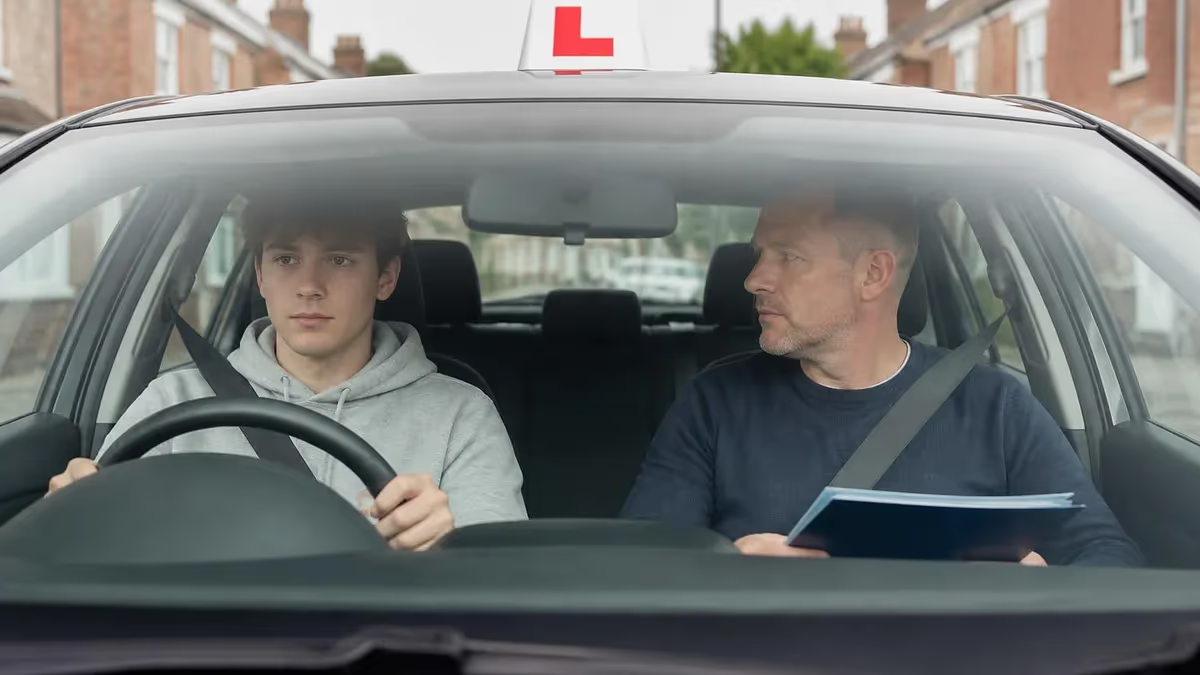
Driving test nerves affect roughly four out of five learners in the UK, and the DVSA itself acknowledges that anxiety is one of the single biggest reasons candidates fail tests they would otherwise pass on a normal day. The feeling is unmistakable: shaking hands, a dry mouth, a racing pulse, and that sudden inability to remember which pedal is which despite forty hours of lessons. Understanding why this happens is the first step toward defeating it, because nerves are not a character flaw but a predictable physiological response. Practice with the free DVSA UK Driving Theory practice test on PracticeTestGeeks (7 questions with answer explanations).
The good news is that test anxiety follows patterns that can be interrupted, redirected, and ultimately turned to your advantage. Examiners are trained to spot nervous candidates and will go out of their way to put you at ease during the opening minutes of the test. Knowing this single fact alone reduces fear for many learners, because it reframes the examiner from an adversary hunting for mistakes into a professional who genuinely wants to see you drive well and pass.
This guide draws on advice from DVSA examiners, driving instructors with thirty-plus years of experience, sports psychologists who train Olympic athletes, and thousands of learners who have walked the same path you are walking now. We will cover the science of why your body reacts the way it does, the night-before routine that consistently produces calm candidates, the breathing techniques you can use at the wheel, and the cognitive tricks that stop a single mistake from spiralling into a failed test.
You will also learn the difference between helpful nerves — the alert, focused energy that sharpens reactions — and harmful nerves that flood your brain with cortisol and shut down decision-making. The aim is not to eliminate every butterfly in your stomach. A small amount of adrenaline is what makes you check your mirrors twice and signal at exactly the right moment. The aim is to keep that energy in the productive zone rather than letting it tip into panic.
If you have already booked your test and are reading this in the days or hours beforehand, skip ahead to the practical timeline near the end. If you are months away and want to build resilience slowly, work through the sections in order and practise each technique during your lessons. Many learners find that simply rehearsing the test scenario in their head reduces actual test-day anxiety by half. For broader test-day strategy, see our guide to the DVSA Car Practical Test: Complete Guide to Passing First Time.
Throughout this article you will find quiz links, checklists, and FAQs that reinforce the techniques. Treat this as a toolkit rather than a single solution — different methods work for different personalities, and the candidates who pass tend to be those who experiment until they find their personal combination of preparation, breathing, and mindset. Your nerves are not unique, they are not permanent, and they absolutely do not have to cost you your licence.
By the end of this guide you will have a clear, step-by-step plan covering the week before, the morning of, the waiting room, the first five minutes behind the wheel, and the moment when a mistake happens mid-test. Every section is built on what actually works in the real world, not on generic advice telling you to simply relax — because anyone struggling with test anxiety knows that is the least helpful instruction ever given.
Free DVSA UK Driving Theory Study Tools
Interactive DVSA UK Driving Theory resources on PracticeTestGeeks, free to start:
- DVSA UK Driving Theory flashcards — review key terms and concepts card by card
- DVSA UK Driving Theory study guide — topic-by-topic overview of what the exam covers
- DVSA UK Driving Theory cheat sheet — one-page printable summary for last-minute review
Driving Test Nerves by the Numbers
Why Driving Test Nerves Happen: The Science
Your brain interprets the test as a threat, releasing adrenaline and cortisol. Heart rate jumps, palms sweat, and blood diverts from your prefrontal cortex — the area you need for clear decision-making and smooth manoeuvres.
Knowing someone is watching and judging triggers social-evaluation anxiety. The presence of a stranger holding a clipboard activates the same brain regions as public speaking, which most people fear more than physical danger.
Your mind imagines worst-case outcomes — failing, wasting money, disappointing family. These thoughts create a feedback loop that intensifies physical symptoms and makes simple tasks like checking mirrors feel impossibly complex.
Unlike lessons in your instructor's car on familiar routes, the test introduces unknowns: a new passenger, possible new roads, sat-nav instructions, and the awareness that this counts. Novelty itself increases the stress response.
Under high stress, conscious thinking interferes with automatic skills you have practised hundreds of times. Learners who can perform a flawless bay park in a lesson suddenly forget the reference points the moment they think too hard.
Preparation is the single most powerful antidote to driving test nerves, and the form that preparation takes matters more than the sheer number of hours you log. Learners who arrive at the test centre feeling calm have almost always done three specific things: they have practised on test routes near the centre, they have completed at least one mock test with a different instructor or examiner, and they have studied the marking criteria so they understand exactly what counts as a fault. Random hours behind the wheel build skill but not necessarily confidence.
Start by asking your instructor to plan lessons that mirror the real test structure — twenty minutes of independent driving, an emergency stop on perhaps one in three tests, and one of the four manoeuvres. Doing this repeatedly trains your nervous system to associate that pattern with familiar success rather than novel threat. By the time test day arrives, your body should recognise the sequence and respond automatically rather than with alarm. This is the same principle elite athletes use when rehearsing competition conditions.
Test routes are no longer published by the DVSA, but most learners drive on them during regular lessons because instructors know the local area intimately. Ask explicitly to cover the trickiest junctions, the multi-lane roundabouts, the residential streets where parents park inconsiderately, and the dual carriageway slip roads. Familiarity with terrain reduces cognitive load on test day, freeing mental bandwidth for the actual decisions you need to make rather than basic navigation. A good intensive driving course with test often builds this kind of route familiarity in a concentrated burst.
Mock tests are the closest thing to a vaccine against test anxiety. A proper mock means your instructor sits silently throughout, marks faults on a real DL25 sheet, and gives you the standard examiner brief at the start. The first time most learners experience this they make small mistakes they would never make in a normal lesson — proof that the test environment itself, not the driving skill, is what trips people up. Repeat mocks two or three times and the effect fades dramatically.
Sleep, hydration, and food in the days before the test matter more than people realise. A learner running on five hours of sleep has reaction times equivalent to someone over the drink-drive limit, regardless of how skilled they are. Aim for at least seven hours of sleep for three nights running before the test, drink plenty of water, and eat slow-release carbohydrates the morning of. Skip the energy drinks — caffeine spikes mimic and amplify anxiety symptoms.
Visualisation is dismissed by many learners as airy-fairy nonsense, but it is backed by serious neuroscience. Mental rehearsal activates the same neural pathways as physical practice, which is why footballers visualise penalty kicks and surgeons mentally walk through operations. Spend ten minutes each evening the week before your test imagining the full sequence — arriving, the eyesight check, getting in the car, driving the first five minutes calmly, completing manoeuvres, and finishing with the examiner saying you have passed.
Finally, make your preparation routine boring on purpose. Eat the same breakfast, wear the same comfortable clothes, listen to the same playlist, and leave at the same time on lesson days as you plan to on test day. The more your test morning resembles a normal lesson morning, the less your brain will categorise it as a threatening novelty. This deliberate sameness is one of the most underrated techniques in the entire toolkit.
DVSA Practice Test Questions
Prepare for the DVSA - UK Driving Theory Test exam with our free practice test modules. Each quiz covers key topics to help you pass on your first try.
DVSA Eco-Friendly Driving and Vehicle Loading
DVSA Exam Questions covering Eco-Friendly Driving and Vehicle Loading. Master DVSA Test concepts for certification prep.
DVSA Hazard Awareness
Free DVSA Practice Test featuring Hazard Awareness. Improve your DVSA Exam score with mock test prep.
DVSA Incidents, Accidents and First Aid
DVSA Mock Exam on Incidents, Accidents and First Aid. DVSA Study Guide questions to pass on your first try.
DVSA Motorway Rules and Smart Motorways
DVSA Test Prep for Motorway Rules and Smart Motorways. Practice DVSA Quiz questions and boost your score.
DVSA Rules of the Road (Highway Code)
DVSA Questions and Answers on Rules of the Road (Highway Code). Free DVSA practice for exam readiness.
DVSA - UK Driving Theory Hazard Awareness ...
DVSA Mock Test covering - UK Driving Theory Hazard Awareness and Perception. Online DVSA Test practice with instant feedback.
DVSA - UK Driving Theory Motorway Rules an...
Free DVSA Quiz on - UK Driving Theory Motorway Rules and Regulations. DVSA Exam prep questions with detailed explanations.
DVSA - UK Driving Theory Road and Traffic ...
DVSA Practice Questions for - UK Driving Theory Road and Traffic Signs. Build confidence for your DVSA certification exam.
DVSA - UK Driving Theory Rules of the Road
DVSA Test Online for - UK Driving Theory Rules of the Road. Free practice with instant results and feedback.
Breathing Techniques to Calm Driving Test Nerves
Box breathing is used by Royal Marines, surgeons, and elite athletes precisely because it works under extreme pressure. Inhale slowly through your nose for four counts, hold for four counts, exhale through your mouth for four counts, then hold empty for four counts. Repeat the cycle four times. The technique works by activating the parasympathetic nervous system, which directly counteracts the adrenaline flooding your body and slows your heart rate within ninety seconds.
Use box breathing in the waiting room before the examiner calls your name, and again while sitting in the car before you turn the key. You can also use a shortened version — four in, four out — at red lights during the test itself. Examiners will not mark you down for a learner who takes a deep breath before pulling away. In fact many examiners notice and silently approve of candidates who self-regulate this way.
Is a Small Amount of Nerves Actually Helpful?
- +Heightened alertness improves observation of mirrors and blind spots
- +Adrenaline sharpens reaction times to hazards and emerging vehicles
- +Mild stress increases attention to detail like correct signalling
- +Caring about the outcome motivates thorough preparation
- +Nerves keep you respectful of the examiner's instructions
- +Slight tension prevents the complacency that causes silly faults
- −Excessive cortisol blocks access to learned motor skills
- −Racing heart can cause shaking hands on the steering wheel
- −Tunnel vision reduces peripheral awareness of hazards
- −Catastrophic thinking after one mistake leads to multiple mistakes
- −Dry mouth and shallow breathing impair concentration
- −Severe nerves can trigger memory blanks during manoeuvres
Pros and Cons at a Glance
| Pros | Cons |
|---|---|
| Heightened alertness improves observation of mirrors and blind spots | Excessive cortisol blocks access to learned motor skills |
| Adrenaline sharpens reaction times to hazards and emerging vehicles | Racing heart can cause shaking hands on the steering wheel |
| Mild stress increases attention to detail like correct signalling | Tunnel vision reduces peripheral awareness of hazards |
| Caring about the outcome motivates thorough preparation | Catastrophic thinking after one mistake leads to multiple mistakes |
| Nerves keep you respectful of the examiner's instructions | Dry mouth and shallow breathing impair concentration |
| Slight tension prevents the complacency that causes silly faults | Severe nerves can trigger memory blanks during manoeuvres |
Test Day Checklist to Beat Driving Test Nerves
- ✓Get at least seven hours of sleep the night before your test
- ✓Eat a slow-release carbohydrate breakfast like porridge or wholegrain toast
- ✓Drink water steadily but avoid coffee, energy drinks and excess caffeine
- ✓Bring your provisional licence and theory test pass certificate
- ✓Wear comfortable, loose clothing and flat-soled shoes for pedal feel
- ✓Arrive at the test centre fifteen minutes early — not earlier
- ✓Practise four cycles of box breathing in the waiting room
- ✓Use the toilet before your name is called, even if you do not feel you need to
- ✓Take a one-hour warm-up lesson before the test if budget allows
- ✓Switch your phone to silent and put it out of sight in your bag
DVSA examiners are not trying to catch you out
Examiners are professional drivers who pass roughly half of all candidates they assess. They are paid the same whether you pass or fail and have no targets, quotas or hidden motivations to fail you. Most are former driving instructors themselves and remember exactly how nerve-wracking the test feels. Treating the examiner as a neutral, supportive professional rather than a hostile gatekeeper changes everything about how your body responds to the test.
Once the test begins, the first five minutes set the tone for everything that follows. Examiners universally agree that candidates who start calmly almost always finish calmly, while those who panic in the opening minutes often spiral. Your goal during these first five minutes is not to drive perfectly — it is simply to drive normally. Pull away smoothly, settle into a comfortable speed for the road, check your mirrors at regular intervals, and let your body remember what it has done in every lesson for the past several months.
The eyesight check happens before you even get in the car, so use it as your first calming anchor. The examiner will ask you to read a number plate from twenty metres away. Take your time, take a breath, and read it clearly. If you cannot see it on the first car, the examiner will simply move you to a closer one — this is not a failure, just a recalibration. Many learners report that completing this small task successfully gives them an immediate confidence boost going into the rest of the test.
Show-me-tell-me questions come next, asked while the car is stationary outside the centre. Two questions, simple mechanical and safety topics. Even if you get one wrong, it counts only as a single minor fault and does not affect the rest of the test. Treat these as a gentle warm-up rather than a high-stakes interrogation. Many learners find that simply talking out loud to the examiner about something familiar — like how to check the brake fluid — breaks the ice and makes the subsequent driving feel less formal.
During the drive itself, remember that the examiner is required by law to remain silent except when giving directions. Long silences are normal and do not mean you are doing badly. If anything they usually mean you are doing fine, because examiners only speak to give directions or, in rare cases, to take control of the car for safety reasons. Resist the temptation to chat constantly to fill the silence — focus on the road, but a few friendly comments at appropriate moments are perfectly welcome.
If you genuinely do not understand a direction, ask the examiner to repeat it. This is allowed, encouraged, and does not affect your score in any way. Examiners would much rather repeat instructions than watch a flustered candidate go the wrong way at a roundabout. Similarly, if you take a wrong turn by accident, it is not a fail — examiners simply redirect you and continue the test. Many candidates have passed after going the wrong way, because the marking is based on how safely you drive, not on perfect navigation.
Manoeuvres are where nerves often flare up again because they require precision. The examiner will choose one of four: parallel park, bay park forward or reverse, or pull up on the right and reverse two car lengths. You are allowed to take your time, adjust your position with multiple shunts if needed, and even pause to look around carefully. Slow, controlled, observed manoeuvres are rewarded. Rushed, untidy ones are punished. The clock is not against you during this section.
The independent driving section uses either a sat-nav supplied by the examiner or verbal directions for about twenty minutes. Missing a sat-nav turn is not a fail — the device simply recalculates and the test continues. The point of independent driving is to assess how safely you navigate without step-by-step guidance, not to test your sat-nav obedience. Stay calm, drive defensively, and trust that the examiner is judging your decision-making rather than your route choice.

The single biggest cause of unnecessary fails is candidates assuming they have already failed after one minor mistake and then giving up mentally. You are allowed up to fifteen minor faults and still pass. Only a serious or dangerous fault results in an automatic fail. If you make any kind of mistake, take a breath, reset, and drive the next five minutes as if nothing happened — examiners are far more forgiving than learners imagine.
Recovering from mistakes mid-test is arguably the most important skill in beating driving test nerves, because almost every candidate makes at least one small error during a forty-minute drive. The candidates who pass are not the ones who drive flawlessly — they are the ones who let mistakes go and continue driving safely afterwards. The candidates who fail are usually those who replay a single mistake over and over until their attention drifts and a second, larger mistake follows. Mental recovery is the entire game.
The technique driving instructors teach is called park-it-and-drive-on. The moment you notice you have made a mistake — a clipped kerb, a stalled engine, a missed mirror check — mentally place that mistake in an imaginary box, close the lid, and put it aside until after the test. You can analyse it later with your instructor. During the test, your only job is to drive the next thirty seconds well, then the thirty seconds after that. Compounding errors are the enemy, not isolated ones.
If you stall, the recovery is mechanical and unemotional. Apply the handbrake if you are on a hill, put the car in neutral, restart the engine, perform full observations including blind spot checks, then move off again when safe. Done calmly, a stall is a single minor fault. Done in panic, it becomes a serious fault because you forget to look properly before pulling away. Practise stalling on purpose during lessons so the recovery becomes automatic and emotionally neutral.
Hitting the kerb gently during a manoeuvre is often recoverable. If the wheel touches the kerb you can sometimes correct without faulting, depending on the examiner's assessment. If you mount the kerb fully it is more likely to be serious. Either way, complete the manoeuvre calmly and continue the test. Examiners are looking at your overall standard of driving across the full route, not at one isolated event. If you do need to driving test closer to the date, our complete guide explains your refund options.
If the examiner intervenes verbally or physically — touching the dual controls, for example — this is a serious fault and the test will continue but you will not pass. Even so, you must finish the drive professionally. Examiners take notes on how candidates respond to setbacks, and this resilience matters if you ever need to discuss your performance afterwards or appeal a result. Walking off the test or visibly giving up is the worst response possible.
Nerves can spike most sharply during the second half of the test when fatigue sets in. Combat this by sipping water during stationary moments at traffic lights, rolling your shoulders to release tension, and consciously relaxing your grip on the wheel — many nervous learners squeeze the steering wheel until their forearms ache without realising. A relaxed body sends signals to the brain that the situation is safe, which is the opposite of how the fight-or-flight response normally operates.
Above all, remember that the test will end. In approximately thirty-eight minutes, regardless of what happens, you will be back at the test centre receiving feedback. This finite quality is enormously calming when you remind yourself of it. The test is a brief window, not a permanent state. By the same time tomorrow, you will either be a licensed driver or you will have booked a retest with a clearer idea of what to work on — both outcomes are entirely survivable.
The final week before your test is when practical preparation should slow down and mental preparation should ramp up. By this point your driving skill is essentially fixed — you cannot meaningfully improve your manoeuvres in seven days. What you can improve dramatically is your mindset, your test-day routine, and your ability to access the skill you already have under pressure. Many instructors recommend reducing lesson intensity in the final days to avoid arriving at the test exhausted and over-thinking every small fault.
Two days before the test, do a normal one-hour lesson covering routes near the test centre. Do not cram, do not attempt to learn new skills, and do not push for a perfect performance. The aim is simply to remind your body what driving feels like in the local area. Many learners try to fit in extra practice the day before and arrive at the test centre tired and over-corrected. Confidence is built by feeling competent, not by drilling weak areas to exhaustion.
The night before your test, prepare everything practical so that morning runs on autopilot. Lay out your provisional licence, check the test centre address, confirm your appointment time, set two alarms, and decide what you will wear. Eat a normal dinner — not something experimental — and avoid alcohol entirely because even small amounts disrupt sleep architecture and impair next-day reaction times. Most importantly, do something completely unrelated to driving in the evening: a film, a walk, dinner with friends. Brooding makes nerves worse.
On the morning of the test, follow your normal routine as closely as possible. Wake up with enough time for a proper breakfast, drink water steadily, and leave for the test centre with a buffer for traffic. Arriving fifteen minutes early is ideal — much earlier and you sit in the waiting room building up nerves, much later and you are flustered before you even start.
If you are taking a warm-up lesson, end it ten minutes before your appointment so you have time to settle. For learners considering more lessons before retesting, see our overview of learn to drive uk.
In the waiting room, resist the temptation to chat to other nervous candidates. Their anxiety is contagious and unhelpful. Instead, put in headphones and listen to calm music, run through your breathing exercises, or read something completely unrelated. Some learners find a short walk around the block helps burn off excess adrenaline. Whatever you choose, have it planned in advance so you are not making decisions in a heightened state.
When the examiner calls your name, smile, make eye contact, and respond warmly. This small social ritual signals to your brain that this is a normal human interaction, not a courtroom proceeding. Examiners notice candidates who greet them naturally and often respond with extra friendliness themselves. Walking to the car together is a chance for small talk if it feels natural — about the weather, the test centre, anything light. By the time you sit down behind the wheel, the ice should be broken.
If you do not pass, remember that the average UK learner passes on their second attempt. The pass rate for first attempts is around forty-eight percent, and many people who fail their first test pass comfortably on their second. The feedback the examiner gives you at the end of the test is gold — listen carefully, ask questions if anything is unclear, and discuss it with your instructor afterwards. A failed test that produces clear learning is more valuable than a passed test that leaves you uncertain why you got through.
Sample DVSA UK Driving Theory Practice Questions
Try these questions from our free DVSA UK Driving Theory practice tests. The correct answer and an explanation follow each question.
You are driving and an emergency vehicle approaches with blue flashing lights. What should you do?
- A. Stop immediately wherever you are
- B. Speed up to get out of its way
- C. Take appropriate action to let it pass without endangering others
- D. Flash your headlights to acknowledge it
Answer: C. Take appropriate action to let it pass without endangering others
When an emergency vehicle approaches, you should take appropriate action to let it pass. Do not panic, do not mount the kerb, do not brake harshly, and do not go through a red light. Only move aside when it is safe to do so.
What hazard should you be particularly aware of at a junction near a school during term time?
- A. Heavy goods vehicles delivering supplies
- B. Parked cars reducing visibility and children crossing unexpectedly
- C. Road works near the school entrance
- D. Cyclists using the bus lane
Answer: B. Parked cars reducing visibility and children crossing unexpectedly
Near schools during term time, parked cars from parents dropping off or collecting children can severely restrict visibility. Children may also dash across the road unexpectedly, especially at the start and end of the school day.
You are driving along a residential road with cars parked on the left-hand side. A ball bounces out into the road ahead. What is the most significant potential hazard you should be prepared for?
- A. The ball damaging your car's paintwork.
- B. A child running out to retrieve the ball.
- C. A vehicle door opening suddenly from a parked car.
- D. An oncoming vehicle swerving to avoid the ball.
Answer: B. A child running out to retrieve the ball.
A ball bouncing into the road is a classic sign that a child may follow it without checking for traffic. You must anticipate this and be ready to stop immediately. While other hazards exist, a child running into the road is the most immediate and serious danger.
You are driving a car towing a small trailer on a UK motorway. What is the maximum speed at which you are legally permitted to travel?
- A. 50 mph
- B. 70 mph
- C. 60 mph
- D. The same as cars, but you must stay in the left-hand lane
Answer: C. 60 mph
The national speed limit for a car towing a trailer or caravan on a motorway is 60 mph. This is lower than the 70 mph limit for cars, motorcycles, and car-derived vans not towing a trailer.
DVSA Questions and Answers

Cancelling Driving Test: The Complete UK Guide to Refunds, Rebooking and Avoiding Lost Fees in 2026

DVSA Car Practical Test: Complete Guide to Passing First Time
How to Change Theory Test Date: Complete DVSA Rebooking Guide for 2026
Learn to Drive UK: The Complete 2026 Beginner's Guide to Lessons, Tests and Licence Success
Intensive Driving Course With Test: Complete UK Guide to Fast-Track Your Licence in 2026
About the Author

Licensed Driving Instructor & DMV Test Specialist
Penn State UniversityRobert J. Williams graduated from Penn State University with a degree in Transportation Management and has spent 20 years as a certified driving instructor and DMV examiner consultant. He has personally coached thousands of applicants through written knowledge tests, skills assessments, and commercial driver licensing programs across more than 30 states.