
CPR First Aid Course: Complete 2026 October Guide to Certification, Cost, and What You'll Actually Learn
Complete CPR first aid course guide: 💡 ACLS algorithm basics, BLS certification, infant CPR, AED use, costs, and how to pass on the first try.
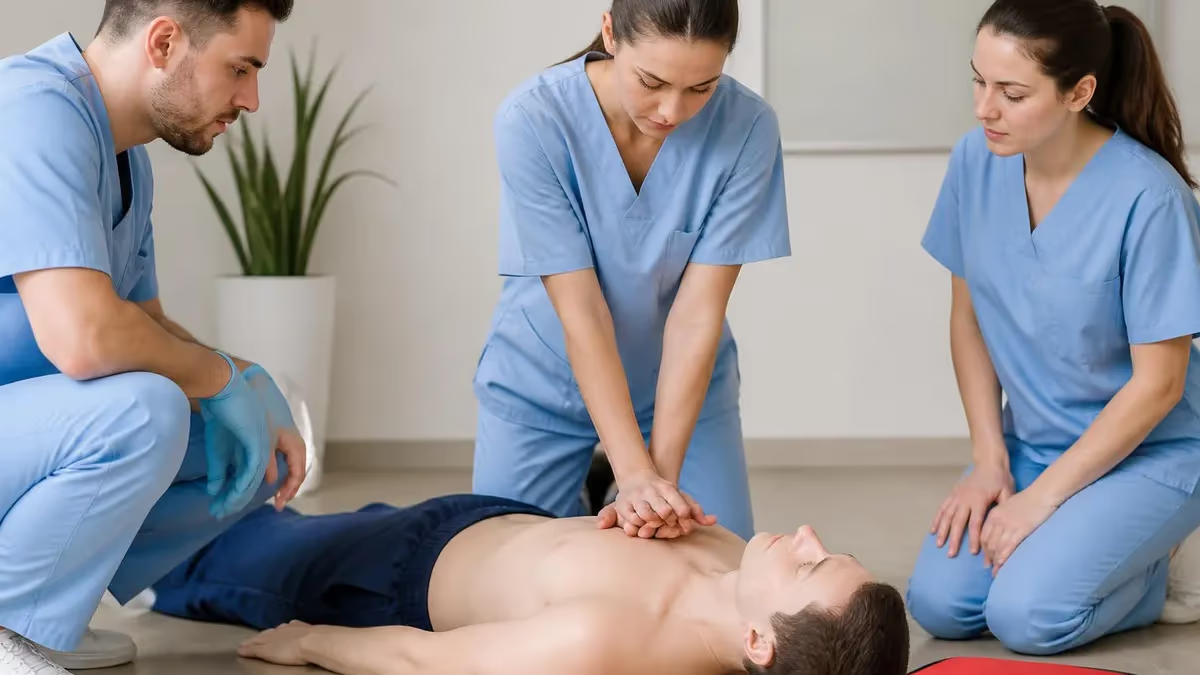
A combined CPR course and first aid certification is the most common workplace credential in the United States, taken by daycare workers, swim instructors, lifeguards, gym staff, teachers, scout leaders, and millions of bystanders who simply want to be useful when something goes wrong. The standard offering bundles cardiopulmonary resuscitation, automated external defibrillator (AED) operation, and first aid for trauma and medical emergencies into a single 4 to 6 hour class.
Two providers dominate the market: the American Heart Association Heartsaver First Aid CPR AED program, and the American Red Cross Adult and Pediatric First Aid CPR AED course. Both produce a wallet card valid for two years and are accepted by virtually every employer that requires the credential.
Pricing has stayed remarkably stable. Expect to pay between 75 and 125 dollars for a classroom course, depending on city, instructor, and whether the location is a hospital community education program, a fire station, a Red Cross chapter, an AHA training center, a YMCA, or a private CPR school.
Online and blended versions exist for both providers and run cheaper, often 40 to 80 dollars, but include a mandatory in-person skills check before the card is issued. The cheap online-only certifications you sometimes see advertised for 15 dollars are not the same product — they typically lack the hands-on component and are not accepted by employers who specifically require AHA or Red Cross credentialing.
What you actually learn matters more than the brand on the card. The curriculum covers two distinct domains. CPR and AED skills teach you to recognize sudden cardiac arrest, perform high-quality chest compressions on adults, children, and infants, deliver rescue breaths, switch on a public AED, and follow its prompts.
First aid covers the bleeding, breathing, and circulation problems you are far more likely to encounter day-to-day — heavy bleeding, choking, anaphylaxis, seizures, burns, fractures, head injuries, heat stroke, hypothermia, diabetic emergencies, stings, bites, eye injuries, and dental trauma. The combined class teaches you to scan a scene for hazards, decide whether to act, and choose the right intervention without freezing.
The combined CPR first aid course is a 4 to 6 hour class that certifies you in CPR, AED operation, and first aid for trauma and medical emergencies. The AHA Heartsaver First Aid CPR AED program and Red Cross Adult and Pediatric First Aid CPR AED are the two recognized standards. Cost is typically 75 to 125 dollars in person or 40 to 80 dollars blended. The card is valid for two years. Common employers requiring the credential include childcare centers, lifeguards, swim instructors, OSHA workplace responders, gym staff, teachers, scout leaders, and camp counselors.
The people who walk through the classroom door fall into a few predictable groups. Childcare workers and preschool teachers are required by every state licensing agency to hold current pediatric first aid and CPR — most states require both adult and pediatric components together.
Swim instructors and lifeguards need the lay rescuer or professional version depending on the facility, and most pool operators want both. OSHA does not mandate a single certification for designated workplace responders but does require that whoever volunteers for the role hold training appropriate to the workplace hazards, and the Heartsaver or Red Cross combined course is what most employers select.
Personal trainers and group fitness instructors must hold the credential to maintain their NASM, ACE, or AFAA certifications. Scout leaders, camp counselors, and youth sports coaches need it before working with kids. Teachers in many states are now required to hold it as a condition of their teaching license. Build parents, in-home day-care providers, and even some real estate agents (yes, really, in some states managing properties with pools) are added to the list.
Then there is the much larger group of people taking the course voluntarily. Parents who want to be ready if their toddler chokes on a grape. Adult children caring for aging parents. People who hike, hunt, or work remote sites where help is far away. Office workers who watched a coworker collapse and never want to feel that helpless again.
The American Heart Association estimates that more than 350,000 cardiac arrests happen outside hospitals each year in the United States, and survival roughly doubles when a bystander starts compressions before paramedics arrive. The math is brutal: every minute without CPR drops survival odds by about 10 percent. Sixty percent of cardiac arrests happen in homes. The person you save is statistically a family member.
Recognized CPR First Aid Course Providers
The flagship lay rescuer program from the American Heart Association. Four to six hours classroom or blended online plus skills check. Covers adult, child, and infant CPR and choking, AED use, and a full first aid module. Two-year card. Accepted by essentially every U.S. employer.
The American Red Cross equivalent. Same scope and recognition as Heartsaver with slightly different teaching style and digital card. Available through Red Cross chapters, partnered training providers, and online blended formats. Two-year certification.
The provider-level version required for nurses, EMTs, paramedics, medical and dental students, respiratory therapists, and similar clinical roles. More technical than Heartsaver and includes two-rescuer techniques, bag-mask ventilation, and team dynamics. Not the right course for most non-clinical workers.
American Safety and Health Institute and Medic First Aid offer OSHA-recognized programs accepted by many workplaces but not always by state childcare or healthcare licensing bodies. Confirm acceptance with your employer or licensing board before enrolling.
NSC programs are widely available through workplace safety contractors and meet OSHA requirements for designated workplace responders. Acceptance for licensed roles like childcare or pool operations varies by state.
For backcountry guides, scout leaders, and outdoor educators, programs like Wilderness First Aid (WFA) from NOLS or SOLO build on basic first aid with extended scenarios — long evacuations, improvised splinting, environmental injuries — that are not part of standard Heartsaver.
The first aid half of the combined course is the part most students underestimate. The CPR portion is dramatic and well-known. The first aid portion is the toolkit you will actually use every year. Instructors typically open with scene safety and the universal action plan: check the scene, check the person, call 911 or have someone call, then care.
The CABs of trauma assessment — catastrophic bleeding, airway, breathing — replace the older ABC framework for trauma cases because uncontrolled hemorrhage kills faster than airway obstruction in penetrating injuries. Direct pressure with a clean cloth, packing wounds when bleeding will not stop, and the proper use of commercial tourniquets like the CAT or SOFTT-W are now standard topics, driven by the Stop the Bleed campaign that grew out of the Sandy Hook and Boston Marathon responses.
Shock recognition and treatment, splinting fractures and sprains with whatever is available, cooling thermal burns and managing chemical and electrical burns, choking response (the abdominal thrusts most people still call the Heimlich maneuver), the recovery position for an unconscious but breathing person, and how to help someone use their own epinephrine auto-injector during anaphylaxis are all hands-on stations.
Diabetic emergencies — low blood sugar, the conscious patient who can swallow versus the patient who cannot — and the difference between a generalized tonic-clonic seizure and a focal seizure get classroom time too. Heat exhaustion versus heat stroke is the kind of distinction that saves a soccer player on a hot August Saturday. Hypothermia and frostbite cover the other end of the temperature spectrum. Stings, bites (insect, snake, marine), eye flushes for chemical splashes, and how to manage a knocked-out tooth so a dentist can save it round out a typical first aid station rotation.
Course Format Options
The traditional 4 to 6 hour single-session class with an instructor, mannequins, AED trainers, bandage and splint supplies, and a small group of classmates. You watch demonstrations, practice on Annie and infant mannequins, and complete a short written test plus skills evaluation. Best for hands-on learners and anyone who has not done CPR before. Cost typically 75 to 125 dollars depending on city and provider.
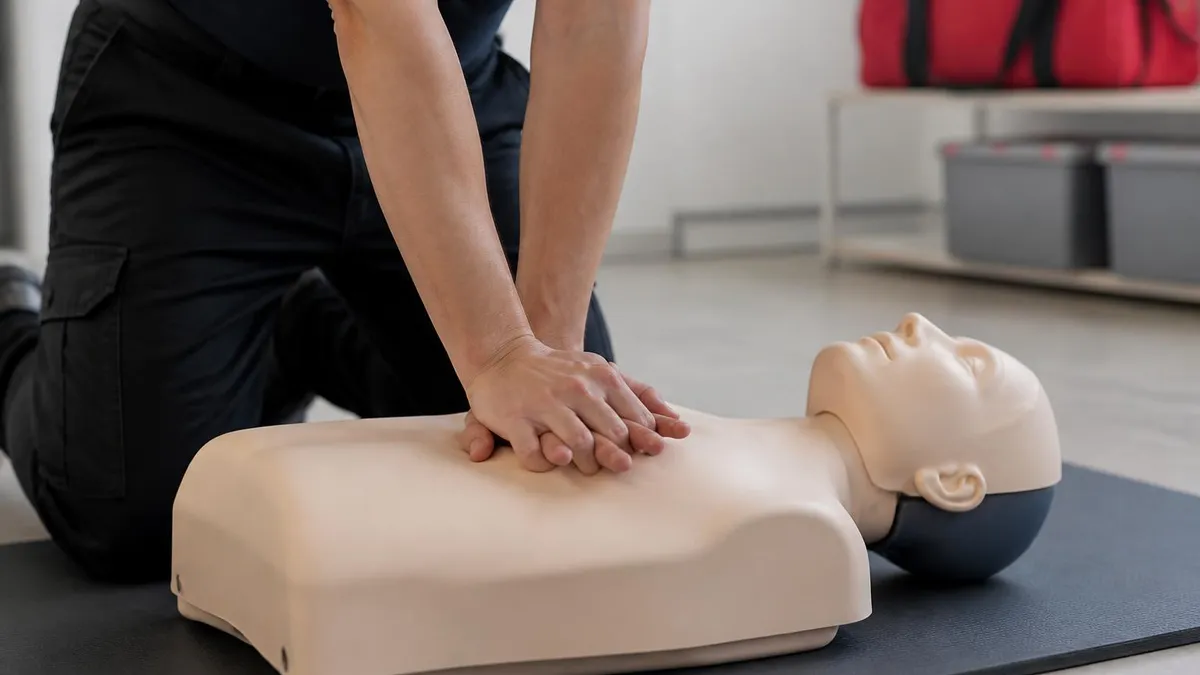
The CPR and AED half of the course is where the textbook starts to feel real. You will practice on an adult mannequin first. Hard surface, hands stacked center of the chest at the lower half of the sternum, arms straight, body weight driving 100 to 120 compressions per minute at a depth of at least 2 inches, allowing the chest to recoil fully between each push. The Bee Gees Stayin' Alive runs at 103 beats per minute, which is why every instructor in America hums it during practice.
Lay rescuer Heartsaver teaches the 30 compressions to 2 breaths ratio for single-rescuer adult CPR; for child and infant CPR the ratio stays 30 to 2 for one rescuer and changes to 15 to 2 for two trained rescuers. Compression-only (hands-only) CPR is taught as an acceptable alternative for untrained or unwilling rescuers performing adult CPR, but the full course teaches breaths because they matter more for pediatric arrests, drowning, and drug-overdose arrests where the cause is respiratory.
Infant CPR — for any patient under one year old — uses two fingers in the center of the chest just below the nipple line and a compression depth of about 1.5 inches. Two-thumb encircling technique is taught for two-rescuer infant CPR. The breath is a gentle puff covering both the nose and mouth, just enough to see the chest rise.
The transition between adult, child, and infant technique is the part students stumble over most, and the skills test will check that you choose correctly when the instructor announces the patient's age. Detailed infant technique is covered in our infant CPR guide.
AED practice is the calmest part of the day. Modern AEDs talk you through every step. You turn the unit on, expose the chest, apply the pads as shown on the packaging, let the AED analyze, and either deliver the shock (clearing everyone away first) or continue CPR as the device directs.
The course teaches pediatric pad placement and pediatric dose attenuators for AEDs that have them. You learn that if no pediatric pads are available for a child arrest you use the adult pads, just placed front-to-back on the torso so they do not touch. By the end of the AED station most students agree the device is simpler than their TV remote.
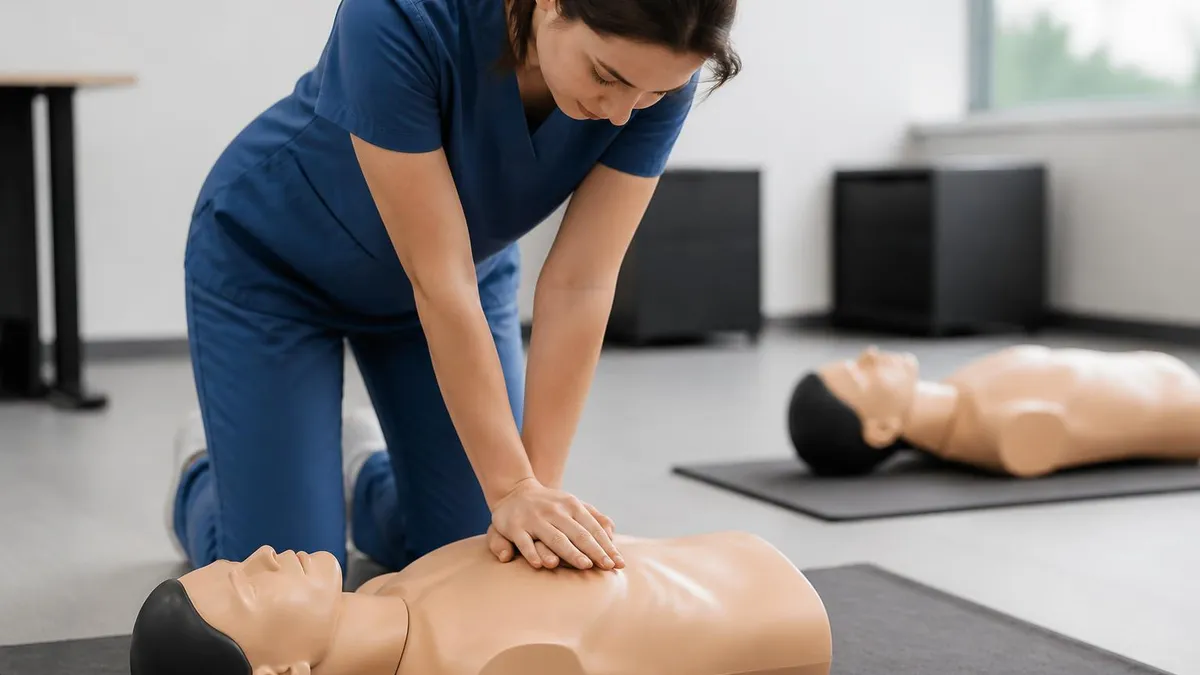
Online-only certifications that issue a card without any in-person skills check are not the same product as AHA Heartsaver or Red Cross First Aid CPR AED. They are routinely rejected by childcare licensing boards, hospitals, OSHA-required workplace responders, fitness employers, and pool operators. Always confirm in writing with your employer or licensing body that a specific online-only credential is accepted before paying. If your employer says AHA or Red Cross, take an AHA or Red Cross course.
CPR First Aid Course Cost Breakdown
75 to 125 dollars for a 4 to 6 hour in-person class. Includes all materials, mannequin time, AED trainer, instructor fee, and the wallet card. Group rates lower.
40 to 80 dollars. Online portion 25 to 45 dollars, skills check 15 to 35 dollars depending on the provider. Card issued only after skills pass.
55 to 95 dollars for a renewal course, typically 3 to 4 hours. Some providers run renewal-only blended for around 35 dollars plus skills.
50 to 75 dollars per person for groups of 8 or more. Employer typically pays the instructor a flat fee plus a per-card fee.
Hospital community education, fire department open houses, and some employer-sponsored programs offer the course at no cost. See our <a href="/cpr/free-cpr-classes">free CPR classes</a> directory.
Wilderness First Aid (WFA) is typically 200 to 300 dollars for a 16 to 20 hour course. Wilderness First Responder (WFR) is 700 to 1,200 dollars for a full 70 to 80 hour program.
Employer acceptance is the single most important question to ask before you pay for any course. State childcare licensing agencies almost universally require AHA Heartsaver Pediatric First Aid CPR AED or the Red Cross Adult and Pediatric First Aid CPR AED. Some states explicitly name the providers in their administrative code. The American Camp Association requires the same family of credentials.
The American Lifeguard Association, Ellis and Associates, and the YMCA accept their own internal lifeguard programs which bundle CPR for the Professional Rescuer with first aid; these are higher-level credentials than Heartsaver and not interchangeable. Personal trainer governing bodies (NASM, ACE, ACSM, AFAA, NSCA) accept AHA, Red Cross, and ASHI but check current published lists because acceptance does change. Public school teaching license requirements vary by state — some states accept any AHA or Red Cross course, others specify Heartsaver pediatric variants.
OSHA does not list approved certifications but does require, under 29 CFR 1910.151, that workplace first aid responders be "adequately trained." The interpretive guidance points to AHA, Red Cross, ASHI, NSC, and Medic First Aid as examples of programs that meet the standard. For most non-healthcare workplaces, any of those providers will satisfy the OSHA designated responder requirement. Healthcare facilities require BLS for Healthcare Providers, not Heartsaver. Dental offices typically require BLS for dentists and dental hygienists plus Heartsaver for front desk and assistants.
Fitness facilities require Heartsaver or equivalent for trainers and front desk staff and often want at least one shift lead with the AED-aware version on duty whenever the gym is open. Get a clear written acceptance statement from your employer before enrolling — the wasted weekend of taking the wrong course is a frustrating mistake we see in our forum every recertification cycle. For more on what counts, see our CPR certification overview.
Before You Enroll in a CPR First Aid Course
- ✓Confirm with your employer or licensing board exactly which provider and which variant (adult-only, pediatric, or combined) is accepted in writing
- ✓Decide between classroom, blended online plus skills, or group on-site based on your schedule and learning style — pure online-only certifications are rarely accepted
- ✓Check the expiration date on your previous card — most providers offer a discounted recertification course for cards expiring within 30 days
- ✓Bring a photo ID, your previous card if recertifying, and a face mask or shield if you prefer your own during practice
- ✓Wear comfortable clothes you can kneel and lean forward in — much of the class is on the floor practicing on mannequins
- ✓If you have a back, knee, or shoulder limitation that prevents chest compressions, tell the instructor before class starts so accommodations can be discussed
- ✓Plan to stay the full duration — partial attendance does not earn a card and most providers will not refund a no-show
Variants of the combined course matter when your job is age-specific. AHA Heartsaver Pediatric First Aid CPR AED focuses on infants and children for daycare, preschool, and elementary settings, with a brief adult module included. AHA Heartsaver First Aid CPR AED (the unmodified name) covers adult and pediatric equally. The Red Cross Adult and Pediatric First Aid CPR AED is the all-ages equivalent.
Adult-only Heartsaver CPR AED exists for workplaces with no realistic pediatric exposure but is uncommon because the price difference is small and employers prefer the broader credential. If you work in a setting that mixes ages — a community center pool, a family fitness club, a school front office — the combined adult-pediatric course is the safe choice.
Recertification arrives every two years. The AHA does not allow renewal grace periods beyond the printed expiration date; if your card lapses you may be charged the full new-student rate at some training centers. The Red Cross treats lapsed cards similarly. Renewal courses typically run 3 to 4 hours, skipping the introductory background but keeping the skills practice and the written test.
Many busy professionals run their renewal in a blended format, completing the online portion during a lunch hour and booking a 30-minute skills check on the way home. AHA renewal options are discussed in detail in our AHA CPR recertification guide and a wider CPR renewal overview covers Red Cross and other providers.
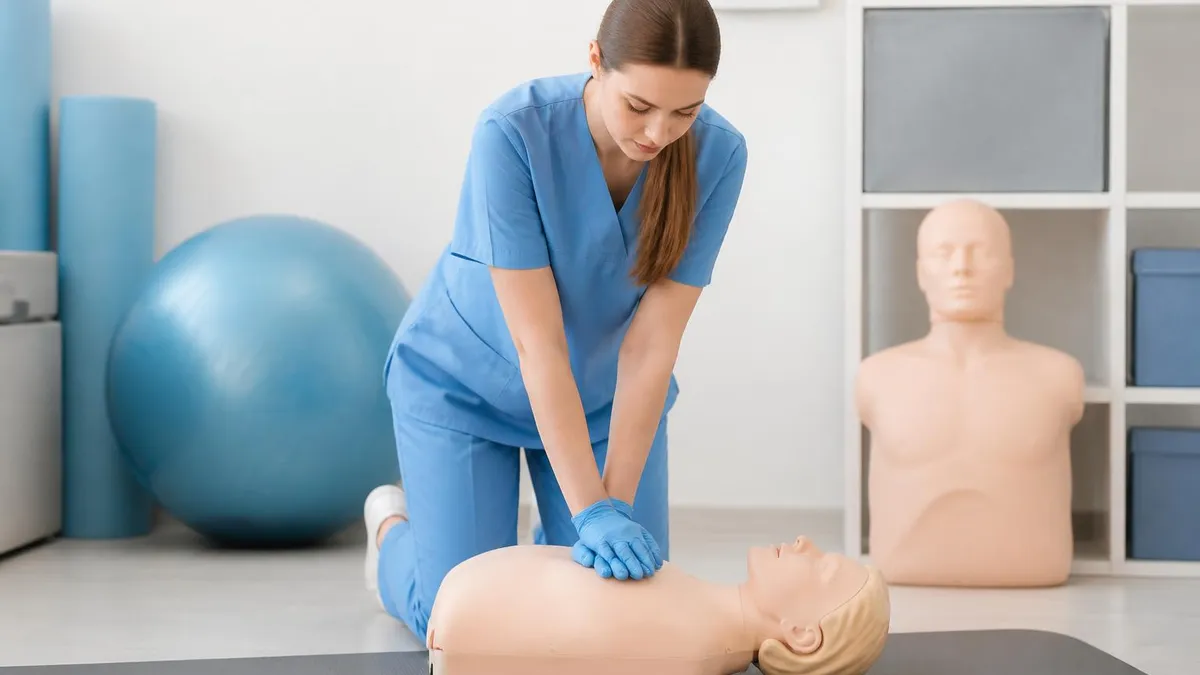
CPR First Aid Course By the Numbers
Key Facts at a Glance
| Item | Value | Details |
|---|---|---|
| Classroom Time | 4-6 hr | |
| Typical Cost | $75-$125 | |
| Card Validity | 2 yr | |
| Compressions Per Minute | 100-120 |
Finding a course near you is mostly a matter of opening one of three websites and entering your ZIP code. The American Heart Association ATLAS Class Connector lists every AHA training center within your radius. The Red Cross course catalog does the same for Red Cross programs. Independent training centers — there are thousands — appear on both.
Beyond those, local Red Cross chapters often run their own monthly schedules, hospital community education departments at large regional hospitals (Kaiser, HCA, Ascension, Sutter, Cleveland Clinic) run open-enrollment Heartsaver classes typically priced at the low end of the market, YMCAs run them as community service, and fire departments — especially in suburban and rural districts — host free or low-cost open community CPR days at least once or twice a year. See our CPR course near me page for a state-by-state directory.
Free options are real but limited. The Hands-Only CPR village events organized in partnership with the AHA at sports stadiums and shopping malls provide free 15-minute training to bystanders but do not issue cards. The Take 10 program in some cities offers similar bystander-only training. Some employers — large warehouse operators, manufacturing plants, school districts, transit agencies — pay for staff certification as a covered benefit and run on-site classes monthly.
Veterans Affairs sometimes runs free Heartsaver courses for caregivers of disabled veterans. AmeriCorps and Peace Corps cover the credential during pre-deployment training. Public health departments occasionally fund free community CPR pushes after high-profile pediatric drowning seasons or following media coverage of bystander saves. Check our free CPR certification tracker for current legitimate offers.
CPR Questions and Answers
Combined CPR First Aid Course vs CPR Only
- + —
- + —
- + —
- + —
- + —
- − —
- − —
- − —
- − —
Recertification rhythm and skill maintenance matter as much as the initial card. The skills decay fast — research shows compression depth and rate quality drop within 3 to 6 months of certification for most students who do not practice. Many AHA training centers now offer free or low-cost "skills check-in" sessions between certifications, letting you practice for 20 minutes on a mannequin to keep the muscle memory fresh.
Several manufacturers sell home practice mannequins (CPR Anytime kits from the AHA, the Brayden Pro feedback device, the Prestan family mannequins) that turn a 10-minute refresher into a coffee-break habit. If you live with someone at improved cardiac risk — parents over 65 with coronary disease, a partner with arrhythmia, a child with congenital heart issues — the small home investment is one of the highest-use purchases in your house.
Beyond the basic certification, several adjacent credentials extend your usefulness. Stop the Bleed is a free 90-minute course teaching bleeding control with tourniquets and wound packing; tens of thousands of schools, businesses, and community centers now host it. Naloxone (Narcan) training, often offered free through state public health departments, teaches opioid overdose reversal — a separate skill that pairs well with first aid and CPR.
Wilderness First Aid (WFA) and Wilderness First Responder (WFR) extend the standard curriculum for backcountry and remote-work environments. Mental Health First Aid teaches you to support someone in psychological crisis. For parents specifically, an infant-and-child focused course (often called Baby and Toddler Safety or similar) adds extended content on car seats, sleep safety, and childproofing alongside infant CPR. None of these replace the foundational Heartsaver or Red Cross combined course but each fills a real gap that a single certification cannot cover.
The final note is the one that drives every adult in the room to sign up eventually: confidence under pressure is a perishable resource that the course exists to build and rebuild. Watching a video on YouTube does not develop the reflex of dropping to your knees, calling for help, finding the right hand position, and pushing hard and fast while another bystander runs for the AED.
Reading a pamphlet does not teach you the feel of a foreign object popping free during abdominal thrusts, or the weight of an unconscious child as you turn them into the recovery position, or the calm authoritative voice you need to direct a panicked stranger to call 911. Those are physical, social, decision-making skills that come from the practice you get in a classroom. The 4 to 6 hours and the 100 dollars are the entire investment. The next 24 months of confidence — and possibly someone's life — are the return.
About the Author

Registered Nurse & Healthcare Educator
Johns Hopkins University School of NursingDr. Sarah Mitchell is a board-certified registered nurse with over 15 years of clinical and academic experience. She completed her PhD in Nursing Science at Johns Hopkins University and has taught NCLEX preparation and clinical skills courses for nursing students across the United States. Her research focuses on evidence-based exam preparation strategies for healthcare certification candidates.