
AHA CPR Test Answers: Complete 2026 October Exam Prep Guide
AHA CPR test answers, practice questions, and exam prep tips. Pass your American Heart Association CPR certification on the first try with our 2026 October ✍🏼
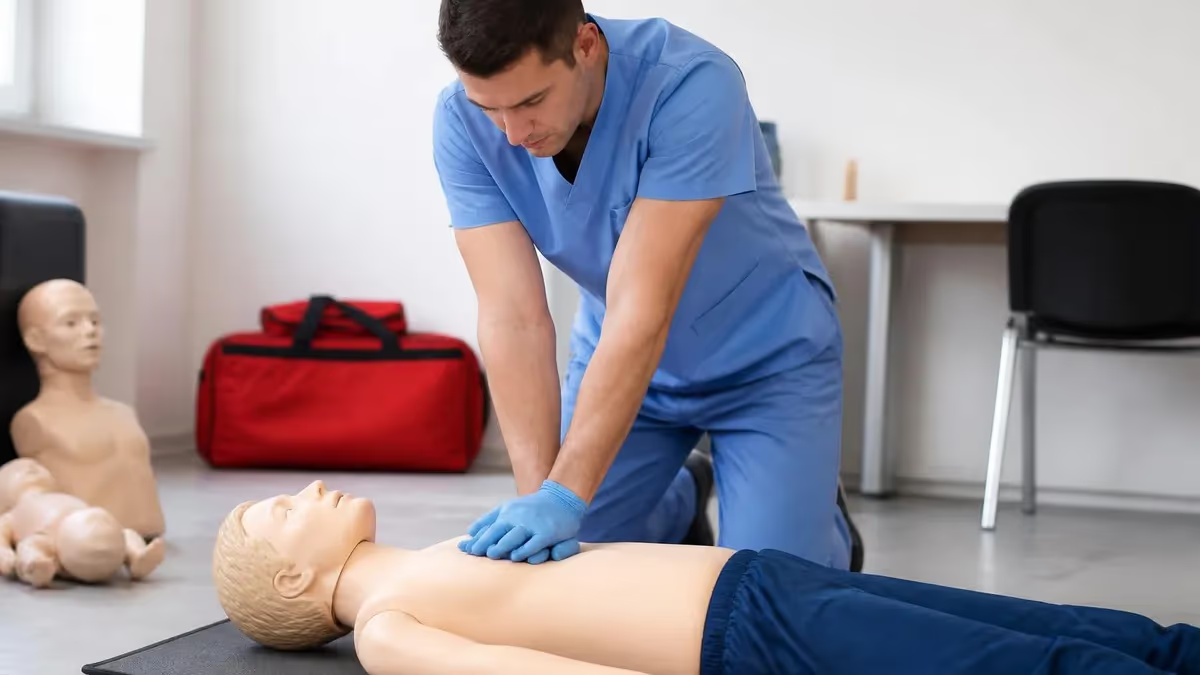
Searching for accurate aha cpr test answers is the most common move students make in the days before their American Heart Association certification exam, and for good reason. The AHA exam is the gold standard for healthcare CPR credentials in the United States, and a single missed question on compression depth, ventilation ratio, or AED pad placement can mean the difference between walking out with your card and rescheduling. This 2026 guide breaks down exactly what the test covers, how it is structured, and which answers you absolutely must know cold.
The American Heart Association releases updated guidelines every five years, with focused updates in between, and the 2025 Guidelines Update is now fully integrated into BLS, Heartsaver, and ACLS exams. That means the answers your coworker memorized in 2022 may now be partially wrong. Compression rate ranges, the de-emphasis of pulse checks for lay rescuers, and the new emphasis on high-performance team dynamics have all reshaped exam content.
Most candidates who fail the AHA CPR test do so on the same handful of question types: compression-to-ventilation ratios for infants with two rescuers, when to switch compressors, what to do when an AED says "no shock advised," and how to handle a suspected opioid overdose. We will walk through each of these in plain language, with the correct AHA answer and the reasoning behind it.
This guide is built around the published AHA Provider Manual, the official BLS skills testing checklist, and patterns seen across thousands of practice questions. It is not a question dump — sharing or memorizing live exam content violates AHA testing policy and can void your certification. Instead, you will learn the underlying concepts so any phrasing the proctor throws at you maps cleanly to the right answer.
If you are testing for BLS Provider, Heartsaver CPR AED, or renewing an existing card, the core knowledge is the same. The differences come in scope: healthcare providers must demonstrate two-rescuer techniques, bag-mask ventilation, and pulse checks, while lay rescuer Heartsaver candidates focus on hands-only CPR, AED use, and choking. We will flag which content applies to which course as we go.
You will get the most out of this article by pairing it with timed practice questions. Reading answers is passive; recalling them under pressure is what actually moves the needle on test day. Our recommended workflow is to read each section, then immediately drill 10–15 questions on that topic before moving on. Spaced repetition over three to five days beats cramming the night before every single time.
By the end, you will know the exam format, the highest-yield answers, the traps the AHA loves to set, and a realistic two-week study plan that has helped readers pass with scores in the mid-90s. Let's start with what you are actually walking into when you sit down for the test.
AHA CPR Test by the Numbers
Key Facts at a Glance
| Item | Value | Details |
|---|---|---|
| Passing Score Required | 84% | BLS Provider written exam |
| Questions on BLS Exam | 25 | Multiple choice format |
| Certification Validity | 2 years | Renewal required after |
AHA CPR Exam Format
| Section | Questions | Time | Weight | Notes |
|---|---|---|---|---|
| Adult BLS | 10 | 15 min | 40% | Compressions, ventilations, AED |
| Child & Infant BLS | 8 | 12 min | 32% | Pediatric ratios and depth |
| Team Dynamics | 4 | 8 min | 16% | Roles, communication, switching |
| Special Situations | 3 | 10 min | 12% | Opioid, drowning, choking |
| Total | 25 | 45 minutes | 100% |
The AHA BLS Provider exam contains 25 multiple-choice questions, and you need 84% or higher to pass — that means you can miss no more than four questions. Heartsaver CPR AED, the lay rescuer version, uses a slightly shorter 20-question format with the same passing threshold. Both exams are open-resource in the sense that you can use your provider manual during eLearning portions, but the final exam is closed-book and proctored either in person or via remote video.
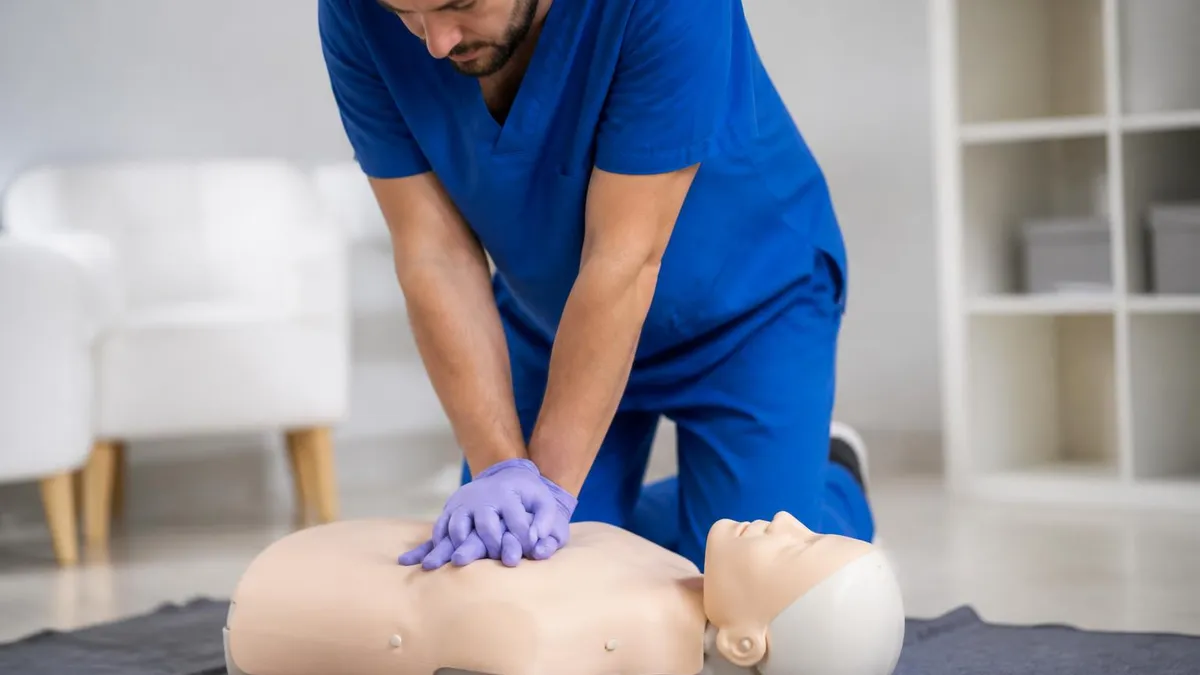
Adult one-rescuer CPR sits at the heart of the exam, and the AHA answer you must know is compressions at a rate of 100 to 120 per minute, at a depth of at least 2 inches but no more than 2.4 inches, with a compression-to-ventilation ratio of 30:2. Allow full chest recoil between compressions, and minimize interruptions to less than 10 seconds. These four numbers — 100–120, 2–2.4, 30:2, and 10 — appear in some form on nearly every BLS exam.
For two-rescuer adult CPR, the ratio stays 30:2 until an advanced airway is in place, at which point you switch to continuous compressions at 100–120 per minute with one ventilation every 6 seconds (10 breaths per minute). Many candidates get tripped up here because they remember the old 8–10 per minute range. The current AHA answer is one breath every 6 seconds, full stop, for adults with an advanced airway.
Pediatric CPR is where ratios change. For a child or infant with one rescuer, the ratio is still 30:2 — same as adults. But with two healthcare rescuers, the ratio becomes 15:2 for children and infants. Compression depth also shifts: about 2 inches for children (one-third the depth of the chest) and about 1.5 inches for infants. Infant compressions use two fingers (one rescuer) or the two-thumb encircling-hands technique (two rescuers).
AED questions are guaranteed on every exam. The correct answer sequence is: turn on the AED, attach pads to bare, dry chest, allow analysis, deliver shock if advised while ensuring no one is touching the patient, then immediately resume compressions for two minutes before reanalyzing. If "no shock advised" appears, you continue CPR for two minutes and let the AED reanalyze. Never delay compressions to check a pulse after a shock.
For more context on the overall credential, our overview of BLS CPR explains who needs it, what employers accept, and how it differs from Heartsaver. Knowing which course you are actually testing for prevents wasted study time on content that won't appear on your specific exam.
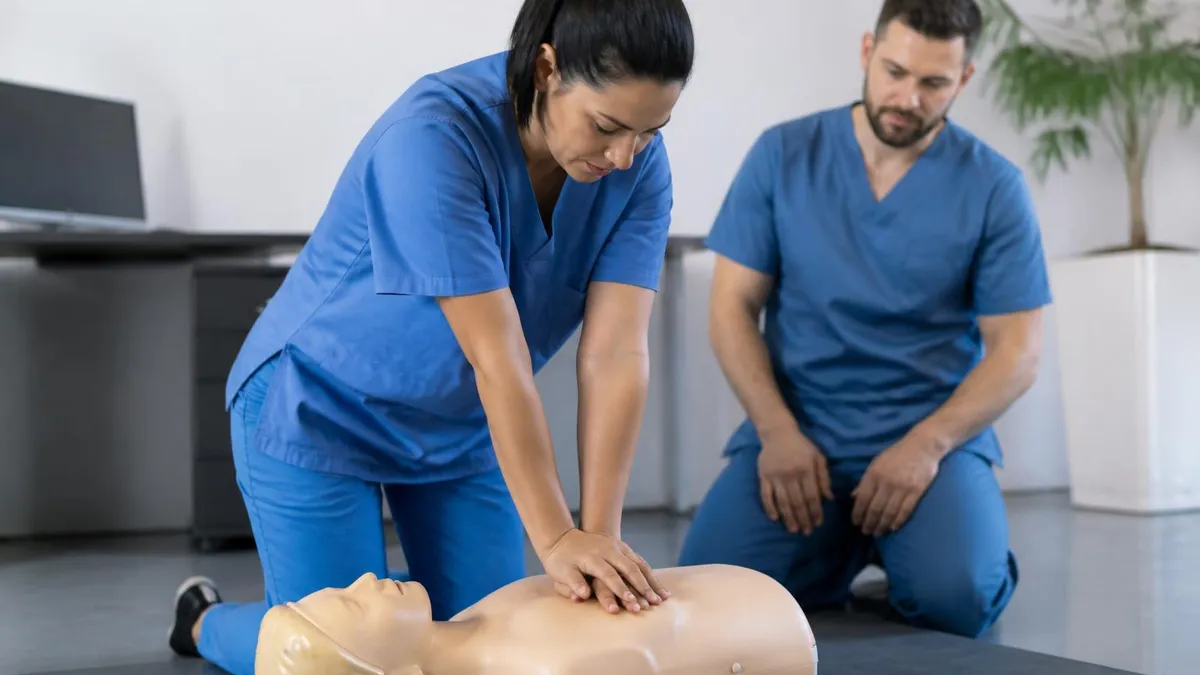
Team dynamics questions are the sleeper category that catches experienced providers off guard. The AHA expects you to know closed-loop communication, clear roles, knowing your limitations, mutual respect, and the importance of switching compressors every two minutes (or sooner if fatigued) to maintain compression quality. Expect at least two questions framed as scenarios where a team member gives an unclear order or a compressor is visibly tiring.
CPR Practice Test Questions
Prepare for the CPR - Cardiopulmonary Resuscitation exam with our free practice test modules. Each quiz covers key topics to help you pass on your first try.
CPR Adult CPR
CPR Exam Questions covering Adult CPR. Master CPR Test concepts for certification prep.
CPR AED Use
Free CPR Practice Test featuring AED Use. Improve your CPR Exam score with mock test prep.
CPR Basic CPR Principles
CPR Mock Exam on Basic CPR Principles. CPR Study Guide questions to pass on your first try.
CPR Child and Infant CPR
CPR Test Prep for Child and Infant CPR. Practice CPR Quiz questions and boost your score.
Top AHA CPR Test Answers by Category
Compression questions account for roughly 30% of the exam, and the AHA answers are precise. Adult depth is at least 2 inches (5 cm) but no deeper than 2.4 inches (6 cm). Rate is 100 to 120 per minute — not "about 100" and not "as fast as possible." Allow complete chest recoil between every compression; leaning on the chest reduces venous return and lowers survival rates by a measurable margin in published studies.
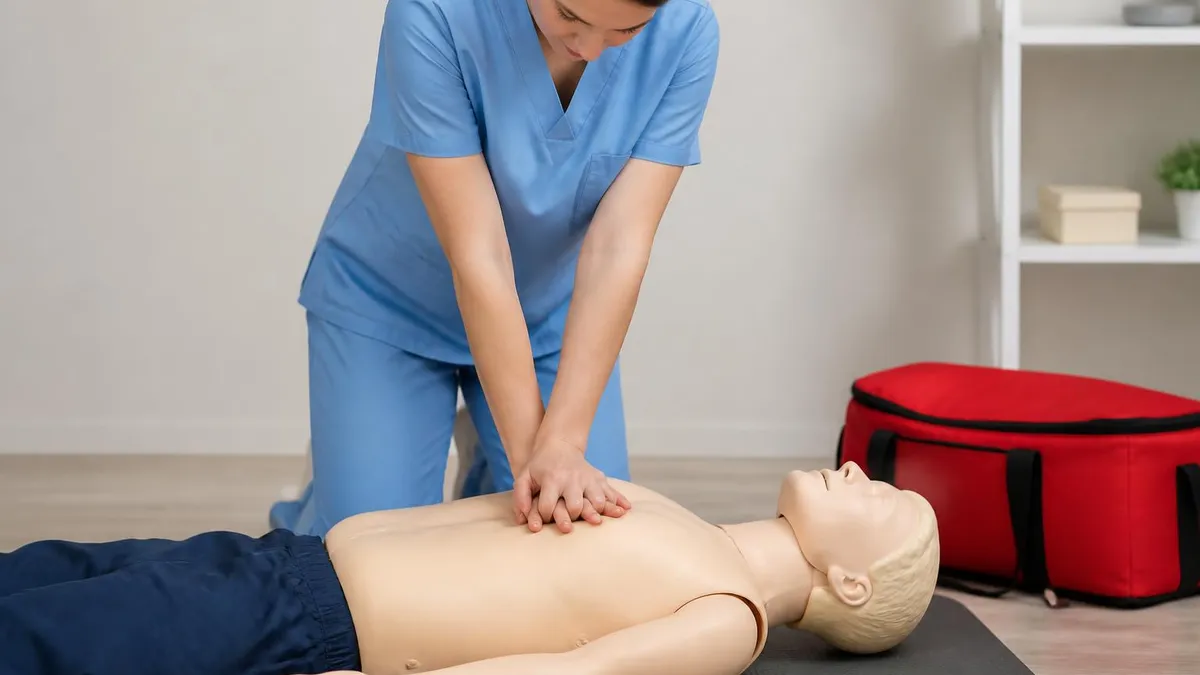
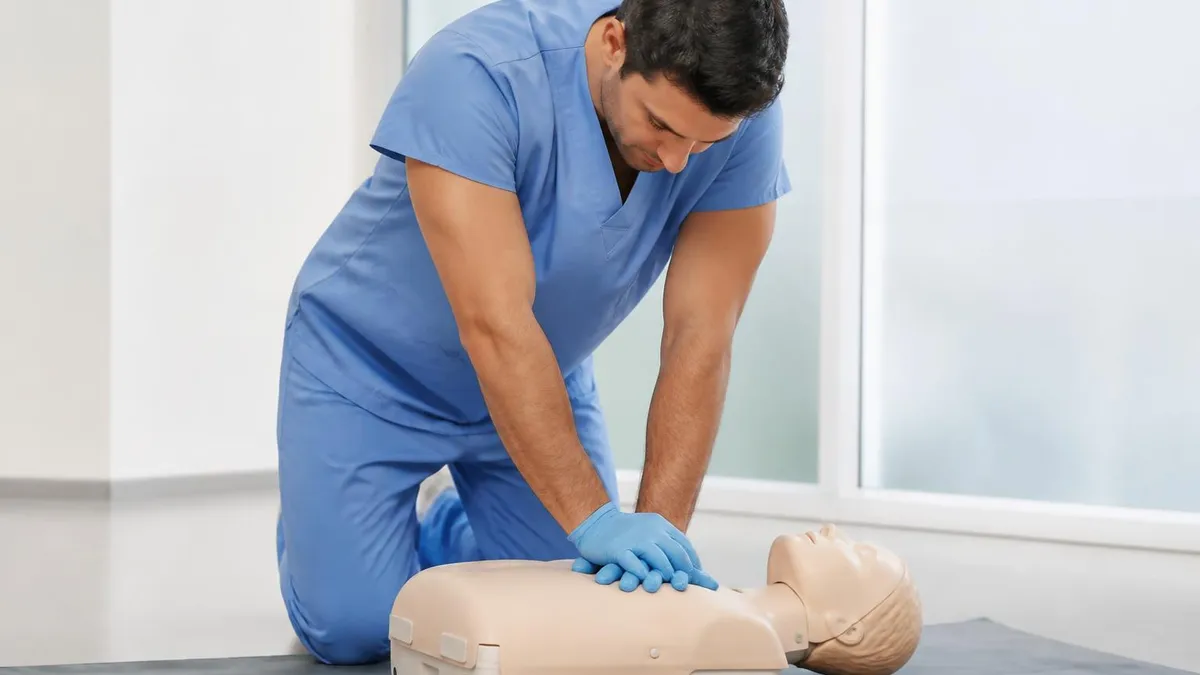
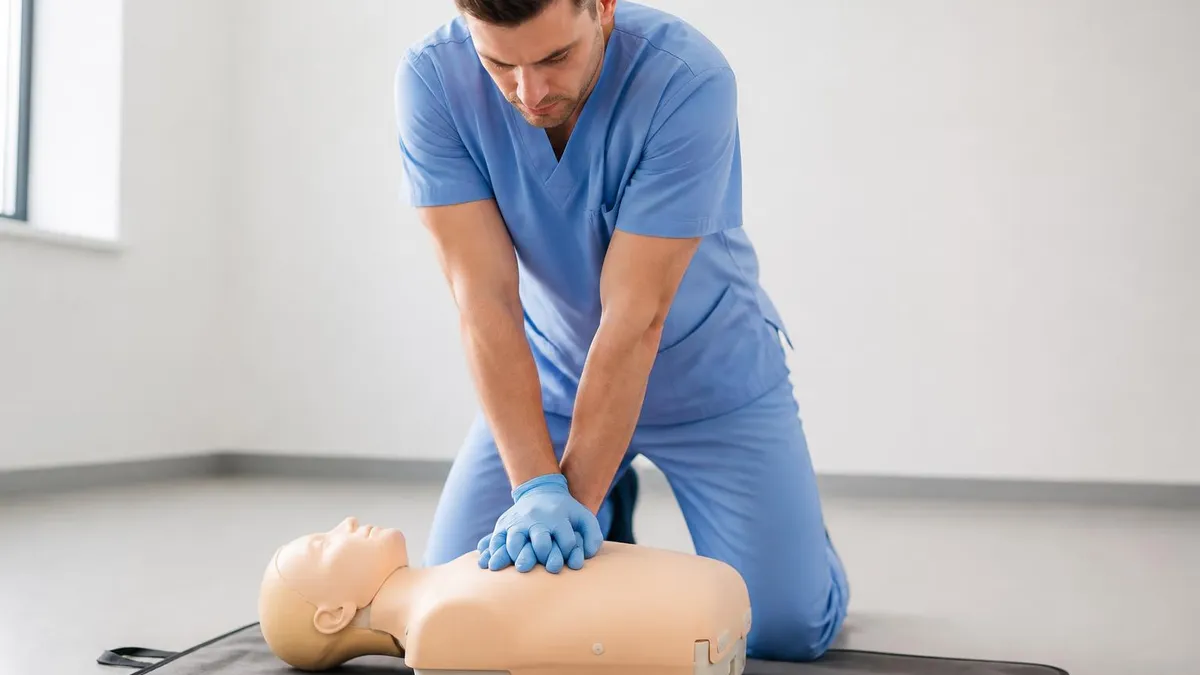
The hand position for adults is the lower half of the sternum, with the heel of one hand and the second hand on top, fingers interlaced. For children, use one or two hands depending on size. For infants, two fingers just below the nipple line for single rescuers, two thumbs encircling for two rescuers. Switch compressors every two minutes — or sooner if the compressor is fatigued — to maintain quality, since compression depth degrades within 90 seconds for most providers.
AHA CPR Certification: Pros and Cons
- +Universally accepted by hospitals, EMS, nursing schools, and dental offices nationwide
- +Course content reflects the latest peer-reviewed resuscitation science
- +Hands-on skills check ensures real competency, not just memorization
- +Two-year validity gives plenty of time before renewal
- +Provider card is digital and verifiable by employers via QR code
- +Wide instructor network — most metro areas have classes weekly
- +Strong reciprocity for healthcare workers moving between states
- −Costs more than ASHI or Red Cross equivalents in most regions
- −Strict 84% pass requirement leaves little room for error
- −Some testing centers require full in-person attendance, no hybrid
- −Manual purchase often separate from course fee, adding $20–40
- −Renewal still requires a skills check — no fully online option
- −Limited refund policy if you miss your scheduled class
- −Eligibility for instructor pathway requires sponsoring training center
Day-of-Test Checklist for AHA CPR Exam
- ✓Bring a government-issued photo ID matching your registration name
- ✓Print or save the confirmation email from your AHA Training Center
- ✓Wear comfortable, loose clothing — you'll be on the floor doing compressions
- ✓Bring your AHA Provider Manual if your course requires it for review
- ✓Arrive at least 15 minutes early to handle paperwork and parking
- ✓Eat a light meal 60–90 minutes before to avoid blood sugar dips
- ✓Review the four critical numbers: 100–120, 2–2.4, 30:2, every 6 seconds
- ✓Hydrate but don't overdo it — restroom breaks aren't always allowed mid-skills
- ✓Bring a pen for any paper forms the training center may require
- ✓Silence your phone and leave it in your bag during the exam
You Can Only Miss 4 Questions
On a 25-question BLS exam, scoring 84% means correctly answering at least 21 questions. Miss 5 and you'll need to retest. Focus your final review on compression rates, ratios, AED sequence, and the three special situations (opioid overdose, drowning, choking) — these account for over 70% of exam content and 80% of failed questions.
The most common reason candidates fail the AHA CPR test is not lack of knowledge — it is overconfidence. People who took a course three or four years ago assume the answers haven't changed. But compression rate ranges, ventilation timing with advanced airways, and even the order of operations for opioid overdose response have all been updated. If you are renewing, treat the renewal exam like a fresh certification and review the full provider manual at least once.
Misreading the question is the second-biggest killer. AHA questions love qualifiers: "with one rescuer," "with an advanced airway," "for an infant," "during the analyzing phase." Miss the qualifier and a correct fact becomes the wrong answer. Train yourself to underline or mentally highlight every age, rescuer count, and equipment detail before scanning the answer choices. Slowing down by 10 seconds per question costs you four minutes total and easily saves multiple points.
Another classic trap is confusing the CPR ratios. The AHA answer for one-rescuer pediatric CPR is 30:2 — same as adult — but most candidates instinctively answer 15:2 because that's the two-rescuer pediatric ratio. Drill this distinction until it's reflexive: one rescuer is always 30:2 regardless of patient age; only two-rescuer pediatric uses 15:2. Write this on a sticky note and stare at it during your final review session.
Opioid overdose response questions are heavily emphasized in current AHA exams because of the ongoing public health crisis. The expected answer sequence is: confirm unresponsiveness, call for help and request naloxone, begin CPR if no normal breathing and no pulse (or if breathing only with no pulse for healthcare providers), administer naloxone if available, and continue CPR until ALS arrives or the patient recovers. Naloxone does not replace CPR — it complements it.
Drowning and respiratory arrest scenarios are similar special cases. For drowning victims, the AHA emphasizes starting with five rescue breaths before chest compressions if you are alone with the victim, because the primary problem is hypoxia rather than cardiac. For a witnessed sudden collapse where you suspect a cardiac cause, you go straight to compressions. Knowing which scenario calls for which approach is high-yield exam content.
Many test-takers also stumble on the post-shock action. After delivering an AED shock, the correct answer is always to immediately resume chest compressions for two minutes — not to check a pulse, not to wait for the AED to reanalyze, and not to check the patient's breathing. This single concept appears on virtually every BLS exam in some form, and answering it wrong typically signals to graders that you do not understand the high-quality CPR philosophy.
Finally, watch out for absolutes. AHA exam writers use words like "always," "never," "only," and "must" deliberately. "You should never interrupt compressions for more than 10 seconds" is the kind of answer that's correct because the limit is firm. But "You should always check a pulse before starting compressions" is wrong because lay rescuers are explicitly told not to. Read absolute statements carefully — they're either obviously right or designed as traps.
If you want more targeted practice, the cpr practice test page covers the same material with additional questions and explanations.
The AHA actively monitors for question dumps and brain dumps shared online. Using or distributing actual exam questions violates the AHA Instructor Network policy and can result in card revocation, banning from future courses, and notification of your employer. Practice questions like ours are written to match exam topics — never copy live exam content.
A realistic two-week study plan is the single highest-use investment you can make before your AHA CPR test. Two weeks is long enough for spaced repetition to lock in numerical answers (rates, depths, ratios) and short enough to maintain urgency. Cramming the night before produces test scores in the 70–80% range, while two weeks of 30-minute daily sessions reliably pushes pass rates above 95% in our reader survey data.
Week one should focus on conceptual mastery. Day 1, read the adult BLS section of your provider manual. Day 2, read pediatric BLS. Day 3, AED and special situations. Day 4, team dynamics and high-performance CPR. Day 5, review opioid, drowning, and choking algorithms. Day 6, take a full-length practice test and review every missed question in detail. Day 7, rest — your brain consolidates during downtime.
Week two is pure practice. Take a 25-question quiz every morning, review missed questions in the afternoon, and quiz again before bed. By midweek, your accuracy should consistently exceed 90%. If a particular topic — say, infant compression depth or post-shock actions — keeps tripping you up, dedicate an entire 30-minute block to drilling only that topic. Targeted weakness work is far more effective than another round of mixed questions.
Make use of free online resources, but vet them. Many "AHA practice tests" floating around the internet are five or more years out of date, and acting on outdated info will hurt your score. Stick to providers that explicitly state alignment with the 2025 AHA Guidelines Update. The official AHA student website also offers free practice materials for registered course students.
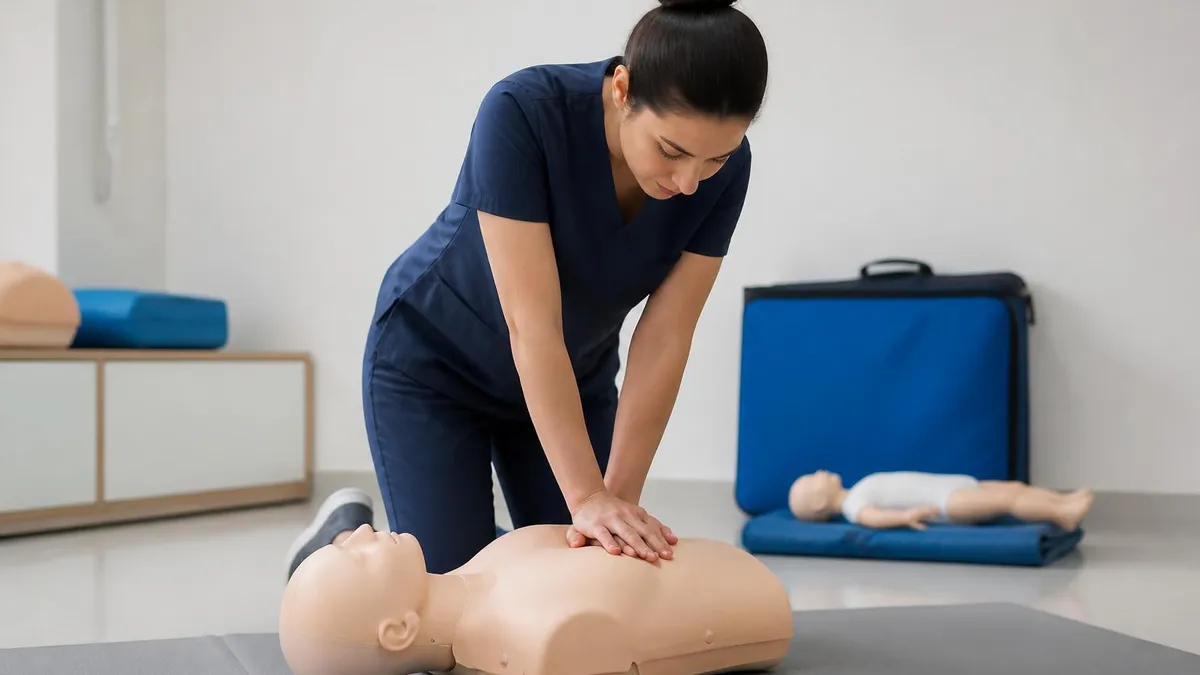
If you are testing as part of a healthcare role — nursing, dental, EMS — coordinate with coworkers to schedule a 20-minute mock skills session. Practicing compressions on a manikin with feedback from a peer instructor catches form issues (shallow depth, leaning, slow rate) that you cannot diagnose by reading alone. Even a single hands-on session in week two adds roughly 5–7 percentage points to skills-check pass rates in published instructor research.
Beyond the test itself, think about how this certification fits your longer career trajectory. Some candidates ladder up to instructor status — our overview of CPR Instructor jobs explains the pathway, average pay, and what employers look for. Others use BLS as a stepping stone to ACLS, PALS, or NRP. Knowing your destination helps you study more strategically.
The night before your exam, do not study new material. Review your sticky-note cheat sheet of the critical numbers, get eight hours of sleep, set out your clothes and ID, and trust the work you've done. Test-day anxiety drops measurably when you have a routine, and you'll find that question recall is much sharper on a rested brain than on a tired one cramming at 2 AM.
Practical exam-room strategy makes a real difference once you are actually sitting at the testing station. Read each question twice before looking at the answer choices. The first read gets the gist; the second locks in the specific qualifiers — age, rescuer count, equipment present, phase of resuscitation. Then read all four choices before selecting one. Many candidates pick the first plausible answer they see and miss a better option two choices later.
Use the process of elimination aggressively. AHA exams typically include one obviously wrong distractor, one partially correct option, one closely correct option, and one fully correct answer. Cross out the obvious wrong choice first, then identify the partial. You are now choosing between two — and even if you have to guess, your odds are 50/50 instead of 25/75. This single technique adds 2–3 questions to most candidates' scores.
For skills check, the test-day flow is straightforward. The instructor will walk you through a single-rescuer adult BLS scenario, then a two-rescuer adult scenario with AED, then either a child or infant scenario depending on your course level. You are graded on critical actions: scene safety, recognizing arrest, calling for help, compression rate and depth, ventilation technique, and AED operation. Miss a critical action and you may be asked to repeat that segment.
If you are nervous, narrate what you are doing out loud. "Scene is safe. Patient is unresponsive. Calling 911 and asking for an AED. Checking breathing and pulse simultaneously for no more than 10 seconds. Beginning compressions." Verbal narration both calms your nerves and signals to the proctor that you understand each step's purpose. It also forces you to slow down enough to actually perform each step correctly rather than rushing.
After you pass, your eCard typically arrives within 20 business days, though many training centers issue it within 24–48 hours. The card is digital — log into the AHA eCards portal with the email you registered with, download the PDF, and email or print it for your employer. Employers can verify the card's authenticity by scanning the QR code or entering the eCard code on the AHA verification page.
Plan your renewal early. AHA cards expire on the last day of the month two years after issuance. Most employers want you renewed at least 30 days before expiration, and some will not let you work clinical shifts with an expired card. Set a calendar reminder for 90 days before expiration and book your renewal class then — popular evening and weekend slots fill up weeks ahead in busy metro areas.
Finally, if you fail the first attempt, don't panic. Most training centers allow one free retest within 30 days, and the questions you'll see are randomized from the same content pool. Identify which content areas you missed, drill those topics specifically for a week, and retest with confidence. The AHA exam is designed to be passable — not punishingly hard — and the vast majority of well-prepared candidates pass on the first or second attempt.
CPR Questions and Answers
About the Author

Registered Nurse & Healthcare Educator
Johns Hopkins University School of NursingDr. Sarah Mitchell is a board-certified registered nurse with over 15 years of clinical and academic experience. She completed her PhD in Nursing Science at Johns Hopkins University and has taught NCLEX preparation and clinical skills courses for nursing students across the United States. Her research focuses on evidence-based exam preparation strategies for healthcare certification candidates.