
BLS CPR: What It Is, Who Needs It, and How to Get Certified 2026 October
BLS CPR is the healthcare-level certification for CPR and emergency response. Learn what BLS covers, who needs it, exam details, and how to get certified. ✅
What Is BLS CPR?
If you're entering healthcare or already work in a clinical setting, BLS CPR is the certification you'll hear about constantly. It's one of the very first requirements listed on hospital job applications, nursing school prerequisites, and clinical rotation checklists.
And unlike many professional certifications that take months or years to earn, BLS can be completed in a single day — but the skills it teaches can determine whether a patient survives a cardiac arrest. Understanding exactly what BLS covers, how it differs from the basic CPR course you might have taken in high school, and how to get certified efficiently saves you time and ensures you get the right credential on your first try.
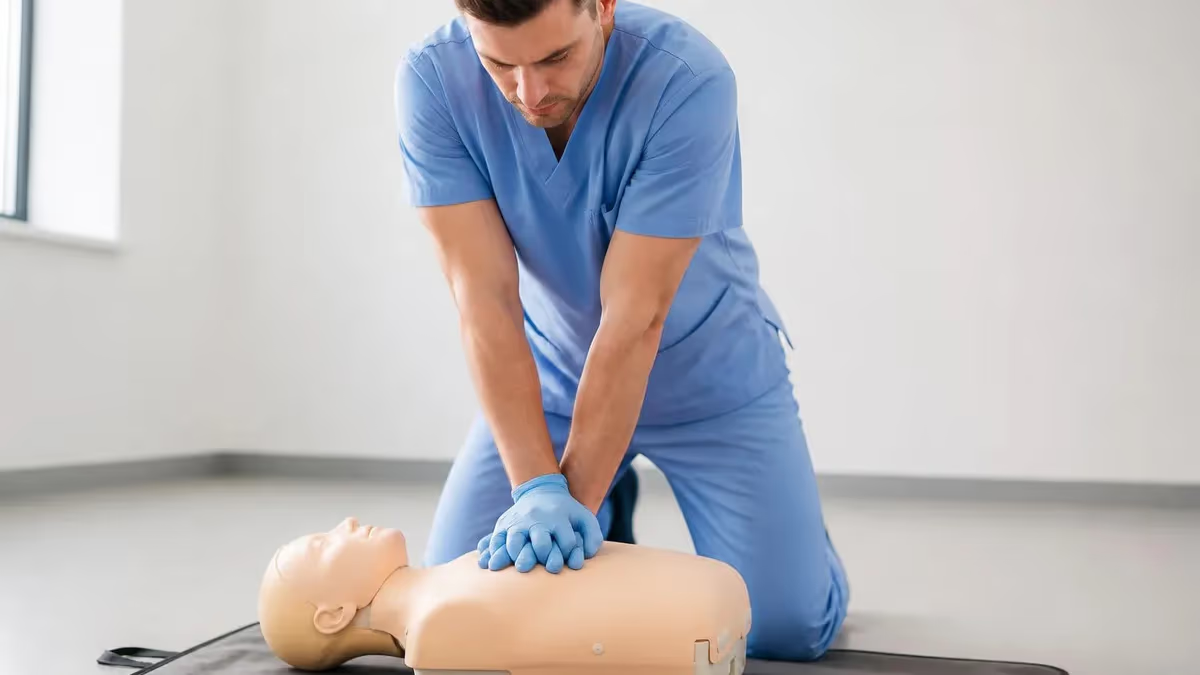
BLS CPR stands for Basic Life Support Cardiopulmonary Resuscitation — the professional-level CPR certification designed for healthcare providers and anyone who may need to respond to cardiac emergencies in a clinical or professional setting. BLS goes beyond the standard Heartsaver CPR course that laypersons take: it covers adult, child, and infant CPR, two-rescuer techniques, bag-mask ventilation, team dynamics in a resuscitation scenario, and the use of automated external defibrillators (AEDs) in both clinical and out-of-hospital settings.
If you work in healthcare — or plan to — BLS certification is almost certainly a job requirement. Hospitals, medical schools, nursing programmes, dental offices, EMS agencies, and long-term care facilities universally require BLS for their clinical staff. But BLS isn't exclusively for healthcare workers. Lifeguards, athletic trainers, personal trainers in some certifying bodies, law enforcement officers, and firefighters also commonly need BLS-level training because their roles involve a higher likelihood of encountering cardiac emergencies than the general public.
The BLS curriculum follows the American Heart Association's guidelines for CPR and emergency cardiovascular care — the same evidence-based protocols that hospitals use. When you hold a BLS certification, you're trained to the same standard as the nurses and paramedics who respond to cardiac arrests in a hospital setting. That's why healthcare employers specifically require BLS rather than accepting a basic Heartsaver CPR card: the training depth, the multi-rescuer techniques, and the clinical context are fundamentally different.
This guide explains what BLS CPR covers in detail, who needs it, how to get certified, what the course and exam involve, and how it differs from other CPR certifications. Whether you're a nursing student who needs BLS before clinical rotations, an experienced nurse renewing your certification, or someone in a non-healthcare role that requires BLS, you'll find the practical information you need here.
- Full name: Basic Life Support for Healthcare Providers (BLS)
- Primary provider: American Heart Association (AHA) — the most widely recognised BLS certification
- Also offered by: American Red Cross, ASHI, and other accredited providers
- Course duration: 4–5 hours (in-person); 2–3 hours classroom + 1–2 hours in-person for blended courses
- Cost: $50–$85 depending on location and provider
- Valid for: 2 years — requires renewal before expiration
- What it covers: Adult, child, and infant CPR; 2-rescuer CPR; bag-mask ventilation; AED use; choking relief; team dynamics
- Who needs it: Nurses, doctors, paramedics, EMTs, dental staff, medical students, nursing students, physical therapists, and other healthcare professionals
- Exam: Skills assessment on a manikin + written knowledge test (25 multiple-choice questions for AHA BLS)
What the BLS Course Covers
High-Quality Chest Compressions
Rescue Breathing and Airway Management
Two-Rescuer CPR and Team Dynamics
AED Use and Integration With CPR
Choking Relief for Adults, Children, and Infants
BLS vs Heartsaver CPR: What's the Difference?
BLS and Heartsaver are both CPR certifications, but they serve different audiences and cover different depth of material. Understanding the difference prevents you from taking the wrong course for your needs — and potentially having to retake the correct one at additional cost.
Heartsaver CPR/AED is designed for non-healthcare workers: teachers, coaches, office workers, personal trainers, babysitters, and anyone who wants or needs basic CPR skills. It covers adult CPR and AED use, with optional child and infant modules. The course takes 3–4 hours, and the skills assessment is straightforward. Heartsaver is sufficient for most non-healthcare workplace requirements and for anyone who wants to be prepared for a cardiac emergency in their personal life.
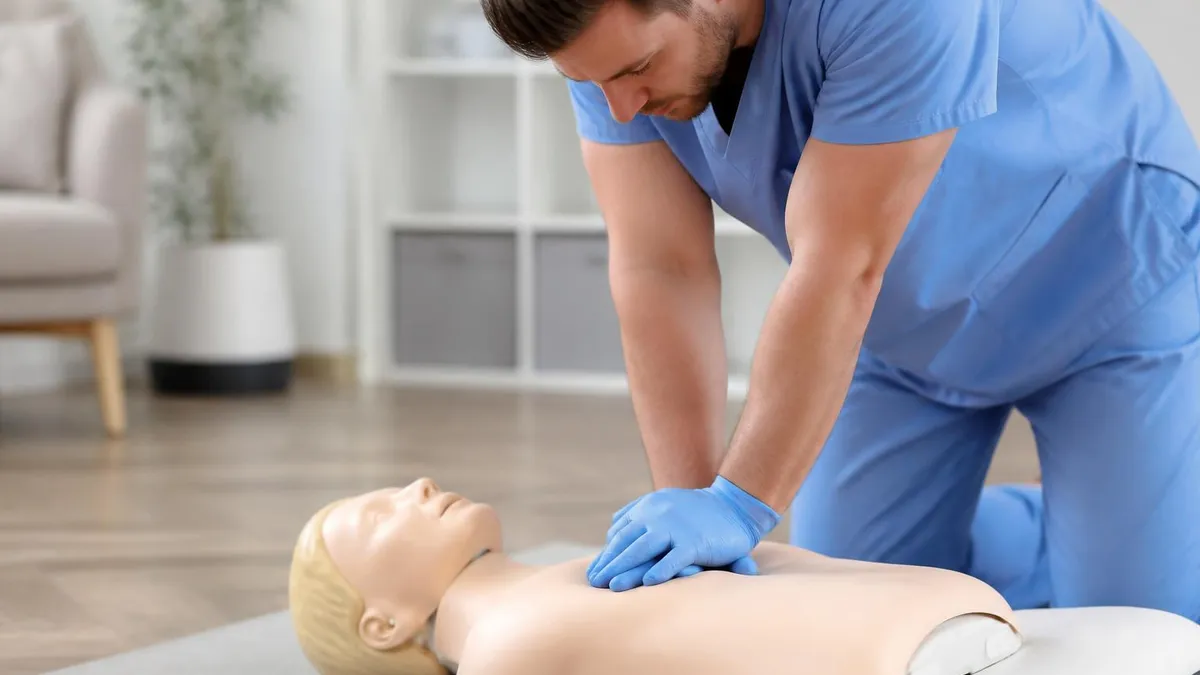
BLS for Healthcare Providers is designed for clinical professionals who may be involved in resuscitation as part of their job. It covers adult, child, and infant CPR comprehensively, adds two-rescuer CPR and bag-mask ventilation, includes team dynamics training, and has a more rigorous skills assessment. The course takes 4–5 hours, and the written test (25 questions for AHA BLS) requires studying the course material. BLS is required by hospitals, medical schools, dental offices, EMS agencies, and most healthcare employers.
The key practical differences: BLS includes bag-mask ventilation skills (Heartsaver doesn't). BLS includes two-rescuer CPR (Heartsaver focuses on single-rescuer). BLS has a written knowledge test (Heartsaver typically doesn't). BLS costs more ($50–$85 vs $40–$75 for Heartsaver). And most importantly, healthcare employers accept only BLS — a Heartsaver card won't satisfy a hospital's BLS requirement, even though both teach CPR.
If you're unsure which you need, check with your employer or school. Healthcare programmes and employers will specify 'BLS for Healthcare Providers' or 'AHA BLS.' If neither is specified, Heartsaver CPR/AED is likely sufficient. When in doubt, take BLS — it's accepted everywhere Heartsaver is accepted, plus healthcare settings. The reverse isn't true.
One common source of confusion: some online CPR courses market themselves as 'BLS equivalent' or 'healthcare provider CPR' without being an actual AHA or Red Cross BLS course. These courses may teach similar content but aren't recognised by most healthcare employers. The specific credential that hospitals and medical schools look for is the AHA BLS Provider card. If a course doesn't issue an AHA-branded eCard with a QR code that verifies on the AHA's verification site, it likely won't satisfy your employer's BLS requirement — regardless of what the course provider claims about equivalency.
Who Needs BLS Certification?
Nurses (RN, LPN, NP), physicians (MD, DO), physician assistants (PA), dentists and dental hygienists, pharmacists, respiratory therapists, physical and occupational therapists, medical assistants, surgical technologists, and radiology technologists all require BLS. Most healthcare employers mandate current BLS as a condition of employment — letting your certification lapse can mean being pulled from clinical duties until you renew.
Nursing, medical, dental, PA, PT, OT, and pharmacy students must obtain BLS certification before beginning clinical rotations. Most programmes specify AHA BLS specifically. Getting certified early in your programme (before clinical rotations start) avoids last-minute scheduling stress. Many schools arrange group BLS courses for incoming students, though you can also obtain certification independently from any AHA-authorized training centre.
EMTs, paramedics, firefighters, and law enforcement officers need BLS-level training. For EMS professionals, BLS is part of their broader certification (EMT-Basic includes BLS as a foundational component), but separate BLS certification may still be required for hospital-based or cross-credentialing purposes. Firefighters and police officers who may respond to medical emergencies before EMS arrives need the multi-rescuer and AED skills that BLS provides.
Personal trainers (certified by ACE, NASM, ACSM, or NSCA), lifeguards, athletic trainers, and workplace safety officers often need BLS or its equivalent. Some certifying bodies for personal trainers accept Heartsaver CPR, while others specifically require BLS. Lifeguard certification programmes typically include their own CPR/AED component, but many employers additionally require standalone BLS certification. Check your specific certifying body's requirements.
BLS Certification Providers
The AHA BLS course is the most widely required and recognised BLS certification in the United States:
- Course name: BLS Provider (formerly BLS for Healthcare Providers)
- Format: Instructor-led classroom (4–5 hours) or HeartCode BLS blended (online learning + in-person skills session, 1–2 hours in-person)
- Exam: Skills assessment on manikins (adult, child, infant CPR + AED + bag-mask) plus a 25-question written test (passing score: 84%)
- Cost: $50–$85 depending on location and training centre
- Card valid for: 2 years from course completion date
- Find a course: Search the heart association cpr classes locator on the AHA website by ZIP code
What the BLS Exam Involves
The BLS certification exam has two components: a hands-on skills assessment and a written knowledge test. Both must be passed to receive certification. The skills component is typically assessed during the course itself, while the written test is administered at the end.
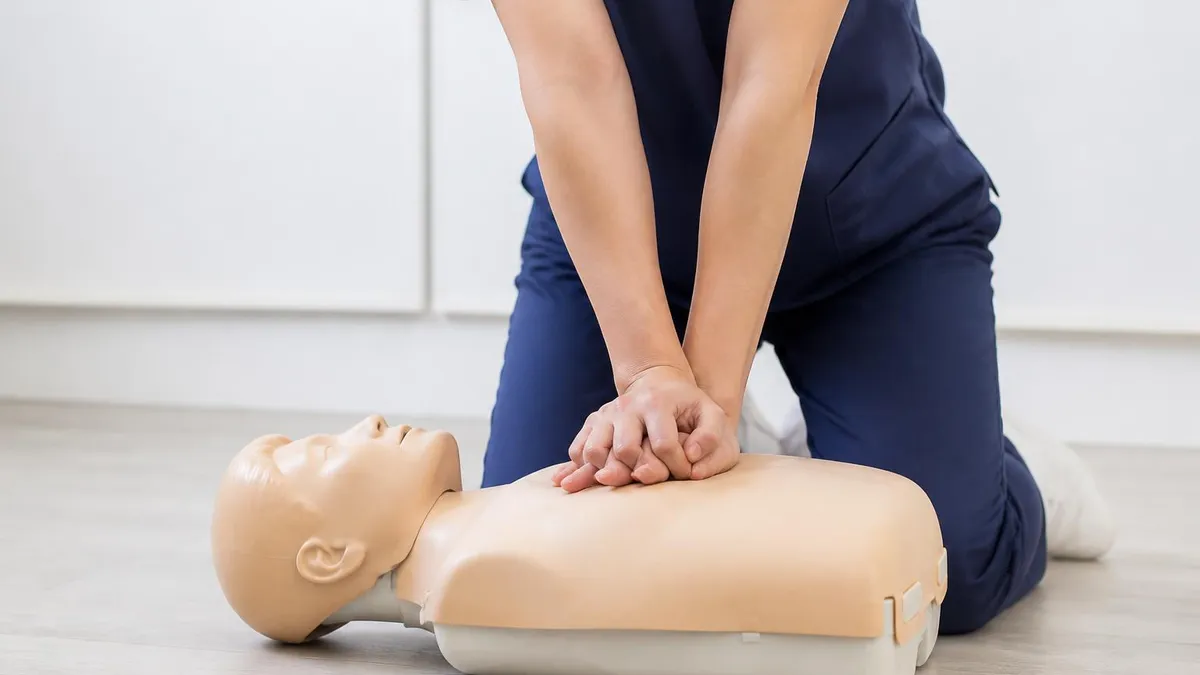
The skills assessment evaluates your ability to perform high-quality CPR on manikins — adult, child, and infant. The instructor watches you deliver compressions at the correct rate and depth, provide ventilations using a bag-mask device, operate an AED, and execute two-rescuer CPR with a partner (including switching roles and maintaining closed-loop communication). Most BLS courses use manikins with electronic feedback that displays your compression rate and depth in real time, so both you and the instructor can see whether your technique meets the standard.
The skills check isn't competitive — the instructor coaches you during practice and provides feedback before the assessment.
The AHA BLS written test consists of 25 multiple-choice questions with a passing score of 84% (21 out of 25 correct). Questions cover CPR algorithms (the sequence of actions for different cardiac arrest scenarios), AED operation, airway management techniques, the chain of survival, and team roles during resuscitation.
The test is open-book in the traditional classroom course (you can reference the AHA BLS Provider Manual during the test) but is more restrictive in some blended course formats. Studying the provider manual before the course and reviewing it during class ensures a comfortable passing score — the questions test practical knowledge, not obscure details.
If you don't pass either component on the first attempt, most AHA Training Centres allow one immediate remediation attempt for the failed section. If you fail the remediation, you'll need to retake the course. In practice, the failure rate is very low — the vast majority of students who attend the course and engage with the material pass on their first attempt.
Preparing for Your BLS Course
- ✓Confirm that your employer or programme requires AHA BLS specifically — some accept Red Cross BLS or other providers, while others require AHA by name
- ✓If taking the blended HeartCode BLS, complete the entire online portion BEFORE your in-person skills session — you can't participate without completing the online component first
- ✓Wear comfortable clothing that allows you to kneel on the floor — BLS practice involves kneeling beside manikins for extended periods during hands-on exercises
- ✓Review the BLS Provider Manual before the course — familiarity with the algorithms and key numbers (compression rate, depth, ratios) makes the course more productive and the exam easier
- ✓Bring a valid photo ID — many training centres verify identity before issuing certification
- ✓If you have physical limitations (knee or back problems), inform the instructor at the start — accommodations are available, and some centres have elevated manikin stations
- ✓After certification, set a calendar reminder 2 months before your expiration date to schedule your renewal course — BLS renewal courses are shorter and cheaper than initial certification
In-Person BLS vs Blended (HeartCode) BLS
- +In-person BLS provides 4–5 hours of continuous instructor-led training with immediate hands-on practice — the traditional format that many students find most effective for learning physical skills
- +Blended BLS (HeartCode) reduces the in-person time to 1–2 hours by moving the knowledge content online — ideal for busy healthcare professionals who can complete the online portion at their own pace
- +In-person courses provide more practice repetitions with manikins and more time for instructor feedback — beneficial for first-time BLS students who are learning the skills from scratch
- +Blended courses offer scheduling flexibility — complete the online portion whenever you have time, then attend a shorter in-person session for the skills check
- −In-person courses require a full half-day commitment — harder to schedule for working professionals who can't easily take 5 hours away from clinical duties
- −Blended courses provide less hands-on practice time — the 1–2 hour skills session focuses on assessment rather than extended practice, which may not be enough for students who struggle with compression technique
- −In-person courses are typically more expensive than blended options because of the longer instructor time
- −Blended course online components can be tedious — watching hours of video content alone requires self-discipline, and some students find they retain less without an instructor guiding the learning
BLS Renewal: Keeping Your Certification Current
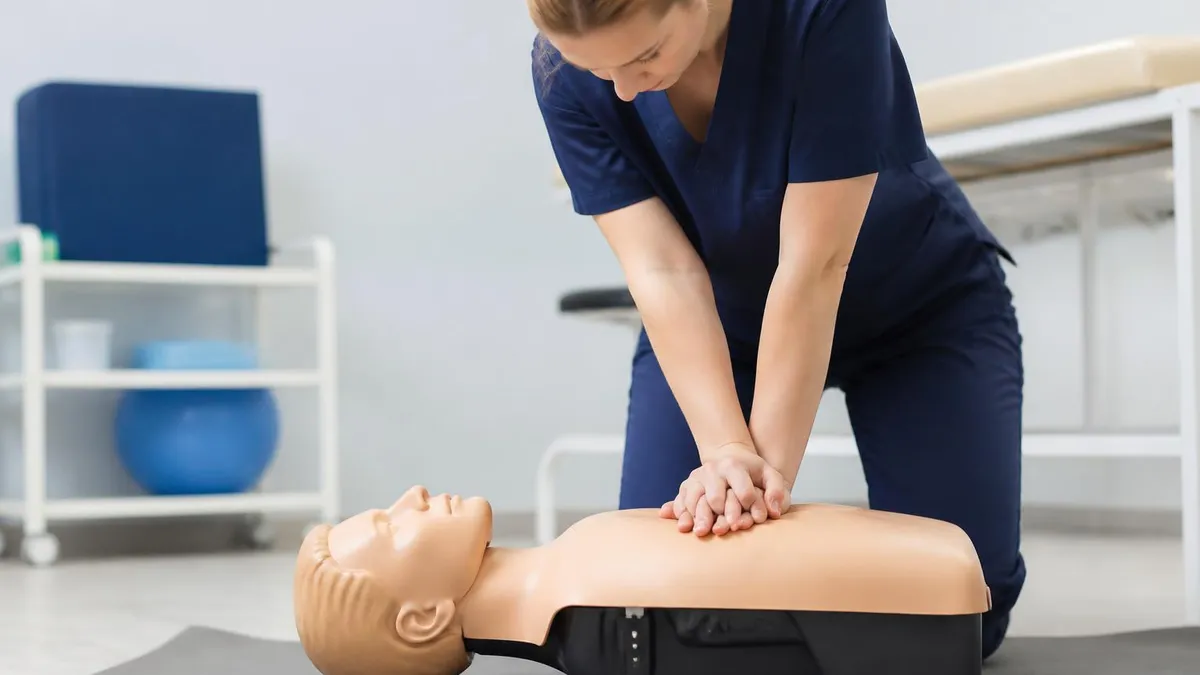
BLS certifications expire after 2 years, and healthcare employers enforce this strictly — an expired BLS card means you can't work in a clinical role until you recertify. Renewal courses are shorter than initial certification courses because they assume you already have the foundational knowledge and skills.
AHA BLS renewal courses (called BLS Renewal or HeartCode BLS Renewal) typically take 2–3 hours for the in-person format or 1–2 hours in-person after completing the online HeartCode renewal. The renewal includes a skills reassessment (demonstrating that you can still perform high-quality CPR and use a bag-mask device) and a written knowledge check. Renewal courses also update you on any guideline changes since your last certification — the AHA updates its CPR guidelines every 5 years (most recently in 2020), and renewal courses incorporate those changes.
Renewal costs are typically $30–$60 — less than the initial certification course. Many healthcare employers cover the cost of BLS renewal as a professional development expense, so check with your employer's HR or education department before paying out of pocket. Some employers offer on-site BLS renewal classes, which is the most convenient option if available.
Don't wait until the last minute to renew. Popular training centres have limited seats, and the class you need may not be available in the week before your certification expires. Schedule your renewal 1–2 months before the expiration date. If your certification lapses, most AHA Training Centres allow you to take the renewal course within 30 days of expiration. Beyond 30 days, you may need to take the full initial BLS course again rather than the shorter renewal — check with the training centre for their specific policy.
Group renewal classes are a practical option for healthcare teams. Many hospitals, clinics, and dental offices organise BLS renewal days where an AHA instructor comes on-site and certifies multiple staff members in one session. This reduces the disruption of sending individuals to off-site classes and often costs less per person through group pricing. If your workplace doesn't currently organise group renewals, suggest it to your manager or education department — the efficiency benefits are significant for any facility with more than a handful of BLS-certified staff.
BLS CPR: Key Numbers
BLS in Clinical Practice: How It's Used
In a hospital setting, BLS skills are the foundation that every member of the code team relies on. When a patient goes into cardiac arrest, the first responders (often the bedside nurse and any available staff) begin BLS immediately — starting compressions, calling a code, and attaching the AED or defibrillator. BLS skills sustain the patient until the full code team arrives and advanced cardiac life support (ACLS) interventions begin.
The transition from BLS to ACLS happens seamlessly in a well-functioning code team. BLS continues throughout — high-quality compressions don't stop just because advanced providers have arrived. The BLS-trained team members maintain the compression and ventilation cycle while ACLS providers establish IV access, administer medications, interpret cardiac rhythms, and make decisions about defibrillation and other interventions. Everyone on the team needs BLS proficiency because everyone may be called upon to deliver compressions or manage the airway at any point during the code.
Outside the hospital, BLS-trained healthcare workers use the same skills in outpatient clinics, dental offices, long-term care facilities, and community settings where patients may experience cardiac events. A dental hygienist whose patient has a cardiac arrest in the dental chair, a physical therapist whose patient collapses during a rehabilitation session, or a pharmacist whose customer becomes unresponsive in the store — all use BLS skills in these situations. The 2-year renewal cycle ensures that these skills stay current even for healthcare workers who rarely encounter real cardiac arrests in their daily practice.
Studies on CPR skill retention show that compression quality degrades significantly within 3–6 months after training if not practised. This is why the 2-year renewal cycle exists — and why some organisations require more frequent skills refreshers for high-risk areas like emergency departments and ICUs. Between formal renewals, brief practice sessions on a CPR manikin (even 10–15 minutes) help maintain the muscle memory for effective compressions. Some hospitals make manikins available for staff to practise on during downtime for exactly this reason.
Before enrolling in any BLS course, confirm which provider your employer or school requires. The majority of U.S. hospitals, medical schools, and nursing programmes specifically require American Heart Association (AHA) BLS certification. While Red Cross BLS and other provider certifications teach equivalent content, not all employers accept them interchangeably. Taking a non-AHA BLS course when your employer requires AHA means paying for a second course. Always verify the requirement before registering — the words 'AHA BLS' or 'American Heart Association BLS Provider' in your employer's policy are the confirmation you need.
BLS and Advanced Certifications: The Career Progression
BLS is the foundational certification in the American Heart Association's emergency cardiovascular care hierarchy. It's the prerequisite for more advanced certifications that healthcare providers may need as their careers progress.
ACLS (Advanced Cardiovascular Life Support) builds on BLS for providers who manage cardiac arrest and other cardiovascular emergencies — physicians, nurses in emergency departments and ICUs, paramedics, and anaesthesia providers. ACLS covers cardiac rhythm interpretation, pharmacology (emergency medications), advanced airway management, and team leadership during codes. BLS certification is a prerequisite for ACLS.
PALS (Paediatric Advanced Life Support) is the paediatric equivalent of ACLS — covering recognition and management of respiratory and cardiac emergencies in children and infants. Paediatric nurses, paediatric emergency physicians, paediatricians, and paediatric intensive care staff commonly hold PALS in addition to BLS. Like ACLS, BLS is a prerequisite.
NRP (Neonatal Resuscitation Program) covers resuscitation of newborns — required for labour and delivery nurses, neonatologists, paediatric hospitalists, and other providers who attend deliveries. The progression from BLS through ACLS, PALS, or NRP represents increasing specialisation in emergency response, with BLS providing the common foundation that all advanced certifications build upon.
For many healthcare professionals, the certification progression looks like: BLS first (required for entry-level clinical work), then ACLS after gaining clinical experience (required for ICU, ED, and anaesthesia roles), then PALS or NRP depending on speciality. Each advanced certification requires current BLS as a prerequisite, which reinforces why keeping your BLS current is essential — an expired BLS prevents you from obtaining or renewing ACLS and PALS as well.
For students considering which advanced certifications to pursue beyond BLS, the answer depends entirely on your clinical speciality. Emergency department nurses and critical care nurses need ACLS. Paediatric nurses and paediatric NPs need PALS. Labour and delivery nurses need NRP. Family medicine providers may need all three depending on their practice setting.
Your clinical programme or employer will specify exactly which certifications are required for your role — start with BLS and add the advanced certifications as your career demands them rather than collecting credentials preemptively. Each additional certification carries its own renewal schedule, continuing education requirements, and costs — so adding certifications you don't actively need creates an ongoing maintenance burden without corresponding career benefit.
BLS CPR Questions and Answers
About the Author

Registered Nurse & Healthcare Educator
Johns Hopkins University School of NursingDr. Sarah Mitchell is a board-certified registered nurse with over 15 years of clinical and academic experience. She completed her PhD in Nursing Science at Johns Hopkins University and has taught NCLEX preparation and clinical skills courses for nursing students across the United States. Her research focuses on evidence-based exam preparation strategies for healthcare certification candidates.