
CADET Leadership: Building Command Skills from Recruit to Officer 2026 September
Discover how to become an effective cadet leader. Explore leadership frameworks, the cadet portfolio, lady cadet course options, and practical 🎓
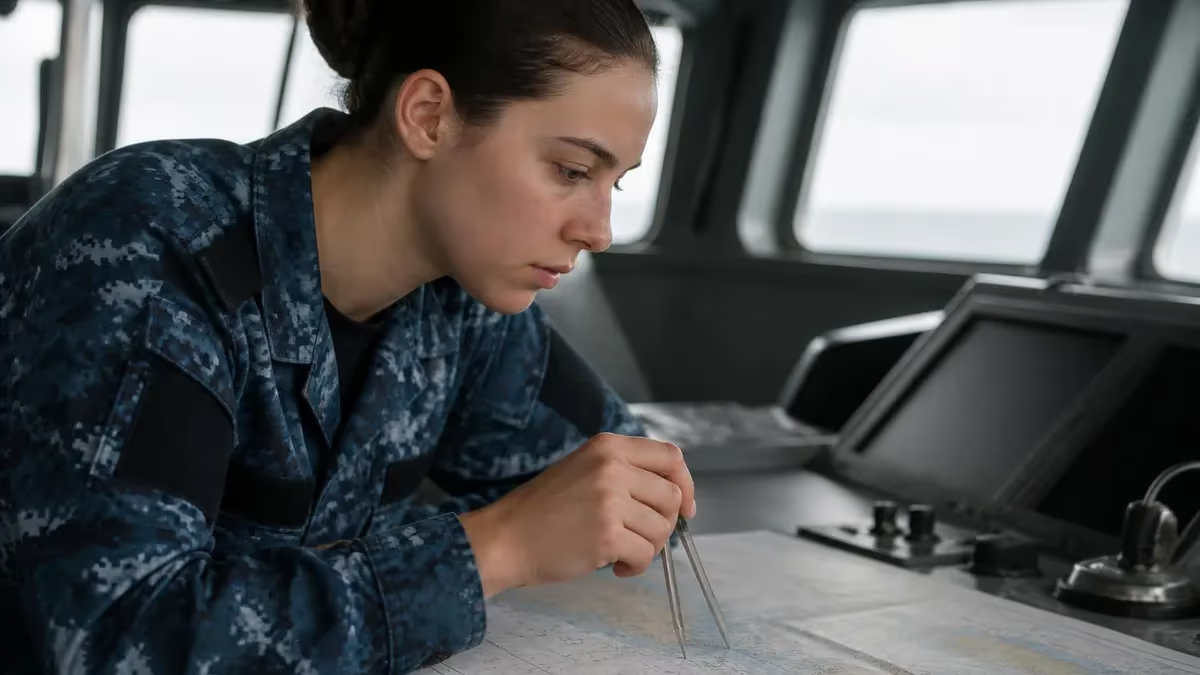
Every successful cadet leader begins their journey by understanding what leadership truly means within military and civilian training programs. Whether inspired by the determination shown in the popular cadet kelly story or motivated by real-world command responsibilities, aspiring leaders must develop communication skills, tactical awareness, and personal discipline that distinguish them from their peers. The path from new recruit to confident leader requires structured preparation, guidance from experienced officers, and a genuine willingness to push beyond comfort zones into challenging growth opportunities that test every dimension of character.
Leadership within cadet programs differs significantly from leadership in corporate or civilian settings because it combines physical endurance requirements with intellectual rigor and moral accountability. A cadet must demonstrate competence across multiple domains simultaneously, balancing academic performance with field exercises, community service obligations, and peer mentoring responsibilities. This multifaceted approach ensures that graduates emerge as well-rounded individuals capable of making sound decisions under pressure, managing diverse teams, and maintaining composure during high-stakes operations that demand immediate action.
The cultural impact of cadet programs extends far beyond military installations. The film cadet kelly introduced millions of viewers to the discipline, camaraderie, and personal transformation that military academies offer young people. While Hollywood naturally dramatizes certain elements, the core message resonates truthfully: cadets who commit fully to their training discover strengths they never knew existed. Real programs mirror this trajectory, pushing participants through progressive challenges designed to build confidence incrementally while establishing leadership foundations that last throughout entire careers.
Understanding the broader cadet ecosystem helps contextualize leadership development within these programs. The term cadet applies across numerous contexts, from junior military academies and ROTC units to police training programs and international youth organizations. Each context demands slightly different leadership competencies, yet all share common threads including integrity, accountability, physical fitness, and service orientation. Regardless of which specific program a candidate enters, the leadership principles remain remarkably consistent across organizational boundaries and national traditions worldwide.
Modern cadet leadership development has evolved considerably from purely authoritarian command-and-control models toward more collaborative, emotionally intelligent approaches. Today's programs recognize that effective leaders must inspire voluntary followership rather than merely enforce compliance through rank authority. This shift reflects broader changes in organizational psychology and management science, incorporating research on motivation, team dynamics, conflict resolution, and adaptive leadership that responds to rapidly changing operational environments with flexibility and creative problem-solving capabilities.
Physical conditioning remains an essential component of cadet leadership because it builds mental toughness alongside bodily strength. Programs incorporate running, obstacle courses, swimming, martial arts, and endurance marches that push cadets past perceived limitations. Leaders who have personally experienced physical hardship can better empathize with subordinates struggling through difficult training evolutions. This shared experience creates authentic bonds of trust and mutual respect that no classroom lecture or textbook chapter could ever replicate in real-world team environments.
The lady cadet course and similar specialized training tracks demonstrate how cadet programs have expanded to serve diverse populations while maintaining rigorous standards. These pathways ensure that leadership development opportunities reach all qualified candidates regardless of background, creating more representative command structures. Research consistently shows that diverse leadership teams make better decisions, consider more perspectives, and achieve superior outcomes compared to homogeneous groups operating within narrow experiential frameworks and limited viewpoints about complex operational challenges.
Cadet Leadership by the Numbers

Core Leadership Competencies for Cadets
Master clear verbal orders, written reports, and active listening skills essential for directing teams effectively under both routine conditions and high-pressure operational scenarios requiring immediate coordinated responses.
Develop rapid assessment capabilities for field situations, weighing available intelligence against mission objectives while managing risk and maintaining troop welfare during complex multi-variable operations.
Build a moral framework for difficult choices that balances mission accomplishment with rules of engagement, legal obligations, humanitarian considerations, and long-term strategic consequences of immediate actions.
Lead from the front during demanding physical evolutions, demonstrating personal fitness standards that inspire subordinates and establish credibility through visible commitment to shared hardship and excellence.
Manage personnel records, logistics coordination, training schedules, and resource allocation efficiently, ensuring smooth unit operations that support mission readiness while maintaining regulatory compliance at all times.
Building a strong leadership foundation requires cadets to invest significant time in both theoretical study and practical application of command principles. Textbook knowledge about leadership styles, motivational theories, and organizational behavior provides essential vocabulary and conceptual frameworks, but these ideas only become truly meaningful when tested against real human dynamics in field exercises, team projects, and peer leadership rotations. The most effective cadet leaders combine intellectual understanding with experiential learning gained through deliberate practice in progressively challenging scenarios.
One critical resource for tracking leadership development is the cadet portfolio, which documents achievements, competencies demonstrated, leadership positions held, and feedback received from supervisors and peers throughout the training period. This living document serves multiple purposes: it provides evidence for promotion boards, helps cadets identify development gaps requiring attention, and creates a reflective practice habit that promotes continuous improvement. Maintaining a comprehensive portfolio requires discipline but pays dividends throughout an entire military or professional career.
Mentorship represents perhaps the single most powerful accelerator for cadet leadership development. Programs that pair junior cadets with experienced upperclassmen or commissioned officers create knowledge transfer channels that supplement formal instruction with practical wisdom. Good mentors share not only tactical knowledge but also the emotional intelligence lessons learned through their own mistakes and successes. They help mentees navigate interpersonal conflicts, manage imposter syndrome, balance competing demands, and develop authentic leadership styles rather than merely imitating authority figures they observe.
Physical training intersects with leadership development in ways that purely academic programs cannot replicate. When a cadet leads a squad through a grueling ruck march or coordinates a team obstacle course attempt, abstract leadership concepts become viscerally real. The leader must read fatigue levels in teammates, adjust pace without sacrificing mission timelines, motivate flagging individuals with appropriate encouragement, and make real-time decisions about risk management. These experiences build neural pathways for decision-making under stress that classroom simulations simply cannot activate with equivalent intensity.
Academic coursework in cadet programs increasingly incorporates case study methodology drawn from historical military campaigns, corporate leadership failures, and crisis management scenarios. Cadets analyze decisions made by leaders ranging from ancient generals to modern CEOs, identifying principles that transcend specific contexts. This analytical approach develops critical thinking capabilities essential for senior leadership positions where problems rarely present with obvious solutions and where second-order consequences of decisions must be carefully anticipated before committing resources or personnel to action.
Peer evaluation systems within cadet programs provide uniquely valuable leadership feedback that superior-only assessment cannot capture. When peers rate each other's leadership effectiveness, the resulting data reveals interpersonal dynamics invisible to commanding officers who observe from hierarchical distance. Cadets learn that true leadership requires earning respect from equals, not merely directing subordinates. This horizontal accountability mirrors modern organizational structures where influence matters more than positional authority and where collaborative relationships determine operational effectiveness.
Cross-training opportunities between different branches and international partner programs broaden cadet leadership perspectives beyond single-service parochialism. Joint exercises expose cadets to different organizational cultures, communication protocols, and tactical approaches, building the interoperability skills essential for modern coalition operations. Leaders who understand multiple operational frameworks can bridge cultural gaps, translate between professional vocabularies, and facilitate cooperation among diverse stakeholders with competing priorities and different institutional traditions that might otherwise create friction.

CADET Practice Test Questions
Prepare for the CADET - Canadian Armed Forces Aptitude Test exam with our free practice test modules. Each quiz covers key topics to help you pass on your first try.
CADET Mathematics and Problem Solving
CADET Exam Questions covering Mathematics and Problem Solving. Master CADET Test concepts for certification prep.
CADET Military History and Customs
Free CADET Practice Test featuring Military History and Customs. Improve your CADET Exam score with mock test prep.
CADET Navigation and Map Reading
CADET Mock Exam on Navigation and Map Reading. CADET Study Guide questions to pass on your first try.
CADET Spatial Reasoning and Visualization
CADET Test Prep for Spatial Reasoning and Visualization. Practice CADET Quiz questions and boost your score.
CADET Petty Officer First Class
CADET Mock Test covering Petty Officer First Class. Online CADET Test practice with instant feedback.
CADET Police Officer
CADET Practice Questions for Police Officer. Build confidence for your CADET certification exam.
Cub Cadet Leadership Training Pathways
Military academies like West Point, Annapolis, and the Air Force Academy offer the most intensive cadet leadership development available in the United States. These four-year programs combine rigorous academic curricula with progressive military training, physical conditioning, and character development. Cadets advance through increasingly responsible leadership positions each year, culminating in senior year command roles that prepare them for immediate commissioning as military officers upon graduation.
Academy graduates consistently rank among the most effective junior officers due to their comprehensive preparation. The structured environment ensures every cadet receives leadership opportunities regardless of personality type, with introverts and extroverts alike developing command presence through repeated practice. Academy alumni networks provide lifelong professional connections that support career advancement well beyond initial service obligations, making the investment worthwhile even for those who eventually transition to civilian leadership roles.
Pros and Cons of Pursuing Cadet Leadership Roles
- +Develops transferable leadership skills valued in military and civilian careers
- +Provides structured mentorship from experienced officers and senior cadets
- +Builds physical fitness habits and mental toughness that last a lifetime
- +Creates professional networks spanning multiple industries and organizations
- +Offers scholarship opportunities covering tuition and living expenses
- +Establishes discipline and time management capabilities early in life
- −Demands significant time commitment that limits social and recreational activities
- −Requires strict adherence to regulations that some find overly restrictive
- −Physical training intensity may cause injuries without proper preparation
- −Hierarchical culture can conflict with independent-minded personalities
- −Early career geographic assignments may limit personal choice flexibility
- −High-pressure environments contribute to stress and burnout if unmanaged

Cadet Leader Development Checklist
- ✓Complete all required physical fitness assessments above minimum standards
- ✓Document leadership experiences in your cadet portfolio with specific examples
- ✓Volunteer for at least one peer mentoring or tutoring assignment per semester
- ✓Attend all mandatory leadership development seminars and workshops on schedule
- ✓Practice public speaking by leading at least two formation briefings monthly
- ✓Seek written feedback from three different supervisors each evaluation period
- ✓Participate in at least one joint exercise or inter-service training event annually
- ✓Read one leadership-focused book per month and discuss key takeaways with mentors
- ✓Organize one community service project demonstrating planning and coordination skills
- ✓Complete conflict resolution training and demonstrate mediation capabilities practically
The 70-20-10 Rule in Cadet Development
Research shows that 70% of leadership development occurs through challenging assignments and on-the-job experiences, 20% comes from developmental relationships and mentoring, and only 10% results from formal coursework and classroom instruction. Cadets who actively seek stretch assignments and build strong mentor relationships accelerate their growth dramatically compared to those relying solely on scheduled training events.
Advanced command strategies separate competent cadet leaders from truly exceptional ones who inspire extraordinary performance from their units. At this level, leadership transcends basic task management and enters the realm of vision-casting, culture-building, and strategic thinking that anticipates challenges before they materialize. Senior cadets preparing for commissioning must demonstrate not only the ability to execute orders effectively but also the capacity to design operations, allocate resources intelligently, and develop subordinate leaders who will eventually replace them in command positions.
Emotional intelligence emerges as a critical differentiator at advanced leadership levels where technical competence is assumed rather than exceptional. Leaders who can accurately read team morale, identify emerging interpersonal conflicts before they escalate, and adapt their communication styles to different audiences achieve superior results through voluntary engagement rather than mere compliance. Studies of military unit effectiveness consistently correlate commander emotional intelligence scores with unit cohesion metrics, retention rates, and mission accomplishment percentages across diverse operational contexts.
Crisis leadership requires specific capabilities that routine operations never fully develop. Cadets must seek out high-pressure training scenarios, emergency response exercises, and competitive events that simulate the cognitive load and time pressure of actual crisis situations. The neurological pathways activated during genuine stress differ from those engaged during calm deliberation, meaning leaders must train their brains to function effectively under conditions of uncertainty, incomplete information, physical fatigue, and emotional intensity simultaneously.
Adaptive leadership theory provides a particularly useful framework for cadet leaders facing twenty-first-century operational environments characterized by rapid technological change, asymmetric threats, and complex multi-stakeholder dynamics. Unlike technical problems with known solutions, adaptive challenges require leaders to facilitate learning processes, challenge existing assumptions, and tolerate productive discomfort while organizations develop new capabilities. Cadets who master adaptive leadership approaches can navigate ambiguity without defaulting to rigid procedural responses inappropriate for novel situations.
Cross-cultural competence has become non-negotiable for military leaders operating in coalition environments and diverse domestic units. Cadet programs increasingly incorporate language training, cultural immersion experiences, and diversity education that prepares graduates for effective leadership across demographic boundaries. Understanding how cultural background influences communication preferences, conflict resolution approaches, and motivational factors enables leaders to build inclusive teams where every member contributes their full potential without feeling marginalized or misunderstood.
Technology integration represents both an opportunity and a challenge for modern cadet leaders. Digital communication tools, data analytics platforms, simulation systems, and artificial intelligence applications are transforming military operations at every level. Leaders must develop sufficient technical literacy to leverage these tools effectively while maintaining the human judgment, ethical reasoning, and interpersonal connection that technology cannot replace. Programs that balance technological fluency with traditional leadership fundamentals produce the most capable graduates.
Succession planning and subordinate development distinguish mature leaders from those focused solely on personal achievement. The best cadet leaders actively invest in developing their replacements, sharing knowledge generously, delegating meaningful responsibilities that build competence, and providing honest feedback that accelerates growth. This multiplier approach creates leadership depth within organizations and ensures continuity when personnel transitions inevitably occur through graduation, reassignment, or promotion to higher-level responsibilities.
Most cadet programs require leadership position applications 60-90 days before the start of each academic term. Missing these deadlines means waiting an entire semester for the next opportunity. Check your specific program's administrative calendar and submit all required documentation, including supervisor endorsements and cadet portfolio evidence, well before the published cutoff dates to ensure full consideration by selection boards.
Real-world application of cadet leadership skills begins long before commissioning or graduation, manifesting in every interaction with peers, subordinates, and superiors throughout daily training activities. The most effective leaders treat routine moments as practice opportunities, consciously applying communication techniques, decision-making frameworks, and motivational strategies during ordinary tasks rather than reserving leadership behavior exclusively for evaluated exercises. This consistent practice builds automaticity that ensures reliable performance when high-stakes situations demand immediate effective action without conscious deliberation.
Community engagement provides invaluable leadership practice while simultaneously building public support for cadet programs. Organizing volunteer events, coordinating with civilian organizations, and representing military values in public settings develop skills directly transferable to operational leadership. Cadets who actively engage their surrounding communities learn stakeholder management, public relations, and collaborative planning with entities outside their chain of command. The cub cadet riding mower maintenance projects and similar community service activities at programs like the Texas A&M Corps of Cadets demonstrate this principle beautifully in practice.
After-action review methodology transforms every training event into a leadership development opportunity regardless of whether the event succeeded or failed. Effective leaders facilitate honest debriefs that identify what happened, why it happened, and what should change for next time without assigning blame or creating defensive reactions. This learning culture accelerates organizational adaptation and ensures that mistakes become stepping stones rather than repeated failures. Cadets who master facilitation of after-action reviews become invaluable to any unit they join.
Physical leadership during challenging field exercises remains essential despite technological advances in modern warfare. When units face exhaustion, adverse weather, equipment failures, or unexpected obstacles, they look to their leaders for energy, optimism, and calm problem-solving. Leaders who maintain composure and positive attitude during hardship create psychological safety that enables team members to acknowledge difficulties honestly without spiraling into defeatism. This emotional regulation capability develops through repeated exposure to controlled discomfort during training.
Networking across cadet cohorts and with alumni creates professional development opportunities that compound throughout careers. Senior cadets and recent graduates can offer perspective on immediate next steps, while more experienced alumni provide strategic career guidance and potential mentorship relationships. Understanding how to cub cadet zero turn one's career trajectory through deliberate relationship building and opportunity recognition separates those who drift through assignments from those who strategically construct meaningful professional narratives.
Written communication skills often receive less attention than verbal command presence in cadet programs, yet they prove equally critical for career advancement. Leaders who can compose clear operational orders, persuasive memoranda, comprehensive after-action reports, and concise email communications operate more effectively in bureaucratic military and corporate environments. Investing time in improving writing skills through practice, peer review, and professional development courses pays extraordinary dividends across decades of leadership responsibility at progressively higher organizational levels.
Conflict resolution capabilities distinguish leaders who build cohesive high-performing teams from those who merely manage collections of individuals working in proximity. Interpersonal friction is inevitable when diverse personalities operate under stress and time pressure, making mediation skills essential rather than optional. Cadet leaders who learn to address conflicts early, facilitate productive conversations between disagreeing parties, and establish team norms that prevent destructive patterns create unit cultures where people genuinely want to contribute their best efforts consistently.
Practical preparation tips for aspiring cadet leaders should focus on developing daily habits rather than attempting dramatic transformations immediately before selection boards or evaluation periods. Leaders are built through thousands of small decisions and consistent behaviors repeated over months and years. Establishing a morning physical fitness routine, maintaining a daily leadership journal, reading professional development material for thirty minutes each evening, and practicing mindfulness techniques for stress management create compound improvements that become unmistakably visible to evaluators over time.
Mock leadership scenarios practiced with trusted peers provide low-risk environments for experimenting with different approaches before deploying them in evaluated settings. Gather three to five motivated colleagues and rotate through scenarios involving subordinate counseling sessions, emergency response coordination, ethical dilemma resolution, and resource allocation decisions under time pressure. Video recording these practice sessions enables detailed self-assessment of body language, vocal tone, decision quality, and communication clarity that written reflection alone cannot capture effectively.
Studying historical military leaders through biographies, documentaries, and academic analyses provides mental models that inform real-time decision-making. When facing a novel challenge, leaders with rich historical knowledge can recall how previous commanders handled analogous situations, adapting proven principles to current circumstances. Focus on leaders from diverse backgrounds, time periods, and operational contexts to build a comprehensive library of approaches rather than fixating on a single leadership archetype that may not suit your personality or situation.
Physical preparation extends beyond meeting minimum standards to building the reserve capacity that enables clear thinking during extended operations. Leaders operating at their physical limits cannot simultaneously process complex information, manage team dynamics, and make sound decisions. Maintaining fitness significantly above minimum requirements creates the cognitive bandwidth necessary for leadership responsibilities during demanding field exercises. Incorporate strength training, cardiovascular conditioning, flexibility work, and sleep optimization into a sustainable long-term fitness plan.
Mental health awareness and stress management techniques deserve deliberate attention in leadership preparation because burnout and psychological strain undermine leadership effectiveness more reliably than any external threat. Learn to recognize your personal stress indicators, develop multiple coping strategies for different situations, and establish support relationships with peers who can provide honest feedback when your behavior suggests declining well-being. Effective leaders model healthy stress management for their teams rather than glorifying overwork and sleep deprivation.
Financial literacy may seem unrelated to cadet leadership but proves practically essential for officers managing budgets, making career decisions involving geographic relocation, and advising subordinates facing personal financial stress that affects duty performance. Understanding compensation structures, retirement systems, investment principles, and budgeting fundamentals enables leaders to make informed career decisions and provide meaningful guidance to team members struggling with financial challenges that distract from mission focus.
Finally, developing a personal leadership philosophy statement crystallizes values, priorities, and principles into a coherent framework that guides consistent decision-making across diverse situations. Write a one-page document articulating what you believe about leadership, how you intend to treat people, what standards you will maintain, and why you serve. Review and revise this document quarterly as experiences refine your understanding. Share it with subordinates when assuming new positions so they understand your expectations and values from the first day of your leadership tenure.
CADET Questions and Answers


About the Author

Educational Psychologist & Academic Test Preparation Expert
Columbia University Teachers CollegeDr. Lisa Patel holds a Doctorate in Education from Columbia University Teachers College and has spent 17 years researching standardized test design and academic assessment. She has developed preparation programs for SAT, ACT, GRE, LSAT, UCAT, and numerous professional licensing exams, helping students of all backgrounds achieve their target scores.
Join the Discussion
Connect with other students preparing for this exam. Share tips, ask questions, and get advice from people who have been there.
View discussion (9 replies)