
CADET Ranks Explained: CAP, JROTC, West Point and Canada 2026 October
Cadet ranks explained: 🎯 Civil Air Patrol (16 grades), JROTC by branch, West Point class ranks, and Canadian Cadet Corps. Insignia, timelines
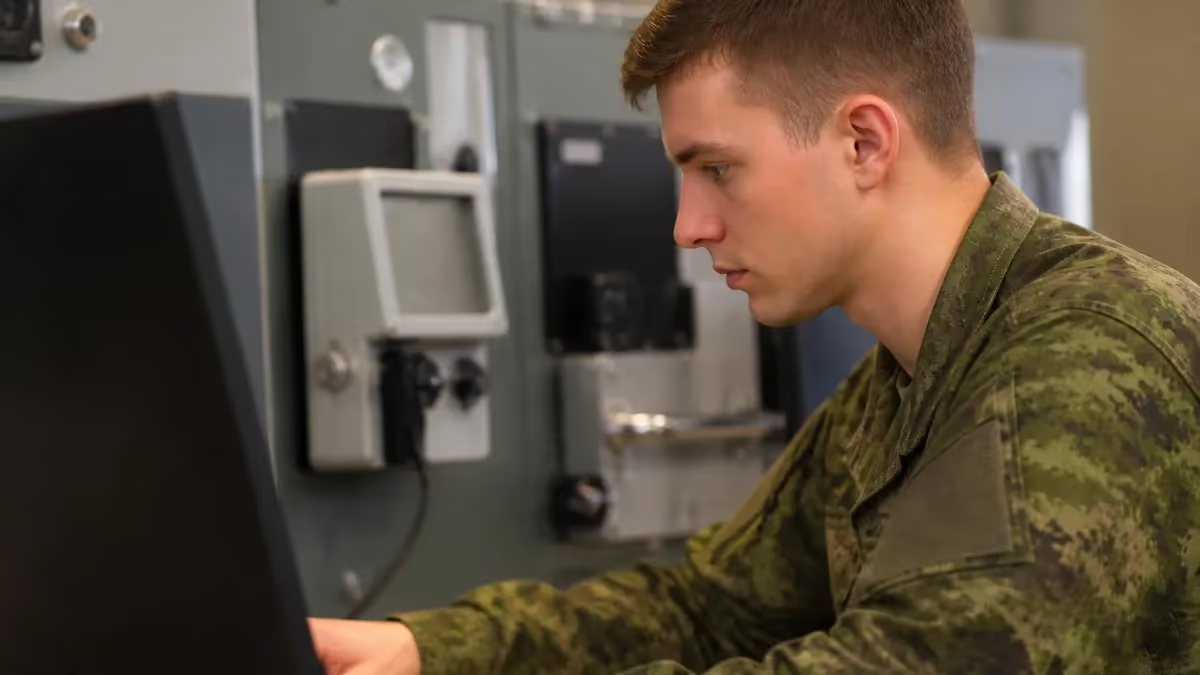
Cadet ranks look like a maze the first time you see them. Sleeves, shoulders, and collars get covered in stripes, diamonds, chevrons, and bars — and the same word like "cadet lieutenant" can mean very different things depending on which program you're in. The ranks aren't decoration. They tell you where a cadet sits in a chain of command, what training they've finished, and what they can do next.
This guide walks through the four cadet rank systems most people actually search for: Civil Air Patrol (CAP), Junior ROTC across the U.S. military branches, the unique class-based ranks at the United States Military Academy at West Point, and the Canadian Cadet Organizations. You'll see the full rank ladders, what each insignia looks like in plain words, and roughly how long promotions take when a cadet is doing the work.
Two things to keep in mind before we start. First, "cadet" is a grade modifier — cadet lieutenant is not the same as a real military lieutenant, and a cadet doesn't outrank an enlisted soldier no matter how many stripes are on the sleeve. Second, every program runs promotions on its own clock. Civil Air Patrol moves cadets through 16 grades over several years; JROTC programs often have nine or ten ranks tied to school year and merit. The patterns are similar; the details are not.

Civil Air Patrol Cadet Ranks: 16 Grades, Two Phases
Civil Air Patrol uses the most elaborate cadet rank ladder in the United States. CAP is the official auxiliary of the U.S. Air Force, and its cadet program mirrors Air Force structure on purpose. There are 16 cadet grades, split across an enlisted phase and an officer phase, and a cadet has to pass an academic test, a physical fitness test, a leadership evaluation, and a character-development module to move up at every single step.
The enlisted phase covers the first six grades. New cadets pin on Cadet Airman Basic (C/AB) — no insignia at all — and work upward through Cadet Airman (one stripe), Cadet Airman First Class (two stripes), and Cadet Senior Airman (three stripes). Then come the NCO grades: Cadet Staff Sergeant, Cadet Technical Sergeant, and Cadet Master Sergeant. Each NCO promotion brings extra chevrons on the upper-arm patch and a step up in expected leadership of newer cadets.
The officer phase is where the cadet program really stretches. After completing the Wright Brothers Achievement, cadets become Cadet Second Lieutenant (C/2d Lt) and wear a single silver bar. From there the ladder climbs the same way an Air Force officer would: First Lieutenant, Captain, Major, Lieutenant Colonel, and finally Cadet Colonel (C/Col), with the silver eagle and the Spaatz Award — the highest cadet achievement in CAP. Roughly half of one percent of cadets ever earn it.
Promotion timelines run on cadet effort, not the calendar. A motivated cadet can move from C/AB to a cadet NCO in under a year. Reaching Cadet Colonel typically takes four to six years and requires passing the Spaatz Exam — an academic, leadership, and fitness test that has a pass rate around 50 percent on a first attempt. CAP publishes the full requirements in CAPR 60-1. For background on the term itself, see our explainer on cadet meaning; it's worth reading if you're a parent or a new cadet trying to plan ahead.
Quick Mental Model: Cadet vs Real Military Grade
A cadet's rank is a training milestone, not a chain-of-command rank over enlisted service members. Even a Cadet Colonel wearing eagles still salutes any active-duty officer, and a Cadet Master Sergeant doesn't outrank a real Airman First Class. The insignia signals achievement within the cadet program. Once cadets commission as officers later in life — through ROTC, OCS, or a service academy — their cadet grade is left behind and they start at O-1.
JROTC Cadet Ranks by Branch
Junior ROTC operates in high schools across the country and trains roughly 500,000 cadets a year. The Army, Air Force, Navy, Marine Corps, and Coast Guard each run their own JROTC programs, and while the rank ladders share a pattern, the names and insignia differ branch by branch.
Army JROTC uses ten cadet ranks. They start at Cadet Private (C/PVT) with no insignia, move through Cadet Private First Class, Cadet Corporal, and Cadet Sergeant, then up the NCO ladder — Staff Sergeant, Sergeant First Class, Master Sergeant, First Sergeant, Sergeant Major, and finally Cadet Command Sergeant Major. Most Army JROTC programs reserve the top NCO ranks for senior cadets running the battalion staff.
Air Force JROTC (AFJROTC) follows the Air Force enlisted-and-officer split. Cadets begin as Cadet Airman Basic and progress through the airman and NCO grades, then can earn cadet officer rank as juniors and seniors — Cadet Second Lieutenant up through Cadet Colonel. Unit leadership positions (Group Commander, Squadron Commander) line up with the higher cadet officer ranks.
Navy JROTC (NJROTC) uses sailor-style ranks. New cadets are Cadet Seaman Recruit; they work up through Seaman Apprentice, Seaman, and the petty officer grades. Senior cadets earn officer titles like Cadet Ensign and Cadet Lieutenant Junior Grade. NJROTC unit commanders carry the rank of Cadet Lieutenant Commander or higher.
Marine Corps JROTC (MCJROTC) uses Marine ranks: Cadet Private, Cadet Private First Class, Cadet Lance Corporal, Cadet Corporal, Cadet Sergeant, and up through the staff NCO grades. The unit's senior cadet officer typically carries the rank of Cadet Captain or Cadet Major, depending on the school's size. Marine JROTC programs are smaller in number than Army JROTC, but they're known for high standards on drill, physical fitness, and uniform appearance.
Promotion in JROTC depends on classroom grades, attendance, leadership board interviews, drill performance, and time in grade. Many programs only promote at the start of each semester, so cadets plan their goals around the school calendar rather than running promotion boards monthly.
Cadet Rank Systems Side by Side
16 grades from Cadet Airman Basic to Cadet Colonel. Enlisted + officer phase, mirrors USAF structure. Pass academic, fitness, and leadership tests at every step. Top achievement is the Spaatz Award.
9-10 ranks per branch, named after that service's enlisted and junior officer grades. Promotion tied to semester GPA, attendance, drill, and leadership board interviews. Senior cadets run unit staff.
Class-based ranks: Cadet Private (4th class / plebe), Cadet Corporal (3rd class / yearling), Cadet Sergeant (2nd class / cow), and Cadet Officer ranks (1st class / firstie). Brigade staff hold positions up to Cadet Captain Major.
Single ladder across Sea, Army, and Air Cadets: Cadet, Lance Corporal/Trooper, Corporal/Master Corporal, Sergeant, Warrant Officer, Master Warrant Officer, and Chief Warrant Officer (CWO). CWO is the highest cadet rank.
West Point Cadet Ranks: Built Around the Four Class Years
The United States Military Academy at West Point uses a rank system that's tied to the cadet's class year, not just achievement. There are four years and four corresponding base ranks — with leadership positions layered on top during the senior year.
Fourth-class cadets (freshmen, called plebes) carry the rank of Cadet Private. They wear no rank insignia. Plebe year is the most restrictive: cadets memorize knowledge, eat at attention in the mess hall, and learn the basics of Army drill and ceremony.
Third-class cadets (sophomores, yearlings) become Cadet Corporal. They wear two chevrons and take on more responsibility, especially in mentoring incoming plebes during summer training at Camp Buckner.
Second-class cadets (juniors, cows) become Cadet Sergeant. They wear three chevrons and run small-unit leadership inside their cadet companies. The name "cow" supposedly comes from cadets "coming home" after Christmas leave their second year — though the etymology is debated even on campus.
First-class cadets (seniors, firsties) hold one of several cadet officer ranks, depending on assignment. The basic firstie rank is Cadet Lieutenant. From there, cadets selected for company, regimental, or brigade staff can wear ranks up through Cadet Captain, Cadet Major, and at the very top, the First Captain of the Corps of Cadets — the senior cadet in the entire 4,400-cadet brigade, who carries a rank often noted as Cadet Captain Major depending on the year's organizational chart. Notable First Captains include Douglas MacArthur, John J. Pershing, and Pete Dawkins.
Cadet officer ranks at West Point are leadership assignments, not academic ranks. A cadet doesn't automatically become a Cadet Captain because their grades are high — they're selected because they're trusted to lead a company, a regiment, or a portion of summer training. After graduation, every cadet commissions as an Army Second Lieutenant regardless of their cadet rank, so the "Cadet Lieutenant Colonel rank" you might have heard about isn't a stepping stone to anything — it's recognition of one final year of leadership at the Academy.

CAP enlisted cadets wear chevron patches on the upper sleeve — one stripe (C/Amn) up to six stripes with a star (C/MSgt). Cadet officers wear metal pin-on insignia at the collar: silver bars (Lt), gold oak leaf (Maj), silver oak leaf (Lt Col), and silver eagle (C/Col). The insignia is intentionally similar to USAF officer pins, but cadet pins are marked with "CAP" on the back. Full uniform regulations live in CAPM 39-1.
Canadian Cadet Ranks: One Ladder, Three Elements
Canada runs the Canadian Cadet Organizations under the Department of National Defence, a structure that parallels the U.S. Naval Sea Cadet Corps, with three elemental branches — Sea Cadets, Army Cadets, and Air Cadets. Unlike U.S. JROTC, all three Canadian programs share a single rank ladder, just with slightly different rank names depending on the element.
Cadets join as Cadet with no insignia. They move up through Cadet (Sea) / Lance Corporal (Army) / Leading Air Cadet (Air), then Master Cadet / Master Corporal / Sergeant equivalents. The senior NCO ranks — Warrant Officer, Master Warrant Officer, and the top rank of Chief Warrant Officer (CWO) — are reserved for the most experienced senior cadets, typically 17 or 18 years old and serving as Coxswain (Sea Cadets) or Cadet Commander.
Promotion through the Canadian system depends on completing training stars (a multi-year curriculum), attending mandatory training nights, achieving leadership qualifications, and passing performance reviews. The Royal Canadian Air Cadets, for example, use a five-star training program — from Proficiency Level 1 through Master Cadet — with rank promotions roughly tracking those levels.
One thing parents in Canada often ask: does the Canadian Cadet program lead automatically into the Canadian Armed Forces? It doesn't. The program is youth development and citizenship training; it isn't a military reserve commitment. Many former cadets do enlist later (the program is one of the largest pipelines into the CAF) but there's no obligation, and CAF basic training starts from zero regardless of cadet rank.
A Cadet Lieutenant Colonel does not outrank an Army Sergeant First Class, even though the cadet wears more chevrons or oak leaves. Cadet ranks signal achievement inside a training program; they don't sit on the active-duty pay scale. When cadets visit military installations, the standing protocol is that they render the first salute to any officer or warrant officer regardless of their cadet grade.
How Cadets Get Promoted: The Pattern Every Program Shares
Different uniforms, different insignia, but the promotion pattern looks similar across CAP, JROTC, West Point, and the Canadian Cadets. Five components show up in nearly every program.
1. Time in grade. Every program enforces a minimum stay at each rank — typically 60 to 120 days at lower ranks, longer at higher ones. Time in grade prevents cadets from racing to the top without absorbing the leadership lessons each step is supposed to teach.
2. Academic testing. CAP runs leadership and aerospace exams at every grade. JROTC programs grade cadets on classroom content and end-of-semester tests. West Point cadets accumulate a class GPA that determines order of merit and ultimately branch selection. Canadian cadets pass the training-star curriculum.
3. Physical fitness. CAP and JROTC require passing scores on the Cadet Physical Fitness Test. West Point uses the Army Combat Fitness Test (ACFT) plus the Indoor Obstacle Course Test (IOCT). The Canadian Cadets run a fitness assessment tied to each training-level promotion.
4. Leadership evaluation. Promotion boards, peer reviews, and supervisor recommendations carry weight at every rank. Senior cadets evaluate junior cadets — one of the few places where being "graded by your peers" is built into the structure on purpose.
5. Character and conduct. All four programs run formal character-development modules. A cadet caught lying, cheating, or violating the program's honor code can lose rank or be removed from the program entirely. West Point's honor code — "A cadet will not lie, cheat, steal, or tolerate those who do" — is the most well-known, but every cadet program enforces something similar.
What surprises a lot of new cadets is how much paperwork is involved. Promotion in CAP requires a digital checklist signed off in eServices; JROTC promotions move through the cadet's senior Army instructor and a battalion S-1 (administration officer); West Point promotions are tracked by the Brigade Tactical Department. The administrative side teaches cadets something every officer eventually learns: leadership is partly about getting the documentation right.
- ✓Met the minimum time-in-grade requirement for your current rank (60 to 120 days in most programs)
- ✓Passed the academic exam covering aerospace, military history, or service-specific knowledge
- ✓Scored the required level on the Cadet Physical Fitness Test (sit-ups, push-ups, run)
- ✓Completed all character-development module discussions and submitted reflections in writing
- ✓Earned a leadership-position evaluation from your direct cadet supervisor
- ✓Reviewed by a promotion board or rank advancement panel of senior cadets and staff
- ✓Uniform inspection passed at the level expected for the new rank
- ✓All paperwork signed off in the program's tracking system (eServices for CAP, S-1 for JROTC, BTD for West Point)

Cadet Lieutenant Colonel: A Rank That Appears in Three Different Programs
Search results for "cadet lieutenant colonel rank" pull from at least three different programs, and the meaning shifts in each. It's worth pulling them apart.
In Civil Air Patrol, Cadet Lieutenant Colonel (C/Lt Col) is the second-highest cadet grade. A cadet reaches it after earning the Eaker Award — one step before the Spaatz. CAP cadet Lt Cols typically serve as wing or unit cadet commanders and have been in the program for at least four years.
In Air Force JROTC, Cadet Lieutenant Colonel is also a senior cadet officer rank, usually reserved for the deputy group commander or a major staff officer at a large school's unit. Promotion typically happens in the senior year and recognizes outstanding leadership over the cadet's junior and senior years.
At West Point, Cadet Lieutenant Colonel-equivalent insignia appears on certain brigade staff positions during the firstie year. Cadets selected for the highest staff positions wear cadet officer rank that mirrors the higher Army officer grades for ceremonial reasons — though again, none of these convert to active-duty ranks at commissioning.
The lesson: when you hear "Cadet Lieutenant Colonel," ask which program. A 17-year-old high school senior wearing the silver oak leaf in AFJROTC is doing the same thing as an 18-year-old college student in CAP — demonstrating four or more years of consistent leadership in a youth program. Neither one outranks anyone in the regular military.
- +Real leadership practice — cadets run drill, planning meetings, and training events well before college
- +Structured promotion criteria force time management, fitness, and academic discipline
- +Clear ladder of achievement that colleges and scholarship boards understand and reward
- +Strong peer network — many cadets meet lifelong friends and future military colleagues
- +Pathway preview — cadets learn whether military service fits them before signing a contract
- −Cadet rank doesn't transfer to active duty — commissioning starts at O-1 regardless of cadet grade
- −Time commitment is significant: weekly meetings, weekend events, and summer training
- −Promotion politics exist at every level — favoritism and personality conflicts happen
- −Heavy uniform and inspection focus can feel disconnected from real-world military operations
- −Cost of uniforms, travel, and optional summer schools can add up in CAP and JROTC
Pros and Cons at a Glance
| Pros | Cons |
|---|---|
| Real leadership practice — cadets run drill, planning meetings, and training events well before college | Time commitment is significant: weekly meetings, weekend events, and summer training |
| Structured promotion criteria force time management, fitness, and academic discipline | Promotion politics exist at every level — favoritism and personality conflicts happen |
| Clear ladder of achievement that colleges and scholarship boards understand and reward | Heavy uniform and inspection focus can feel disconnected from real-world military operations |
| Strong peer network — many cadets meet lifelong friends and future military colleagues | Cost of uniforms, travel, and optional summer schools can add up in CAP and JROTC |
What Insignia Tells You at a Glance
Learning to read cadet insignia in the wild is mostly pattern recognition. A few quick rules will get you 80 percent of the way there.
Chevrons go up, oak leaves and bars come later. In CAP and most JROTC programs, chevron stripes on the sleeve identify enlisted-phase cadets. Once you see pin-on bars on the collar or shoulder boards, you're looking at a cadet officer. The same rule applies broadly across military services worldwide.
More metal usually means more responsibility. A single bar means second lieutenant. Two bars (parallel) means captain. A gold oak leaf means major; a silver oak leaf means lieutenant colonel; a silver eagle means colonel. The progression is identical to active-duty officer insignia in the U.S. Army and Air Force — which is why CAP and JROTC use it.
Stars are rare. Star insignia in cadet programs is reserved for the very top — First Captain at West Point, certain national cadet officers in CAP — or for special program designations. If you see a star on a cadet, ask before assuming.
Crossed devices identify the branch. Crossed rifles on chevrons mean Army or Marine JROTC. Crossed anchors or fouled anchors mean Navy or Sea Cadets. Wings mean Air Force or Civil Air Patrol. Cadet shoulder patches often add the school's name or the local unit number.
One last visual tip: the dress uniform matters as much as the rank. A cadet in Service Dress (CAP's blue Air Force-style uniform) signals a formal occasion — a parade, an inspection, a graduation. BDUs or working dress signal weekly meetings or field training. The combination of uniform and rank tells you not just "who" this cadet is but also "what they're doing today."
Choosing a Cadet Program: What the Ranks Tell You
If you or your kid is deciding between programs — including paths into cadet college programs —, the rank structure is a useful tell about what each program emphasizes.
Civil Air Patrol has the most elaborate ladder — 16 grades — because CAP cadets stay in the program for years and need granular milestones to maintain motivation. If you want a long-term commitment with clear stepwise rewards, CAP is the deepest experience. The downside: weekly meetings and summer encampments require real family scheduling.
JROTC ranks are tied to the school year. A high school junior or senior who reaches a senior staff rank will graduate having run a battalion of 100 to 300 cadets. That kind of leadership volume looks excellent on college and academy applications. If your school offers JROTC, it's the easiest entry point because it's built into the school day.
West Point isn't really a cadet program in the same sense — it's an undergraduate college. Cadets commission as Army Second Lieutenants after four years. The rank structure is more about leadership rotation than about earning recognition. If commissioning as a regular Army officer is the goal, West Point is one of three paths (ROTC and OCS being the others).
Canadian Cadets offer Sea, Army, and Air elements with no enlistment obligation. The unified rank ladder makes it easier to compare progress across elements. For Canadian families, the program is free to join and runs nearly every community across the country.
Whatever program a cadet picks, the ranks aren't the point — they're the scoreboard. The real value is what cadets practice while earning them: physical fitness, teaching others, getting in front of a room, accepting feedback, recovering from a bad inspection, and finishing what they start. That's the skill set every cadet program trains, and the ranks are just the public way to recognize it. Try the practice tests linked above to test your knowledge of military traditions, customs, and history — the same content cadets study before each promotion board.
Sample CADET - Canadian Armed Forces Aptitude Test Practice Questions
Try these questions from our free CADET - Canadian Armed Forces Aptitude Test practice tests. The correct answer and an explanation follow each question.
The Cadet Logistics Readiness Squadron (LRS), Cadet Security Forces (SF), Cadet Quick Reaction Forces (QRF), and Cadet Civil Engineering are under the command of the Cadet Operations Group Commander (OG/CC) (CV).
- A. TRUE
- B. FALSE
Answer: A. TRUE
This statement is TRUE, outlining the specific units under the command of the Cadet Operations Group Commander (OG/CC). The listed squadrons—Logistics Readiness, Security Forces, Quick Reaction Forces, and Civil Engineering—are typical operational components that would fall under an Operations Group in a military-style organization.
What is the correct sequence of ranks from lowest to highest within the Royal Canadian Navy's Other Ranks structure?
- A. Ordinary Seaman → Able Seaman → Leading Seaman → Petty Officer 2nd Class → Petty Officer 1st Class → CPO2 → CPO1
- B. Able Seaman → Ordinary Seaman → PO2 → PO1 → Leading Seaman → CPO1 → CPO2
- C. Leading Seaman → PO1 → PO2 → CPO2 → Able Seaman → CPO1
- D. PO2 → PO1 → Leading Seaman → Able Seaman → CPO2 → CPO1
Answer: A. Ordinary Seaman → Able Seaman → Leading Seaman → Petty Officer 2nd Class → Petty Officer 1st Class → CPO2 → CPO1
The correct ascending RCN OR rank order is OS → AB → LS → PO2 → PO1 → CPO2 → CPO1.
You face west and make a 180° turn. Which direction are you now facing?
- A. East
- B. West
- C. North
- D. South
Answer: A. East
A 180° turn reverses your direction; turning from west results in facing east.
The Cadet FLT/CC will stop the flight once they are in a serving line outside the building, call them to "attention," and then lead them calmly into the DFAC.
- A. TRUE
- B. FALSE
Answer: B. FALSE
This statement is FALSE. While a Cadet FLT/CC leads the flight, the specific procedure described for entering the DFAC (stopping, calling to attention, then calmly leading) is often incorrect or incomplete according to detailed cadet regulations. There are usually more precise commands and procedures for DFAC entry.
Take the full CADET - Canadian Armed Forces Aptitude Test practice test
Cadet Questions and Answers
About the Author

Educational Psychologist & Academic Test Preparation Expert
Columbia University Teachers CollegeDr. Lisa Patel holds a Doctorate in Education from Columbia University Teachers College and has spent 17 years researching standardized test design and academic assessment. She has developed preparation programs for SAT, ACT, GRE, LSAT, UCAT, and numerous professional licensing exams, helping students of all backgrounds achieve their target scores.
Join the Discussion
Connect with other students preparing for this exam. Share tips, ask questions, and get advice from people who have been there.
View discussion (9 replies)