
What Is a Cadet? Complete Guide to Cadet Programs, Training & the CADET Test
From Cadet Kelly to JROTC and the CADET test — learn what a cadet is, how programs work, and how to prepare. 🎯 Full guide inside.

The word a cadet carries a great deal of meaning depending on the context in which you encounter it. At its most fundamental level, a cadet is a young person who is enrolled in a structured military-style training program, working toward either a commission as an officer, a uniform position in a service branch, or simply the development of leadership, discipline, and civic responsibility. From the wildly popular 2002 Disney Channel film Cadet Kelly starring Hilary Duff to the rigorous academic environment of West Point, the term touches millions of American lives every year.
The concept of cadets dates back centuries, with European military academies first formalizing the term in the 1600s. In the United States today, cadet programs span an enormous range of ages and purposes. High school students join the Junior Reserve Officers' Training Corps (JROTC), college students participate in ROTC programs, and young adults attend military service academies like West Point, the Naval Academy, and the Air Force Academy.
Beyond these, youth organizations such as the Civil Air Patrol and the US Naval Sea Cadets introduce the cadet lifestyle to children as young as 12. You can explore the cadet world more deeply through our dedicated program guides.
The CADET test is a standardized assessment used by various programs to evaluate a candidate's readiness for cadet enrollment or advancement. Unlike a general aptitude test, the CADET exam covers military history, customs, mathematics, and problem-solving skills that directly reflect what cadets are expected to master during training. Understanding the test's structure is essential for anyone aiming to join a competitive program, and preparation resources like practice tests can make a meaningful difference in your final score.
Pop culture has long been fascinated with the cadet experience. The film Cadet Kelly introduced an entire generation to the world of military academies, portraying the struggles and triumphs of a free-spirited teenager who must adapt to the strict routines of a fictional academy. While the movie takes dramatic license, many of its themes — earning respect, building team cohesion, and persisting through adversity — are entirely authentic to what real cadets experience. The cadet Kelly film remains one of the most-watched portrayals of cadet life in American popular culture.
Beyond entertainment, cadet programs offer tangible life benefits. Studies show that students who complete JROTC or similar programs are significantly more likely to graduate high school, attend college, and secure stable employment. Leadership skills learned as cadets translate directly into professional environments, whether or not participants ever serve in the military. Many Fortune 500 executives and government leaders credit their early cadet experiences with shaping their ability to manage people, handle pressure, and execute long-term plans with precision.
Interestingly, the word "cadet" also appears in entirely non-military commercial contexts. The well-known brand Cub Cadet — famous for its riding mowers, zero-turn mowers, and outdoor power equipment — borrowed the name to evoke reliability, precision, and structured performance. When homeowners search for a cub cadet riding mower or look for cub cadet parts, they are tapping into the same cultural resonance that makes the cadet name so recognizable. We will explore this brand connection later in the article alongside the broader meaning of the cadet identity.
Whether your interest in cadets stems from planning to join a program, preparing for the CADET test, researching the Cadet Kelly story, or simply wanting to understand what the term means across its many uses, this guide covers everything you need. We will walk through major US cadet programs, explain the CADET exam in detail, discuss what it takes to succeed, and provide actionable tips to help you or your student get started on the right foot.
Cadet Programs by the Numbers

Major US Cadet Programs at a Glance
A high school leadership program offered by all US military branches. Over 500,000 students participate annually, learning discipline, teamwork, and civic values. Completion does not obligate military service but provides a head start for future enlistment or officer candidacy.
West Point, the Air Force Academy, and similar institutions produce commissioned officers. Cadets receive a fully funded four-year education in exchange for a service commitment after graduation, making these among the most competitive programs in the country.
The official auxiliary of the US Air Force accepts cadets aged 12 to 21. CAP cadets train in aerospace education, emergency services, and leadership development, and many earn scholarships and flight time as part of the program.
Open to youth ages 10 to 17, the Naval Sea Cadet Corps introduces participants to naval customs, seamanship, and maritime careers. Advanced cadets can attend Navy and Marine Corps training programs alongside active-duty personnel.
Reserve Officers' Training Corps programs at over 1,700 colleges allow students to earn a commission upon graduation. ROTC scholarships can cover full tuition and fees, making them one of the most financially valuable paths to becoming a military officer.
The CADET test is a standardized assessment that measures competencies directly relevant to cadet program participation and advancement. While the specific format can vary slightly between programs and administering bodies, the core subject areas remain consistent: mathematics and problem solving, military history and customs, reading comprehension, and situational judgment. Understanding each section's weight and content is the first step toward building an effective study plan. Candidates who approach the CADET exam without structured preparation consistently score lower than those who dedicate even a few weeks to targeted review.
Mathematics and problem-solving questions on the CADET test typically cover arithmetic, algebra, geometry, and applied word problems. These are not advanced calculus questions — but they do require careful attention to detail and the ability to work efficiently under time pressure. Cadets are trained to be precise and methodical, and the math section reflects that ethos.
Practice tests reveal that many test-takers lose points not because they lack the knowledge but because they misread questions or rush through multi-step calculations. Slowing down and checking your work is a discipline the exam actively rewards. You can find great resources through our cub cadet parts of the curriculum guide section.
Military history and customs represent a substantial portion of the CADET exam and require dedicated study. Questions cover the founding of the US military, major conflicts from the Revolutionary War through modern engagements, rank structures across service branches, and the protocols governing military ceremonies and traditions. Many candidates underestimate this section, assuming general knowledge is sufficient. In reality, questions frequently test specific dates, battle names, and the names of key figures in military history — details that must be memorized rather than reasoned through.
Reading comprehension passages on the CADET test are drawn from military manuals, historical documents, and policy texts. They are designed to assess whether a candidate can extract key information from dense, formal writing — a skill critical to following orders, understanding regulations, and communicating clearly in a military environment. Practicing with authentic military-style reading passages gives test-takers a significant edge. The vocabulary used in these passages often differs from everyday English, with terms like "deployment," "echelon," "logistical support," and "chain of command" appearing frequently.
The situational judgment component places candidates in realistic scenarios and asks them to choose the most appropriate response. These questions assess integrity, teamwork, leadership potential, and respect for authority. There are no trick questions in this section — the correct answers consistently align with core military values: honor, courage, and commitment. Candidates who have studied the ethos of their specific program (Army values for JROTC Army, core values of the Air Force for CAP) will find these questions more intuitive than those who approach them cold.
Preparation timelines vary by individual background, but most successful CADET test candidates spend between four and eight weeks in structured review. A strong plan divides study sessions by subject area, alternating between math practice, history memorization, and reading exercises. Full-length practice tests taken under timed conditions are particularly valuable in the final two weeks before the exam, as they train your brain to switch between subject areas quickly and manage the cognitive load of a multi-section assessment.
One often-overlooked aspect of CADET test preparation is physical and mental readiness on test day. Many cadet programs administer the academic exam on the same day as physical fitness assessments, meaning candidates must manage their energy carefully. Getting adequate sleep, eating a balanced meal before the test, and arriving early enough to settle your nerves are practical steps that consistently correlate with higher performance. Treating exam day like a training event — preparing systematically and executing with confidence — is the mindset that distinguishes top-scoring cadets from the rest of the field.
Cadet Kelly, Lady Cadet Course & the Cadet Portfolio
The 2002 Disney Channel original movie Cadet Kelly starred Hilary Duff as Kelly Collins, a creative teenager whose free-spirited lifestyle collides with the rigid structure of the George Washington Military Academy after her mother marries the commandant. The cadet Kelly film resonated deeply with young audiences because it captured a universal tension: the struggle between individual identity and institutional discipline. Kelly's journey from rebellious outsider to respected cadet became a cultural touchstone for an entire generation of Disney Channel viewers.
Beyond its entertainment value, the film introduced millions of American kids to the vocabulary, customs, and routines of cadet life. Drilling formations, uniform inspections, honor codes, and the strict hierarchy of cadet ranks all feature prominently in the story. Many adults who later joined real JROTC or ROTC programs cite film cadet Kelly as their first exposure to military culture. The movie's enduring popularity — it remains one of the most-searched cadet-related terms online, with over 18,100 monthly searches — speaks to its lasting cultural impact and the genuine curiosity it sparked about cadet programs.

Joining a Cadet Program: Benefits and Challenges
- +Develops leadership skills applicable to any career path
- +Provides access to scholarships, including full ROTC tuition coverage
- +Builds physical fitness, mental toughness, and time management
- +Creates a strong peer network of motivated, disciplined individuals
- +Opens doors to military service academies and officer commissioning
- +Documented cadet experience enhances college applications and resumes
- −Strict schedules and mandatory activities limit personal flexibility
- −Physical and academic standards can be demanding for new participants
- −Uniform, equipment, and activity fees can add up over time
- −Military-style authority structures require significant adjustment
- −Time commitment can conflict with other extracurricular activities
- −Not all cadet programs are available in every school district or region
Pros and Cons at a Glance
| Pros | Cons |
|---|---|
| Develops leadership skills applicable to any career path | Strict schedules and mandatory activities limit personal flexibility |
| Provides access to scholarships, including full ROTC tuition coverage | Physical and academic standards can be demanding for new participants |
| Builds physical fitness, mental toughness, and time management | Uniform, equipment, and activity fees can add up over time |
| Creates a strong peer network of motivated, disciplined individuals | Military-style authority structures require significant adjustment |
| Opens doors to military service academies and officer commissioning | Time commitment can conflict with other extracurricular activities |
| Documented cadet experience enhances college applications and resumes | Not all cadet programs are available in every school district or region |
Cadet Program Application Checklist
- ✓Research the specific cadet program you want to join and confirm its eligibility requirements
- ✓Obtain a copy of your official academic transcript and verify your GPA meets program minimums
- ✓Schedule and complete a physical fitness baseline assessment before your program application date
- ✓Request letters of recommendation from teachers, coaches, or community leaders who know you well
- ✓Assemble your cadet portfolio with achievements, awards, and leadership experiences documented
- ✓Complete the required physical examination with a licensed physician and obtain medical clearance
- ✓Register for and take the CADET test (or equivalent entrance exam) with adequate preparation time
- ✓Attend an information session or visit day at the program to ask questions and show commitment
- ✓Submit all application materials at least two weeks before the stated deadline to allow for corrections
- ✓Prepare for your in-person interview by practicing responses to leadership and character questions
Practice Tests Cut Failure Rates in Half
Research on standardized test preparation consistently shows that candidates who complete at least three full-length practice tests under timed conditions score an average of 12 to 18 percentile points higher than those who study only from notes or textbooks. For the CADET exam specifically, timed practice is critical because the exam's pacing demands are as challenging as its content. Start your practice tests at least three weeks before your scheduled exam date.
The word "cadet" has traveled far beyond the walls of military academies into the world of consumer products, most notably through the Cub Cadet brand. Founded in 1961 as a division of International Harvester, Cub Cadet built its reputation on reliable, durable outdoor power equipment designed for homeowners who wanted professional-grade results. The brand's name was deliberately chosen to evoke the precision, dependability, and structured performance associated with military cadets — qualities that resonate strongly with customers investing in long-term lawn and garden equipment.
Today, Cub Cadet is one of the most recognized names in the outdoor power equipment industry. Their product lineup includes cub cadet riding mowers, cub cadet zero turn mowers, walk-behind mowers, snow throwers, utility vehicles, and a comprehensive range of attachments. The cub cadet zero turn line is particularly popular among homeowners with larger properties, offering maneuverability and speed that traditional riding mowers cannot match. Zero-turn models allow operators to pivot around obstacles like trees, flower beds, and playground equipment without leaving uncut strips of grass — a significant time-saver for properties over half an acre.
Finding a cub cadet dealer near me is straightforward through the brand's official dealer locator tool, which maps authorized service centers and retail partners across the United States. Authorized dealers are important not just for new equipment purchases but for warranty service and access to genuine cub cadet parts. Using authentic replacement parts ensures that equipment maintains its performance specifications and does not void the manufacturer's warranty. Common parts requests include blades, belts, filters, spark plugs, and deck components — all of which are stocked by authorized dealers and available through the brand's official parts portal.
The cub cadet riding mower segment has seen particularly strong growth in recent years, driven by the combination of aging homeowner demographics (older homeowners prefer riding mowers to push models), larger suburban lot sizes, and increasing disposable income directed toward home improvement. Entry-level riding mowers from Cub Cadet start around $1,500, while premium zero-turn models with wider cutting decks and more powerful engines can exceed $5,000. For homeowners making this kind of investment, working with an authorized dealer ensures proper setup, expert advice, and access to ongoing service. Discover more equipment resources through our guide to cub cadet mowers.
Beyond the brand connection, the popularity of Cub Cadet search terms alongside military cadet terms reflects something interesting about American culture: the word "cadet" functions as a signifier of quality, discipline, and readiness across wildly different domains. Whether someone is researching a military academy, watching a cadet Kelly film, or shopping for a new zero-turn mower, the underlying appeal of the cadet concept — structured excellence, reliable performance, earned results — remains consistent. This cultural resonance is precisely why the Cub Cadet brand continues to thrive decades after its founding.
For test-takers preparing for the CADET exam, this broader cultural context is worth understanding. The exam itself is designed to assess whether candidates embody the same qualities that the word "cadet" has always signified: precision, discipline, knowledge, and readiness to serve.
Studying military history and customs is not just an academic exercise — it is an immersion in the values and traditions that define the cadet identity across all its contexts. Candidates who approach the CADET test with this mindset, rather than treating it as a mere hurdle to clear, tend to perform better and transition more smoothly into their programs.
The connection between Cub Cadet's commercial success and military cadet programs also illustrates a broader truth about the value of cadet training as a preparation for professional life. The skills developed in cadet programs — attention to detail, systematic thinking, accountability, and team coordination — are exactly the qualities that successful organizations, whether military units or manufacturing companies, depend on. This is why alumni of cadet programs consistently report that their training gave them advantages in civilian careers that they never anticipated when they first put on their uniforms.

Most US cadet programs have strict age cutoffs that cannot be waived. JROTC enrollment typically requires students to be in grades 9 through 12. Civil Air Patrol cadet membership closes at age 21. Service academy applications must be submitted during your junior year of high school, with nominations from a US Senator or Representative required. Missing these deadlines by even one semester can disqualify you for an entire application cycle, so research timelines early.
Succeeding as a cadet — whether in JROTC, a service academy, the Civil Air Patrol, or any other structured program — requires a combination of physical preparation, academic diligence, and the right mental framework. Physical fitness is often the first obstacle new cadets encounter. Most programs have minimum standards for push-ups, sit-ups, and a timed run, and these standards are tested regularly throughout the program. Beginning a progressive fitness program at least 12 weeks before your start date gives your body enough time to build genuine capacity rather than simply cramming for the initial assessment.
Academic performance matters enormously in competitive cadet programs, particularly at the service academy level. West Point and the Air Force Academy require strong SAT/ACT scores, rigorous high school coursework, and evidence of leadership outside the classroom. ROTC scholarship recipients are typically in the top quarter of their graduating class. Even for less academically competitive programs like JROTC, maintaining solid grades demonstrates the time management and intellectual discipline that cadet programs are designed to cultivate. Think of academic performance not as a separate pursuit from cadet preparation but as an integral component of the same overall development.
Leadership experience is one of the most powerful differentiators among cadet program applicants. Serving as a team captain, student council member, Eagle Scout, or community volunteer coordinator signals to selection boards that you already understand how to motivate others, manage conflict, and take responsibility for outcomes. If you are currently in a cadet program and aiming for advancement, seek out leadership roles proactively. Volunteer for the challenging assignments, step up when a unit needs someone to take charge, and document every leadership experience carefully in your cadet portfolio.
Mentorship plays a critical but often underutilized role in cadet success. Every established cadet program has alumni networks, senior instructors, and current upper-level cadets who have navigated the same challenges you are facing. Reaching out to these individuals — through formal mentorship programs, unit social events, or simply approaching a senior cadet after a training session — gives you access to insights that no study guide can provide. Experienced cadets know which aspects of the program are most challenging, which preparation strategies work best, and how to manage the culture and interpersonal dynamics of their specific unit.
Mental resilience is perhaps the least discussed but most important quality for cadet success. Military-style training is deliberately designed to stress participants — not to break them, but to build the confidence that comes from discovering you can handle more than you thought. New cadets who enter their programs expecting comfort and ease consistently struggle more than those who anticipate difficulty and embrace it as part of the growth process.
Developing a resilience mindset before you begin — through activities like endurance sports, debate, or competitive academics — accelerates your adaptation to cadet culture significantly. Read more about leadership training through our guide on the cadet kelly film and what it reflects about real cadet life.
Time management becomes one of the defining skills of successful cadets almost immediately after enrollment. Between physical training before dawn, academic classes, unit activities, study hall, and personal maintenance requirements like uniform upkeep, the cadet schedule is deliberately packed. Learning to prioritize ruthlessly, eliminate time-wasting habits, and complete tasks to standard without waiting for perfect conditions is a skill that most cadets report as their single greatest takeaway from the program — and the one that serves them best in civilian life afterward.
Finally, understanding and embodying the core values of your specific cadet program is not optional — it is foundational. Army JROTC cadets recite the Army Values: Loyalty, Duty, Respect, Selfless Service, Honor, Integrity, and Personal Courage. Air Force cadets follow the Air Force Core Values: Integrity First, Service Before Self, and Excellence in All We Do. Civil Air Patrol cadets work toward the Cadet Promise.
These are not just mottoes to memorize for the CADET test — they are behavioral commitments that the program will hold you to every day. Cadets who internalize these values genuinely, rather than performing them for appearances, consistently advance faster, earn more leadership positions, and leave their programs more prepared for whatever comes next.
Practical preparation for the CADET test begins with understanding the difference between passive review and active recall. Reading through your notes or a study guide feels productive, but research on learning science consistently shows that actively testing yourself — writing answers from memory, explaining concepts aloud, or completing practice questions without looking at the answers first — produces dramatically better long-term retention. For every hour you spend reading CADET study material, spend at least another hour testing yourself on that material without notes. This ratio may feel inefficient at first, but it is the most reliable path to genuine mastery.
Spaced repetition is the second most powerful tool in a CADET test-taker's arsenal. Rather than cramming all your military history review into one marathon session the weekend before the exam, distribute your study sessions across multiple weeks. Review new material, then revisit it again after two days, then again after a week, then again after two weeks. Each time you successfully recall a fact or concept after a delay, the memory consolidates more deeply. Free spaced repetition apps like Anki are well-suited to CADET history and customs content because the material is largely factual and benefits from repeated, timed retrieval.
For the mathematics section, the most efficient preparation strategy is to identify and target your specific weak areas rather than practicing math you already know well. Take a diagnostic practice test first, note which question types you got wrong, and build your study sessions around those specific gaps.
Common weak areas for CADET math test-takers include multi-step word problems involving rates and ratios, geometry problems requiring knowledge of area and perimeter formulas, and problems that require converting between units of measurement. Ten focused minutes on a genuine weak area produces more score improvement than an hour of practicing problems you can already solve easily.
Group study can be highly effective for CADET test preparation, particularly for the military history and customs section. Quizzing each other on dates, names, and events is both more engaging than solo memorization and more effective — explaining a concept to someone else forces you to identify gaps in your own understanding.
If you have access to other cadets or applicants preparing for the same exam, organizing weekly study sessions builds both your content knowledge and the kind of team cohesion that cadet programs value. Frame these sessions as mini-training events, not casual study halls, to keep participants focused and productive.
On test day itself, time management within the exam is just as important as the preparation that precedes it. The CADET test is designed to be completed within the allotted time by well-prepared candidates, but only if you manage each section efficiently.
A practical approach: work through questions in order, flag any question you are uncertain about, skip to the next question immediately rather than dwelling, and return to flagged items after you have answered everything you are confident about. This strategy ensures that easy points are never left on the table because you ran out of time stuck on hard questions.
After the exam, regardless of your initial result, seek feedback if your program offers it. Many JROTC instructors and program administrators are willing to discuss your performance and point you toward specific areas for improvement. A second attempt at the CADET test, informed by specific feedback and a revised study plan, consistently produces significant score improvements. Treat a disappointing first result not as a final verdict but as the most precise diagnostic tool available — it tells you exactly where to focus your energy before the next attempt.
Finally, remember that the CADET test is one component of a larger assessment process. Physical fitness scores, letters of recommendation, interview performance, and cadet portfolio quality all contribute to your overall candidacy. Candidates who obsess exclusively over the written exam sometimes overlook these other dimensions to their detriment. A balanced preparation strategy that develops your whole profile — academic, physical, personal, and interpersonal — positions you for success not just on test day but throughout the entire cadet program that follows.
Sample CADET - Canadian Armed Forces Aptitude Test Practice Questions
Try these questions from our free CADET - Canadian Armed Forces Aptitude Test practice tests. The correct answer and an explanation follow each question.
What is the standard altimeter setting at sea level in the International Standard Atmosphere (ISA)?
- A. 29.92 inches of mercury
- B. 30.00 inches of mercury
- C. 28.50 inches of mercury
- D. 31.00 inches of mercury
Answer: A. 29.92 inches of mercury
The ISA standard sea-level pressure is 29.92 inHg (1013.25 hPa), used as the standard altimeter setting.
What is the function of flaps on an aircraft?
- A. Increase speed during cruise
- B. Increase lift and drag for takeoff and landing
- C. Control yaw during crosswind landings
- D. Stabilize the aircraft in turbulence
Answer: B. Increase lift and drag for takeoff and landing
Flaps extend from the wing to increase both lift and drag, allowing the aircraft to fly slower during takeoff and landing.
What is the role of a police officer's notebook in Canada?
- A. A personal diary exempt from disclosure
- B. A contemporaneous record of events that may be used as evidence in court
- C. An internal communication tool only
- D. A daily schedule planner
Answer: B. A contemporaneous record of events that may be used as evidence in court
An officer's notebook is a legal document containing contemporaneous notes that can be used to refresh memory when testifying in court.
What is the purpose of a vessel's 'general alarm' signal?
- A. To signal meal times for the crew
- B. To alert crew to muster at emergency stations for a serious emergency
- C. To announce a change of watch
- D. To warn other vessels of approach in fog
Answer: B. To alert crew to muster at emergency stations for a serious emergency
The general alarm signals all hands to muster at emergency stations in preparation for damage control, fire, or other major emergencies.
Take the full CADET - Canadian Armed Forces Aptitude Test practice test
CADET Questions and Answers

Air Force CADET Chapel: History, Architecture & Visitor Guide 2026

Cadet Wings Program: Complete Guide to Earning Your Wings as a Military Cadet
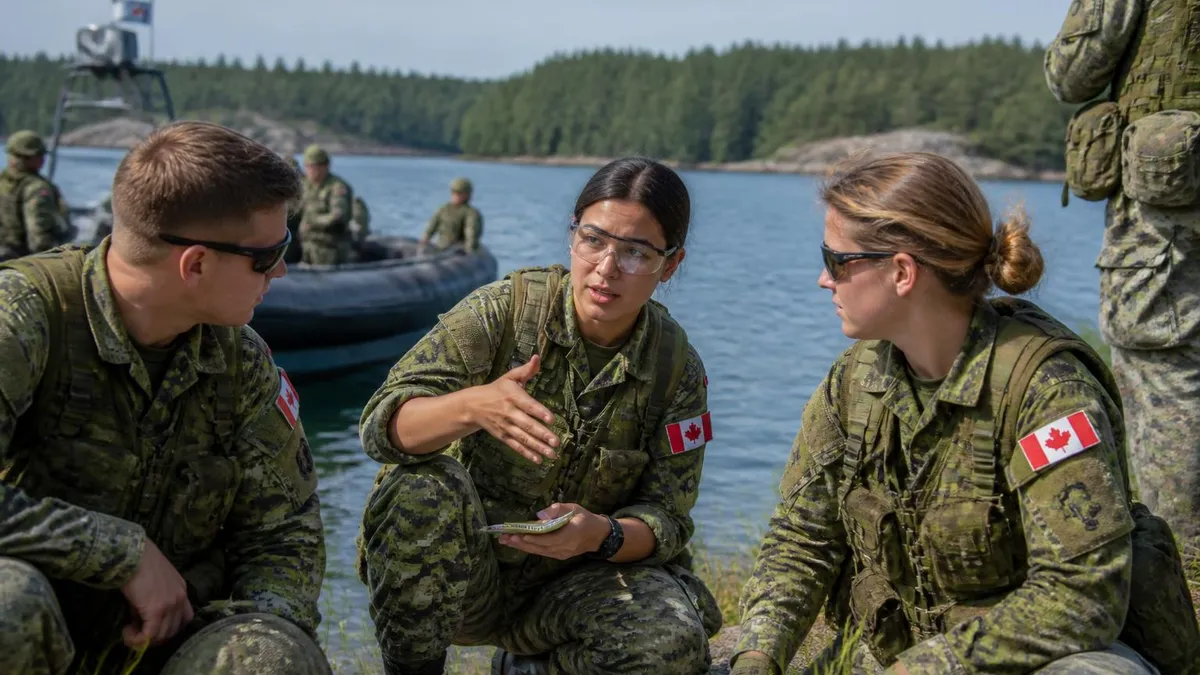
CADET Programs Explained: From CADET Kelly to JROTC, ROTC, and the CADET Test

Sea Cadet Program: Complete Guide to the US Naval Sea Cadets
CADET Ranks Explained: CAP, JROTC, West Point and Canada
About the Author

Educational Psychologist & Academic Test Preparation Expert
Columbia University Teachers CollegeDr. Lisa Patel holds a Doctorate in Education from Columbia University Teachers College and has spent 17 years researching standardized test design and academic assessment. She has developed preparation programs for SAT, ACT, GRE, LSAT, UCAT, and numerous professional licensing exams, helping students of all backgrounds achieve their target scores.
Join the Discussion
Connect with other students preparing for this exam. Share tips, ask questions, and get advice from people who have been there.
View discussion (9 replies)