
Driver's License Test: What to Expect on Test Day 2026 October
What the driver's license test actually involves: written knowledge test, vision check, road skills test, required documents, costs, and how to pass. 🎓
The Driver's License Test, From Permit to Plastic
Getting a driver's license in the United States involves three distinct tests at most state BMVs and DMVs: a vision check, a written knowledge test, and a road skills test. The exact format varies by state, but the structure is broadly consistent. New drivers typically hold a learner's permit for at least six months before attempting the road test, and most states require supervised practice hours during that period. Understanding the full sequence prevents the most common surprise — showing up unprepared for one piece of a multi-step process.
The vision test is usually quick: read a line on the chart, demonstrate basic peripheral vision, sometimes a depth perception check. The knowledge test covers rules of the road, road signs, and traffic laws — typically 25 to 50 multiple-choice questions, with a passing threshold around 80 to 85 percent depending on the state. The road test puts you behind the wheel with an examiner who scores your handling of real driving situations: parallel parking, lane changes, three-point turns, merging, intersections, and basic traffic compliance.
The honest truth is that most first-time test-takers focus on the road skills portion and underprepare for the knowledge test. The knowledge test trips up more applicants than the road test in many states, particularly because the questions probe specific details (exact stopping distances, alcohol limits, right-of-way edge cases) that casual driving experience does not teach. Practice tests are the single best preparation tool for the knowledge portion, and they are widely available online including through this site.
The licensing journey often takes 6 to 18 months from learner's permit to full unrestricted license. The actual time depends on age (under-18 applicants take longer because of graduated licensing), state requirements (some require longer permit periods), and personal preparation pace. Adults switching states or returning after license expiration sometimes complete the entire process in a single visit if they qualify for streamlined testing. The variation is wide enough that asking about your specific situation at the BMV before scheduling produces better planning than guessing.
One detail many applicants miss: the appointment scheduling itself can take weeks at busy BMV offices. Slot availability for road tests sometimes stretches three to six weeks out in dense urban areas, particularly during summer months when high school graduates are testing. Booking the appointment as soon as your permit period reaches its minimum saves substantial calendar time. Some states offer last-minute cancellation alerts via email or text — sign up if your state offers it.
Quick Test Day Reality Check
Most states require: (1) proof of identity (birth certificate or passport), (2) proof of residency (utility bill or lease), (3) social security number documentation, and (4) a parent/guardian signature for under-18 applicants. Bring all originals — copies usually do not count. Total cost typically runs $25 to $50 for the license itself, with separate fees for the knowledge test ($10–$25) and road test in some states. Always check your specific state's BMV website before your appointment.
The Knowledge Test: What It Actually Covers
The knowledge test is a written or computerised exam covering material from the state driver's manual. The manual is the single best study resource because the test pulls questions directly from its content. Most state manuals run 80 to 150 pages and cover signs, signals, road markings, right-of-way rules, parking restrictions, drinking-and-driving law, vehicle equipment requirements, sharing the road with bicycles and pedestrians, and emergency situations. Skipping the manual and relying on driving experience produces inconsistent results.
Test format varies by state. Some use 25 questions with 80 percent passing; others use 40 or 50 questions with 85 percent passing. Most are multiple choice with three or four answer options per question. A few states still use fill-in-the-blank or true/false questions. The exam is now computerised in most states, with immediate scoring at the end. Some states still offer paper tests if requested or required for accommodations. Test results print out at the end and you walk to the road test counter or the next step in the same visit.
The questions tend to cluster around content that matters in real-world driving but that experienced drivers do not always articulate consciously. Right-of-way at four-way stops trips up applicants who 'know' the rule from driving but cannot answer the multiple-choice question precisely. The same applies to specific blood alcohol limits, exact stopping distances at posted speed limits, and the precise sequence of steps for parallel parking. Reading the manual converts informal knowledge into the exact phrasing the test expects.
State-specific content is also tested heavily. Cell phone law varies enormously between states; one state allows hands-free use only, another bans all use while driving, another permits use except in school zones. School bus stopping requirements similarly vary. Move-over law for emergency vehicles varies. Reading the state-specific sections of your manual catches these details that national driving education resources sometimes get wrong for your specific state.
What You'll See on the Knowledge Test
Stop signs, yield signs, warning signs (yellow diamond), regulatory signs, school zone signs, construction zone markings. Includes recognising signs by shape and colour even without reading the text. Roughly 15-25 percent of questions on most tests.
Four-way stops, intersections without signs, turning across traffic, pedestrian rights, emergency vehicles, school buses with flashing lights. The most commonly missed category because questions probe specific edge cases people rarely think about consciously while driving.
Default limits in residential, school zones, highways. Three-second rule for following distance, increased distance in poor weather, stopping distance at various speeds. Specific numerical thresholds the manual lists explicitly.
Blood alcohol concentration limits (0.08 most states, 0.04 commercial drivers, 0.00-0.02 under 21), implied consent law, license suspension consequences, prescription drug restrictions. Heavily tested because it is heavily covered in the manual.
Headlights, taillights, brake lights, mirror requirements, child safety seat law, seatbelt law, insurance requirements. State-specific details (cell phone law, hands-free requirements) test surprisingly often because they vary substantially between states.
Pedestrians, bicyclists, motorcycles, large trucks, school buses, emergency vehicles. Move-over law for stopped emergency vehicles. School bus stopping requirements when red lights flash. Right-of-way at crosswalks.
The Road Skills Test: What the Examiner Watches
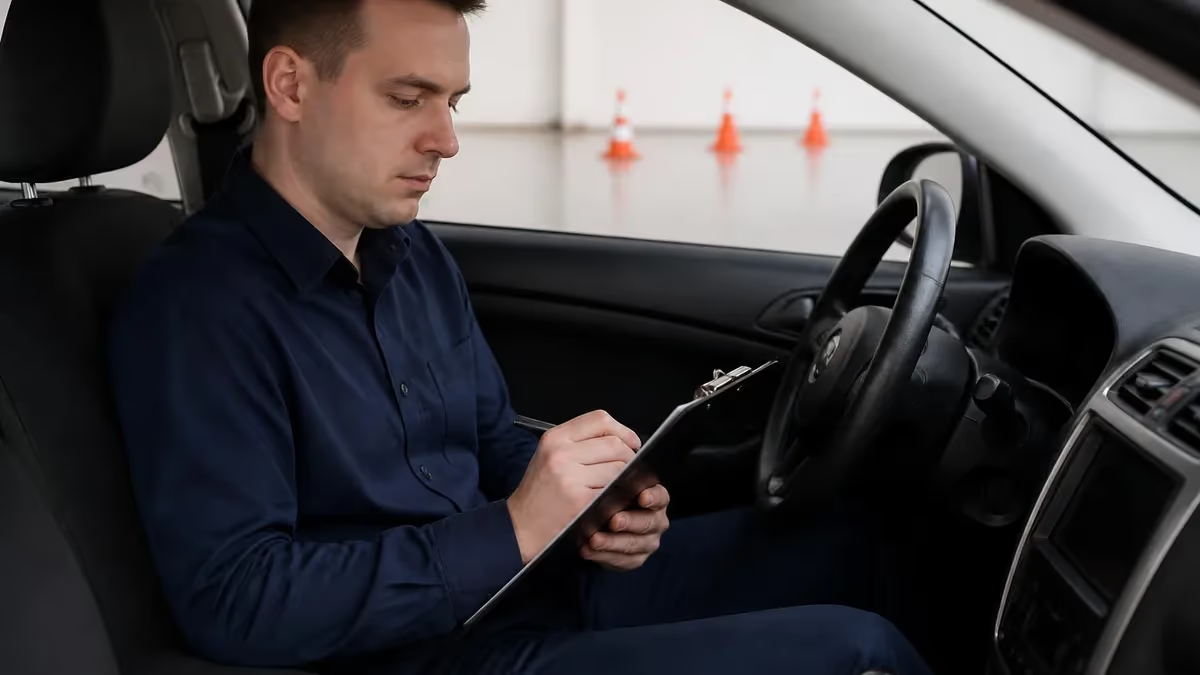
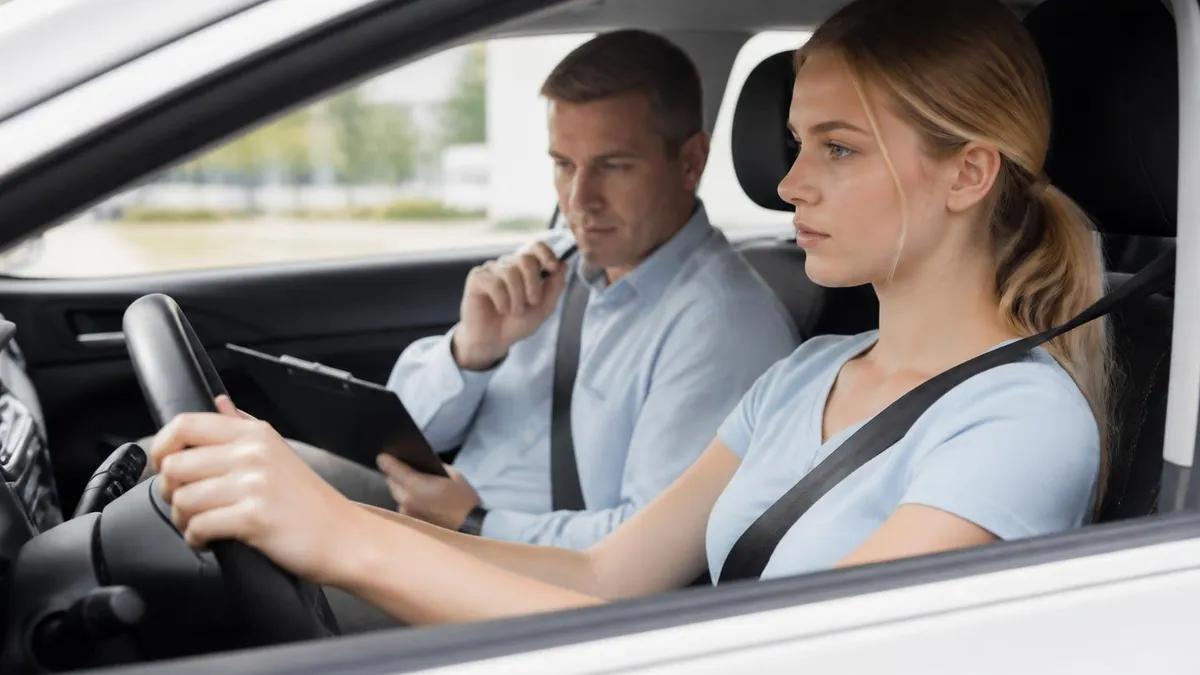
The road skills test puts you in the driver's seat of a vehicle (yours or rented at some BMVs) with a state-certified examiner in the passenger seat. The examiner gives directions, observes your handling, and scores you on a state-specific checklist. Tests typically run 15 to 25 minutes covering basic neighbourhood streets, an arterial road, sometimes a freeway entrance, parking manoeuvres, and a return to the test site. The examiner is looking for safe, lawful, controlled driving — not exceptional skill. The bar is competent, not impressive.
Most road tests include parallel parking. The vehicle must end up parallel to the curb, within 12 inches, without striking the curb or any markers. Some states have replaced parallel parking with simpler curb parking; others still require the full manoeuvre. Three-point turns, lane changes with proper mirror checks and signals, intersection handling, and merging into traffic all appear on most tests. Backing in a straight line and demonstrating proper hand position on the wheel sometimes get checked too. The exact checklist is published online by most state BMVs.
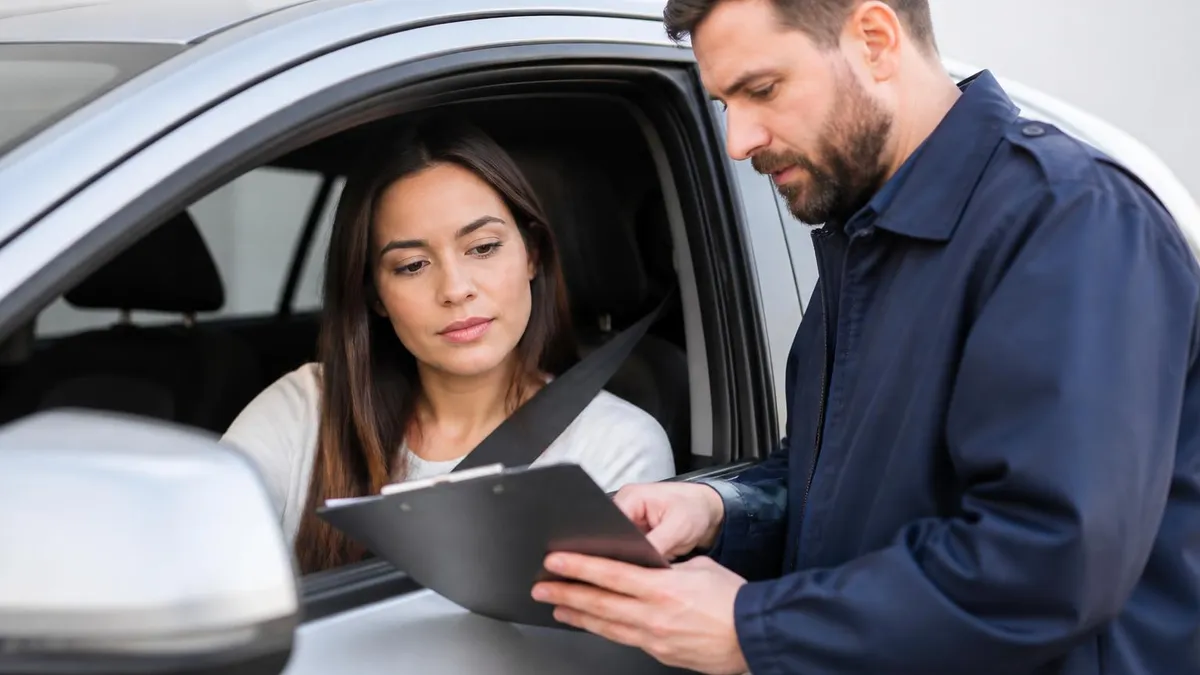
The examiner marks errors as critical or non-critical. Critical errors (collisions, traffic violations, dangerous behaviour) end the test immediately. Non-critical errors (improper signal, late lane change, mild speed variance) accumulate to a failure threshold — typically 30 to 50 points depending on the state. Knowing your specific state's scoring system before the test helps you understand what matters most. The examiner is not allowed to coach you during the test, so the test is a performance, not a lesson.
The examiner is grading specific behaviours, not impressions. Hand position on the wheel (9-and-3 or 10-and-2 depending on state), mirror checks before lane changes, head turns to check blind spots, signal timing (typically at least 100 feet before turn or lane change), and complete stops at signs and red lights all get specific check marks on the scoring sheet. Smooth, controlled driving that hits each specific behavioural marker outscores enthusiastic but inconsistent driving even if the overall outcome looks similar to a passenger.
Common Road Test Failures and How to Avoid Them
The single most common road test failure. A complete stop means the vehicle is fully stationary for one to two seconds at stop signs and red lights before turning right. Hesitating to a slow roll counts as a critical error in most states. Practice complete stops during permit driving until the muscle memory is automatic.
Required Documents and What to Bring
Most states require four document categories: identity, social security, residency, and parent or guardian consent for under-18 applicants. Identity documents include a certified birth certificate (not a hospital souvenir certificate), valid passport, or permanent resident card. Bring originals — most BMVs do not accept photocopies. Social security verification can be the actual card or a W-2 form, pay stub, or 1099 with the full number listed.
Residency documents prove you live in the state where you are getting licensed. Two documents typically required: utility bill, lease agreement, mortgage statement, bank statement, or insurance documents from the last 60 days. The residency name must match the identity document name exactly; nicknames or shortened versions sometimes cause rejection. Parent or guardian consent for under-18 applicants involves a signed form (provided by the BMV) and the parent or guardian's own valid identification at the appointment.
The most common document failure is residency proof. Many young applicants live with parents and do not have utility bills or leases in their own name. Acceptable workarounds include: parents' utility bills paired with a parent's signed statement of cohabitation, school enrolment letters from accredited schools, or W-2 forms from local employment. Each state lists acceptable workarounds on the BMV website. Calling ahead with your specific situation prevents wasted appointment time when documents do not match the standard list.
Identity document name matching also causes failures. The name on your birth certificate must match the name on your social security card, residency documents, and the name you give on the application. Marriage, divorce, adoption, or legal name changes require documentation of the change (marriage certificate, divorce decree, court order). Bringing the documentation even if you think you do not need it prevents the appointment from being rescheduled because of paperwork mismatches.
Since May 2025, federal law requires Real ID-compliant licenses for boarding domestic flights and entering federal facilities. Real ID applications require additional documentation beyond standard licensing: typically two proofs of residency (not one), full legal name documents (any name change documentation if applicable), and verification of social security number. Mark on your application whether you want Real ID. The cost is the same in most states, but the document requirements are stricter. Standard non-Real ID licenses are still issued in some states for those who do not need federal compliance.
The Permit Period: What Happens Before the Road Test
Most states require a learner's permit period of at least six months before the road test. The permit allows supervised driving (with a licensed adult, usually 21 or older, in the passenger seat) and gives the applicant practice time before the road test. Some states require documented practice hours — Maryland requires 60 hours including 10 night-time hours, for example. The hours typically need to be logged on a state-provided form signed by the supervising adult.
Under-18 applicants face graduated licensing in nearly every state. The permit holds for six months minimum, then the provisional or intermediate license restricts night-time driving (typically 10 PM to 5 AM), passenger limits (often only family members for the first 6-12 months), and zero alcohol tolerance. The full unrestricted license arrives at age 18 or after a graduated period. Knowing your state's specific graduated licensing rules prevents accidental violations during the intermediate period.
The supervised driving requirement matters more than most permit holders realise. The hours requirement is often unverified for adult learners, but examiners can detect inadequate supervised practice within minutes of the road test starting. Mirror habits, hand position, smoothness in braking and accelerating, and confidence at intersections all telegraph the amount of practice the applicant has accumulated. Forty hours of supervised driving with focused practice on test-specific manoeuvres performs better than 100 hours of casual driving without targeted skill building.
Night driving practice is particularly important because most states require it explicitly and because night driving requires different skills than day driving. Practicing 10 hours of night driving in varied conditions (residential, arterial, highway, rain) prepares applicants for night-driving questions on the knowledge test and for the practical skills the graduated license requires. Some applicants under 18 face restrictions specifically because they have not built night-driving skills during the permit period.
Test Day Checklist
- ✓Bring birth certificate or passport (originals only)
- ✓Bring social security card or alternate verification document
- ✓Bring two proofs of residency from last 60 days (utility bill, lease, bank statement)
- ✓Parent or guardian consent form signed if under 18
- ✓Cash, check, or card for licensing fee ($25-$50 typical)
- ✓For road test: registered, insured vehicle in safe operating condition
- ✓Proof of vehicle insurance and registration for road test
- ✓Glasses or contact lenses if required by your vision result
- ✓Arrive 15-20 minutes early to handle paperwork before scheduled time
What Happens If You Fail Your First Try
Failing a knowledge test or road test on the first attempt is common — failure rates run 30 to 50 percent depending on the state. The retest waiting period varies. Most states allow a retest after one to seven days, with a few requiring two-week or thirty-day waits. The retest fee is sometimes the same as the original; some states discount it. The examiner provides feedback on what you missed, which helps target preparation for the retest. Asking specific questions about your failed sections produces more useful feedback than general 'how did I do' questions.
Most states allow up to three failed attempts before requiring additional driver education. After three failures, some states require completion of a state-approved driver's training course or formal lessons before the fourth attempt. This is the system's way of intervening when test-taking pattern suggests genuine skill gaps rather than test anxiety. Reading the manual cover-to-cover and taking five to ten practice tests catches most knowledge gaps before they show up on the actual exam.
Test anxiety is a real factor that compounds beyond simple skill gaps. Applicants who pass the practice test consistently sometimes fail the actual exam because of nerves rather than knowledge. Strategies that help: arrive early enough to handle paperwork without rushing, eat a light meal before the test, take a few practice tests in the days leading up to the exam to build confidence, and remember that failure is not a permanent setback — most states allow retests within a week.
State-by-State Variation You Should Know About
License requirements differ substantially between states. The minimum age for a learner's permit ranges from 14 (South Dakota, Iowa, Kansas) to 16 (most states). The full unrestricted license age ranges from 16 (some southern states) to 18 (most states with graduated licensing). The road test format varies in scope: some states require freeway driving; others stay on neighbourhood streets entirely. Practice with the specific test format your state uses, not the generic format you might find on national driving education websites.
Out-of-state applicants often face additional complications. Moving from one state to another typically requires transferring your existing license within 30 to 60 days of establishing residency. The transfer usually waives the road test if you have a valid out-of-state license but still requires the knowledge test to verify familiarity with state-specific law. International applicants from countries with reciprocity agreements (UK, Germany, Japan, Canada among others in some states) may transfer without testing; those without reciprocity must complete the full testing sequence as a new applicant.
Provisional license restrictions also vary substantially between states. The night-driving curfew might run 11 PM to 5 AM in one state and 9 PM to 6 AM in another. Passenger restrictions might allow only family members for the first six months in one state and ban all teen passengers entirely for the first year in another. The cell phone restrictions for provisional drivers are sometimes total bans regardless of hands-free capability. Reading your specific state's restrictions during the permit period prevents accidental violations during the intermediate period.

Driver's License Test Numbers
Key Facts at a Glance
| Item | Value | Details |
|---|---|---|
| Typical license fee | $25-$50 | |
| Minimum permit period (most states) | 6 months | |
| Knowledge test passing score | 80-85% |
Test Preparation Strategy
The manual is the single best preparation resource because it is the source material for test questions. Most state manuals run 80 to 150 pages. Reading once is good; re-reading specific sections (right-of-way, alcohol law, signs and signals) is better. The manual is free online or at any BMV office.
Practice tests reveal which content areas you have learned thoroughly versus which still trip you up. Score 90+ on three consecutive practice tests before scheduling the actual exam. The questions on practice tests are not identical to the real exam, but the pattern coverage is similar enough to predict performance.
Permit driving builds the muscle memory the road test evaluates. Drive in varied conditions: residential, arterial, highway, parking lots, night, rain. Practice the specific manoeuvres your state's road test will check (parallel parking, three-point turns, lane changes) until they are routine. The road test is designed to be passable with adequate preparation.
Examiners are typically less rushed early in the day, traffic is lighter, and you have done your morning routine without the stress of squeezing the appointment between other commitments. Mid-week appointments avoid Friday backlog and Monday morning rush. Avoid scheduling during your high-anxiety hours of the day if you have any flexibility.
Costs and Fees You'll Encounter
License costs vary by state but typically run $25 to $50 for the license itself, valid for four to eight years depending on state. Add separate fees for the knowledge test (often $10 to $25, sometimes included in the license fee) and the road test (often $20 to $40 for the in-person examiner time, sometimes included). Real ID compliance does not change the fee in most states but does require additional documents. Failed retests sometimes carry the same fee as the original; check your state's policy before assuming.
Insurance costs are typically the larger expense for new drivers, dwarfing the licensing fees themselves. New driver insurance rates run two to four times higher than established driver rates, particularly for drivers under 25. Adding a teen driver to a parent's policy is usually less expensive than a separate policy. Driver's education completion provides insurance discounts in most states — typically 5 to 15 percent — that can offset the upfront cost of the course over the first one to two years of coverage.
Vehicle registration is also a separate fee not included in the license cost. Registration fees vary widely by state and vehicle type, ranging from under $50 to over $500 annually. Combined first-year cost for a new driver — license fee, knowledge test fee, road test fee, vehicle registration, insurance, possible driver's education — can total $1,500 to $3,000 depending on state and circumstances. Budgeting for the full picture prevents surprise costs after the license is issued.
Pre-Booked Driving School Lessons vs Self-Study
- +Driving school instructors know exactly what your state's road test scores
- +Structured curriculum covers all knowledge test categories systematically
- +Some states require a course before licensing for under-18 applicants
- +Insurance discount eligibility for completed driver education programs
- +Real-world feedback from instructors who have seen thousands of test takers
- −Cost: $300 to $700 for full driving school programs
- −Schedule conflicts with school, work, or extracurricular activities
- −Adult learners often find structured classes paced too slowly for their needs
- −Quality varies substantially between schools — research carefully
- −Self-study with state manual + practice tests + supervised driving works for many
BMV Questions and Answers
About the Author
Licensed Driving Instructor & DMV Test Specialist
Penn State UniversityRobert J. Williams graduated from Penn State University with a degree in Transportation Management and has spent 20 years as a certified driving instructor and DMV examiner consultant. He has personally coached thousands of applicants through written knowledge tests, skills assessments, and commercial driver licensing programs across more than 30 states.
Join the Discussion
Connect with other students preparing for this exam. Share tips, ask questions, and get advice from people who have been there.
View discussion (9 replies)