
Indiana BMV Practice Test: Free Questions to Pass Your Permit Exam
Take a free Indiana BMV practice test with questions matching the real permit exam. Covers road signs, traffic laws, and safe driving for Indiana learners.
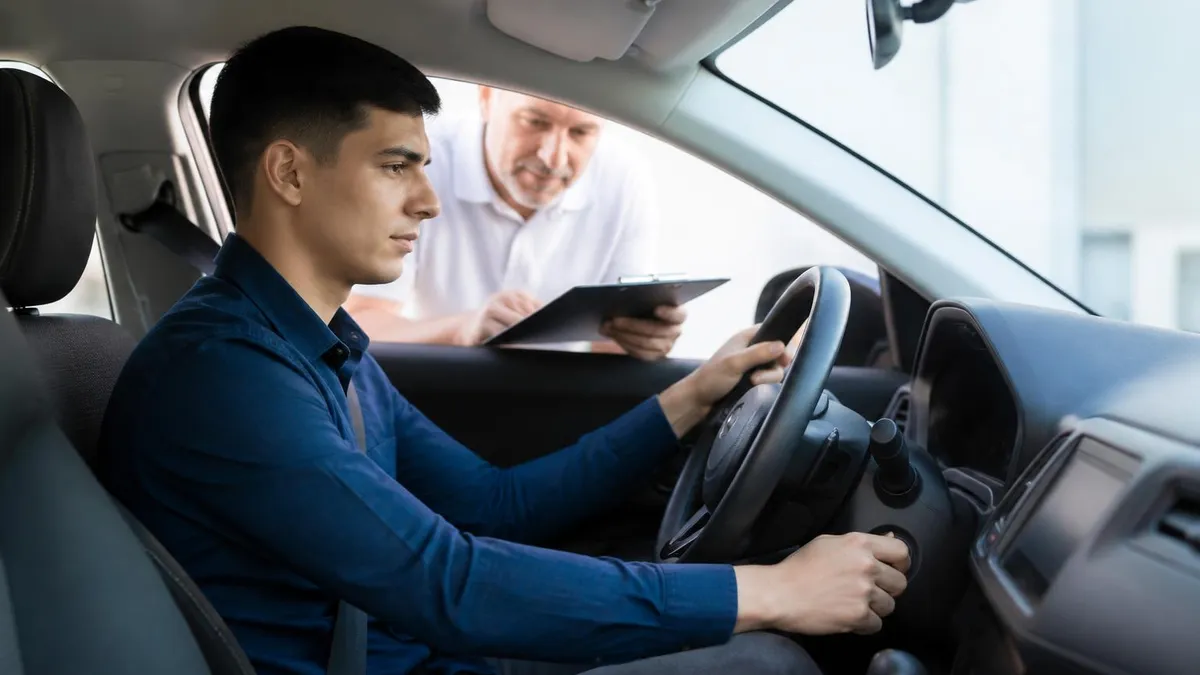
Indiana BMV Practice Test: Prepare to Pass
The Indiana BMV written knowledge test is 34 questions — 16 road sign identification questions and 18 general knowledge questions about traffic laws and safe driving. You need at least 28 correct answers to pass (approximately 82%). That passing score leaves very little room for error: you can only miss 6 questions out of 34. Students who walk into the BMV without preparation fail at a surprisingly high rate because the test includes specific numbers, rules, and sign meanings that casual driving experience alone doesn't teach you.
An Indiana BMV practice test is the most effective preparation tool because it mirrors the actual exam format — multiple choice questions covering the same topics at the same difficulty level. When you answer practice questions, check your answers, and review the explanations for anything you got wrong, you build the specific knowledge the BMV tests.
Reading the Indiana Driver's Manual cover to cover helps with general understanding, but practice tests tell you exactly which topics you know and which need more study. Most people who take 3–4 full practice tests before the real exam pass comfortably on their first attempt.
Indiana's BMV written test is administered on a computer terminal at any BMV branch location across the state. You can walk in without an appointment at most branches, though some locations offer online scheduling. The test is available in English and Spanish, and accommodations are available for people with disabilities or reading difficulties. Once you pass, you proceed to the next step in obtaining your Indiana learner's permit or driver's licence — which means the written test is quite literally the gateway to driving legally in Indiana.
This guide covers what the Indiana BMV practice test includes, what topics are most heavily tested, the specific rules and numbers you need to know, and strategies for passing on your first attempt. Whether you're a teenager getting your first learner's permit or an adult who needs to take the written test for a new licence, the preparation advice here applies equally.
- Total questions: 34 — split into 16 road sign questions and 18 general knowledge questions
- Passing score: 28 out of 34 correct (approximately 82%)
- Test format: Computer-based, multiple choice, at any Indiana BMV branch
- Study material: Indiana Driver's Manual (free from in.gov/bmv)
- Time limit: No official time limit — take as long as you need
- Languages: English and Spanish; other language accommodations available by request
- Retake policy: If you fail, you can retake the next business day at no additional charge
- Permit age: You can take the test at age 15 to obtain an Indiana learner's permit
- Cost: The test fee is included in the permit application fee ($9 for a learner's permit)
How to Prepare for the Indiana BMV Test
Step 1: Download the Indiana Driver's Manual
Step 2: Take a Diagnostic Practice Test
Step 3: Focus on Your Weak Areas
Step 4: Take 3–4 Full Practice Tests
Step 5: Visit Your Local BMV Branch

What the Indiana BMV Test Covers
The 34 questions on the Indiana BMV written test break into two distinct sections: 16 road sign questions and 18 general knowledge questions. Understanding what each section tests — and which areas are most heavily weighted — helps you allocate your study time effectively.
Road sign questions show you an image of a sign and ask you to identify what it means. The test covers all major sign categories: regulatory signs (white rectangles — speed limits, no U-turns, one-way), warning signs (yellow diamonds — curves, hills, merging traffic), guide signs (green rectangles — highway exits, distances), construction signs (orange diamonds — road work, detours), and special signs (school zones, railroad crossings, pedestrian crossings). Learning the sign classification system — shape and colour communicate the sign's category before you even read the text — is more efficient than memorising each sign individually.
The sign shapes you need to know: octagon means stop. Inverted triangle means yield. Diamond means warning. Pentagon means school zone. Round means railroad crossing ahead. Pennant shape means no passing zone. Rectangle means regulatory (if vertical) or guide (if horizontal). Knowing these shape-meaning associations lets you answer sign questions even for signs you haven't specifically studied, because the shape tells you the category of message the sign communicates.
General knowledge questions cover Indiana-specific traffic laws, right-of-way rules, safe driving practices, alcohol and drug laws, parking regulations, and emergency procedures. These questions test specific knowledge — not general driving intuition. For example, you need to know that Indiana's BAC limit is 0.08% for drivers 21 and older and 0.02% for drivers under 21. You need to know the correct following distance (3–4 seconds under normal conditions). You need to know when to use headlights, how to respond to emergency vehicles, and what Indiana's move-over law requires.
Speed limits are frequently tested and Indiana-specific: 30 mph in urban districts (unless posted otherwise), 55 mph on other roads, and 70 mph on interstate highways. Work zones have reduced speed limits and doubled fines. School zones have specific speed restrictions when children are present. Knowing these default speed limits — and knowing that posted speed limits override defaults — is essential for the test.
Seat belt and child restraint laws are also tested. Indiana law requires all front-seat occupants to wear seat belts, and children under 8 must be in a properly fitted child restraint system (car seat or booster seat). Children between 8 and 16 must wear seat belts. Violations result in fines. The specific age and weight thresholds for transitioning from rear-facing car seats to forward-facing seats to booster seats to regular seat belts are testable — check the Indiana Driver's Manual for the current requirements, which align with national recommendations but are enforced at the state level.
Alcohol and drug questions appear on every Indiana BMV test. Beyond BAC limits, you need to understand implied consent (refusing a chemical test results in automatic licence suspension), the look-back period for repeat offences, and that operating a vehicle while intoxicated is a criminal offence with escalating penalties. These questions are among the most commonly missed because test-takers who've never been in legal trouble often don't know the specific numbers and legal consequences that the test asks about.
Most Commonly Missed Indiana BMV Topics
At an intersection with no traffic signs or signals, the vehicle on the right has the right of way. If two vehicles arrive at the same time, the vehicle on the right goes first. When turning left, you must yield to oncoming traffic. These rules are tested frequently on the Indiana BMV exam and are among the most commonly missed questions because many experienced drivers follow informal patterns rather than knowing the formal rules.
Indiana has a graduated licensing system for drivers under 21. Learner's permit holders (age 15–16) must log 50 practice hours (including 10 hours at night) before taking the driving test. Provisional licence holders (under 18) have driving curfews (no driving between 11 PM and 5 AM except for work, school, or emergencies) and passenger restrictions. These GDL rules are specific to Indiana and are tested on the permit exam.
You must park at least 15 feet from a fire hydrant, 20 feet from a crosswalk at an intersection, and 50 feet from a railroad crossing. Parking on a hill requires turning your wheels — toward the curb when facing downhill (to prevent rolling into traffic), away from the curb when facing uphill. These specific distances are testable and easy to forget if you haven't memorised them.
When an emergency vehicle approaches with lights and sirens, Indiana law requires you to pull to the right and stop. Indiana's move-over law requires drivers to move over one lane (when possible) or slow to 10 mph below the posted speed limit when passing stopped emergency vehicles, utility vehicles, or tow trucks with flashing lights on the roadside. Failing to move over can result in fines. This is a newer law that many test-takers aren't aware of.
Indiana Learner's Permit: Requirements and Process
Indiana residents under 18 follow these steps to obtain a learner's permit:
- Age: Must be at least 15 years old
- Written test: Pass the 34-question BMV knowledge test (28/34 correct)
- Parental consent: A parent or legal guardian must accompany you to the BMV and sign the application
- Identification: Bring birth certificate or passport, Social Security card, and two proofs of Indiana residency
- Vision test: Pass a basic vision screening at the BMV (bring glasses or contacts if you need them)
- Practice driving: Must complete 50 hours of supervised driving (including 10 night hours) before taking the road test
- Fee: $9 for the learner's permit
Tips for Passing the Indiana BMV Test on Your First Try
The Indiana BMV test isn't difficult if you prepare properly — but the margin for error is slim at 82% passing. These tips maximise your chances of passing on the first attempt.
Start with road signs. They represent 47% of the test (16 out of 34 questions) and are the easiest to study for because they're purely visual — you either recognise the sign or you don't. Use flashcards, online sign quizzes, or the sign section of the Indiana Driver's Manual.
Pay special attention to signs that look similar but mean different things: the yellow diamond warning signs versus the orange diamond construction signs, or the difference between a school zone sign (pentagon) and a school crossing sign (pentagon with child figures). Mastering road signs is the fastest way to lock in points before the test.
Read each question carefully. Many BMV exam questions are designed so that two answers seem plausible, and the correct one is distinguished by a specific detail in the question. Words like 'always,' 'never,' 'must,' and 'should' change the meaning significantly. 'You must stop' is different from 'you should slow down.' Test-takers who read too quickly often select the second-best answer because they missed a qualifying word in the question.
Answer according to the manual, not according to how you actually drive. The BMV tests textbook-correct answers based on Indiana law and the Driver's Manual, not real-world driving conventions. If the manual says you should maintain a 3–4 second following distance and your real-world habit is 2 seconds, the correct test answer is 3–4 seconds. Similarly, if a question asks what you should do when approaching a school bus with flashing red lights, the answer is 'stop and remain stopped until the lights stop flashing' — even if in practice you might assess the situation differently.
Don't overthink the questions. The BMV test assesses basic driving knowledge, not complex reasoning. If a question seems straightforward, it probably is — the test isn't trying to trick you with subtle wordplay or hidden meaning. Choose the answer that aligns most directly with the Driver's Manual's instruction for that situation.
If you fail, don't panic — you can retake the test the next business day at no additional charge. But rather than immediately retaking, use the interval to study the areas you struggled with. The BMV can't tell you which specific questions you missed, but they may indicate which sections (signs vs general knowledge) were weaker. Focus your re-study on the weaker section before retaking.
Indiana BMV Test Day Checklist
- ✓Bring a birth certificate or passport as proof of identity — your name must match your application exactly
- ✓Bring your Social Security card or a W-2 showing your full SSN
- ✓Bring two documents proving Indiana residency: utility bill, bank statement, rental agreement, or school enrollment letter with your Indiana address
- ✓If under 18, bring a parent or legal guardian who can sign the application and consent forms
- ✓Bring payment: $9 for learner's permit (check accepted payment methods — some branches don't accept cash)
- ✓Wear glasses or contact lenses if you need them — the BMV administers a vision screening at the same visit
- ✓Take one final practice test the morning of your exam as a refresher — focus on reviewing, not learning new material
Indiana BMV Practice Tests vs Reading the Manual
- +Practice tests build active recall — answering questions from memory produces stronger knowledge retention than passively reading the manual
- +Practice tests reveal your specific weak areas — you find out exactly which signs, rules, or scenarios you don't know rather than studying everything equally
- +The manual provides comprehensive reference — it contains every testable topic and is essential for reviewing the specific rules you missed on practice tests
- +Combining both is the most effective strategy — read the manual for understanding, then use practice tests to verify your knowledge and identify remaining gaps
- −Reading the manual alone creates false confidence — material seems familiar when you read it, but you can't recall the specific details when tested
- −Practice tests without manual review can leave conceptual gaps — you might learn the right answer to a specific question without understanding the underlying rule
- −Low-quality practice tests with outdated or inaccurate questions can teach you wrong answers — use practice tests from reputable sources
- −Relying on only one method leaves you underprepared — the manual teaches; practice tests verify
Indiana BMV Practice Test vs the Real Exam
A good Indiana BMV practice test closely mirrors the real exam — same question format (multiple choice), same topic distribution (road signs and general knowledge), and similar difficulty level. The goal is eliminating surprises so the real test feels like another practice round.
The real BMV test pulls from a larger question bank than any single practice test, so you won't see the exact same questions on test day. But the topics and question styles are consistent. If you can correctly identify road signs, answer right-of-way questions, state BAC limits, and recall parking distances on practice tests, you'll handle the real exam's versions of those questions without difficulty.
One difference to know: the real exam is administered on a computer terminal at the BMV, and you can't go back and change answers to previous questions. In practice tests, you typically can review and change answers — don't rely on this capability during the real exam. Read each question carefully and commit to your answer before moving forward. This is why developing confidence through multiple practice tests matters: on the real exam, second-guessing wastes mental energy because you can't revisit decisions.
The question pool the BMV draws from is larger than any single practice test, which means you won't see the exact same questions — but the topics and difficulty level are consistent. A practice test question about following distance will use different numbers or scenarios than the real exam's version, but the core knowledge being tested is identical. The value of practice tests isn't memorising specific questions; it's building the knowledge base that makes any version of the question answerable.
Indiana BMV Test: Key Numbers
After Passing: Next Steps in Indiana
Once you pass the Indiana BMV written test, your next steps depend on your age and whether you're getting a learner's permit or a full licence.
If you're under 18, passing the written test qualifies you for a learner's permit. With the permit, you can practise driving with a licensed adult (at least 25 years old or a licensed driving instructor) in the passenger seat.
You must complete 50 hours of supervised practice driving (including 10 hours at night) before you're eligible to take the road test. Keep a driving log — the BMV may ask to see it. After completing your practice hours and holding the permit for the required period, you can schedule your road test at a BMV branch that offers driving skills tests.
If you're 18 or older, you can either obtain a learner's permit and practise before taking the road test, or schedule the road test directly if you already have driving experience. Adults aren't required to log supervised practice hours, though practising before the road test is strongly recommended — especially if you haven't driven before or haven't driven recently. The road test evaluates your ability to operate a vehicle safely in traffic conditions: starting and stopping, turning, lane changes, parking, and responding to traffic signals and signs.
The examiner uses a standardised scoring sheet, and you can make a certain number of minor errors and still pass — but any serious safety violation (running a stop sign, failing to yield, causing a hazardous situation) results in automatic failure regardless of how well you performed otherwise. Practise the specific manoeuvres the road test evaluates before your appointment: parallel parking, three-point turns, and backing up in a straight line are common test elements that many drivers don't practise enough.
The road test itself is a practical demonstration of driving skills — not a written exam. You drive a vehicle (which you provide — it must be registered, insured, and in safe working condition) while a BMV examiner evaluates your performance from the passenger seat. The test takes about 15–20 minutes and covers a route near the BMV branch. Passing the road test qualifies you for a probationary licence (if under 21) or a full operator's licence (if 21 or older).
You don't need to pay for Indiana BMV practice test access. The Indiana Driver's Manual is free from in.gov/bmv, and numerous legitimate free practice test websites offer questions matching the real exam format. Some websites charge $10–$30 for 'premium' practice tests or 'guaranteed pass' packages — these aren't necessary and don't offer meaningfully different content from free alternatives. The information on the BMV exam comes from the publicly available Indiana Driver's Manual. Save your money for the permit application fee.
Indiana BMV Locations and Hours
Indiana has BMV branches throughout the state — over 140 locations serving all 92 counties. The largest concentration is in the Indianapolis metro area, but branches exist in every region of the state including smaller cities and rural areas. You can take the written test at any BMV branch — you're not limited to the branch nearest your home.
Most Indiana BMV branches are open Monday through Friday, with some offering Saturday hours. Specific hours vary by location — check in.gov/bmv for your nearest branch's schedule. Some branches accept walk-ins only; others offer online appointment scheduling. Scheduling an appointment (when available) reduces wait time significantly — walk-in visitors may wait 30–60 minutes or longer during peak times.
Peak times to avoid: Monday mornings (backlog from the weekend), the last business day of the month (registration renewals), and the first few weeks of June (graduation season for teens getting permits). Mid-week mornings (Tuesday through Thursday, 9:00–11:00 AM) tend to have the shortest wait times.
If your nearest branch is consistently crowded, consider driving to a smaller branch in a neighbouring county — the test is the same at every location, and a 20-minute drive to a less busy branch can save you an hour of waiting in line. If your branch offers Saturday hours, those sessions can be busy because they serve people who can't visit during the work week.
Indiana BMV Practice Test Questions and Answers
About the Author
Attorney & Bar Exam Preparation Specialist
Yale Law SchoolJames R. Hargrove is a practicing attorney and legal educator with a Juris Doctor from Yale Law School and an LLM in Constitutional Law. With over a decade of experience coaching bar exam candidates across multiple jurisdictions, he specializes in MBE strategy, state-specific essay preparation, and multistate performance test techniques.