
Road Test: What to Expect and How to Pass Your Driving Exam 2026 September
🔎 Everything about the road test: what the examiner evaluates, common reasons for failing, what to bring, and how to prepare for your driving exam.
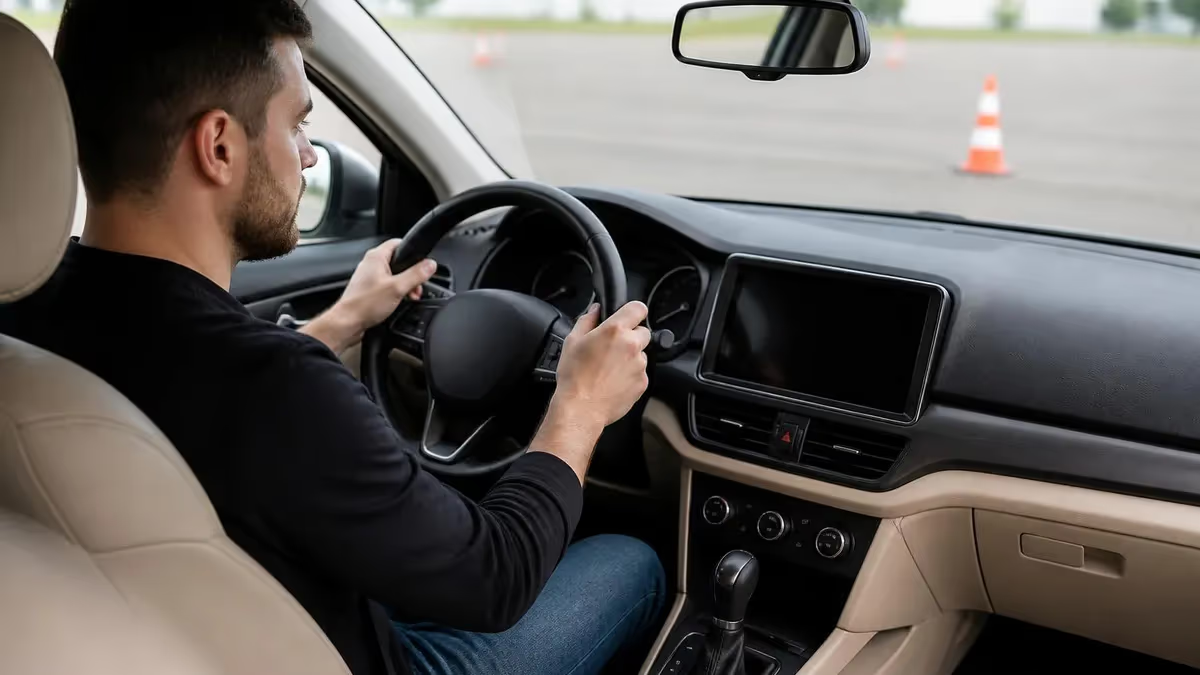
The road test is the practical skills assessment that stands between a learner driver and a full license. Unlike the written knowledge test, the road test requires you to demonstrate actual driving skill in real traffic conditions while an examiner scores your performance against a standardized rubric. Every error, hesitation, and technique is evaluated during the 15 to 30 minutes you spend behind the wheel.
Understanding what the examiner is looking for — and why — gives you a strategic advantage in preparation. Examiners aren't looking to fail candidates; they're evaluating specific observable behaviors that predict safe, independent driving. The skills tested on the road test were selected because research and accident data show that deficiencies in these areas correlate with crash risk. Knowing this context transforms the road test from an arbitrary hurdle into a logical checklist of demonstrable competencies.
Most states use a point-based scoring system where critical errors cause automatic failure and lesser errors accumulate toward a point threshold. An automatic failure — called a critical error or safety violation — occurs for actions like running a red light, making contact with another vehicle or object, requiring the examiner to intervene to prevent a collision, or refusing to comply with a traffic control device. These are instant failure scenarios regardless of how well you performed on everything else.
The DMV practice test covers the traffic laws and sign recognition that underpin the road test. Knowing the rules is a prerequisite for demonstrating them correctly — an examiner who asks you to make a legal U-turn expects you to know when and where a U-turn is permitted before you attempt it.
Preparation for the road test has two distinct components: building the technical skills (vehicle control, steering, braking, lane positioning) and building the judgment skills (when to yield, how to merge, how to handle intersections without traffic signals). Both require practice under conditions similar to the actual test, which usually takes place in moderate suburban traffic around the BMV or DMV testing facility.
After scheduling your road test appointment (the process for which is covered in the schedule road test guide), you should be spending your final preparation weeks practicing on the actual roads near the testing location. If you don't know which route the examiner uses, practice in the surrounding neighborhood — most test routes involve the same types of maneuvers regardless of specific streets.
Nervousness during the road test is expected and normal. Examiners are trained to work with nervous candidates and will not take points off for visible anxiety as long as your driving behavior is safe and correct. Breathing exercises in the parking lot before the test, arriving early to watch other candidates exit the facility, and having a clear mental checklist of what to demonstrate all help channel nervous energy into focused performance rather than paralysis. The goal is to arrive in a mental state where you are thinking about driving, not thinking about whether you are going to pass.
Weather conditions on test day require adjustment in your technique. Rain means slower speeds, greater following distance, and more deliberate stops. Snow or ice may mean the testing site cancels appointments entirely -- call ahead to confirm if weather is severe the night before. If conditions are wet but tests are running, your performance expectations adjust slightly: examiners understand that braking distances extend in rain, and the adjustment is built into how they score speed management in wet conditions.
Road Test at a Glance
The road test evaluates five core skill areas at every testing site in the country. Vehicle control includes smooth acceleration, controlled braking, steering precision, and proper speed management. Observation and scanning covers mirror use, head checks, checking blind spots before changing lanes or merging, and scanning intersections before entering.
Traffic sign and signal compliance tests whether you follow the rules you learned for the knowledge exam. Lane usage and positioning evaluates whether you drive in the correct lane, maintain appropriate lane position, and transition between lanes safely. Parking and backing skills — parallel parking, uphill and downhill parking with curbs, three-point turns, or backing maneuvers — are tested at most sites.
Each of these areas contains specific observable behaviors the examiner marks on the score sheet. For observation, they're watching whether your head actually moves to check blind spots or whether you only glance at mirrors. For lane positioning, they're watching whether you drift or maintain a consistent centered position within the lane. For speed management, they're watching whether you adjust speed appropriately for conditions, not just whether you stay under the posted limit.
Left turns are one of the highest-failure-rate items on road tests nationwide. Examiners look for three things on every left turn: approach in the correct lane, waiting until there is a safe gap in oncoming traffic, and completing the turn into the correct lane. Failing to complete the turn into the near lane — instead swinging wide into the far lane — is a common critical error. The correction is simple: after completing the turn, your vehicle should be in the leftmost through lane, not the right lane or anywhere in the oncoming travel path.
Right turns have their own failure points. Approaching too wide (hugging the center line before turning) and cutting the corner (turning into the curb or bicycle lane) are the most common errors. On right turns at stop signs or red lights, rolling stops — where the vehicle slows dramatically but never reaches a full stop — are automatic failures at many testing sites. The vehicle must come to a complete stop where the front bumper is behind the stop bar, or behind the crosswalk line if there is no stop bar.
Speed management is a consistent source of errors for anxious test-takers who drive too slowly. Driving 15 mph in a 35 mph zone is not safer in the examiner's view — it's a form of unsafe driving because it disrupts the normal flow of traffic and causes other drivers to react unpredictably to work around a slower vehicle. The test anxiety guide covers techniques for managing the fear response that causes overcautious driving during the road test.
Parking maneuvers represent the skills that most test-takers practice least and that generate the highest error rates relative to how much they affect the scoring sheet. Parallel parking, when tested, is evaluated on both completion and process: did you end up within 12-18 inches of the curb without contact, and did you look in all appropriate directions during the maneuver? A three-point turn is evaluated for completing the turn within the allowed space, checking for traffic before each movement, and ending up traveling in the intended direction.
Following distance is another high-failure area that inexperienced drivers underestimate. The three-second rule -- maintaining at least three seconds of gap to the vehicle ahead at any speed -- is the standard most states use to evaluate following distance during road tests. At 30 mph, three seconds translates to roughly 130 feet. Many nervous test-takers crowd the vehicle ahead trying to stay in a tight lane position, which reads as tailgating on the score sheet. Practice the three-second rule consciously until it becomes your default following distance rather than something you have to remember to do.
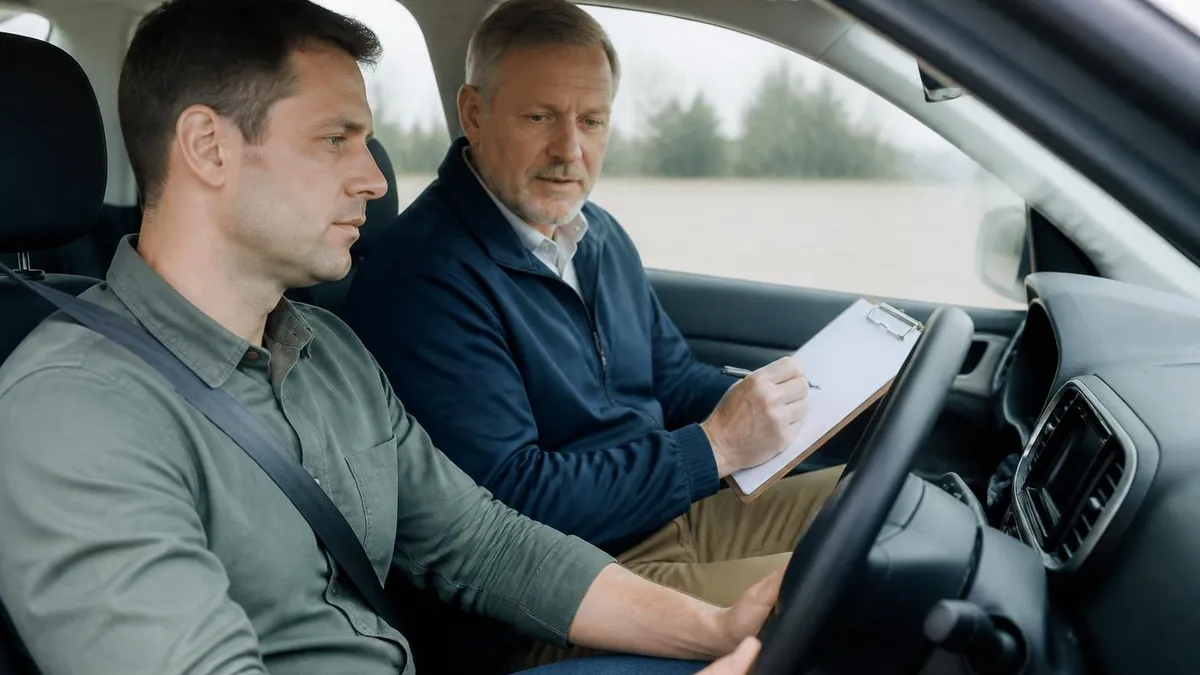
A rolling stop — where you slow to near-zero but the vehicle never fully stops — is an automatic failure at most testing sites. The vehicle must come to a complete stop with tires not moving at every stop sign and every red light before turning right. Practice full stops where you can feel the vehicle settle completely before proceeding.
The documentation you must bring to a road test varies by state, but the core requirements are consistent. You need your valid learner permit (not expired, and within its valid date range). You need your vehicle's registration and proof of insurance — not just the insurance card, but insurance that specifically covers the vehicle you're using for the test.
In Ohio, where the road test is managed by the BMV, the accompanying licensed driver must be present in the vehicle throughout the test and must have held their license for at least four years. In Indiana, the adult supervisor requirement for permit holders ends when the road test begins, and the examiner occupies the passenger seat.
The vehicle you bring to the road test must be in safe operating condition. Examiners will check that all lights work (headlights, brake lights, turn signals), the horn functions, mirrors are properly adjusted, and all windows have clear visibility. A vehicle with a broken brake light, a malfunctioning windshield wiper in wet weather, or a cracked windshield that obstructs the driver's view may be rejected before the test begins. The examiner's refusal to test in an unsafe vehicle is not a failed attempt — you can reschedule with a different vehicle without it counting against your attempt record.
Your seat and mirror positions should be adjusted before the examiner gets into the vehicle, not after they're seated and observing. Adjusting mirrors and seat during the pre-drive inspection period signals organization and preparation. If the examiner has to ask you to adjust anything, it's not a failure, but setting everything correctly before they sit down demonstrates competence from the first moment.
Cell phones must be completely out of reach and view during the road test. Even a phone in a cup holder that you never touch creates an immediate failure condition at some testing sites. Put it in the glove compartment, center console, or back seat before the examiner approaches the vehicle. The same applies to water bottles, food, or other items that might be interpreted as distractions.
The BMV practice test PDF covers traffic law knowledge that forms the foundation of the road test — particularly rules about right-of-way, turn lane usage, and yielding situations that are commonly tested through practical demonstration during the driving portion. Candidates who struggle with the knowledge test often show the same gaps in practice during the road test when these situations arise.
Night driving requirements for permit holders in most states -- typically 10 hours of supervised nighttime driving before road test eligibility -- exist because nighttime conditions test different skills than daytime driving. Vision range is limited, hazard detection requires more active scanning, and headlight management adds a layer of decision-making. Candidates who have met the minimum night driving hours but have done most of their practice in daylight conditions often show reduced confidence in nighttime scenarios. If your permit included night driving hours, practice night driving specifically as part of your final preparation.
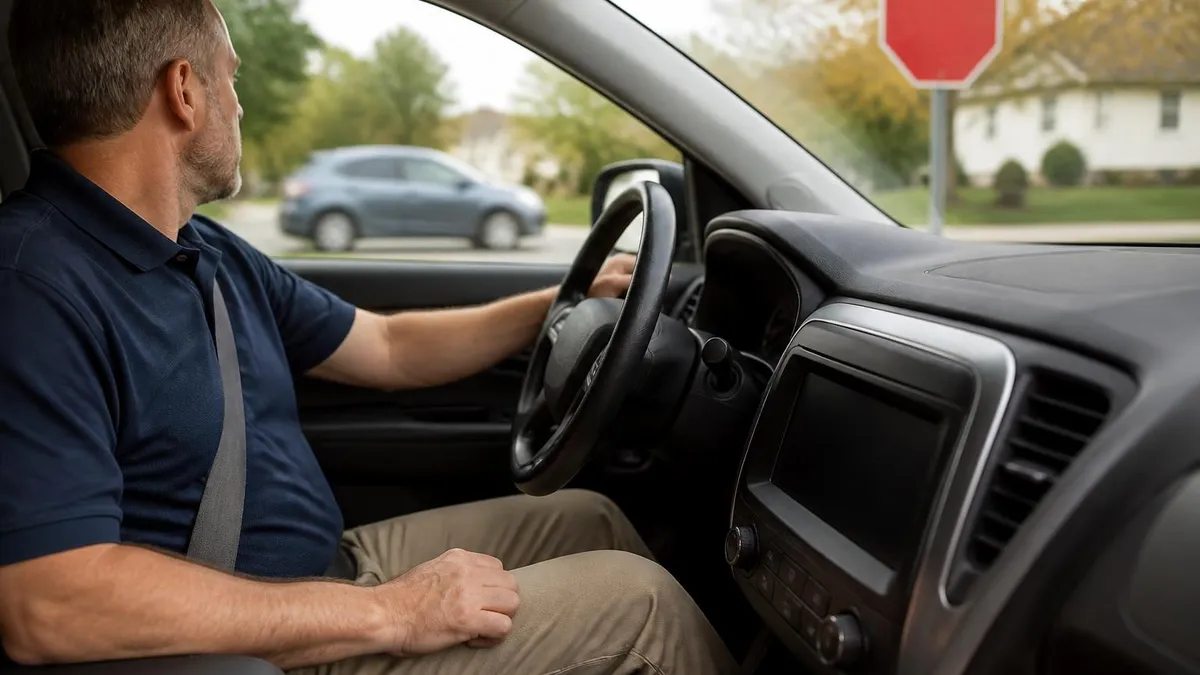
Most Common Road Test Failure Reasons
Vehicle fails to come to a complete stop at stop signs or before right turns on red. One of the most automatic failures. Practice full stops where the car settles completely.
Completing a left turn into the far lane instead of the near lane. The correction: after turning, your vehicle should be in the leftmost through lane immediately.
Only checking mirrors without turning your head to check blind spots before lane changes. Examiners watch your head movement. Your head must visibly turn to the side.
Both speeding and driving excessively slow below the speed of traffic are scored errors. Match traffic speed unless conditions require otherwise.
Ending too far from the curb (over 18 inches), making contact with cones or curb, or failing to look all directions before each movement of the maneuver.
Not yielding right-of-way at unmarked intersections, when merging, or to pedestrians in crosswalks. Yield situations are tested at multiple points on every road test route.
Candidates who fail the road test receive a score sheet showing where errors occurred. Reading this score sheet carefully is the most valuable feedback available for the next attempt. If the score sheet shows multiple errors in left turn technique, spend the next 30 days specifically drilling left turns until they feel automatic and correct. If errors cluster around observation habits, practice exaggerated head movements at every intersection and before every lane change until the behavior is unconsciously consistent.
Most states require a 30-day wait period before retaking a failed road test. Some states allow retaking within two weeks; a few require 30 days. Use this time productively — not just by driving more generally, but by targeting the specific failure points identified on the score sheet. A candidate who returns after 30 days having specifically corrected their documented errors has a much higher second-attempt pass rate than one who simply drives more hours without addressing the identified issues.
Private driving schools offer road test preparation courses that simulate the test environment with professional instruction. These are particularly valuable for candidates who failed once and need targeted feedback, or who lack access to a licensed adult supervisor for adequate practice hours. A two-hour lesson with a professional instructor who knows the local test routes can provide more targeted preparation than a week of unsupervised practice.
For Indiana BMV and Ohio BMV candidates specifically, the test routes tend to include residential streets with 25 mph zones, at least one school zone, a stop-sign-controlled intersection, and at minimum one parallel parking demonstration. Ohio tests also include uphill parking (wheel turned toward the curb) and downhill parking (wheel turned away from the curb) at marked test locations along the route.
Candidates who repeatedly fail the road test should consider enrolling in a structured driver improvement program rather than continuing to practice independently. Some patterns of errors — particularly consistent failures to yield or persistent blind spot omissions — reflect underlying habits or attentional patterns that private instruction is better positioned to identify and correct than additional solo practice with an adult supervisor who may not have the training to give precise feedback.
If you receive a score sheet showing errors in the same category across two consecutive failed attempts, that pattern indicates a systematic problem rather than a bad day. Systematic problems require structured correction -- a driving instructor who can observe you and identify whether the issue is knowledge (you don’t know when to yield), habit (you know but revert under pressure), or attention (you miss the cue that triggers the correct response). Each cause requires a different intervention, and only direct observation of your driving can determine which one is present.
The driving theory component of road readiness -- knowing traffic laws, right-of-way rules, and sign meanings -- is covered in the driving theory test guide. Candidates who have mastered the theory are better positioned to demonstrate it practically, because they recognize the situations that require specific responses before they encounter them on the route rather than reacting after the fact when it’s already too late to score the maneuver correctly.
Road Test Day Checklist
- ✓Valid learner permit with no expired dates
- ✓Vehicle registration in the glove compartment
- ✓Current proof of insurance covering this vehicle
- ✓All lights tested and functional (headlights, brake lights, turn signals)
- ✓Horn tested and functioning
- ✓All windows clean and unobstructed
- ✓Mirrors and seat adjusted before the examiner approaches
- ✓Cell phone stowed completely out of sight
- ✓Arrive 15 minutes early to allow for check-in procedures
- ✓Adult supervisor or licensed driver present if required by your state
Road Test by State
Indiana road tests are scheduled through branches.bmv.in.gov or at a BMV branch directly. The examiner accompanies the candidate during the test. Required documents: valid permit, vehicle registration, proof of insurance. The test covers basic vehicle control, right and left turns, stopping at intersections, parking maneuvers, and lane changes. Indiana does not require parallel parking at every test site — check your specific location. Permit holders must have completed 50 hours of supervised driving including 10 at night before testing.
Road Test Preparation: What Works
- +Practicing on the actual roads near the testing facility builds route familiarity
- +Targeting specific documented failure areas is more efficient than general driving
- +Professional instruction provides objective feedback that self-practice misses
- +Full-stop discipline at stop signs eliminates one of the most common auto-fails
- +Exaggerated head movement for blind spot checks is easy to practice and highly scored
- −Practicing in low-traffic conditions doesn't prepare you for test-route traffic density
- −Driving more hours without addressing specific weak points rarely improves scores
- −Anxiety-driven slow driving is scored negatively — practice matching traffic speed
- −Vehicle problems discovered at the test site cause reschedule delays, not passes
- −Skipping parking maneuver practice because they feel low-stakes leads to avoidable failures
BMV Questions and Answers
About the Author

Licensed Driving Instructor & DMV Test Specialist
Penn State UniversityRobert J. Williams graduated from Penn State University with a degree in Transportation Management and has spent 20 years as a certified driving instructor and DMV examiner consultant. He has personally coached thousands of applicants through written knowledge tests, skills assessments, and commercial driver licensing programs across more than 30 states.
Join the Discussion
Connect with other students preparing for this exam. Share tips, ask questions, and get advice from people who have been there.
View discussion (9 replies)