
Driving Theory Test: What It Is, How to Pass, and What Happens If You Fail (Indiana BMV)
Everything you need to know about the Indiana BMV driving theory test: 34 questions, passing score, what to study, and what happens if you fail. 📗
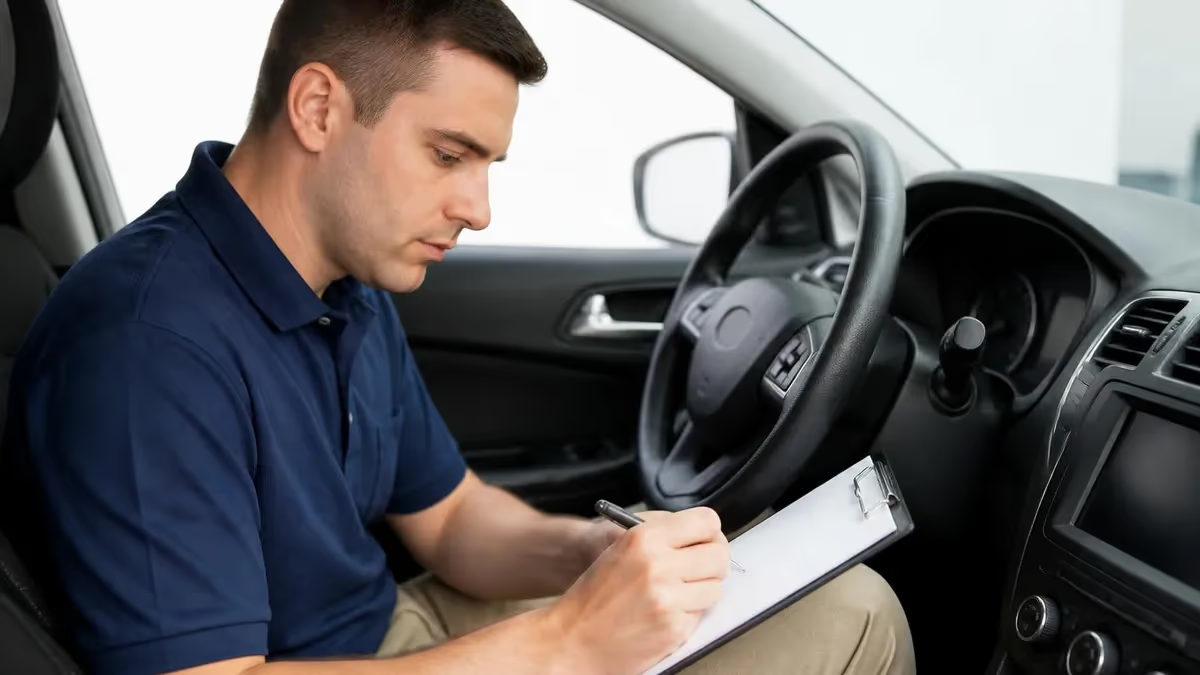
What Is the Driving Theory Test?
The term "driving theory test" gets used a lot — mostly borrowed from the UK, where the written portion of the licensing process goes by that exact name. In the United States, it's the same thing. Different label, same concept: before you ever sit behind the wheel for a road test, you have to prove you understand the rules. Traffic laws. Road signs. What to do when two cars arrive at a four-way stop at the exact same moment.
In Indiana, that test is administered by the Bureau of Motor Vehicles — the BMV. It's the knowledge exam you must pass to get your learner's permit or your first driver's license. No shortcuts. You can't skip it by claiming you already know how to drive. Whether you're 16 or 46, first-time applicants have to sit down at a computer terminal and answer questions about the Indiana Driver's Manual.
Worth knowing: the BMV practice test on this site is built around exactly what shows up on that exam. More on that later.
The Indiana BMV Knowledge Test — The Numbers You Need
Here's what you're actually dealing with:
- 34 questions total
- You need 28 correct answers to pass — that's roughly 82%
- The test is computerized, taken at a BMV branch office
- No time limit in the traditional sense, but don't expect unlimited hours either
- All multiple choice
The questions come from the Indiana Driver's Manual. That 114-page document covers everything from blood alcohol content thresholds to what a pennant-shaped sign means. If you haven't read it — at least the key sections — you're going to struggle.
The test isn't designed to trick you. But it does require specific knowledge. "I think it's 35 mph" isn't going to cut it when the question asks about speed limits in a school zone and you've got four options that are all plausible numbers. Specific beats approximate every time.
Failing six questions still gets you a passing score. That's intentional — the BMV doesn't expect perfection. But those six aren't guaranteed to be the easy ones. You don't get to choose which questions are in your "allowable mistakes" category. That's why 90%+ on practice tests is the real benchmark, not 82%.
Indiana BMV Knowledge Test at a Glance

Who Has to Take It
Not everyone who walks into a BMV needs to pass this test. But you do if you fall into any of these categories:
Teen drivers getting a learner's permit. Indiana's graduated licensing system starts with a learner's permit — and to get one, you have to pass the knowledge test first. You must be at least 15 years old, have parental consent, and pass this exam before you're allowed supervised driving time. The learner's permit then allows supervised behind-the-wheel practice before you're eligible for a probationary license. There's no way around this step.
First-time adult applicants. If you've never held a valid driver's license from any state, you take the test. Doesn't matter if you're 25 or 55. Age doesn't exempt you from the knowledge requirement — the BMV has no way to verify that your life experience translates into knowledge of Indiana traffic law, so everyone starts with the written test. No exceptions for people who've been driving in other countries, either.
License reinstatements. Depending on why your license was suspended or revoked, you may be required to retake the knowledge test before getting back behind the wheel legally. OWI convictions, certain point accumulations, or extended lapse periods can all trigger this requirement. The BMV will tell you whether it applies to your specific situation — call ahead or check your reinstatement notice for details.
Out-of-state transfers — sometimes. Moving to Indiana from another state? You typically get a grace period to transfer your license without retesting. But if your out-of-state license has been expired for too long, the BMV may require the written exam. The threshold varies based on how long the license has been lapsed. When in doubt, check with your local branch before making the trip.
Not sure which category you fall into? The BMV licensing requirements practice covers eligibility rules and what each applicant type needs to bring.
What the Indiana BMV Test Covers
Road signs are the single most common reason people fail the driving theory test. Not because the signs are complicated — but because test-takers assume they already know them. They don't. Not well enough to distinguish between a yield sign and a warning sign on paper, without any road context.
Signs fall into four main categories you need to recognize cold:
- Regulatory signs — tell you what you must or must not do. Stop, yield, speed limit, do not enter. Violating them is a traffic offense.
- Warning signs — yellow (or orange in work zones), diamond-shaped, telling you something's coming. A curve, a school zone, a railroad crossing ahead.
- Guide signs — green or blue, helping you navigate. Mileage markers, exit signs, hospital-ahead markers.
- Construction/work zone signs — orange background. Speed limits in these zones often carry doubled fines in Indiana. The test knows this.
The BMV exam will show you sign images and ask what they mean — or describe a situation and ask which sign applies. If you haven't memorized the shape-color-meaning combinations, you're guessing. That costs you points you can't afford to lose.

What Happens If You Fail the Driving Theory Test
Failing isn't the end of the world. But it does have a process — and knowing that process ahead of time removes a lot of stress from the situation. Most people who fail on the first try aren't far off. They missed it by two or three questions — often road signs, often right-of-way edge cases. The fix isn't starting over from scratch. It's targeted review of the specific areas that tripped them up.
In Indiana, here's what happens after a failed attempt: you can come back the next business day. No long waiting periods for the first three tries. After that third failure, though, the 30-day clock starts. You're locked out for a full month before the system will allow another attempt — and you pay $9.00 every single time you sit down at that terminal.
The most common reasons people fail — and what to focus on before retaking:
Road signs. If you failed and you're not sure what a fluorescent yellow-green sign means (it's a pedestrian/school crossing warning), go back to the manual's sign section and quiz yourself until you've got every shape-color pair locked in. This is where most points get dropped.
Right-of-way edge cases. The four-way stop scenarios, the T-intersection rules, emergency vehicle protocol. These require you to think through multiple conditions simultaneously. Practice the scenarios — don't just re-read the rules. Reading and doing are different things here.
Speed limits in special zones. People second-guess themselves on school zone vs. residential vs. business district limits. Write them down. Make a list. Quiz yourself on each category separately before you go back to the branch.
OWI thresholds. The 0.02% vs. 0.08% distinction — and implied consent — are high-probability questions. Know the numbers exactly, not approximately. "About 0.08" isn't an answer option. Exact is the only right answer.
The BMV practice questions on this site mirror the test structure. If you missed questions in a specific area, filter to that topic and drill until you're consistently hitting 90%+ before retaking. Ninety percent on practice tests usually means you're genuinely ready — not just familiar.
You can retake it as soon as the next business day. Indiana allows up to 3 attempts before requiring a 30-day waiting period. Each attempt costs $9.00 — that fee applies every time, including retakes. After failing 3 times within a period, you must wait the full 30 days before the BMV will allow another attempt. Use that time to retake practice tests, re-read the sign and traffic law sections of the driver's manual, and focus on the specific content areas your score report flagged.
How to Study Effectively for the Indiana BMV Test
There's a right way and a wrong way to prepare. The wrong way: skimming the manual once, feeling vague confidence, and showing up at the BMV hoping for the best. The right way is more systematic — and it doesn't actually take that long if you approach it deliberately. Most people who fail did too little of one thing: practice testing.
Start with the Indiana Driver's Manual
The BMV publishes the driver's manual for free at in.gov/bmv. Download it. Or pick up a printed copy at any BMV branch — they're free there too. The manual is the source document. Every question on the exam traces back to something in it.
Don't read it like a novel. Skim the narrative sections to understand concepts, but slow down and read carefully any time you hit a specific number (speed limits, BAC thresholds, following distances), a list (things you must do, things you cannot do), or a description of a specific sign. Those are your high-probability test questions.
Take notes as you go. Sounds old-fashioned. Works anyway. Writing information down during reading encodes it differently than just reading — and when you flip back through your notes the night before the test, you'll be reviewing exactly the things that are most likely to show up.
Take Practice Tests — More Than Once
Reading the manual builds knowledge. Practice tests reveal gaps. Those are two different things, and you need both.
The comprehensive BMV practice test covers all five content areas in a format that matches the actual exam. Take it cold first — before studying — to see where your weak spots are. Then study those areas. Then take it again. If you're scoring below 90% on practice tests, you're not ready for the real thing yet. 82% passes the BMV test; 90% on practice means you have a buffer for test-day nerves.
The goal isn't to memorize the practice questions. It's to understand the underlying rules well enough that you can answer any variation the BMV throws at you. The BMV rotates questions from a larger pool — you won't see the exact same test every time. Understanding beats memorization here.
Indiana-Specific Laws You Can't Skip
A few rules are Indiana-specific enough that national study guides won't cover them — but the BMV absolutely will.
Graduated licensing system for teens. Indiana's Probationary License restricts nighttime driving (no driving between 10 PM and 5 AM for the first year, with limited exceptions) and prohibits driving with more than one non-family passenger under 25 during the first 180 days. The BMV licensing requirements practice covers this in detail.
Seatbelt law. Indiana is a primary enforcement state — meaning an officer can pull you over solely for not wearing a seatbelt. Everyone in the vehicle must be buckled, and children under 8 must be in an appropriate child restraint system. Age/weight/height specifics are testable — don't skip this section of the manual.
Hands-free law (effective 2020). Holding a mobile device while operating a vehicle is illegal. First offense: $35 fine plus court costs. Second and subsequent offenses: $100. The law is on the test because it's relatively new and the BMV wants to make sure new drivers know it. Bluetooth and mounted devices are fine. Holding the phone — not fine. That's the line.

Prioritized Study List for the Indiana BMV Test
- ✓Road signs — shape, color, and meaning for all four categories (regulatory, warning, guide, construction)
- ✓Speed limits by zone — interstate, highway, residential, business district, and school zone
- ✓Right-of-way rules — four-way stops, T-intersections, and emergency vehicle protocol
- ✓OWI laws — adult (0.08%), under-21 (0.02%), and commercial driver (0.04%) BAC thresholds
- ✓Implied consent — what it means and what happens if you refuse chemical testing
- ✓Hands-free law — what's allowed (mounted device) vs. what's not (holding the phone while moving)
- ✓Graduated licensing rules for teen drivers — nighttime restrictions and passenger limits
- ✓Seatbelt requirements — primary enforcement, child restraint ages and weight requirements
- ✓Following distance rules and safe driving fundamentals
The Day of the Test — What to Expect
You've studied. You're ready. Here's what actually happens when you walk into the BMV.
What to Bring
Indiana uses a points-based document verification system. You need to accumulate a minimum number of points from acceptable documents to prove your identity and residency. The document checklist above covers what you'll need. Bring originals — no photocopies. The BMV checks authenticity, and a copy of your birth certificate isn't the same thing as a certified copy.
Don't show up guessing. Gather every document before you go. If you arrive missing something, you'll have to reschedule — and pay again when you come back. That's a $9 mistake that's easy to avoid.
The Test Environment
The knowledge test is computerized. You'll sit at a workstation — usually a semi-private station in a row of similar terminals — and questions appear on screen one at a time with multiple choice options. Click your answer and move to the next question. No pencils, no paper test booklets.
You can skip questions and return to them. You can review all your answers before submitting. The BMV doesn't rush you — but branches have appointment slots and limited terminals, so you're not going to have four hours. In practice, most people finish in 20–30 minutes.
Read every question fully before clicking. BMV questions sometimes include phrasing like "which of the following is NOT allowed" — and if you're moving fast, you'll miss the NOT and answer the opposite of what they're asking. Slow down on those. That single word changes the correct answer entirely.
No outside materials. No phone. No notes. It's a closed-book exam and the BMV staff monitors the testing area. Treat it like a classroom exam, not an open-book quiz.
After You Submit
Your result appears immediately on screen. Pass, and a BMV employee will begin processing your permit or license paperwork on the spot. You'll get a temporary document that day; the permanent credential arrives by mail within a few weeks.
Fail, and you'll be told your score and which content areas need improvement — though the BMV doesn't show you which specific questions you missed. Use the score report to target your studying before your next attempt. Most people who fail once and then study the weak areas systematically pass on the second try.
A Note on Online Testing
Indiana does not currently offer the knowledge test online. You have to go to a BMV branch in person. Some states have moved to online testing — Ohio and others piloted remote proctoring programs — but Indiana still requires in-person testing as of 2025.
Check in.gov/bmv for current branch hours and appointment availability. Many branches are walk-in only; some offer scheduled appointments. Busier branches (Indianapolis metro area) tend to have longer waits, so if you have flexibility, a smaller branch in a suburb or smaller city might get you in and out faster.
Before test day, run through the comprehensive BMV practice test one final time. Not to cram — just to confirm you're hitting 90%+ consistently. That's the signal you're genuinely ready, not just familiar with the material.
One last thing worth mentioning: the BMV does update the test pool over time as laws change. If you studied from an older manual version or an outdated prep guide, some questions might reference superseded rules. Always download the current Indiana Driver's Manual from in.gov/bmv before you start studying — it's free, it's current, and it's the only official source that matters for the real test.
Day-of-Test Document Checklist
Valid U.S. passport, certified birth certificate, or a permanent resident card. Must be an original or certified copy — photocopies are not accepted. This is the highest-point document in Indiana's verification system.
Social Security card (original, not laminated), a W-2 with your full SSN, a pay stub showing all nine digits, or a Social Security Administration benefit letter. At least one SSN document is required.
Two separate documents showing your current Indiana address. Utility bill, bank statement, mortgage or lease agreement, mail from a government agency, or vehicle registration — all work. Both must be current (typically within 60 days).
Signed Parental Consent form (State Form 54030), available at any BMV branch or online. If you completed an approved driver education course, bring the Certificate of Completion — it may waive the supervised driving hour requirement.
BMV Pros and Cons
- +BMV has a publicly available content blueprint — you know exactly what to prepare for
- +Multiple preparation pathways accommodate different schedules and budgets
- +Clear score reporting shows specific strengths and weaknesses
- +Study communities share current insights from recent test-takers
- +Retake policies allow recovery from a difficult first attempt
- −Tested content scope requires substantial preparation time
- −No single resource covers everything optimally
- −Exam-day performance can differ from practice test performance
- −Registration, prep, and retake costs accumulate significantly
- −Content changes between versions can make older materials less reliable
BMV Questions and Answers
About the Author

Licensed Driving Instructor & DMV Test Specialist
Penn State UniversityRobert J. Williams graduated from Penn State University with a degree in Transportation Management and has spent 20 years as a certified driving instructor and DMV examiner consultant. He has personally coached thousands of applicants through written knowledge tests, skills assessments, and commercial driver licensing programs across more than 30 states.
Join the Discussion
Connect with other students preparing for this exam. Share tips, ask questions, and get advice from people who have been there.
View discussion (9 replies)