
BMV Practice Test 2026 September: Indiana & Ohio DMV Permit Study Guide
⏳ Get ready for your BMV certification. Practice questions with step-by-step answer explanations and instant scoring.
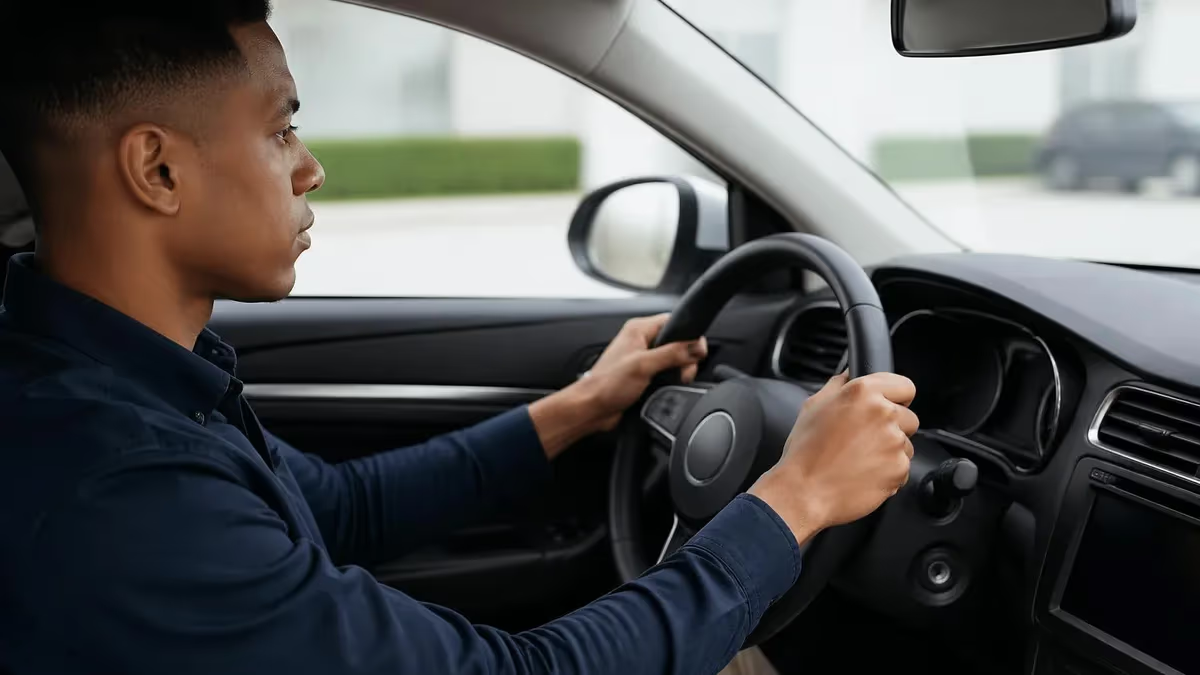
What Is the BMV Permit Test?
The BMV knowledge test (also called the written test or permit test) is required before a first-time driver can obtain a learner's permit and begin supervised driving. The test assesses your understanding of traffic laws, road signs, safe driving practices, and state-specific regulations based on the official driver's manual published by your state BMV.
The knowledge test is administered at BMV branch offices on computer terminals. In both Indiana and Ohio, you schedule your appointment online or walk in at most locations. You must bring proof of identity, residency, and Social Security number — requirements vary slightly between Indiana and Ohio, so check the official BMV website for your state's current documentation list.
If you are under 18, both Indiana and Ohio require a parent or guardian to sign your permit application. Minors may also have additional waiting periods and supervised driving hour requirements before being eligible for a full license.

BMV Overview
Indiana BMV Knowledge Test Format
The Indiana BMV knowledge test consists of 50 questions drawn from the Indiana Driver's Manual. You must answer at least 42 questions correctly (84%) to pass. Questions are drawn from three sections: road rules (general traffic laws and driving practices), road signs (sign identification and meaning), and road markings (pavement markings interpretation).
If you fail, Indiana requires a 1-day waiting period before retaking the test. You can take the test up to 3 times within your permit application period. After 3 failures, you must wait 30 days before applying again. The test is available in multiple languages at many BMV locations.
Compare Your Options
Ohio BMV Knowledge Test Format
The Ohio BMV knowledge test contains 40 questions: 20 road rules questions and 20 road sign identification questions. You must answer at least 15 road rules questions correctly AND at least 15 road sign questions correctly (75% in each section) to pass. Failing either section fails the entire test. This dual-section structure means you cannot compensate for poor road sign knowledge with strong road rules performance — both sections require attention.
Ohio allows retakes after a waiting period — typically 24 hours for the first retest and longer intervals for subsequent attempts. Ohio offers the test in English, Spanish, and other languages upon request.
Key BMV Test Topic Areas
Both Indiana and Ohio BMV knowledge tests draw from consistent topic categories. Understanding these categories helps you allocate study time efficiently.
Traffic laws and right-of-way: Who yields at intersections with no signals, four-way stops, uncontrolled intersections. Proper merge procedures, lane change requirements, and rules for passing on two-lane roads. Emergency vehicle passing and stopping requirements.
Speed limits: Default speed limits in residential areas (typically 25 mph), school zones (15–20 mph when flashers are active), interstate highways (70 mph Indiana, 70 mph Ohio on rural interstates), and work zones. Understanding posted vs. advisory speed limits. Speed adjustments required in hazardous conditions.
Following distance: The 3-second rule for maintaining following distance in normal conditions, extended to 4–6 seconds in rain, ice, or fog. Space management around large trucks (no-zones), motorcycles, and bicycles.
Signaling and lane changes: Required signal activation distances (Indiana: 200 feet before a turn; Ohio: 100 feet). Proper mirror checking sequence before lane changes. Rules for turning from multiple-turn lanes.
Parking rules: Distance from fire hydrants (15 feet), crosswalks (25 feet), stop signs (30 feet), and railroad crossings (50 feet). Parking on hills — wheels toward curb when facing downhill, away from curb when facing uphill.
Seat belts and child safety seats: Indiana and Ohio both require seat belts for all vehicle occupants. Child restraint laws specify rear-facing seats through age 2 (minimum), forward-facing through the harness weight limit, then booster seats until the vehicle lap-and-shoulder belt fits correctly (typically around age 8–12 or 57 inches).
Road Signs: The Most Common Test Failure Point
Road sign identification is the leading cause of BMV test failure because many test takers underestimate how many specific signs they need to recognize and memorize. The Indiana and Ohio BMV tests use realistic images of actual signs — not just descriptions — so visual recognition is required.
Signs are categorized by shape and color, which helps identify sign type even without reading the text:
- Red octagon — STOP (only octagonal sign in use)
- Red and white triangle — YIELD
- Yellow diamond — Warning signs (curves, merges, pedestrian crossings, railroad crossings)
- Orange diamond or rectangle — Construction/work zone warning
- Green rectangle — Guide/directional signs (highway exits, distance markers)
- Blue rectangle — Services (hospital, gas, food, lodging, rest areas)
- Brown rectangle — Recreation and cultural sites
- White rectangle — Regulatory signs (speed limits, do not enter, no left turn)
- Yellow-green pentagon — School signs (school zone, school crossing)
- Red circle with slash — Prohibition (no U-turn, no trucks, etc.)
Common signs that frequently appear on BMV tests and that test takers miss: advisory speed signs (yellow diamonds with recommended curve speed), divided highway begins/ends, no passing zone, deer crossing, and one-way signs.
Alcohol and Drug Impaired Driving Laws
Both Indiana and Ohio BMV tests include a significant number of questions on alcohol and drug impaired driving laws — this section is heavily weighted because impaired driving is a leading cause of traffic fatalities. Memorizing the specific legal thresholds and consequences is important for test success.
Legal blood alcohol content (BAC) limits:
- Standard drivers: 0.08% BAC or higher is per se impairment (DUI/OVI)
- Commercial vehicle drivers (CDL): 0.04% BAC
- Drivers under age 21 (Indiana): 0.02% BAC (zero tolerance)
- Drivers under age 21 (Ohio): 0.00% BAC for OVI; 0.02% for administrative per se violation
Indiana alcohol laws: Indiana uses the term OWI (Operating While Intoxicated). Refusing a chemical test (breath, blood, or urine) triggers Implied Consent automatic license suspension of 1 year (first refusal) or 2 years (subsequent refusal). A first OWI conviction can result in up to 1 year in jail, $5,000 fine, and up to 2-year license suspension.
Ohio alcohol laws: Ohio uses the term OVI (Operating a Vehicle while Impaired). Ohio's ALS (Administrative License Suspension) for BAC of 0.08%+ is 90 days (first offense); refusal triggers a 1-year ALS. First OVI conviction: 3 days minimum in jail (or 3-day driver intervention program), $375–$1,075 fine, and 1–3 year license suspension.
The BMV alcohol and impaired driving practice test covers Indiana and Ohio specific thresholds, penalties, and implied consent laws with scored questions and explanations.
BMV Checklist
- ✓Download and read your state BMV driver's manual (Indiana: in.gov/bmv, Ohio: publicsafety.ohio.gov)
- ✓Pay special attention to speed limits, following distances, and right-of-way rules
- ✓Study all road sign shapes, colors, and meanings from the sign identification section
- ✓Memorize BAC thresholds: 0.08% standard, 0.04% CDL, 0.02% under 21
- ✓Review implied consent laws and license suspension consequences
- ✓Take at least 3 full-length BMV practice tests before your appointment
- ✓Target 90%+ on practice tests before scheduling your BMV appointment
- ✓Gather required documents (ID, proof of residency, SSN card or documentation)
- ✓Bring payment for the permit fee (check your BMV website for accepted payment methods)
- ✓Schedule your appointment online if possible to reduce wait times
Study Tips for the BMV Permit Test
Most first-time applicants who fail the BMV test do so because they relied on general driving knowledge rather than systematically reviewing the state manual. The test questions are written directly from the manual — guessing based on common sense often leads to selecting answers that are close but not exactly what the manual specifies.
Read the manual from start to finish at least once. It takes 2–3 hours and is the single most important preparation step. Note any specific numbers (speed limits, following distances, signal distances, blood alcohol limits) as you read — these are almost always tested.
Use flashcards for signs and numbers. Road sign identification and specific legal thresholds (BAC limits, following distances, speed limits in school zones) are best memorized through active recall. Create flashcards for each sign type and each numerical threshold.
Take practice tests strategically. The free comprehensive BMV practice test on PracticeTestGeeks simulates the actual question format and provides instant scoring with explanations. Take an initial diagnostic test before heavy studying to identify which topics need the most attention. Focus additional study on missed question categories before retesting.
Don't neglect the sign identification section. Many test takers read the road rules sections carefully but skim the sign section — then fail specifically on sign questions. Dedicate at least 30–40% of your study time to sign recognition, particularly warning signs and regulatory signs that look similar (e.g., one-way vs. do not enter).
BMV Practice Test Questions
Prepare for the BMV - Test exam with our free practice test modules. Each quiz covers key topics to help you pass on your first try.
BMV Basic BMV Practice
BMV Exam Questions covering Basic BMV Practice. Master BMV Test concepts for certification prep.
BMV Alcohol, Drugs, and Impaired Driving Laws
Free BMV Practice Test featuring Alcohol, Drugs, and Impaired Driving Laws. Improve your BMV Exam score with mock test prep.
BMV Licensing Requirements
BMV Mock Exam on BMV Licensing Requirements. BMV Study Guide questions to pass on your first try.
BMV Traffic Laws
BMV Test Prep for BMV Traffic Laws. Practice BMV Quiz questions and boost your score.
BMV Vehicle Operations
BMV Questions and Answers on BMV Vehicle Operations. Free BMV practice for exam readiness.
BMV Parking, Right-of-Way, and Intersections
BMV Mock Test covering Parking, Right-of-Way, and Intersections. Online BMV Test practice with instant feedback.
BMV Road Signs and Markings
Free BMV Quiz on Road Signs and Markings. BMV Exam prep questions with detailed explanations.
BMV Safe Driving and Hazard Awareness
BMV Practice Questions for Safe Driving and Hazard Awareness. Build confidence for your BMV certification exam.
BMV Driving Skills Test: What to Expect
After passing the knowledge test and obtaining your learner's permit, the next step in the licensing process is the BMV driving skills test (also called the road test or behind-the-wheel test). This test evaluates your ability to operate a vehicle safely in real traffic conditions under the observation of a licensed BMV examiner.
Vehicle requirements: You must provide a vehicle for the driving skills test. The vehicle must be registered, insured, and in safe operating condition. A BMV examiner will inspect the vehicle before the test begins — all lights, signals, wipers, and horn must function. Examiners typically check these in the first few minutes before moving into driving evaluation.
What the examiner evaluates: The skills test typically covers: starting and stopping smoothly, steering control and lane positioning, proper turn technique, intersection management (right-of-way compliance, scanning, signaling), reversing and backing, three-point turns or K-turns, parallel parking (in most states), and compliance with posted speed limits and traffic signs throughout the route.
Scoring: Both Indiana and Ohio use a points-deduction system. You begin with a perfect score, and points are deducted for specific errors. Certain errors — such as making contact with another vehicle, running a red light, failing to stop at a stop sign, or requiring the examiner to use dual controls — are automatic failures. Most candidates who have completed 50+ hours of supervised practice and practice the specific maneuvers tested (particularly parallel parking and three-point turns) pass on their first attempt.
Scheduling the skills test: In Indiana, driving skills tests are scheduled through the BMV website or at a BMV branch. Ohio residents schedule through the Ohio BMV's online portal. Wait times vary by location — popular testing sites during peak seasons (spring/summer) may have 2–4 week waits. Schedule as soon as you are eligible to avoid delays.
BMV Pros and Cons
- +Structured BMV study guides organize all required content in exam-aligned order, reducing time spent identifying what to study
- +Combining review guides with practice questions provides both content knowledge and test-taking fluency
- +Focused study plans allow candidates to allocate more time to weak areas rather than reviewing already-mastered content
- +Free and low-cost study resources mean comprehensive preparation is accessible at any budget level
- +Spaced repetition techniques (Anki, regular review sessions) significantly improve long-term retention of tested facts
- −No single study guide covers all tested content optimally — most candidates need 2–3 resources for complete preparation
- −Study guides can become outdated quickly when exam content is updated; verify edition currency before purchasing
- −Self-study requires self-discipline; candidates without structured external accountability often underallocate preparation time
- −Coverage breadth in comprehensive guides can create false confidence — recognizing content is not the same as answering questions correctly under timed conditions
- −Study time estimates in guides often assume ideal conditions; real preparation time is typically 30–50% longer due to life disruptions
BMV Questions and Answers


About the Author
Licensed Driving Instructor & DMV Test Specialist
Penn State UniversityRobert J. Williams graduated from Penn State University with a degree in Transportation Management and has spent 20 years as a certified driving instructor and DMV examiner consultant. He has personally coached thousands of applicants through written knowledge tests, skills assessments, and commercial driver licensing programs across more than 30 states.
Join the Discussion
Connect with other students preparing for this exam. Share tips, ask questions, and get advice from people who have been there.
View discussion (9 replies)