
DMV Practice Tests: Free Online Permit Test Prep for Every State 2026
Get ready for your DMV certification. 🏆 Practice questions with step-by-step answer explanations and instant scoring.
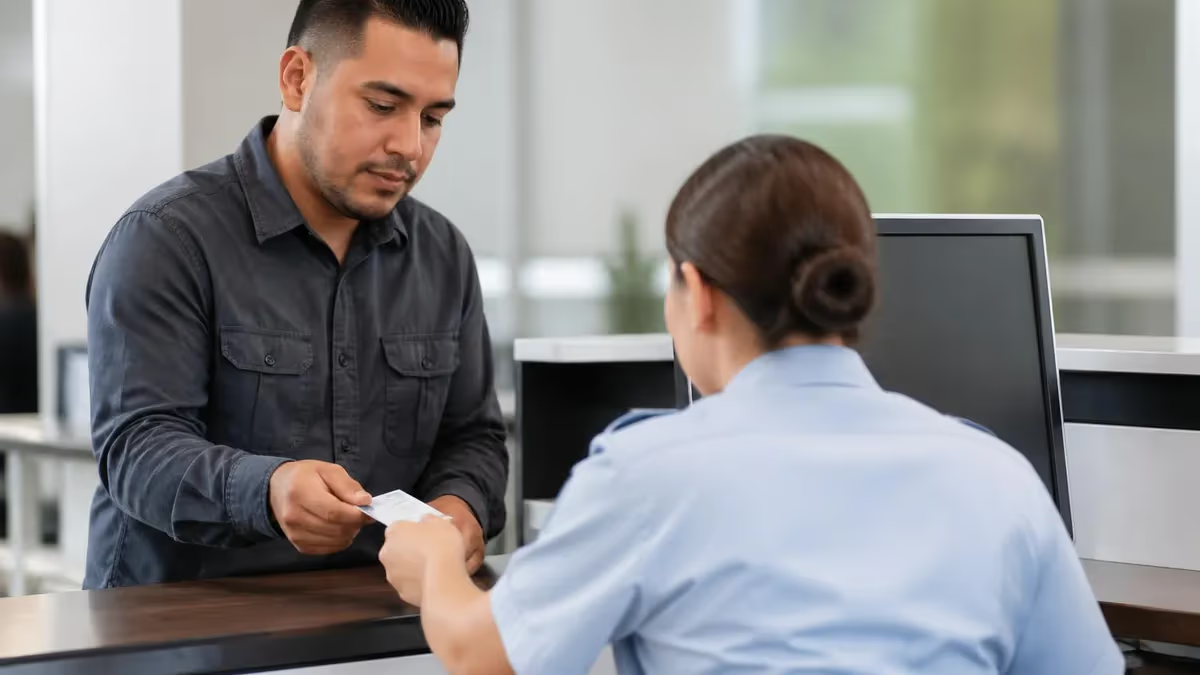
Passing your permit exam doesn't have to feel like a gamble. With the right dmv practice tests, you can walk into the DMV knowing exactly what to expect — and walk out with your learner's permit in hand. Whether you're 16 and nervous or 30 and just never got around to it, structured practice is the single best predictor of first-attempt success. Practice with the free DMV practice test on PracticeTestGeeks (350+ questions with answer explanations).
Most states use a multiple-choice format covering road signs, right-of-way rules, speed limits, and safe driving techniques. The questions aren't trick questions, but they do require you to know specifics — like how far you must park from a fire hydrant or what a flashing yellow arrow means. Some states weight certain topics more heavily than others, so knowing your state's emphasis areas can save you hours of unfocused studying. That's where dmv practice tests come in. They mirror the real exam's format, timing, and difficulty so nothing catches you off guard on test day.
We've built state-specific dmv permit practice tests that pull from actual driver's manual content. Each quiz gives instant feedback, explains why an answer is correct, and tracks your progress over time. You'll spot your weak areas fast — maybe it's parallel parking rules or railroad crossing signals — and you can drill those topics until they stick.
Thousands of test-takers have used these practice exams to pass on their very first try, and there's no reason you can't join them. The only thing standing between you and your permit is focused, consistent preparation — and it starts right here with your first practice test.
Free DMV Study Tools
Interactive DMV resources on PracticeTestGeeks, free to start:
- DMV General Drug and Alcohol Test #1 — 16 questions with instant scoring and answer explanations
- DMV flashcards — review key terms and concepts card by card
- DMV study guide — topic-by-topic overview of what the exam covers
- DMV cheat sheet — one-page printable summary for last-minute review

Before you start memorizing road signs, it helps to understand how the DMV permit test actually works. Every state designs its own exam, but most pull from a shared pool of topics: traffic signals, pavement markings, right-of-way rules, alcohol laws, and safe following distances. Using dmv permit practice tests tailored to your state ensures you're studying the right material — not wasting time on rules that don't apply where you live.
If you're in the Golden State, ca dmv practice tests focus heavily on California-specific regulations like carpool lane rules, smog check requirements, and the state's graduated licensing system. California gives you three attempts per application to pass the written test, which is exactly why targeted practice matters so much.
The format is always multiple choice, usually with three or four answer options. Some states now offer touchscreen testing at DMV kiosks, while others still use paper and pencil. Either way, the content stays the same no matter the format. You won't face essay questions or fill-in-the-blank items. It's purely recognition-based, which means repetition through dmv permit practice tests is the fastest path to a passing score.
One mistake people make is studying only the general rules and ignoring state-specific quirks. For instance, dmv practice permit tests for states like New York include questions about the Move Over Law, while Texas tests emphasize speed limits in school zones. Every state driver's manual has unique content that shows up on the exam, and generic study guides miss those details entirely.
If you're preparing in California, you should know that california dmv practice tests cover topics like U-turn legality, cell phone laws for minors, and the state's zero-tolerance policy for underage drinking and driving. The California DMV also rotates its question bank regularly, so last year's cheat sheet won't cut it. Fresh, updated practice questions that reflect current regulations are absolutely essential for effective preparation.
Our practice exams simulate real testing conditions. You'll face a timer, get scored automatically, and see detailed explanations for every question you miss. This isn't passive studying — it's active recall, which research shows is far more effective than rereading a manual. You can retake each quiz as many times as you need, and the questions shuffle so you're not just memorizing answer positions. Take ca dmv practice tests until you score 90% or higher consistently, and you'll be more than ready for the real thing.
What the DMV Written Test Covers
Expect 8-12 questions on regulatory, warning, and guide signs. You'll need to identify shapes and colors — an octagon always means stop, a pentagon marks a school zone, and diamond shapes indicate warnings. Pay attention to less common signs like the pennant-shaped no-passing zone marker and the round railroad crossing warning sign. Color matters too — red means stop or prohibition, yellow means caution, green means guidance, and blue indicates services. Practice tests drill these visuals until recognition becomes automatic, so you won't hesitate when you see them on the real exam.
DMV exams aren't one-size-fits-all, and that's why state-specific preparation matters. Take Idaho — the idaho dmv practice tests include questions about rural driving, wildlife crossings, and winter road conditions that you simply won't find on a Florida exam. Idaho's test has 40 questions with a 34-correct passing threshold, and topics like chain requirements and mountain driving are fair game.
Meanwhile, il cdl practice tests target commercial driver's license candidates in Illinois. CDL exams are a different beast entirely — they cover air brakes, combination vehicles, hazardous materials, and pre-trip inspections. The general knowledge section alone has 50 questions, and you need 80% to pass. If you're going for your CDL, generic car permit practice won't help. You need CDL-specific material that covers the unique demands of commercial driving.
The key takeaway? Match your practice to your actual test. A teenager in Boise and a truck driver in Chicago face completely different exams, and their study materials should reflect that. Our platform lets you filter by state and license type so you're always practicing the right content for your situation. Don't waste time on material that won't show up on your exam — get targeted and get it done right the first time.
California consistently ranks as one of the toughest states for the written permit test, and dmv practice tests california reflect that difficulty. The state's exam draws from a large question bank, so there is little room for guesswork. Topics unique to California include carpool lane regulations, the state's hands-free cell phone law, and specific rules about U-turns at controlled intersections.
Beyond California, dmv tests practice resources help test-takers in every state sharpen their knowledge. The beauty of online practice is instant feedback — you don't have to wait for a teacher to grade your answers. You see immediately whether you got a question right, and more importantly, you learn why the correct answer is correct. This active learning loop is what makes practice testing so effective compared to passive reading.
Don't overlook dmv practice permit tests as a study tool even if you've already read the manual. Research consistently shows that testing yourself is more effective than rereading. It's called the testing effect — retrieving information from memory strengthens that memory far more than simply reviewing it. Every practice test you take literally makes your brain better at recalling the answers. So even if you feel confident after reading the manual, take a few practice exams anyway — you might be surprised by what you've missed.
Online Practice Tests vs. Traditional Studying
- +Instant feedback shows exactly what you got wrong and why
- +Simulates real test format so there are no surprises on exam day
- +Available 24/7 from any device — study whenever it fits your schedule
- +Tracks your progress over time so you can see improvement
- +State-specific questions match your actual DMV exam content
- +Active recall beats passive reading for long-term retention
- −Requires internet access or a charged device to use
- −Can create false confidence if you memorize answers instead of concepts
- −Doesn't cover the behind-the-wheel driving skills portion
- −Screen fatigue from extended study sessions on a phone or tablet
- −Some free practice sites use outdated or inaccurate questions
- −May not include every possible question from your state's full bank
Pros and Cons at a Glance
| Pros | Cons |
|---|---|
| Instant feedback shows exactly what you got wrong and why | Requires internet access or a charged device to use |
| Simulates real test format so there are no surprises on exam day | Can create false confidence if you memorize answers instead of concepts |
| Tracks your progress over time so you can see improvement | Doesn't cover the behind-the-wheel driving skills portion |
| State-specific questions match your actual DMV exam content | Screen fatigue from extended study sessions on a phone or tablet |
| Active recall beats passive reading for long-term retention | Some free practice sites use outdated or inaccurate questions |
When it comes to practice dmv tests, consistency trumps intensity. Studying for 20 minutes a day over two weeks beats cramming for five hours the night before. Your brain needs time to consolidate information — sleep literally helps move knowledge from short-term to long-term memory. So spread your practice sessions out and let your brain do its work between sessions.
For test-takers in Oregon, oregon dmv practice tests cover the state's unique rules, including its self-service gas pumping regulations (yes, that's on the test), roundabout navigation procedures, and bicycle lane sharing requirements. Oregon's knowledge test has 35 questions, and you need 28 correct to pass. The state also tests on its specific implied consent law and the consequences of refusing a breath test.
A smart approach is to alternate between topic-specific quizzes and full-length practice exams. Use topic quizzes to build knowledge in weak areas, then take full exams to practice managing your time and energy across all topics simultaneously. This combination prepares you for both the content and the experience of the real test. Think of topic quizzes as weight training and full exams as scrimmages — you need both to perform on game day.
Your DMV Test Day Checklist
- ✓Score 90% or higher on at least three consecutive full-length practice tests before booking your appointment
- ✓Review your state's official driver manual one final time the evening before the test — focus on weak areas
- ✓Gather all required documents well in advance: valid ID, proof of residency, Social Security card, and any forms your state requires
- ✓Get a full eight hours of sleep the night before — fatigue destroys focus and kills test performance
- ✓Eat a balanced, light meal before your appointment so you can concentrate without hunger distracting you
- ✓Arrive at least 15 to 20 minutes early to complete any paperwork and check in without feeling rushed
- ✓Bring a parent or legal guardian if you're under 18 — most states legally require their presence during testing
- ✓Leave your phone locked in your car — electronic devices are strictly prohibited in the DMV testing area
- ✓Read each question carefully at least twice before selecting your answer to avoid misreading what's being asked
- ✓Don't second-guess yourself or change answers unless you're absolutely certain your first choice was wrong — initial instincts are usually correct
Let's talk about what happens when you search for dmv california practice tests online. You'll find dozens of sites, but quality varies wildly. Some use questions from 2015 that no longer reflect current law. Others pad their question banks with trick questions that would never appear on an actual DMV exam. That's why it matters where you practice — outdated or inaccurate questions can actually hurt your preparation by teaching you wrong information.
The best practice tests dmv resources update their question banks regularly to match current state laws and DMV exam formats. They also provide detailed explanations, not just "correct" or "incorrect" labels. Understanding why an answer is right — like knowing the physics behind stopping distances — helps you answer related questions even if the wording changes on the real test.
Our california dmv practice tests are reviewed and updated quarterly by a team that monitors law changes across all 50 states. When California updated its hands-free device law in 2024, our questions reflected the change within weeks. That kind of accuracy is what separates effective practice from wasted time. You deserve practice material you can actually trust.
Test-takers in the Southeast and Mid-Atlantic should know that nc dmv practice tests cover North Carolina's unique road rules, including the state's specific school bus stopping laws and its move-over requirements for emergency vehicles. North Carolina's exam has 25 questions, and you need 20 correct — that's an 80% threshold with zero room for guessing. The state also tests heavily on its graduated licensing restrictions for drivers under 18.
Over in Virginia, dmv practice tests va address the Commonwealth's distinctive driving regulations. Virginia is one of only two states (along with Washington, D.C.) where radar detectors are illegal, and that fact shows up on the written test regularly. The state also has specific rules about passing school buses on divided highways and unique penalties for aggressive driving and reckless behavior that differ significantly from neighboring states.
Regional differences like these are precisely why generic, one-size-fits-all study guides fall short. A practice test built for your specific state accounts for local laws, penalties, and driving conditions that a national study guide simply can't cover. When you're aiming for a first-attempt pass, those details make all the difference. Your state's DMV doesn't care what the rules are in another state — they care that you know the rules where you'll be driving.
The three biggest reasons people fail the DMV written test: (1) studying the wrong state's material, (2) relying solely on the driver's manual without taking practice tests, and (3) rushing through questions without reading all answer choices. Slow down, use state-specific practice exams, and read every single option carefully before selecting your answer. The extra few seconds per question could save you a retest fee and another week of waiting.
Spanish-speaking test-takers often search for ca. dmv practice tests in both English and Spanish, and many states now offer the written exam in multiple languages. California, for example, offers its knowledge test in over 30 languages. But here's something important — the translation quality varies, and some terms don't translate perfectly. If you're bilingual, consider taking a few practice tests in both languages to see which version feels clearer to you. Many people find that technical driving terms are easier in the language they learned to drive in.
There's also strong demand for dmv free practice tests because, frankly, nobody wants to pay for something the DMV itself provides for free. The catch is that the DMV's own practice resources are often limited — maybe 20 sample questions when the real test pulls from hundreds. That's where third-party practice platforms fill the gap, offering comprehensive question banks that cover every topic in your state's driver manual.
Quality free resources do exist, though. You're looking at one right now. We believe access to good practice tests shouldn't depend on your budget. Every quiz on this site is free, unlimited, and designed to match your state's actual DMV exam. No paywalls, no "premium" upsells, no bait-and-switch. Just effective, state-specific practice that helps you pass. Start with a practice test for your state below and see how ready you really are.
DMV Practice Test Questions
Prepare for the DMV - Department of Motor Vehicles exam with our free practice test modules. Each quiz covers key topics to help you pass on your first try.
The demand for free dmv practice tests has exploded in recent years, and for good reason. Why risk failing — and paying a retest fee — when you can practice as much as you want for zero cost? Each failed attempt typically costs between $5 and $25 depending on your state, plus the hassle of scheduling another appointment and taking more time off work or school. Prevention through practice is far cheaper than cure through retesting. Plus, every retest means another trip to the DMV — and nobody wants to spend more time there than they have to.
When you search for dmv practice tests free, make sure the resource you choose is actually up to date. A common trap is finding a site that looks professional but hasn't updated its questions since 2019. Laws change — distracted driving penalties have increased in most states, hands-free requirements have expanded, and several states have added questions about electric vehicle and autonomous vehicle rules. Your practice tests need to reflect current law, not outdated regulations.
The bottom line is simple: practice works. Data from DMV offices across the country shows that test-takers who complete at least five full-length practice exams pass at a rate of 92%, compared to just 49% for those who only read the manual. That's nearly double the success rate, and it costs you nothing but time.
Every question you practice now is one fewer surprise on test day. Start with any of the free practice tests on this page and build your confidence one question at a time. Your permit is closer than you think — you just need to put in the reps.
Sample DMV Practice Questions
Try these questions from our free DMV practice tests. The correct answer and an explanation follow each question.
What is assessed by a chemical test:
- A. Vision
- B. Blood alcohol content
- C. Fatigue level
Answer: B. Blood alcohol content
Chemical tests, such as breathalyzer tests, blood tests, or urine tests, are specifically designed to measure the concentration of alcohol or drugs in a person's system. These tests provide an objective measure of a driver's Blood Alcohol Content (BAC) or the presence of other impairing substances. This data is crucial for determining if a driver is operating a vehicle under the influence.
Every time, parking is prohibited:
- A. across from a driveway
- B. less than 1 foot behind another vehicle
- C. in between two trees
- D. within three feet of a fire hydrant
Answer: D. within three feet of a fire hydrant
Parking within a certain distance of a fire hydrant is universally prohibited to ensure emergency services have unobstructed access in case of a fire. This regulation is critical for public safety and allows firefighters to quickly connect hoses to the hydrant without obstruction. The specific distance (e.g., three feet) is legally mandated to maintain clear access.
The State of Alaska Driver Manual indicates that roundabouts are typically designed for speeds of.
- A. about 25—30 mph
- B. about 35—40 mph
- C. about 5—10 mph
- D. about 15—20 mph
Answer: D. about 15—20 mph
Roundabouts are specifically designed to improve traffic flow and safety by requiring drivers to slow down before entering. The State of Alaska Driver Manual, like many others, specifies that roundabouts are typically designed for speeds of about 15-20 mph. This lower speed helps reduce the severity of potential collisions and allows drivers more time to react and yield.
A DRUGS CUTTING PRACTICE CAN BE DEADLY DUE TO THE RESULTING ______.
- A. mineral deposits forming in organs
- B. increased rate of metabolism in the liver
- C. mineral deposits forming in organs and highly variable drug potency
- D. highly variable drug potency
Answer: C. mineral deposits forming in organs and highly variable drug potency
When drugs are 'cut' with unknown fillers, those substances can leave mineral deposits in the organs, and the dilution also makes the drug's potency highly unpredictable, so the answer covering both risks is correct. Each single-risk option is incomplete, and increased liver metabolism is not a recognized danger of cutting.
Take the full DMV practice test
DMV Questions and Answers

DMV Test Guide: Pass Your Written, Vision, and Driving Exams
DMV Permit Test: Study Tips, Practice Questions, and State Requirements
Guide Signs, CDL Study Guide & DMV Complete Guide for 2026
Driver Training Programs: Find Schools Near You and Free CDL Options

DMV Appointment Guide: How to Schedule Your Visit in Every State
How this page was made: written with AI tools and published by Nathan Beja, founder of Practice Test Geeks, who is responsible for its content. Exam facts are checked against the official sources listed below. Not reviewed by a subject-matter expert. Editorial policy
Sources & references
Exam facts on this page (fees, format, dates, passing scores) are checked against these official sources; the date is our last check. Editorial policy
- pa.gov — Exam format, passing score, retake policy · verified Oct 2026
- flhsmv.gov — Fees, retake fee, test delivery, exam format, passing score · verified Oct 2026
- michigan.gov — Fees, retake policy, test delivery, eligibility · verified Oct 2026
- dps.texas.gov — Eligibility, fees, score validity · verified Oct 2026
- dmv.ca.gov — Retake policy, fees, eligibility, score validity, exam information · verified Oct 2026
- driverservicebureau.dps.ms.gov — Test delivery, eligibility, fees, score validity · verified Oct 2026