
DMV License Test: What to Study, Expect, and How to Pass 2026 October
Complete guide to the DMV driver's license test: 🧠 knowledge test topics, road test tips, what to bring, how to study, and what happens if you fail.
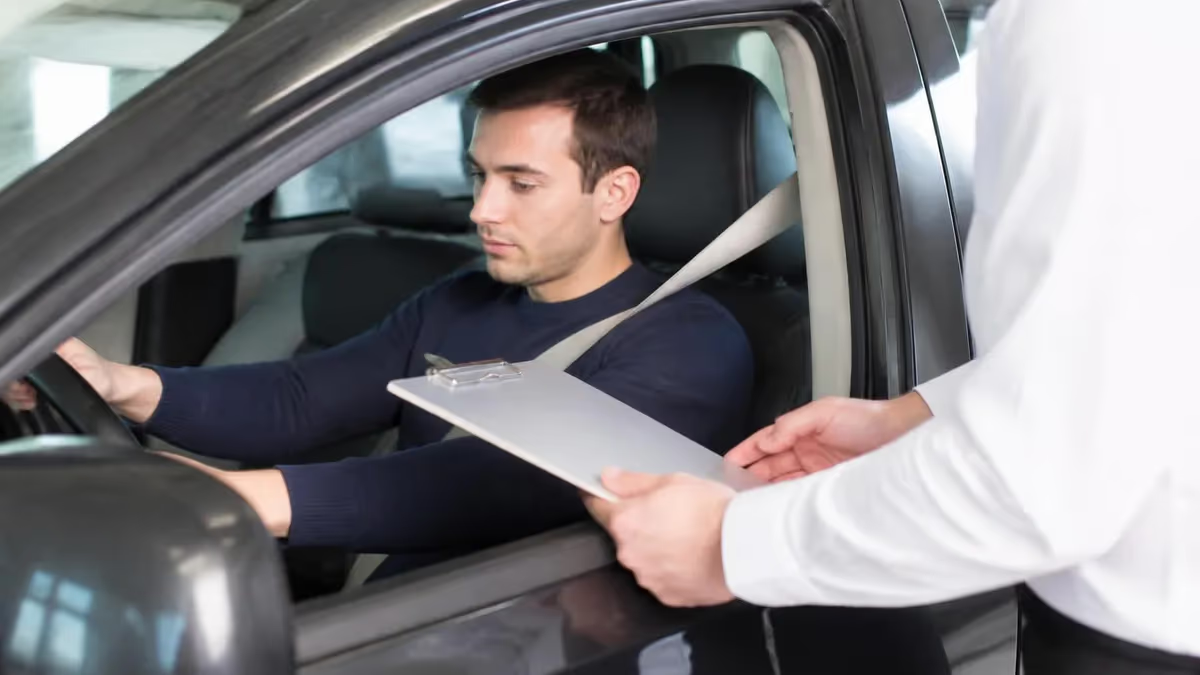
The DMV driver's license test is the gateway credential for operating a motor vehicle legally on public roads in the United States. Every state administers two distinct components: a written knowledge test that covers traffic laws, road signs, and safe driving practices, and a behind-the-wheel road test that evaluates your ability to apply those rules in actual traffic conditions. Both must be passed to receive a full driver's license, and both require deliberate preparation rather than casual familiarity with driving.
Many first-time applicants are surprised to discover that the written test fails a significant percentage of takers who assumed that general driving exposure would be sufficient preparation — the test specifically targets regulatory details, road sign meanings, and numerical thresholds (speed limits, following distances, blood alcohol limits) that require explicit study.
State DMV agencies administer their tests based on each state's vehicle code, so the specific questions vary by state. However, all state knowledge tests draw from a common body of traffic law that is largely consistent nationally — rules about right-of-way, school bus stopping requirements, speed limits in school and construction zones, and DUI limits are either uniform or very similar across states.
A candidate who studies the full spectrum of driver's manual content thoroughly passes the knowledge test in any state far more reliably than one who attempts to predict which specific questions will appear. The best single resource for each state's test is that state's official driver's manual, available free on the state DMV website and at any DMV office. Our practice DMV license test materials are designed to help you apply that knowledge under timed test conditions.
The stakes of the DMV license test are higher than many applicants appreciate. A driver's license is among the most consequential credentials in American life — it enables employment (many jobs require driving), independence, and access to services not served by public transit in most of the country.
First-time failures are more common than public perception suggests: national estimates put the first-attempt failure rate for knowledge tests at roughly 30-40%, and road test first-attempt failure rates even higher in some states. The candidates who pass on the first attempt consistently report the same preparation strategy: reading the full driver's manual, taking multiple practice tests, and specifically drilling the numerical and regulatory details that casual familiarity does not cover.
DMV License Test Quick Facts
- Knowledge test: typically 20-50 questions, 70-80% pass mark required
- Must bring: proof of identity, proof of residency, Social Security card, application fee
- Wait time after fail: typically 7-14 days before retake (varies by state)
- Road test: covers basic vehicle operation, traffic navigation, parking maneuvers
- Road test scheduling: usually separate appointment from knowledge test
- Age for unrestricted license: 18 in most states; GDL restrictions apply to 16-17 year olds
- REAL ID: requires additional documentation beyond standard license requirements
The knowledge test typically consists of 20-50 multiple-choice questions, depending on the state, with a passing score requirement of 70-80%. Questions fall into several major categories: traffic signs and their meanings, right-of-way rules at intersections, speed limits in specific zones (school, construction, residential, highway), following distance requirements, rules for special situations (railroad crossings, emergency vehicles, school buses), BAC limits and DUI consequences, and vehicle equipment requirements.
Numerical values are specifically targeted because they cannot be inferred from common sense — you must know that in most states the legal BAC limit is 0.08%, that a school bus with flashing red lights requires you to stop at a minimum of 20 feet, and that you must yield to pedestrians within how many feet of a crosswalk.
Road sign recognition is a major component of every state's knowledge test and one of the most effective areas to study for quick score improvement. Federal highway sign standards define sign shapes and colors with specific meanings: red octagons for Stop, triangles for Yield, yellow diamonds for warnings, green rectangles for guide and information signs, orange diamonds for construction zones. Regulatory signs (speed limits, turn restrictions) are typically white rectangles.
Many knowledge tests include images of signs without their text, testing whether you can identify the sign's meaning from its shape and color alone. Reviewing the complete sign inventory from your state's driver's manual — not just the common signs you encounter daily — covers the less familiar signs that disproportionately appear as test questions precisely because they are less well-known.
Graduated Driver Licensing (GDL) laws affect the test experience for applicants between 15 and 17. Most states require a learner's permit — issued after passing the knowledge test with a parent or guardian present — before scheduling road test appointments. The learner's permit period typically lasts 6-12 months and requires a minimum number of supervised driving hours (typically 30-50 hours, including a specified number at night) before the road test can be scheduled.
First-time adult applicants (18+) in most states can schedule the road test without a learner's permit period, though some states have recently extended GDL-style requirements to young adults. Understanding your specific state's GDL requirements, documented on that state's DMV website, prevents scheduling surprises when you are ready to test. BMV practice test resources prepare you for the knowledge component regardless of your age category.
Computer-based knowledge testing has replaced paper tests at most state DMV offices, with applicants answering questions on a screen at an individual testing station rather than filling out a paper answer sheet. The transition to computer-based testing has also enabled immediate scoring — results appear on screen within seconds of finishing the test, and in states that allow same-day road test scheduling, candidates who pass the knowledge test can sometimes schedule their road test appointment immediately.
Some states have also introduced smartphone-accessible practice test apps through their official DMV programs, making it easier to study during commutes, breaks, or other fragmented time windows rather than requiring dedicated desktop study sessions.
The vision test is a component of DMV licensing that many applicants overlook entirely. At initial application, DMV staff administer a basic visual acuity test using a vision machine or eye chart. Most states require 20/40 vision (with corrective lenses if you normally wear them) in at least one eye.
If you normally wear glasses or contacts, bring them to the DMV — testing without your usual corrective lenses and failing the vision check prevents you from completing the application that day. Candidates who are uncertain whether they meet the vision standard should visit an optometrist before their DMV appointment to avoid a wasted trip.

What the DMV Knowledge Test Covers
Sign shapes, colors, and meanings. Traffic light rules including flashing signals. Pavement markings (yellow lines, white lines, crosswalks). This category is often tested with images showing signs without text labels.
Who yields at uncontrolled intersections, four-way stops, roundabouts. Pedestrian right-of-way requirements. Emergency vehicle right-of-way. Merging rules on highways. These situations require precise rule knowledge, not intuition.
Default speed limits by road type and zone. School zone and construction zone limits. The 3-second following distance rule and how weather affects it. Maximum safe speeds in specific conditions (rain, fog, ice).
School bus stopping law — when to stop, when a median allows passing. Railroad crossing rules. Funeral processions. Emergency vehicle response. Passing restrictions on solid yellow lines and no-passing zones.
Legal BAC limits: 0.08% for adults, 0.04% for CDL holders, 0.02% or zero for under-21. Implied consent law. Administrative license suspension for refusal. Effects of alcohol on driving ability at specific BAC levels.
Seatbelt laws. Child restraint requirements by age and weight. Headlight use requirements. Windshield wiper operation rules. Minimum tread depth. When to use hazard lights. Inspection requirements.
Preparing effectively for the knowledge test requires more than skimming the driver's manual once. Research on test performance consistently shows that active recall practice — testing yourself on questions rather than passively rereading material — produces significantly better retention and test performance than passive reading. State DMV practice tests, available free on the state's official website and through unofficial practice test platforms, simulate the format and content of the real test.
Working through complete practice tests — not just individual questions — familiarizes you with how questions are phrased and catches knowledge gaps that reading alone does not reveal. A target of 90%+ on multiple practice tests before scheduling the real test provides a meaningful safety margin above the 70-80% pass threshold.
The road test evaluates your ability to apply traffic laws and vehicle control skills in actual driving conditions. Evaluators typically assess: pre-drive vehicle inspection (checking mirrors, adjusting seat, fastening seatbelt before starting), starting and stopping smoothly, following posted speed limits, maintaining proper lane position, executing turns correctly (lane position before, during, and after the turn), yielding at intersections, merging safely, and completing parking maneuvers (parallel parking, backing, three-point turns in most states). Automatic failure criteria in most states include striking a curb or other object, running a stop sign or red light, failing to yield to a pedestrian, or speeding.
One or two minor errors typically do not fail the test; a pattern of repeated errors or a single serious error does.
Scheduling and documentation requirements vary by state but follow a common pattern. You will need at minimum: a birth certificate or passport (proof of identity), a Social Security card or proof of Social Security number, two documents proving current address (utility bills, bank statements), and payment for the application fee ($20-$50 in most states). REAL ID-compliant licenses require documents that meet additional federal standards — typically the same documents plus a certified birth certificate (not a hospital certificate) and a document specifically proving your Social Security number.
Check your state's specific checklist before going to the DMV to avoid making multiple trips due to missing documentation. States that have moved to online appointment systems can have wait times of several weeks for road test slots in high-demand areas.
Specific maneuvers for the road test vary by state, but parallel parking is consistently the most anxiety-inducing. The standard parallel parking test requires fitting your vehicle between two other vehicles (or cones representing them) within a specific number of attempts and without striking the curbs or reference vehicles.
Practice with cones or chalk marks before the test to calibrate the space your vehicle needs and develop the mental reference points that make the maneuver consistent. Three-point turns test your ability to reverse and maneuver in tight spaces. Highway or expressway evaluation (where included) tests merging and lane maintenance at speed. These three maneuvers together account for the majority of road test failures in most states.
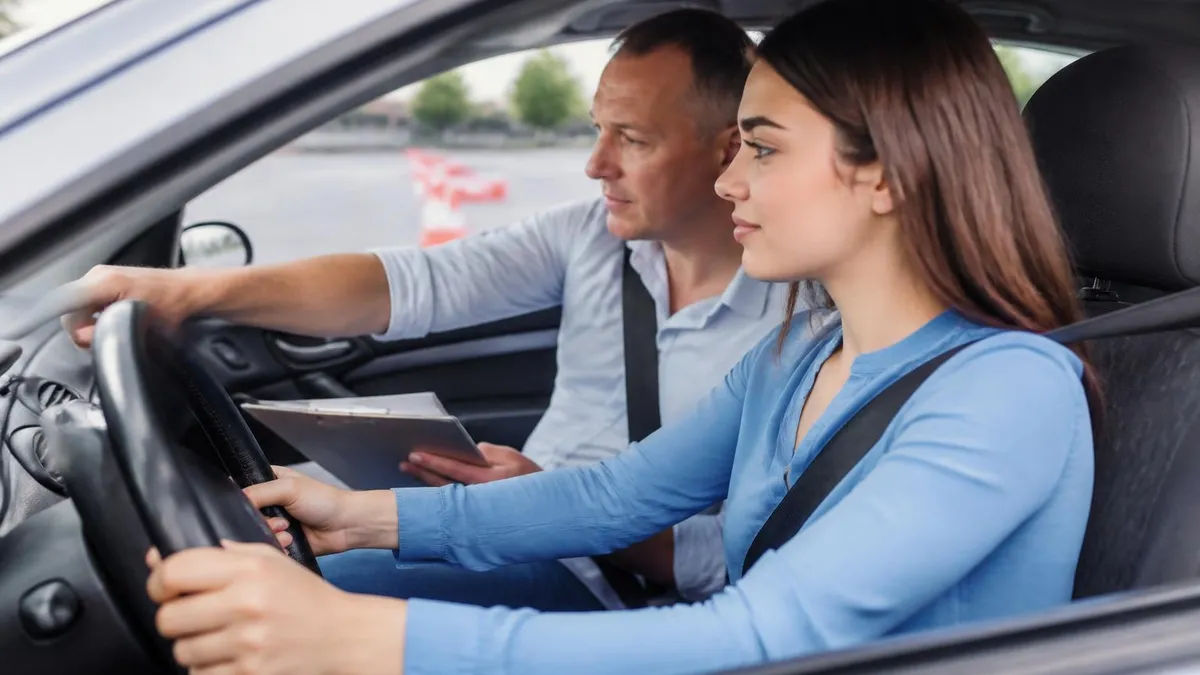
Dual-control vehicles used by driving schools offer a significant safety and learning advantage for nervous new drivers: the instructor has access to a second set of brakes, eliminating the safety concern that makes some new drivers hesitant to practice in unfamiliar or challenging situations.
Many states allow driver's education vehicles — with an instructor present — to be used for road tests rather than requiring the applicant to provide their own vehicle. Using a driving school vehicle for the road test has both advantages (familiar, well-maintained, dual-control) and disadvantages (may feel different from the family car you practiced in) worth weighing before deciding which vehicle to use for your test appointment.

Before the test: practice the maneuvers you will be evaluated on until they feel automatic. Parallel parking, three-point turns, and highway merging are the most commonly failed elements. Schedule practice sessions in the vehicle you will use for the road test so you know its dimensions and mirrors.
During the test: narrate your actions when appropriate ("checking my mirrors, checking blind spot") to make your safety checks visible to the evaluator. Come to complete stops at all stop signs — rolling stops fail tests. Signal for all turns and lane changes, not just the ones you think are obvious. Drive at posted speed limits, not above or significantly below them.
Commercial Driver's License (CDL) tests are a distinct, significantly more complex category of DMV testing. CDL applicants must pass a General Knowledge test plus endorsement tests for specific vehicle types — Tanker, Hazmat, Passenger, School Bus, Doubles/Triples — and a skills test in the specific vehicle class they are testing for. The General Knowledge test alone has 50 questions and requires an 80% pass score.
Hazmat endorsements require a separate knowledge test plus a TSA background check and fingerprinting. CDL applicants typically spend 2-6 weeks studying before testing, using the FMCSA (Federal Motor Carrier Safety Administration) CDL study guide as the primary resource. Endorsement tests add additional study requirements for each specialized category.
Motorcycle license endorsements require both a knowledge test covering motorcycle-specific content and a skills test conducted on a closed course (at most DMVs) or in traffic (in some states). The knowledge test covers motorcycle-specific laws, protective clothing, braking distances, handling in curves, and hazard awareness that is distinct from car driving knowledge. The MSF (Motorcycle Safety Foundation) Basic RiderCourse provides skills training and often waives the DMV skills test for graduates in most states — this is the recommended path for new riders because it combines professional instruction with test requirement satisfaction in a single training event.
Distracted driving laws — covering cellphone use, texting, and handheld device operation while driving — have been added to most state driver's manuals and are increasingly included in knowledge tests. As of 2024, all but four states prohibit handheld cellphone use while driving, and texting while driving is banned in 48 states.
The specific penalties and exceptions (hands-free use, emergency calls) vary by state and are fair game for knowledge test questions. Reviewing your state's distracted driving statutes specifically, since this is a relatively recent addition to many state driver's manuals, helps ensure you have current information on a topic that is both legally significant and actively tested.
Insurance requirements are another frequently tested category. Every state requires drivers to carry minimum liability insurance, and driving without it is a misdemeanor or civil infraction in all states, typically resulting in license suspension and significant fines.
The specific minimum coverage requirements vary by state (expressed as per-person and per-accident bodily injury limits plus property damage) and are specifically tested because they affect the legal obligations of every licensed driver. Understanding that liability insurance covers damage you cause to others — not damage to your own vehicle — is a concept distinction that appears as a question in many state tests.
Not reading the full driver's manual: Relying only on practice tests without reading the manual misses context that explains why specific answers are correct. Reading the manual first, then using practice tests to identify gaps, produces better results than starting with tests alone.
Bringing incomplete documentation: Double-check the document checklist on your state's DMV website the day before your appointment. Missing a single required document means rescheduling, often with additional wait time for a new appointment.
Forgetting to adjust mirrors before the road test starts: Evaluators watch what you do before putting the car in drive. Adjust your seat, check your mirrors, and fasten your seatbelt before starting — these pre-drive steps are evaluated.
Rolling through stop signs: This is an automatic failure in virtually every state. Come to a complete stop with your front bumper behind the stop line, wait a moment, then proceed after confirming the intersection is clear.
Driver's license reciprocity — the process of exchanging a foreign or out-of-state license for a local license — follows different rules than original licensing. US citizens moving between states typically exchange their current license by presenting the out-of-state license plus proof of residency; a knowledge or road test may or may not be required depending on the receiving state and how long the applicant has been a licensed driver.
International license holders must typically pass the full knowledge and road test in the new state, though some states have reciprocity agreements with specific countries. The Department of State's website documents which countries have agreements that simplify the US license acquisition process for their nationals.
Online and kiosk-based DMV services have expanded the options for license renewal, address changes, and duplicate license requests — though original license applications and road tests must still be completed in person. Many states now offer knowledge tests at private testing locations (including high school driver's education programs and third-party testing centers) that may have shorter wait times than state DMV offices. Checking your state's DMV website for all authorized testing locations, not just the nearest official DMV branch, sometimes reveals faster appointment availability at alternative locations that are less well-known to the public.
Enhanced licenses and REAL ID compliance affect the renewal experience for existing license holders in addition to new applicants. The federal REAL ID Act requires that state IDs meeting enhanced standards be used for boarding domestic flights and entering federal facilities. Non-compliant licenses are still valid for driving but cannot be used as federal ID for air travel as of May 2025.
Many existing license holders upgrading to REAL ID compliance are surprised by the documentary requirements — a certified birth certificate, not a hospital-issued one, is the most common documentation that people lack. Planning ahead and obtaining the required documents before your renewal appointment prevents repeat trips to the DMV.
The DMV license test, for all its administrative complexity, exists for a clear purpose: ensuring that every driver operating on public roads has demonstrated a baseline understanding of traffic law and vehicle control. Drivers who prepare thoroughly not only pass the test — they develop the habits and knowledge that make them meaningfully safer on the road for the rest of their driving lives. The time invested in proper preparation is not wasted on a bureaucratic hurdle; it is invested in foundational knowledge that every road trip, commute, and driving decision will draw on indefinitely.
Key Facts at a Glance
| Item | Value | Details |
|---|---|---|
| Questions on most state knowledge tests | 20-50 | |
| Pass mark required in most states | 70-80% | |
| Typical wait after failing before retake | 7-14 days | |
| Questions on the CDL General Knowledge test | 50 | |
| Supervised driving required for teen GDL permit | 30-50hrs |
- +Formal driver's ed provides structured instruction from a licensed teacher
- +Self-study with official manual and practice tests works for many candidates
- +Driver's ed often includes in-car instruction that reduces road test anxiety
- +Self-study is free; driver's ed costs $200-$800 depending on program
- +Driver's ed may reduce car insurance premiums for young drivers
- −Driver's ed quality varies — some programs are better than self-study; some are not
- −Self-study requires more self-discipline to cover all required material
- −Driver's ed does not guarantee passing — knowledge test still requires study
- −Online driver's ed programs vary widely in preparation quality
- −Teen drivers benefit more from driver's ed than adult first-time applicants
BMV Questions and Answers
About the Author
Licensed Driving Instructor & DMV Test Specialist
Penn State UniversityRobert J. Williams graduated from Penn State University with a degree in Transportation Management and has spent 20 years as a certified driving instructor and DMV examiner consultant. He has personally coached thousands of applicants through written knowledge tests, skills assessments, and commercial driver licensing programs across more than 30 states.
Join the Discussion
Connect with other students preparing for this exam. Share tips, ask questions, and get advice from people who have been there.
View discussion (9 replies)