
What Does BLS Stand For? Basic Life Support Explained 2026 September
BLS stands for Basic Life Support. Learn what the acronym means, 🆕 who needs the certification, and how it differs from CPR in under 5 minutes.
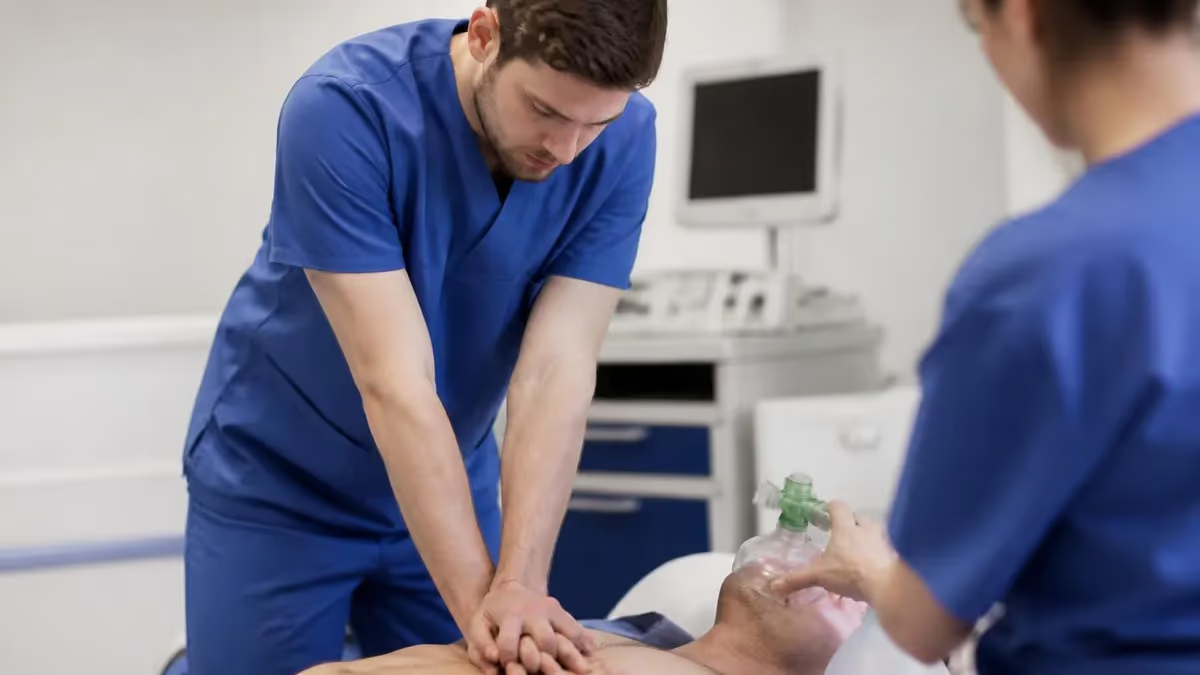
Three letters, one life-saving job. BLS stands for Basic Life Support, the foundation of emergency care that healthcare workers and first responders rely on when a person stops breathing, collapses, or shows signs of sudden cardiac arrest. The acronym shows up on hospital schedules, fire-department call sheets, and lifeguard certificates.
Plenty of new students see the letters and wonder what they actually mean in practice. The short answer: a structured response that combines high-quality chest compressions, rescue breathing, and defibrillation delivered by a trained provider in the first critical minutes of an emergency.
This guide walks through the meaning of the acronym, who needs the certification, how BLS differs from regular CPR, and what to expect if you are signing up for a course this month. By the end, the three letters will read like a job description, not a mystery.

BLS At a Glance
Walk through any emergency department and you will hear staff toss the acronym around as a shared verb. They say someone is BLS-certified, or that a code team needs another BLS provider on the chest. The letters are short for Basic Life Support, but in conversation they are also shorthand for a complete skill set.
The American Heart Association (AHA), American Red Cross, and Health and Safety Institute (HSI) all publish BLS curricula. The science behind each program traces back to the same source: the International Liaison Committee on Resuscitation, which updates global resuscitation guidelines every five years.
Because the underlying science is shared, the cards look interchangeable at a glance. What differs is the issuing organization, the renewal pathway, and which employers will accept which provider. Hospitals overwhelmingly favor the AHA card. Community centers, schools, and many youth programs lean on the Red Cross.
The word basic in Basic Life Support is misleading. The skills are foundational, but they are not casual. A BLS provider learns to recognize cardiac arrest in seconds, run compressions at a specific rate and depth, manage an airway with a bag-mask device, and integrate an automated external defibrillator into a coordinated team response. None of that is intuitive.
BLS stands for Basic Life Support. It is a provider-level emergency response course that teaches high-quality CPR, AED operation, choking relief, and team-based resuscitation for adults, children, and infants. Most US hospitals require staff to hold a current BLS card before patient contact, and renewal is needed every two years.
Who actually needs to know what BLS stands for in a professional sense? The list is longer than most people expect. Nurses, physicians, EMTs, paramedics, dental hygienists, respiratory therapists, surgical technicians, medical assistants, phlebotomists at many employers, lifeguards, athletic trainers, school health staff, and every clinical student rotating through a healthcare setting.
Hospitals will not let an unprovisioned staffer step on the floor without a valid card. Outpatient clinics, dental offices, and surgery centers run the same rule. EMS agencies require BLS as a prerequisite for advanced courses like ACLS and PALS.
Outside healthcare, the credential still has weight. Some commercial driver license programs include BLS components for school bus operators. Many corporate safety teams keep at least one BLS-certified employee on every shift. Coaches, camp counselors, and security officers often hold provider-level cards, especially in venues without an on-site medical team.
A second group is not required to take BLS but probably should. Parents of young children, swim coaches, K-12 teachers, neighborhood watch volunteers, even retirees who spend a lot of time around grandchildren. The training is the same. The card is the same. The only difference is the motivation that pushed you to register.
Who Needs BLS Certification
Nurses, doctors, technicians, and assistants must hold a current BLS card before patient contact. Renewal every two years is non-negotiable.
EMTs and paramedics carry BLS as a prerequisite for ACLS and PALS. Field cards are checked during recertification audits.
Dentists, hygienists, and assistants renew BLS every two years to maintain practice insurance and state licensing.
Lifeguards, athletic trainers, school nurses, and security officers often hold provider-level cards for incident response.
The most common confusion about the acronym is BLS versus CPR. The two overlap, but they are not interchangeable, and treating them as the same thing is a quick way to lose a job offer.
CPR — cardiopulmonary resuscitation — is a single skill set. Chest compressions plus rescue breaths. A lay rescuer can learn it in a couple of hours. The American Heart Association sells a Heartsaver CPR AED course for the general public that produces a useful skill, but the card is community-level. It is not the same as BLS.
BLS is a broader healthcare provider course. It covers high-quality CPR, but it also adds AED integration, choking relief for adults, children, and infants, advanced airway considerations with a bag-valve-mask, team dynamics, and the algorithm for transitioning to an arriving advanced cardiac life support team.
If a clinical supervisor or hospital HR rep asks for a BLS card, do not show up with a Heartsaver CPR AED card. They are different credentials and not interchangeable. The reverse is also true: a community CPR class is the right choice for most parents and teachers, and overpaying for a full provider course is unnecessary unless an employer requires it.

BLS vs Related Courses
The Basic Life Support provider course runs roughly four hours of in-person time, includes a written exam plus a hands-on skills test, and is designed for healthcare workers and emergency responders. The card is valid for two years and is accepted by virtually every hospital and clinical employer in the United States.
What does a BLS class actually look like once you understand what the letters stand for? Expect a mix of video, instructor-led discussion, and a substantial amount of time on a manikin. The classroom-only format runs about four hours total, ending with a written exam and a hands-on skills station.
The blended-learning option splits the cognitive portion into a self-paced online module and condenses the in-person session to a 60 to 90 minute skills check. Both versions meet the same AHA standard. The fully online cards from non-accredited providers do not, and most hospitals reject them outright.
The written exam is multiple choice. On the AHA test you face about 25 questions covering compression rate and depth, ventilation timing, AED use, choking management, and the differences between adult, child, and infant care. The passing score is 84 percent. The skills test is pass or fail. You either move air correctly and compress the chest at the right rate and depth, or you remediate on the spot until you do.
Three places are where most candidates stumble. They compress too fast and lose depth. They forget to allow full chest recoil between compressions. They fumble the bag-mask seal during rescue breathing. Spending an extra ten minutes on the practice manikin before the test solves all three.
You cannot break someone's ribs and kill them. Cracked cartilage during effective compressions is common and not a reason to slow down. You do not need to give breaths if untrained — compression-only CPR has equivalent survival outcomes for adult cardiac arrest. The AED will not shock a beating heart. The device analyzes the rhythm and only delivers a shock when it detects a shockable pattern.
The history behind the acronym helps explain why the modern course feels the way it does. In the 1960s, researchers Peter Safar and James Elam combined mouth-to-mouth ventilation with closed-chest compressions into what is now called the CPR algorithm. The American Heart Association codified the curriculum, and updates roll out every five years based on the International Liaison Committee on Resuscitation consensus.
The 2020 guidelines emphasized compression-only CPR for untrained bystanders and tightened the focus on minimizing pauses between compressions. The 2025 updates pushed harder on early defibrillation and team-based communication. Each refresh shifts the classroom emphasis a little, but the core skills remain unchanged. Compress hard, compress fast, allow recoil, and integrate the AED the moment it arrives.
If you want to dig deeper into the certification before you book a class, our BLS meaning guide covers the broader context around the credential. Both articles answer related questions, but this one focuses specifically on what the acronym stands for and what that means for your career or volunteer role.
What a BLS Provider Can Do
- ✓Recognize sudden cardiac arrest within 10 seconds of assessment
- ✓Activate the emergency response system and call for an AED
- ✓Compress the chest at 100 to 120 per minute with at least 2 inches of depth
- ✓Allow full chest recoil between every compression
- ✓Switch compressors every two minutes to maintain quality
- ✓Operate an automated external defibrillator with correct pad placement
- ✓Manage choking emergencies in adults, children, and infants
- ✓Coordinate team dynamics using closed-loop communication
- ✓Transition smoothly to arriving advanced cardiac life support providers
The acronym BLS sometimes appears in non-medical contexts too, which can confuse students searching for the certification. In finance, BLS is the Bureau of Labor Statistics, the federal agency that publishes monthly jobs reports. In supply chain logistics, BLS can refer to a Bill of Lading Service. In information technology, the same letters occasionally stand for Business Logic System.
If you are reading a healthcare job posting, the meaning is almost always Basic Life Support. The same is true when the letters appear next to ACLS or PALS, or alongside a request for a current AHA certification. Context disambiguates the acronym faster than any dictionary entry, but a quick check of the surrounding sentences will confirm it.
Some employers list BLS as a hard requirement, with the abbreviation followed by the words Basic Life Support in parentheses. Others assume the reader already knows. Either way, the credential they want is the healthcare provider course discussed throughout this guide. Pros and cons below summarize how candidates feel about the certification once they hold the card.

BLS Certification Pros and Cons
- +Universally recognized by US hospitals and clinical employers
- +Two-year validity reduces the admin overhead of frequent renewals
- +Hands-on skills transfer directly to real cardiac arrest scenarios
- +Blended learning options save classroom time without sacrificing standards
- +Prerequisite for advanced courses like ACLS and PALS
- −Annual cost can sting for self-paying students in big metro areas
- −Skills test requires in-person attendance, fully online cards are not accepted
- −A lapsed card can pull you from the schedule with no grace period
- −Quality of training centers varies, smaller class sizes cost more
- −Online resellers sometimes issue cards that hospitals refuse
Renewal sits at the back of every BLS provider's calendar. The card is valid for two years from the date issued, and most employers will not allow clinical work with an expired credential. Renewal classes are shorter than the initial course, usually two to three hours, and many use a HeartCode blended approach where the cognitive portion is online and the skills check runs roughly 45 minutes.
Skipping the renewal window is risky. A few state nursing boards allow a brief grace period, but most hospitals will pull you from the schedule the moment your card lapses. The smartest students stack renewal classes the same week each cycle so the date never sneaks up on them.
If your card lapses entirely, you typically cannot just take a renewal class. You have to repeat the full initial certification, which means a longer course and the higher initial-course fee. The grace period after expiration is zero days in most healthcare systems, so plan ahead.
A second tip applies to anyone who works across multiple employers, which is common in nursing and EMS. Save the AHA eCard PDF in two places. Your inbox can lose a verification email during a routine archive. Cloud storage and a personal email account give you redundancy when an onboarding coordinator asks for a digital copy on short notice.
BLS Questions and Answers
One useful way to lock in what the acronym stands for is to study with a question bank that mirrors the exam. Read the provider manual, then run 10 timed questions, then re-read the section you missed. Repeating that loop three or four times turns the compression rate, depth, ratio, and AED operation answers from memorized facts into automatic reflexes.
Our free practice tests grade you instantly with explanations for every answer. Most candidates need three or four passes through the question bank before they can answer the compression-depth and pulse-check timing items without hesitation. Once those answers feel automatic, the written exam is straightforward.
If you are scheduling a class for the first time, look for a training center with smaller class sizes and recent positive reviews. The cost difference between a good and a mediocre center is usually only $10 to $20, and the time saved in remediation more than makes up for it. Instructor patience and manikin condition matter more than the marketing on the booking page.
One more thing worth flagging for nursing and EMT students. Your school may include a BLS class in your tuition or charge separately. Check before paying for an outside course. A surprising number of students sign up at a commercial training center only to learn later that their program already bundles the cost into lab fees. A short email to your program coordinator can save the entire registration fee.
So next time you spot the letters BLS on a job posting or a hospital lanyard, you will know exactly what they mean and what the holder has trained to do under pressure. The acronym is short. The responsibility behind it is anything but. Whether you are renewing a card or signing up for an initial certification, study the algorithm, practice the rhythm, and walk into the test confident.
Three letters, hours of training, and a credential that hospitals trust because the underlying science has been tested across millions of resuscitation events worldwide. That is what BLS stands for, in every sense of the phrase.
Where You Will See BLS Required
Hospital and clinic listings include BLS as a hard prerequisite, often shorthand for AHA-issued cards specifically.
Nursing, dental hygiene, EMT, and respiratory therapy programs require a current card before clinical rotations.
Workplace safety audits and liability insurance carriers note BLS coverage when assessing premium discounts.
International medical credential verification asks for AHA or Red Cross cards issued inside the United States.
BLS Acronym Meanings by Context
- ✓Medical and emergency response: Basic Life Support — the AHA and Red Cross provider course
- ✓Federal government: Bureau of Labor Statistics, the agency that publishes monthly jobs data
- ✓Supply chain logistics: Bill of Lading Service, used in international freight documentation
- ✓Information technology: Business Logic System, a backend application architecture term
- ✓Academic credentials: Bachelor of Legal Studies, an undergraduate degree in some countries
- ✓Library science: Books, Literacy, and Services, used by some public library systems
- ✓Linguistics: Background Language Subsystem in some natural language processing models
Comparing BLS Course Providers
The American Heart Association is the most widely recognized BLS provider in the United States. Hospitals overwhelmingly accept AHA cards without question. The eCard verification system makes credential checks fast for HR teams during onboarding.
If you are searching for what BLS stands for because of a recent job interview, the credential is almost certainly the AHA version. Hiring managers default to AHA wording in postings because it is the most commonly recognized brand inside US health systems. Red Cross cards are still accepted, but the AHA card is the one that rarely gets questioned during onboarding paperwork.
Another common reason students search for the acronym is a school health-sciences program prerequisite. High school dual-enrollment classes, community college nursing tracks, and many EMT programs ask students to complete BLS before clinical rotations begin. The course is offered during evening and weekend windows specifically to fit the student schedule. Many programs even bundle the registration into lab fees, so check before paying out of pocket.
For workplace safety officers, the answer to what BLS stands for is also about liability. A site with at least one BLS-trained employee on every shift can document a higher standard of care during workers compensation reviews. Insurance carriers occasionally reduce premiums for organizations that maintain a documented BLS roster, especially in construction, manufacturing, and hospitality.
Parents who saw the acronym during a youth sports waiver are looking at a slightly different scenario. Many sports leagues now require coaches to either hold BLS or attend an annual safety briefing. The BLS option is more comprehensive and more useful in the field. The briefing is faster but covers less. Either satisfies the league, but the card is the one worth carrying long-term.
Finally, anyone preparing for a US permanent residency or visa-sponsored medical role will see the acronym on credential verification forms. The international applicant pathway typically asks for a BLS card issued by either the AHA or the Red Cross inside the United States, not a foreign equivalent. Foreign-trained nurses and physicians plan their first US BLS class within the first month of arrival because hospital orientation timelines move quickly.
A handful of specialty fields layer additional requirements on top of BLS. Cardiac catheterization labs frequently want both BLS and ACLS on file. Pediatric units typically require BLS plus PALS. Trauma centers may require an additional TNCC or ATLS credential depending on the role. None of those advanced cards replace BLS, they build on top of it. That is why your initial provider course is worth taking seriously even when the content feels straightforward, because every advanced credential you pursue down the line assumes you can already perform the BLS skill set without thinking about it.
For long-term planners, BLS recertification has become more flexible in recent years. The AHA HeartCode blended pathway now lets you complete the entire cognitive section on a tablet at home, finish a manikin skills check at a partnered training site, and walk out with a renewed card in under two hours total. Many hospital systems also host their own in-house renewal weekends so staff never have to leave the building.
About the Author

Registered Nurse & Healthcare Educator
Johns Hopkins University School of NursingDr. Sarah Mitchell is a board-certified registered nurse with over 15 years of clinical and academic experience. She completed her PhD in Nursing Science at Johns Hopkins University and has taught NCLEX preparation and clinical skills courses for nursing students across the United States. Her research focuses on evidence-based exam preparation strategies for healthcare certification candidates.
Join the Discussion
Connect with other students preparing for this exam. Share tips, ask questions, and get advice from people who have been there.
View discussion (8 replies)