
BLS Exam Answers: Complete 2026 Study Guide with Practice Questions and Verified Solutions
Get verified BLS exam answers, basic life support exam C answers, AHA practice questions, and complete study guide for 2026 certification success. 🧠
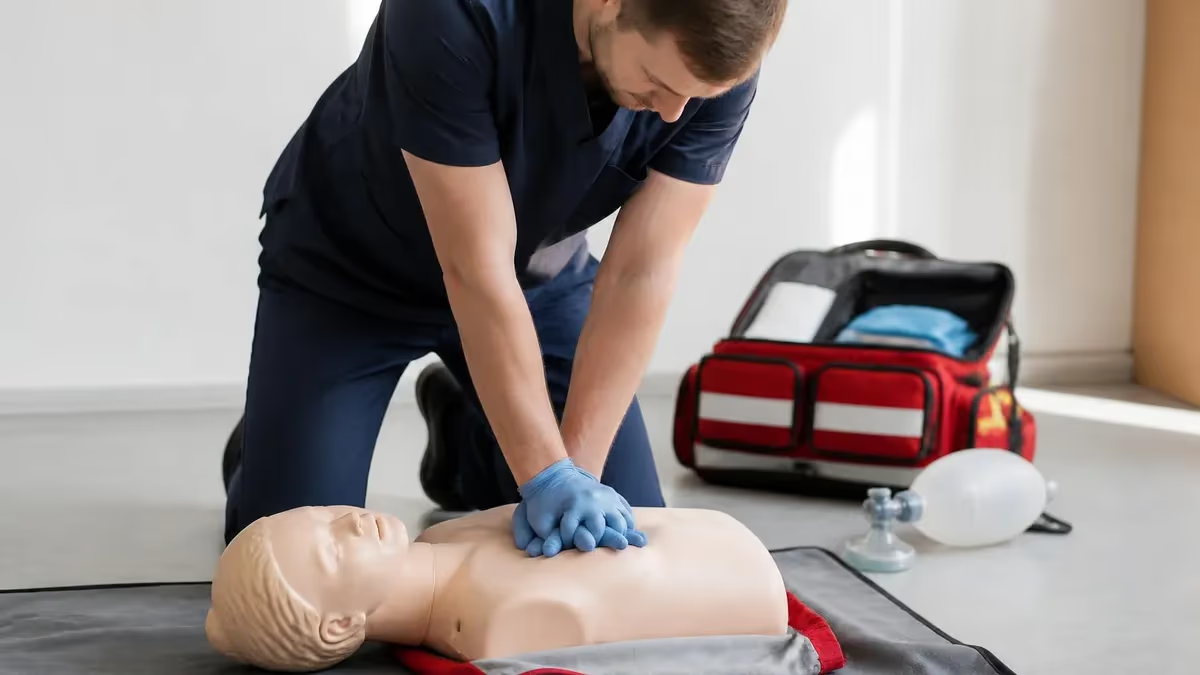
If you are searching for reliable basic life support exam C answers, you are likely days away from sitting the American Heart Association certification test and want to walk in confident, not anxious. This guide compiles verified answer explanations, scenario breakdowns, and the exact rationales examiners use when scoring the 25-question written portion. We focus on understanding, not memorization, so the knowledge sticks long after you leave the classroom. Every answer below ties back to current 2020 Guidelines updates that remain authoritative through the 2026 testing cycle.
So what is a bls certification, exactly? It is a credential issued by the American Heart Association or the American Red Cross that verifies you can recognize cardiac arrest, deliver high-quality chest compressions, use an automated external defibrillator, and coordinate team-based resuscitation in a hospital or prehospital setting. Most employers in healthcare require it, and many require renewal every two years. The exam tests both psychomotor skills and written knowledge, and most candidates who fail the first attempt failed the written portion by one or two questions.
The biggest myth we need to clear up immediately is the relationship between BLS and CPR. Many candidates wonder is bls and cpr the same when they register, and the short answer is no. CPR is a specific skill, while BLS is a comprehensive provider-level course that includes CPR plus bag-mask ventilation, AED use, choking management, and team dynamics. Recognizing this distinction is itself a common exam question, and missing it costs candidates an easy point on the written test.
The current AHA exam draws from a question bank covering adult, child, and infant resuscitation, two-rescuer scenarios, opioid-associated emergencies, and high-quality CPR metrics. Compression depth, rate, recoil, and chest compression fraction appear on nearly every version of the exam, which is why we drill these numbers into your memory below. You will also see questions about the chain of survival, both in-hospital and out-of-hospital, and the differences matter because each chain has six links with distinct priorities.
Throughout this guide, you will find practice quizzes after each major section so you can self-test in five-minute bursts rather than cramming the night before. Active recall beats passive reading by a factor of roughly three to one according to cognitive science research, which is why we built this article around question-and-answer formats. The faster you start testing yourself, the faster weak areas surface, and the more efficiently you can target your final review time before exam day.
Whether you are preparing for the AHA HeartCode online course, an in-person skills session, or a Red Cross blended learning module, the concepts tested are nearly identical. The phrasing differs slightly, the question sequencing differs, and Red Cross tends to emphasize lay-rescuer scenarios more heavily, but the underlying medical content is standardized across both organizations. Use this guide regardless of which provider issued your course materials, and pay attention to the version-specific notes flagged in the alert boxes below.
One final note before we dive in: exam answers change when guidelines change. The 2020 AHA Guidelines updated several numbers, including chest compression depth for infants and the role of advanced airways in compression-to-ventilation ratios. If you took a course before October 2020, some of what you learned is no longer scored as correct. Everything in this guide reflects the most current standards used by certifying bodies in 2026.
BLS Exam by the Numbers
Key Facts at a Glance
| Item | Value | Details |
|---|---|---|
| Written Questions | 25 | Multiple choice format |
| Passing Score | 84% | 21 of 25 correct |
| Time Limit | 45 min | More than enough |
| Renewal Cycle | 2 yrs | Required for healthcare |
BLS Exam Format Breakdown
| Section | Questions | Time | Weight | Notes |
|---|---|---|---|---|
| High-Quality CPR Concepts | 8 | 15 min | 32% | Compression depth, rate, recoil |
| Adult BLS Algorithms | 6 | 10 min | 24% | One and two-rescuer scenarios |
| Pediatric and Infant BLS | 5 | 10 min | 20% | Age-specific modifications |
| AED and Special Situations | 4 | 6 min | 16% | Pads, shock, opioid emergencies |
| Team Dynamics | 2 | 4 min | 8% | Closed-loop communication |
| Total | 25 | 45 minutes | 100% |
To answer exam questions correctly, you first need a clear grasp of what does bls stand for and what the credential actually proves. BLS stands for Basic Life Support, a structured emergency response protocol designed for both lay rescuers and healthcare providers to use during the critical minutes before advanced care arrives. The certification confirms you can perform the core actions that determine survival outcomes: early recognition of arrest, immediate high-quality compressions, rapid defibrillation, and effective ventilation when appropriate.
The aha basic life support exam tests these competencies through scenario-based questions that mimic real clinical situations. Rather than asking you to recite numbers in isolation, the exam embeds them in cases. For example, you might read about a 56-year-old man who collapses in a hospital corridor and be asked to identify the first action a single rescuer should take. The answer requires you to know both the assessment sequence and the appropriate response when an AED is not immediately available, drawing on multiple knowledge domains at once.
The course curriculum behind basic life support for healthcare providers covers six core domains: assessment, high-quality CPR, ventilation, defibrillation, team-based resuscitation, and special circumstances. Each domain contributes proportionally to your final score, but high-quality CPR carries the heaviest weight because compression quality is the single largest determinant of survival in cardiac arrest. Examiners want to verify that you can deliver compressions at the right rate, the right depth, with full recoil, and minimal interruption.
Many candidates ask whether is bls the same as cpr matters for the exam. It absolutely does, because BLS adds layers that pure CPR training does not. You will be tested on bag-mask ventilation technique, the proper way to integrate a second rescuer, how to deliver rescue breaths through an advanced airway, and how to recognize abnormal breathing patterns like agonal gasps. These are provider-level skills not taught in community CPR classes, and they appear on roughly one-third of exam questions.
Certification through the American Heart Association is the most widely recognized credential in clinical settings, but Red Cross BLS certification is equally valid in nearly every hospital system. Both organizations align their content to the International Liaison Committee on Resuscitation consensus guidelines, so the medical facts you study are essentially identical. The differences lie in pedagogy, exam phrasing, and renewal logistics rather than in the underlying science you must master to pass.
One scoring detail catches many test-takers off guard: the written exam and the skills test are scored separately, and you must pass both. A perfect written score will not compensate for missing critical performance criteria during the skills station, and vice versa. The skills test typically requires demonstration of single-rescuer adult CPR with AED use and two-rescuer infant CPR with bag-mask ventilation, evaluated against a checklist of critical actions.
If you are renewing rather than certifying for the first time, the exam content is identical, but the course format may differ. A basic life support renewal class often runs three hours instead of four to five, skips some foundational lectures, and focuses on skill verification. The written exam, however, is the same 25-question test with the same passing threshold. Do not assume renewal is easier because the class is shorter; the questions do not get any gentler for returning candidates.
BLS Practice Test Questions
Prepare for the BLS - Basic Life Support exam with our free practice test modules. Each quiz covers key topics to help you pass on your first try.
BLS High-Quality CPR & Provider Skills
BLS Exam Questions covering BLS High-Quality CPR & Provider Skills. Master BLS Test concepts for certification prep.
BLS Special Situations & Scenarios
Free BLS Practice Test featuring BLS Special Situations & Scenarios. Improve your BLS Exam score with mock test prep.
BLS Adult, Child & Infant Resuscitation
BLS Mock Exam on Adult, Child & Infant Resuscitation. BLS Study Guide questions to pass on your first try.
BLS Airway Management & Ventilation
BLS Test Prep for Airway Management & Ventilation. Practice BLS Quiz questions and boost your score.
BLS Automated External Defibrillator (AED)...
BLS Questions and Answers on Automated External Defibrillator (AED) Use. Free BLS practice for exam readiness.
BLS Certification: Cardiac Arrest
BLS Mock Test covering Certification: Cardiac Arrest. Online BLS Test practice with instant feedback.
BLS Certification: Choking
Free BLS Quiz on Certification: Choking. BLS Exam prep questions with detailed explanations.
BLS Certification: Respiratory Arrest
BLS Practice Questions for Certification: Respiratory Arrest. Build confidence for your BLS certification exam.
BLS Chain of Survival
BLS Test Online for Chain of Survival. Free practice with instant results and feedback.
BLS CPR Techniques & Procedures
BLS Study Material on CPR Techniques & Procedures. Prepare effectively with real exam-style questions.
BLS Legal & Ethical Considerations
Free BLS Test covering Legal & Ethical Considerations. Practice and track your BLS exam readiness.
BLS Post-Resuscitation Care
BLS Exam Questions covering Post-Resuscitation Care. Master BLS Test concepts for certification prep.
basic life support exam american heart association vs Red Cross
The American Heart Association exam delivers 25 multiple-choice questions following completion of either an in-person course or the HeartCode online module. Questions emphasize provider-level decision making, two-rescuer dynamics, and proper integration with advanced cardiac life support teams. The exam is open between you and the instructor in classroom settings, and proctored digitally during online completion. You have unlimited time within reason, though most candidates finish in under thirty minutes.
AHA wording tends to be clinical and precise. Expect to see exact compression rates like 100 to 120 per minute rather than approximations. The organization also tests heavily on the in-hospital chain of survival, including surveillance, recognition, response activation, and post-cardiac-arrest care. If your workplace is hospital-affiliated, AHA is almost always the required certification because most accreditation bodies specifically reference AHA standards.

Studying with Practice Questions vs Reading the Manual
- +Active recall strengthens long-term retention far more than passive rereading of textbook chapters
- +Immediate feedback on wrong answers identifies knowledge gaps you did not know existed
- +Question banks mirror exam phrasing and conditioning helps reduce test-day anxiety significantly
- +You can study in five-minute bursts during commutes, breaks, or before bed
- +Tracking score improvements over time provides clear motivation and measurable progress
- +Scenario-based questions train clinical reasoning rather than rote memorization
- +Practice tests reveal which guidelines updates you missed from older training sessions
- −Low-quality question banks contain outdated answers from pre-2020 guidelines that may mislead you
- −Memorizing answer patterns rather than concepts leads to failure on rephrased exam questions
- −Some banks lack rationales, leaving you guessing why an answer was marked wrong
- −Over-reliance on quizzes can skip foundational concepts the manual explains in depth
- −Skills test preparation requires hands-on practice that questions cannot substitute for
- −Free banks online often contain typos, ambiguous wording, or simply incorrect medical information
BLS Exam Day Preparation Checklist
- ✓Memorize compression rate of 100 to 120 per minute for all age groups without exception
- ✓Lock in compression depth values: at least 2 inches for adults, about 2 inches for children, 1.5 inches for infants
- ✓Review the universal compression to ventilation ratio of 30 to 2 for single rescuer all ages
- ✓Practice the 15 to 2 ratio used for two-rescuer pediatric and infant resuscitation
- ✓Confirm AED pad placement for adults, children, and infants including alternate anterior-posterior positioning
- ✓Study the in-hospital and out-of-hospital chains of survival including the six links of each
- ✓Review opioid-associated emergency response including naloxone administration alongside CPR
- ✓Practice agonal gasp recognition and remember it is not normal breathing
- ✓Print or save your course completion code before logging into the exam platform
- ✓Arrive at the testing center with two forms of ID and any required prerequisite paperwork

Chest compression fraction above 80 percent saves lives
Examiners return to this number repeatedly because clinical research shows that survival to discharge drops sharply when compressions are interrupted for more than ten seconds at a time. Aim to keep hands on the chest at least 80 percent of every minute during a code, pausing only briefly for rhythm checks, defibrillation, and rescuer switches every two minutes. This is the single highest-yield concept on the entire written exam.
Let us walk through the highest-yield answer explanations that appear on nearly every version of the basic life support exam C answers. The first category covers compression mechanics, and the numbers are absolute. Adult compression depth is at least 2 inches but no more than 2.4 inches, performed at a rate of 100 to 120 compressions per minute. Child depth is about 2 inches, infant depth is about 1.5 inches, and the rate remains 100 to 120 for every age group. Memorizing these exact figures eliminates roughly four exam questions instantly.
The second high-yield category is the compression-to-ventilation ratio. For a single rescuer working on any age patient, the ratio is 30 to 2. For two rescuers working on an adult, the ratio remains 30 to 2. For two rescuers working on a child or infant, the ratio shifts to 15 to 2 to reflect the higher likelihood of respiratory etiology in pediatric arrest. Once an advanced airway is in place, the rescuers no longer pause for breaths; instead they deliver one breath every six seconds, or ten breaths per minute, while compressions continue.
The third category is AED operation, and pad placement is the most tested subtopic. Adult pads go anterolateral on bare, dry chest skin, with one pad upper right below the clavicle and the other on the lower left lateral chest. For infants and small children, use pediatric pads if available, placing one on the center of the chest and the other on the center of the back. If only adult pads are available for a child or infant, use them but ensure the pads do not touch each other, which is why anterior-posterior placement becomes necessary.
Special situations questions appear in roughly four to six items on most exams. Opioid-associated emergencies require simultaneous naloxone administration alongside standard CPR, never as a substitute for compressions and ventilation. Pregnant patients require manual left uterine displacement during compressions to relieve aortocaval compression. Drowning patients receive an initial five rescue breaths before standard CPR begins, which is one of the few exceptions to the universal compressions-first sequence introduced in the 2010 guidelines.
The chain of survival appears as both a standalone question and a framework embedded in scenarios. The out-of-hospital chain has six links: recognition and activation of emergency response, immediate high-quality CPR, rapid defibrillation, advanced resuscitation, post-cardiac-arrest care, and recovery. The in-hospital chain swaps the first link for early recognition and prevention through surveillance, reflecting the reality that monitored hospital patients should rarely arrest unexpectedly if warning signs are caught early.
Recognizing cardiac arrest is itself a tested skill. The current standard requires checking for unresponsiveness and abnormal breathing simultaneously, with a pulse check for healthcare providers lasting no more than ten seconds. Agonal gasps are not normal breathing and indicate cardiac arrest, a point examiners love to test because lay rescuers often hesitate when they hear gasping sounds. If you are unsure whether breathing is normal or whether a pulse is present after ten seconds, begin compressions.
Team dynamics questions evaluate your understanding of closed-loop communication, clear role assignment, and the importance of swapping the compressor every two minutes to prevent fatigue-related quality decline. Research shows that compression quality degrades measurably after about two minutes of continuous effort even when the rescuer perceives no fatigue. Knowing why you swap matters as much as knowing when, because exam scenarios often present a team that has been compressing for longer than recommended and ask what action to take next.
For a deeper look at this topic, see our guide to basic life support exam c answers.
If you used study materials published before October 2020, several answers you memorized are no longer correct. The most common error involves infant compression depth, which was previously listed as one-third the anterior-posterior chest diameter without a specific inch measurement. Current guidelines explicitly state approximately 1.5 inches, and the exam scores accordingly. Always verify your study source is dated 2020 or later before trusting any answer key.
If you are deciding between certification providers, the choice often comes down to what your employer accepts and what fits your schedule. The american red cross basic life support course is widely accepted across emergency medical services and many hospital systems, particularly in regions where Red Cross training centers are more accessible than AHA sites. Both certifications are valid for two years, both require renewal through a refresher course rather than re-completion of the full curriculum, and both teach the same underlying medical content.
Cost varies more than most candidates expect. AHA in-person courses typically run between 65 and 120 dollars depending on the training center, while Red Cross courses fall in a similar range. HeartCode online with in-person skills verification often costs slightly more than a full classroom course because you pay separately for the online module and the skills session. Renewal courses are usually 10 to 20 dollars cheaper than initial certification because they run shorter and skip foundational content.
The exam itself is identical in difficulty for first-time candidates and renewers, a point worth emphasizing because many renewing candidates underestimate the prep required. Two years of clinical practice does not automatically refresh your knowledge of exact compression depth or the precise compression-to-ventilation ratio shifts for two-rescuer pediatric scenarios. Practice questions are the fastest way to surface forgotten details before exam day catches you off guard during the skills station.
Question phrasing on the written exam follows predictable patterns once you have seen enough practice items. Watch for absolute words like always and never, which are usually clues that an answer is incorrect because medical practice rarely tolerates absolutes. Conversely, watch for hedged language like usually or in most cases, which often signals the correct answer because it reflects the conditional nature of clinical decision making in resuscitation scenarios.
Many questions present a sequence and ask which action comes next. The standard sequence for an unresponsive patient is check responsiveness, shout for help and activate emergency response, check breathing and pulse simultaneously for no more than ten seconds, begin compressions if no pulse or abnormal breathing, and continue cycles of 30 compressions and 2 breaths until an AED arrives. Knowing this sequence cold eliminates ambiguity on roughly five exam questions, depending on which version you receive.
For online recertification candidates, the testing experience differs from classroom exams in one important way: you cannot ask the instructor for clarification on a confusing question. Read each question twice before selecting an answer, and use the flag feature in HeartCode to mark items you want to revisit before final submission. The platform allows you to change answers freely until you submit, so use that flexibility rather than locking in your first instinct on questions where you feel uncertain.
Finally, do not underestimate the value of the skills test. Even candidates who score perfectly on the written exam can fail certification if they miss critical actions during the skills station. The most common skills failures involve insufficient compression depth, allowing the chest to rest between compressions instead of fully recoiling, or pausing compressions for more than ten seconds during transitions. Practice with a manikin and a metronome if at all possible during the week before your skills appointment.
The most effective final-week study strategy combines short practice tests with targeted review of weak areas. Take a full 25-question practice exam, score it honestly, and then spend your remaining study time only on the categories where you missed more than one question. This focused approach beats general rereading by a wide margin because it allocates your scarce time to actual knowledge gaps rather than reinforcing what you already know cold.
If you are pressed for time and can only review one topic, choose high-quality CPR metrics. Compression rate, depth, recoil, and chest compression fraction collectively account for roughly one-third of all written exam questions. These metrics also drive your score on the skills station, where the manikin records depth and rate electronically and feeds the data to your instructor. Master these four numbers and you simultaneously prepare for both halves of the certification.
For candidates renewing online, consider taking a red cross basic life support course refresher module even if your employer accepts your current credential. The few extra hours of structured review surface forgotten details and rebuild muscle memory for skills you may not have practiced in clinical settings. Most online refreshers cost less than 50 dollars and pay for themselves in reduced exam-day stress alone.
The night before your exam, sleep matters more than cramming. Cognitive performance on multiple-choice tests drops measurably after fewer than six hours of sleep, and resuscitation knowledge requires the kind of pattern recognition that suffers most when you are tired. Eat a moderate breakfast, arrive fifteen minutes early to settle in, and bring water but no caffeine excess that could leave you jittery during the skills station with a manikin and an evaluator watching every compression.
During the exam itself, pace yourself. You have 45 minutes for 25 questions, which works out to roughly 108 seconds per question. Most questions take 30 to 45 seconds, leaving plenty of buffer time for the three or four scenarios that require careful reading. If you encounter a question that stumps you, flag it and move on. Returning to flagged questions with fresh eyes often reveals the answer that was hiding in the wording the first time through.
After passing the exam, your card is typically issued digitally within 24 hours through the AHA eCard system or the equivalent Red Cross digital credential. Save a PDF copy to your phone and email it to your employer's credentialing office immediately. Hospital systems frequently have gaps in their credentialing databases, and providers have been pulled off shifts because their valid certification was not yet visible in the human resources system on the day they were scheduled to work.
Two years from now, you will repeat this process for renewal. Mark your calendar at the one-year-and-ten-month point so you have a two-month buffer to complete your refresher before your card lapses. A lapsed card means re-taking the full initial certification course rather than the shorter renewal class, costing you both time and money. Smart credentialing hygiene is part of being a healthcare professional, and starting that habit early pays dividends throughout a long career.
Sample BLS - Basic Life Support Practice Questions
Try these questions from our free BLS - Basic Life Support practice tests. The correct answer and an explanation follow each question.
What is the recommended rate for chest compressions during adult CPR?
- A. 60–80 compressions per minute
- B. 80–100 compressions per minute
- C. 100–120 compressions per minute
- D. Over 140 compressions per minute
Answer: C. 100–120 compressions per minute
According to current Basic Life Support (BLS) guidelines, the recommended rate for chest compressions during adult CPR is 100 to 120 compressions per minute. This specific rate ensures adequate blood flow to vital organs, maximizing the effectiveness of CPR. Maintaining this rhythm is crucial for patient outcomes.
You are handling this child's foreign body airway blockage situation very well. (True or False) You should continue performing CPR until emergency medical services (EMS) come and take over, or the child begins to breathe, move, or otherwise respond.
- A. False
- B. True
Answer: B. True
True. CPR should be continued without interruption until one of three things occurs: emergency medical services (EMS) arrive and take over care, the child begins to breathe, move, or otherwise respond, or the rescuer becomes too exhausted to continue. Continuous, high-quality CPR is crucial for maintaining vital organ perfusion.
A victim has a nitroglycerin patch on their chest. What should the rescuer do before placing AED pads?
- A. Place the AED pad directly over the patch
- B. Remove the patch and wipe the area clean before applying pads
- C. Apply the AED to the back only
- D. Skip AED use and call for advanced help
Answer: B. Remove the patch and wipe the area clean before applying pads
Medication patches should be removed and the skin wiped clean before AED pad placement to prevent interference with pad adhesion and to avoid burns.
Which community-level intervention has been shown to MOST effectively improve outcomes by strengthening multiple links in the out-of-hospital Chain of Survival simultaneously?
- A. Public access defibrillation (PAD) programs combined with CPR training
- B. Increasing the number of hospital beds
- C. Reducing the number of 911 call centers to streamline dispatch
- D. Restricting AED use to licensed healthcare providers
Answer: A. Public access defibrillation (PAD) programs combined with CPR training
PAD programs place AEDs in public locations and pair them with CPR training, simultaneously strengthening the early CPR and rapid defibrillation links.
BLS Questions and Answers
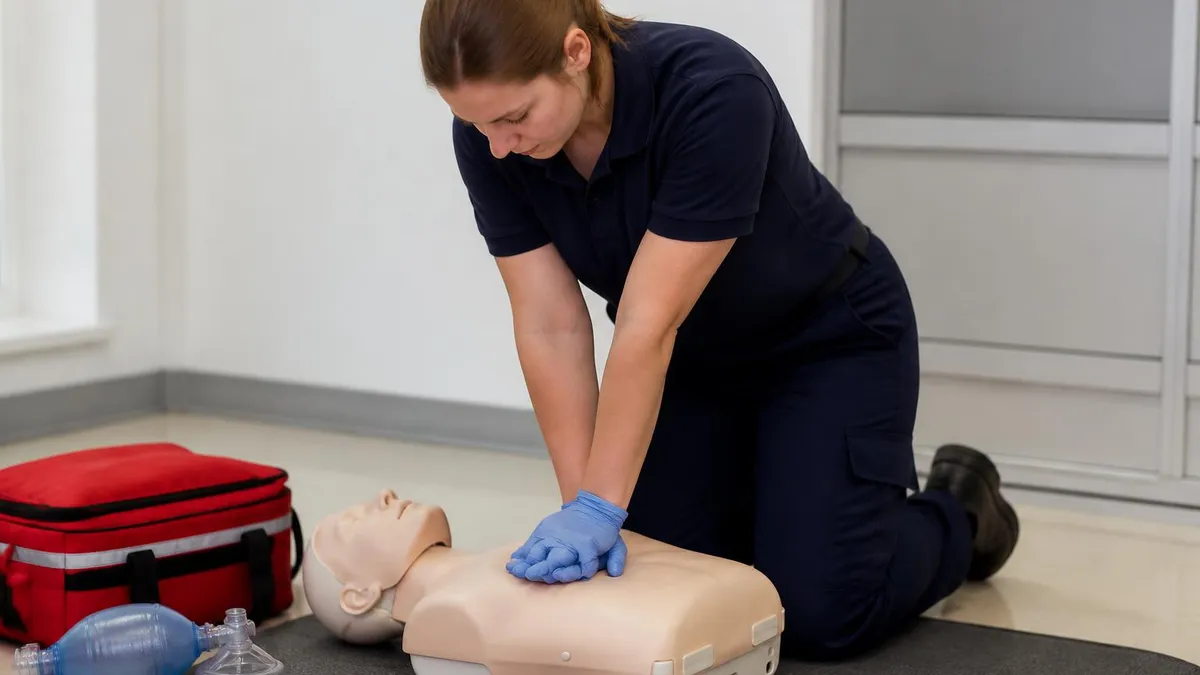
Pediatric BLS Algorithm: Complete 2026 Guide for Healthcare Providers
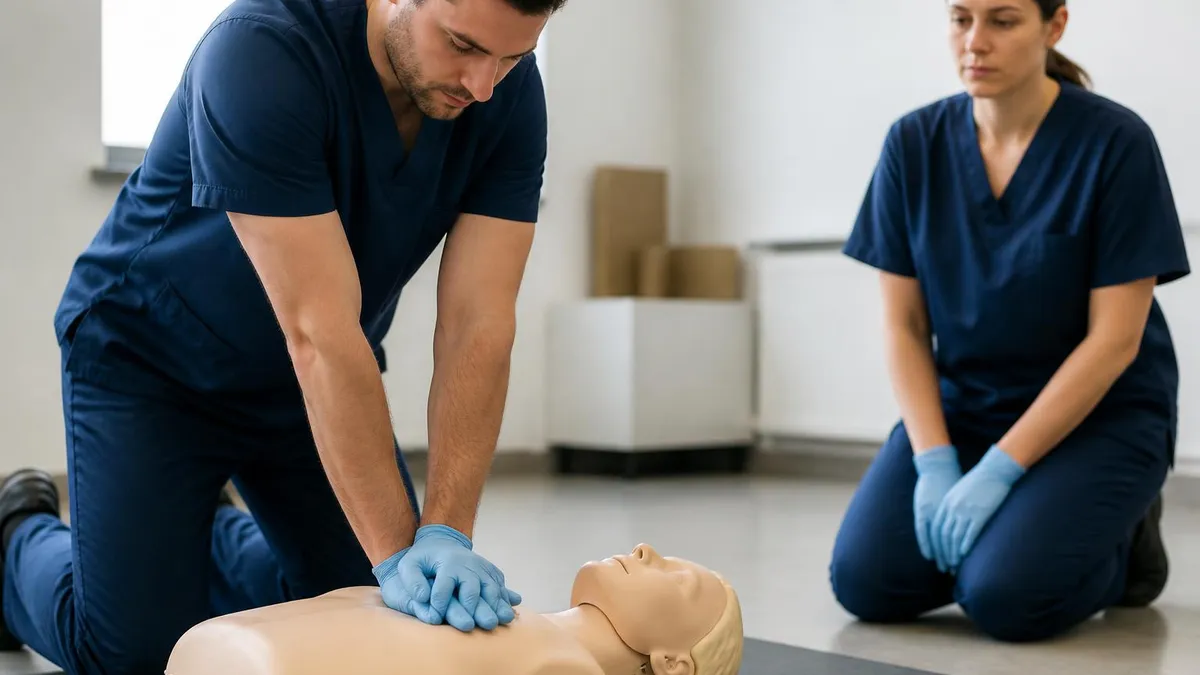
How Long Does BLS Certification Last? Complete 2026 Renewal Guide
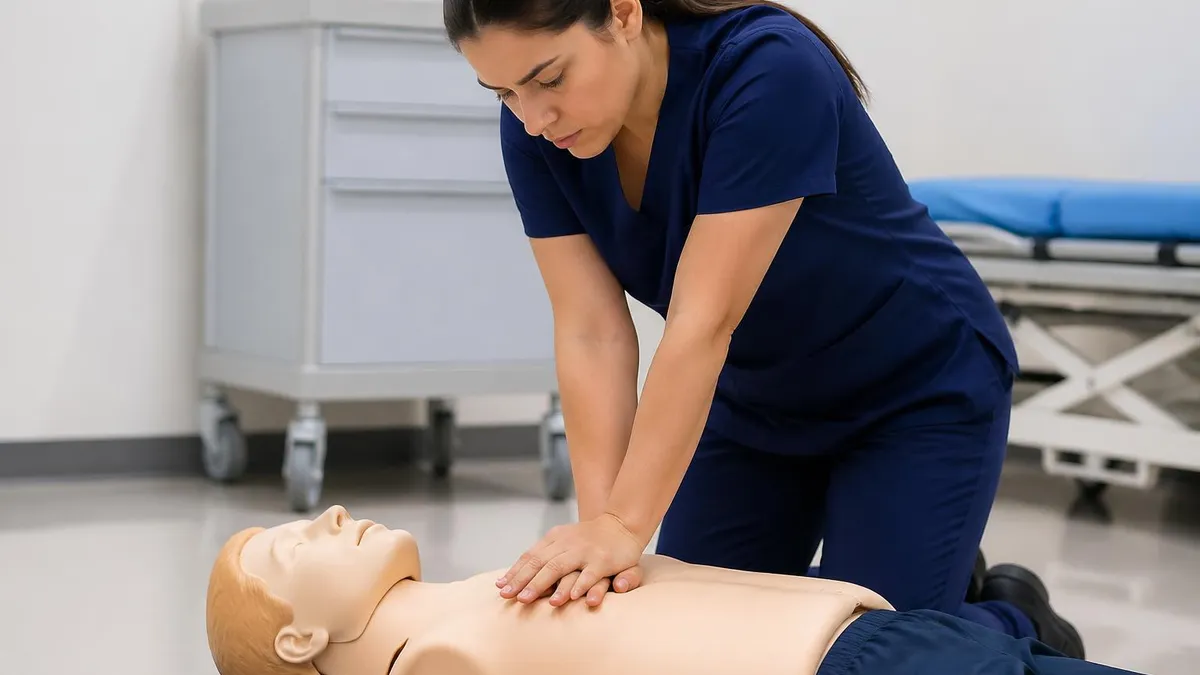
American Heart Association BLS: Certification, Renewal, Cost & What to Expect
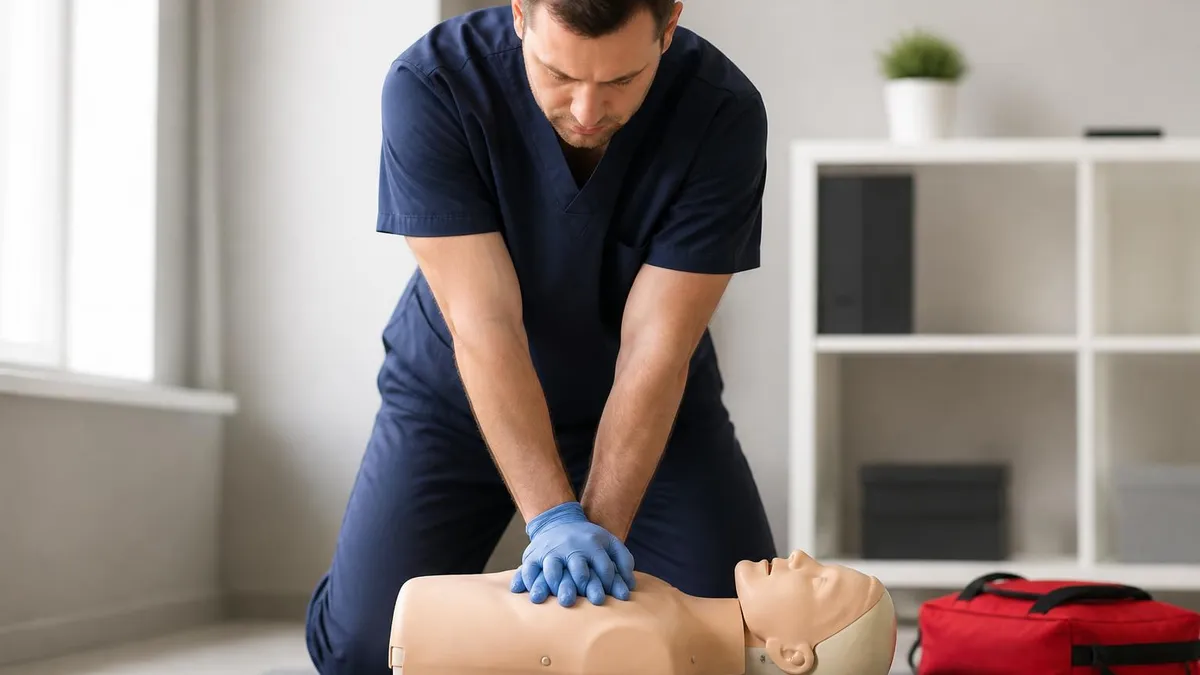
Online BLS Renewal: Complete 2026 Guide to Recertifying Your Basic Life Support Card
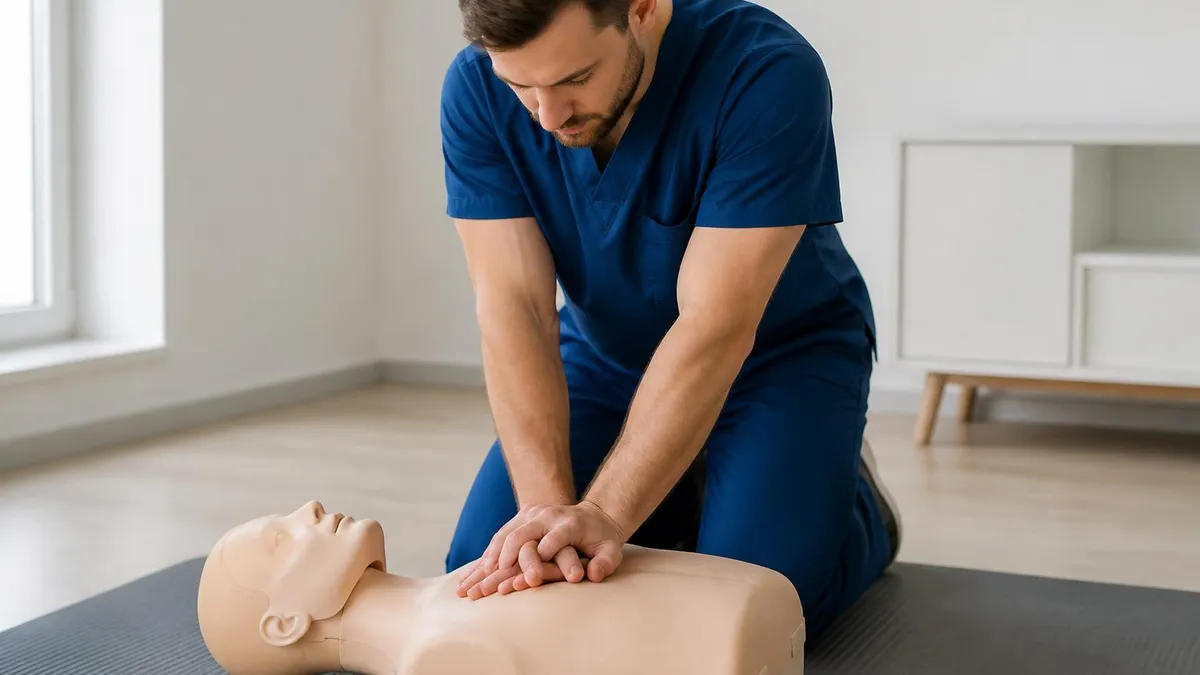
BLS vs ALS: Complete Comparison of Basic and Advanced Life Support
About the Author

Registered Nurse & Healthcare Educator
Johns Hopkins University School of NursingDr. Sarah Mitchell is a board-certified registered nurse with over 15 years of clinical and academic experience. She completed her PhD in Nursing Science at Johns Hopkins University and has taught NCLEX preparation and clinical skills courses for nursing students across the United States. Her research focuses on evidence-based exam preparation strategies for healthcare certification candidates.
Join the Discussion
Connect with other students preparing for this exam. Share tips, ask questions, and get advice from people who have been there.
View discussion (8 replies)